September 1, 2026
Understanding B2C Business to Consumer Dynamics


Discover effective framework marketing planning strategies like SOSTAC, RACE, and AARRR. Boost your campaigns and drive growth today!

Use SOSTAC for annual planning, RACE for digital program execution, and STP combined with the 7Ps for offer positioning. For early-stage growth experiments, AARRR (Pirate Metrics) gives you the fastest feedback loop. The Flywheel and AIDA work best when retention and funnel design are the priority. No single framework does everything well, so the most effective approach pairs a top-level strategy framework with an execution-level one: SOSTAC sets the annual architecture, then RACE or AARRR maps to channels and tests beneath it.
Quick shortlist by business context:
The rule of thumb: choose one strategy-level framework to govern annual priorities, then assign execution frameworks to each program or channel. Trying to run every framework simultaneously produces the same problem as running none.
A marketing framework is a structured decision architecture that organizes how you approach planning, execution, and analysis. It is not the strategy itself. The American Marketing Association describes it as the blueprint that organizes approaches, processes, and principles — the container, not the content.

The distinction matters in practice. Your framework is the structure you use to think. Your strategy is the set of choices you make within that structure. Your tactics are the specific actions that carry those choices into the market. Confusing the three is how teams end up with detailed activity calendars they call strategies.
Richard Rumelt’s kernel of good strategy (diagnosis, guiding policy, coherent actions) and Lafley and Martin’s Playing to Win cascade (winning aspiration, where to play, how to win, capabilities, management systems) are both frameworks in this sense. They do not tell you what to do. They force you to make explicit choices about what to prioritize and, critically, what to deprioritize. SOSTAC is a framework too, but it operates one level lower: it structures an operational plan rather than the strategic choices that should precede it.
The practical consequence: if you skip the strategy layer and go straight to a planning framework like SOSTAC, you will produce a well-organized list of activities with no guiding policy behind them. The framework gives you consistency, scalability, and a repeatable measurement structure. The strategy gives it direction.
The core claim is simple: a good framework saves time and improves outcomes because it forces tradeoffs and makes measurement unavoidable. Without one, most marketing plans are activity lists dressed up as strategy.
Alignment is the first benefit. When a leadership team shares a common framework, they share a common language. Disagreements about priorities become explicit and resolvable rather than implicit and recurring. A CMO and a CFO arguing about budget allocation are often arguing about different mental models of how marketing works. A shared framework surfaces that gap early.
Prioritization is where frameworks earn their keep. A framework that attempts to be everything to everyone is a compromise document. The guiding policy at the center of any good strategy states not only what to do but what not to do. That constraint is what turns a plan into a strategy. Without it, every new channel idea and every competitor move triggers a reallocation conversation that never resolves cleanly.
Measurement follows naturally when a framework is applied correctly. Each framework maps to a specific set of KPIs. RACE maps to channel-level reach, engagement, and conversion. AARRR maps to activation rates, retention curves, and lifetime value. When the framework is clear, the measurement architecture writes itself.
A plan without a guiding policy is just a calendar. Most marketing teams have detailed plans but no explicit statement of what they will not do. That single omission is the most common reason marketing budgets get spread too thin to move any metric meaningfully.
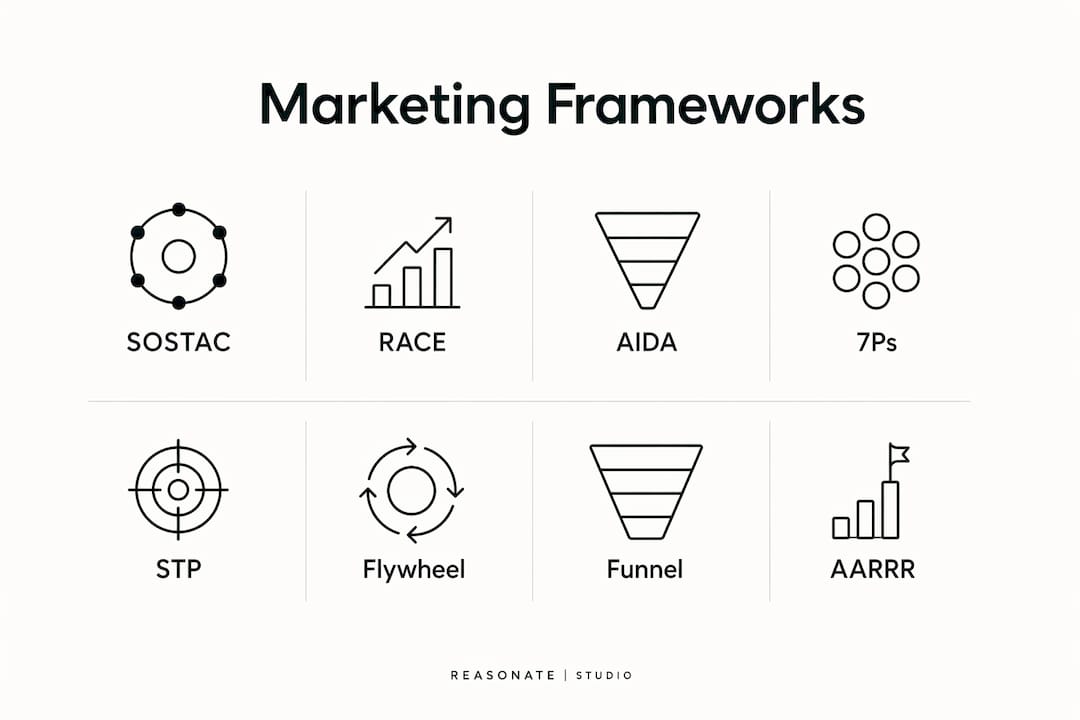
The eight frameworks below cover the full range of planning situations you will encounter. Each entry includes the core idea, when to use it, a quick how-to, pros and cons, and the KPIs that signal it is working.
Core idea: A six-stage planning structure: Situation, Objectives, Strategy, Tactics, Actions, Control. Developed by PR Smith, it remains one of the most widely used frameworks for structured annual marketing plans.

When to use it: Annual planning cycles, new market entries, or any situation where a team needs a shared planning document that connects analysis to execution.
Quick how-to:
Pros: Covers the full planning cycle; easy to teach across a team; built-in measurement stage. Cons: Can become a documentation exercise if the strategy stage is skipped or vague; does not force hard tradeoffs on its own.
KPIs: Lead volume and pipeline velocity, marketing-sourced revenue, cost per acquisition.
Core idea: A digital lifecycle framework: Reach, Act, Convert, Engage. Designed specifically for planning and optimizing digital marketing programs across channels.
When to use it: When the primary challenge is digital channel performance, or when you need a consistent measurement structure across paid, owned, and earned media.
Quick how-to:
Pros: Purpose-built for digital; forces channel-level accountability; easy to visualize in a dashboard. Cons: Less useful for brand-building or offline-heavy programs; can fragment attention if teams optimize stages in isolation.
KPIs: Organic reach, click-through rate, conversion rate by channel, customer lifetime value, Net Promoter Score.
Core idea: Awareness, Interest, Desire, Action. One of the oldest frameworks in marketing, originally developed for advertising copy and now applied to full customer journey design.
When to use it: Funnel design, content mapping, campaign sequencing, or any situation where you need to align messaging to the buyer’s stage of consideration.
Quick how-to:
Pros: Simple and universally understood; works across B2B and B2C; easy to communicate to non-marketers. Cons: Linear model that does not account for non-linear buyer journeys; no built-in retention or advocacy stage.
KPIs: Brand awareness lift, engagement rate, conversion rate, cost per lead.
Core idea: Product, Price, Place, Promotion, People, Process, Physical Evidence. The extended mix adds the service-specific dimensions that the original 4Ps missed.
When to use it: Offer design, pricing reviews, service positioning, or go-to-market planning for professional services and premium brands. Business Queensland’s marketing strategy guidance specifically recommends the 7Ps as a foundational framework for understanding the marketing mix.
Quick how-to:
Pros: Covers the full offer, not just promotion; particularly strong for service businesses; pairs well with STP. Cons: Descriptive rather than prescriptive; does not tell you which levers to pull first.
KPIs: Win rate, average deal size, customer satisfaction score, price realization.
Core idea: Divide the market into segments, choose which to target, and define a position that makes you the preferred choice for that target. STP is the analytical foundation for most positioning work.
When to use it: New product launches, repositioning exercises, or any situation where the business is trying to grow beyond its current customer base.
Quick how-to:
Pros: Forces explicit audience choices; the positioning output feeds directly into messaging and content strategy. Cons: Requires solid market data; positioning statements can become internal documents that never reach the customer.
KPIs: Share of target segment, brand preference score, qualified lead quality.
For a deeper look at applying STP alongside the 7Ps for offer-level decisions, Reasonate Studio’s product marketing strategy framework covers the go-to-market application in detail.
Core idea: A customer-centric growth model (popularized by HubSpot) that replaces the linear funnel with a circular loop: attract, engage, delight. Happy customers generate referrals and repeat purchases that feed the top of the loop.
When to use it: Businesses where retention and referral are primary growth levers, or where the cost of customer acquisition is high relative to lifetime value.
Quick how-to:
Pros: Aligns marketing, sales, and customer success around a shared model; naturally focuses attention on retention. Cons: Requires cross-functional buy-in; harder to measure than a linear funnel in the short term.
KPIs: Net Revenue Retention, referral rate, customer lifetime value, churn rate.
Core idea: The classic top-of-funnel to bottom-of-funnel model: awareness, consideration, preference, purchase, loyalty. Still the most widely used mental model for budget allocation and campaign planning.
When to use it: Budget planning, media mix decisions, or communicating marketing priorities to a CFO or board who think in funnel terms.
Quick how-to:
Pros: Universal language; easy to connect to revenue forecasts; works for both B2B and B2C. Cons: Oversimplifies non-linear journeys; can create siloed thinking between acquisition and retention teams.
KPIs: Funnel conversion rates by stage, cost per stage, marketing-attributed revenue.
Core idea: Acquisition, Activation, Retention, Referral, Revenue. Developed by Dave McClure for startups, AARRR is now used broadly for any growth experimentation program where speed of learning matters more than polish.
When to use it: Early-stage growth programs, new channel tests, product-led growth initiatives, or any situation where you need a fast feedback loop on what is actually driving revenue.
Quick how-to:
Pros: Forces measurement from day one; fast iteration cycles; easy to prioritize by impact. Cons: Can encourage short-term thinking; referral and revenue stages are often underdeveloped in practice.
KPIs: Activation rate, Day-30 retention, referral coefficient, revenue per user, LTV:CAC ratio.
The Ansoff Matrix gives four growth directions: market penetration, market development, product development, and diversification. Each carries a different risk profile, and a common budgeting heuristic pairs it with a 70-20-10 allocation (70% to core, 20% to adjacent, 10% to new). The McKinsey Growth Pyramid ranks seven growth options across three levels based on how close they are to your existing operational strengths, encouraging teams to secure lower-level moves before attempting higher-stretch ones. Both frameworks belong at the strategy layer, before any execution framework is chosen.
| Framework | Best for | Planning horizon | Typical KPIs | Complexity to adopt |
|---|---|---|---|---|
| SOSTAC | Annual planning | 12 months | Pipeline, CPA, revenue | Low |
| RACE | Digital programs | Quarterly | Reach, CVR, LTV | Low |
| AIDA | Funnel/campaign design | Campaign | Awareness, engagement, CVR | Low |
| 7Ps | Offer positioning | 12 months | Win rate, deal size, CSAT | Medium |
| STP | Audience/positioning | 12 months | Segment share, lead quality | Medium |
| Flywheel | Retention-led growth | 12 months | NRR, referral rate, churn | Medium |
| Purchase Funnel | Budget allocation | Quarterly | Stage CVR, attributed revenue | Low |
| AARRR | Growth experiments | Sprint/quarterly | Activation, retention, LTV:CAC | Low |
| Ansoff | Growth path decisions | 3 years | Revenue by growth vector | Medium |
| McKinsey Growth Pyramid | Capability sequencing | 3 years | Revenue by horizon | High |
The right framework depends on four variables: your company’s size and internal capability, your planning horizon, your primary growth constraint, and how much strategic ambiguity you are currently managing.
Decision checklist:
Professor Malcolm McDonald’s planning system makes a point worth taking seriously: start with a three-year strategic vision, not a one-year tactics list. Cascade that vision into measurable marketing objectives tied to revenue, share, and profitability, then build the one-year operational plan beneath it. Most teams do the opposite, which is why their annual plans feel disconnected from the business’s actual direction.
Six-step application template:
Timeline: Allow 6–12 weeks for a pilot (one framework, one program, one team). Full operationalization across a marketing function typically takes 3–6 months, depending on team size and data infrastructure.
Questions to ask during selection:
For a practical template to communicate your chosen framework to leadership, Reasonate Studio’s marketing strategy template guide walks through the slide structure and decision logic.
Measurement is where most framework implementations fail. Teams choose a framework, run it for a quarter, and then evaluate it against the wrong metrics or no metrics at all.
KPI mapping by framework category:
| Category | Framework | Example KPIs |
|---|---|---|
| Acquisition | SOSTAC, RACE, Funnel | Cost per lead, marketing-qualified leads, organic reach |
| Activation | AARRR, AIDA | Activation rate, first-value event completion, trial-to-paid rate |
| Revenue | SOSTAC, Ansoff | Marketing-attributed revenue, pipeline velocity, average deal size |
| Retention | Flywheel, AARRR | Net Revenue Retention, Day-30/Day-90 retention, churn rate |
| Advocacy | Flywheel, AARRR | Referral rate, NPS, customer-generated content volume |
Recommended reporting cadence:
A digital marketing approach focused on measurement and removing waste can reduce inefficient spend by about 30%, according to Reasonate Studio commentary and examples. The mechanism is simple: weekly test reviews surface underperforming spend faster than monthly or quarterly reviews, and kill criteria prevent indefinite pilots from consuming budget.
90-day experiment template:
The Aligned Impact Model™ is Reasonate Studio’s four-stage strategy-to-execution framework: Diagnose the Gap, Define the Position, Build the Message, Activate the Strategy. It maps directly to the planning frameworks covered in this article, which is what makes it operationally useful rather than just conceptually tidy.
Condensed case timeline (anonymized):
An established professional services firm had built its reputation through referrals and founder relationships over more than a decade. Revenue had plateaued. The website did not explain what made the firm worth choosing. Marketing consisted of sporadic content and disconnected vendor relationships.
The engagement followed the Aligned Impact Model™ stages:
Outcomes included a significant increase in sales and a multimillion-dollar partnership secured following the brand repositioning. These are Reasonate Studio client proof points and should not be read as typical or guaranteed results.
Framework mapping table:
| Aligned Impact Model™ Stage | Primary Framework Used | Purpose |
|---|---|---|
| Diagnose the Gap | SOSTAC (Situation stage) | Audit current state, competitive position, and messaging gaps |
| Define the Position | STP | Segment, target, and write the positioning statement |
| Build the Message | 7Ps | Align offer, price, process, and proof with the position |
| Activate the Strategy | RACE + AARRR | Plan digital programs and instrument growth experiments |
Pro Tip: Map your chosen frameworks to your planning stages before you start. A framework applied to the wrong stage (e.g., using AARRR for annual strategy instead of growth experiments) produces the right structure in the wrong place and confuses the team about what they are actually trying to decide.
The most common failure mode is treating a framework as a checklist. Teams work through the stages, tick the boxes, and produce a document that looks like a strategy but functions as a calendar. The guiding policy is either missing or so vague it constrains nothing.
Mistake → Fix:
Red flags during implementation:
When a framework is clearly failing, the recovery is usually not to switch frameworks. It is to go back and write the guiding policy that was skipped. A one-sentence statement of what the business will prioritize and what it will not do is often enough to unlock the rest.
One-page planning template fields:
2-week kickoff checklist:
Recommended tool categories by use case:
For a ready-made structure you can apply immediately, Reasonate Studio’s free marketing plan template covers the essential fields and execution steps in a format built for established businesses.
The short verdict: hire senior help when you face strategic ambiguity, constrained internal bandwidth, or a significant launch or partnership goal where the cost of a wrong framework choice is high. Execute internally when goals are clear, scope is limited, and your team has strong data operations.
Hire senior strategy support when:
Execute internally when:
The cost-benefit consideration a CFO cares about is time-to-impact. A senior strategist who has run SOSTAC or STP across dozens of engagements will compress the planning cycle significantly compared to a team learning the framework for the first time. The risk of founder dependence is real in the other direction: a founder who stays in the marketing weeds to compensate for a lack of strategic structure is not scaling the business, they are managing it.
What success looks like in a senior-led engagement: a clear guiding policy the team can articulate in one sentence, a framework applied to the right planning stage, KPIs with named owners, and a 90-day experiment running within the first six weeks.
Most established businesses do not need more marketing activity. They need a clearer position, sharper messaging, and a planning structure that connects strategy to execution without requiring the founder to manage every decision.
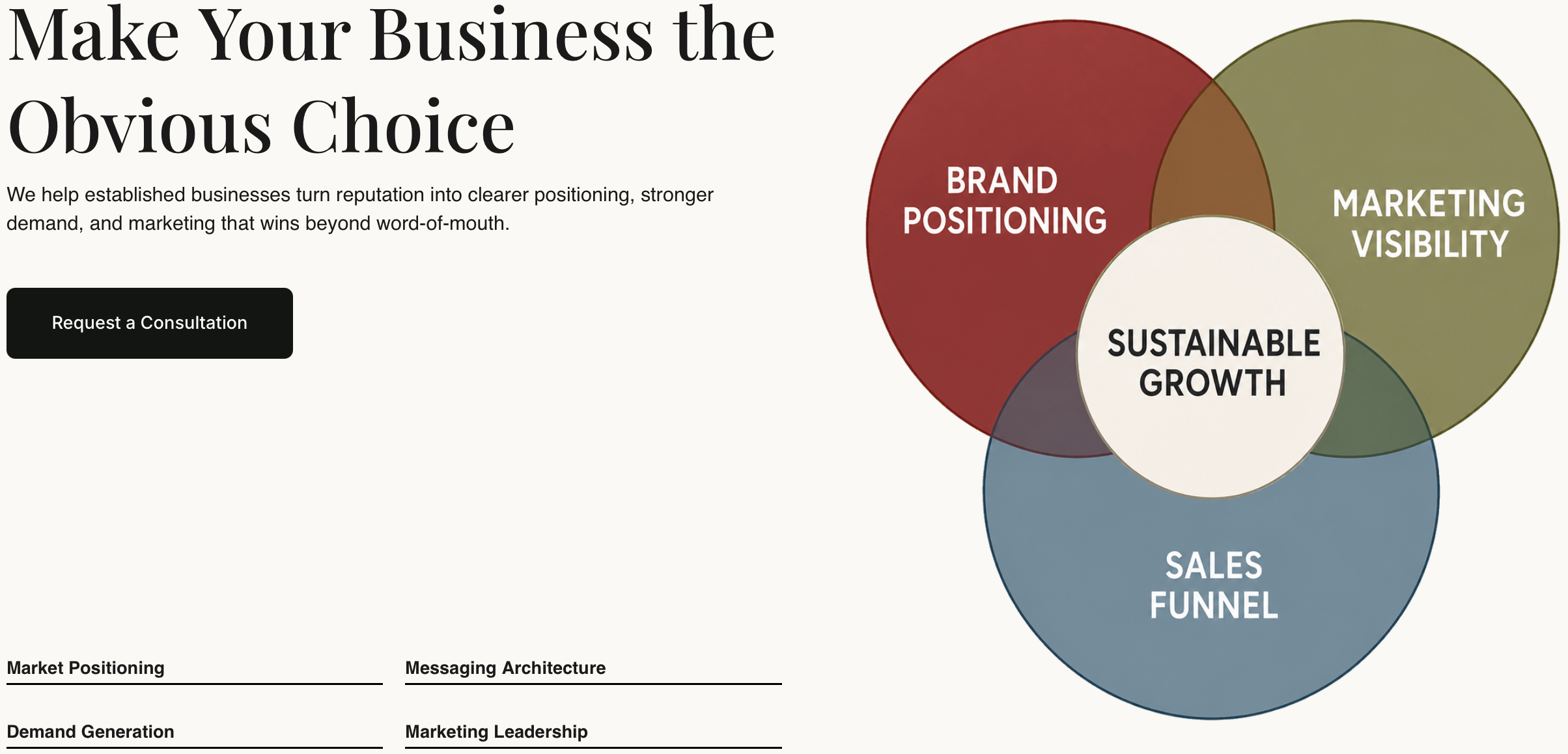
Reasonate Studio works with independently owned businesses generating $2–10M in annual revenue: professional services firms, premium consumer brands, healthcare practices, advisory firms, and boutique specialists who have built real credibility and need marketing that reflects it. The Aligned Impact Model™ applies the frameworks covered in this article in sequence: diagnosis first, then positioning, then messaging, then execution. The result is a marketing system that runs on strategy rather than on whoever has bandwidth this week.
If you are ready to move from disconnected tactics to a framework-driven marketing plan, explore Reasonate Studio’s services or start with a visibility and lead-generation planning conversation to see which frameworks fit your current growth stage.
Research and strategy references used in this article:
Reasonate Studio resources:
For case-study details or to discuss which framework fits your current growth stage, contact Reasonate Studio through the services page.