September 22, 2026
Why Update Brand Messaging: Essential Guide for Growth


Discover how the marketing strategy framework McKinsey helps leaders diagnose issues and optimize marketing performance effectively.

McKinsey’s marketing strategy frameworks give marketing leaders a structured way to diagnose what is actually broken before spending a dollar on execution. The three most widely applied are the McKinsey 7S model, the McKinsey Loop, and the Modern Marketing Model Diagnostic. Together, they cover the full spectrum of what makes marketing work or fail: organizational structure, iterative campaign optimization, and marketing function maturity.
Here is what each one addresses at a glance:
Developed by Tom Peters and Robert Waterman during their time at McKinsey & Company in the 1970s, the 7S framework was built to evaluate organizational alignment across seven interdependent elements. When applied to marketing, it becomes one of the most honest diagnostic tools available because it forces leaders to look at the whole system, not just the campaign calendar.
These three are called “hard” because they are the most tangible and the easiest to document.
Soft elements are harder to measure but often more consequential for marketing execution speed.
Consider a mid-sized B2B firm whose marketing team has invested heavily in marketing technology but is seeing flat pipeline growth. A 7S audit might reveal that Systems (the tech stack) are advanced, but Skills are lagging because the team was never trained on the platforms. Structure may show that brand and demand generation report to different executives with no shared KPIs. The misalignment is not in the tools. It is between the hard and soft elements.

Pro Tip: Run a 7S workshop with your marketing leadership team before any major campaign investment. Map each element honestly, then look for gaps between hard and soft sides. The gaps are where budget disappears without results.
The most common mistake is treating the 7S model as a one-time checklist. Experienced marketing leaders use it as a continuous diagnostic, returning to it whenever strategy shifts, the team changes, or performance drops unexpectedly. The strategic marketing framework lens matters here: the model is only as useful as the frequency with which you apply it.
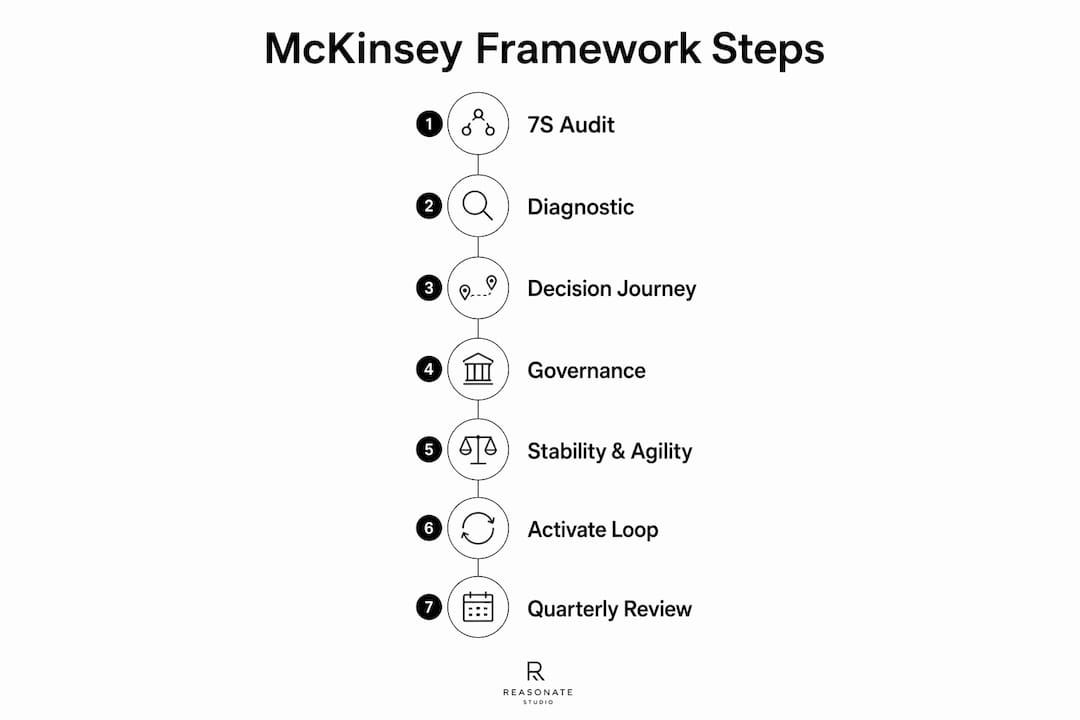
Here is a numbered sequence for running a 7S marketing audit:
The McKinsey Loop reframes how marketing leaders think about the consumer decision journey. Instead of a linear funnel where awareness leads to purchase and stops, the Loop treats the buying process as cyclical. Customers evaluate, purchase, experience, and then either advocate or exit. Marketing’s job is to influence every stage of that cycle, not just the top.
For marketing teams, the Loop has several practical implications:
The Modern Marketing Model Diagnostic is a maturity assessment tool. It evaluates a marketing function across dimensions including data and analytics capability, agility of team structure, quality of governance, and depth of customer insight. The output is a clear picture of where the function sits today and what it needs to reach the next level of performance.
Key areas the diagnostic covers:
The diagnostic complements the 7S model by adding a maturity dimension. Where 7S identifies misalignments, the Modern Marketing Model Diagnostic tells you how far the function needs to travel to reach best-in-class. Together, they give marketing leaders both a diagnostic and a transformation roadmap. The marketing operating model concept that underpins both frameworks treats rigid structures as a liability, replacing them with fluid ecosystems where brand, performance, and finance stakeholders share accountability.
Frameworks do not fail because the models are wrong. They fail because the organizational conditions needed to run them are not in place. This is where the real work is.
ROI-focused management means giving cross-functional teams genuine ownership of KPIs and outcomes, not just tasks. Most marketing organizations still assign ownership of channels rather than outcomes. A social media manager owns posts. A paid media manager owns ad spend. Nobody owns the customer’s path from awareness to retention. That structural gap is what the 7S model’s Structure and Shared Values elements are designed to surface.
Brand managers must evolve from task owners into orchestrators who balance internal strategy with external agency execution. That shift requires technical fluency across digital disciplines, not just strategic vision. A brand manager who cannot evaluate SEO performance data or interpret a paid media attribution report cannot effectively lead the agencies doing that work.
The Organize to Value framework maps twelve operating model design elements to align resources and workflows with strategy. Applied to marketing, it can reduce the time needed to redesign a marketing organization significantly compared to traditional approaches.
Reasonate Studio’s Aligned Impact Model™ follows a similar logic: diagnose the gap between the business’s actual reputation and how it is being marketed, define the position, build the message, then activate the strategy with a repeatable system. Clients who have gone through this process have seen outcomes including a $46.3 million partnership secured within a month of a brand repositioning and 1,000% website traffic growth through sustained Fractional CMO leadership. These are not typical results, but they illustrate what becomes possible when strategy, structure, and execution are genuinely aligned.
Common challenges when applying McKinsey frameworks in marketing contexts:
The sequence matters. Most teams jump to execution before the diagnostic is complete, which means they are optimizing the wrong things.
Step 1: Run the 7S audit. Gather input from marketing, sales, finance, and operations. Document the current state of all seven elements without filtering for what leadership wants to hear.

Step 2: Apply the Modern Marketing Model Diagnostic. Use it to assess maturity across data, agility, talent, and governance. This tells you not just where the gaps are but how significant the transformation required actually is.
Step 3: Map the consumer decision journey for your specific market. Identify where customers are actually making decisions and where current marketing spend is concentrated. The gap between those two things is usually where budget is being wasted.
Step 4: Redesign governance first. Before restructuring teams or upgrading platforms, establish joint accountability between brand, performance, and finance. Without this, new structures and systems will revert to old behaviors within a quarter.
Step 5: Build stable backbones for routine processes, agile teams for innovation. Best-in-class marketing organizations keep strategy development in-house while outsourcing high-volume execution tasks until they are proven. This balance protects core competencies while allowing operational flexibility.
Step 6: Activate the Loop. Once governance and structure are in place, shift campaign planning from linear to cyclical. Build measurement systems that track loyalty and advocacy, not just acquisition.
Step 7: Reassess quarterly. The 7S model’s value compounds with frequency. Schedule a structured review at the start of each planning cycle and adjust the action plan based on what has changed.
| Framework | Primary Focus | Strength | Limitation |
|---|---|---|---|
| McKinsey 7S | Organizational alignment | Holistic, covers people and culture | Requires honest internal audit |
| McKinsey Loop | Customer journey optimization | Cyclical, loyalty-inclusive | Less useful for early-stage brands |
| Modern Marketing Model Diagnostic | Marketing function maturity | Clear transformation roadmap | Requires baseline data to benchmark |
| SWOT Analysis | Situational awareness | Simple, widely understood | No structural or cultural depth |
| Porter’s Five Forces | Competitive positioning | Strong for market entry decisions | Ignores internal organizational factors |
| OKR-based planning | Goal alignment | Measurable, team-level clarity | Does not address culture or capability gaps |
The McKinsey frameworks are not better in every situation. SWOT and Porter’s Five Forces remain useful for specific decisions, particularly competitive positioning and market entry. Where McKinsey’s approach pulls ahead is in diagnosing why a marketing organization is underperforming despite having a sound strategy on paper. The 7S model forces the conversation about soft elements that most other frameworks skip entirely. A marketing strategy development process that ignores culture, skills, and leadership style will produce a plan that looks right in a slide deck and stalls in execution.
The Loop and Modern Marketing Model Diagnostic add dimensions that frameworks like SWOT simply do not cover: iterative optimization and maturity benchmarking. For established businesses with existing marketing functions, those dimensions are often where the most significant performance gains are hiding.
The frameworks are well-documented. The failure mode is almost always the same: leaders treat them as planning tools rather than diagnostic ones. They run the 7S model to validate a decision they have already made, rather than to surface the misalignments that would challenge it.
The soft elements are where this shows up most clearly. Strategy, Structure, and Systems get documented and debated. Staff, Skills, Style, and Shared Values get acknowledged and then quietly set aside because addressing them requires harder conversations. A marketing team with a sophisticated tech stack and a culture of risk aversion will underperform a less-equipped team that moves fast and owns outcomes. The model tells you this directly. Most leadership teams read it and then focus on the tech stack anyway.
The other pattern worth naming: frameworks borrowed from large enterprise contexts get applied to mid-sized businesses without adjustment. The McKinsey 7S model works across business sizes, but the diagnostic questions need to be calibrated to the actual scale and structure of the organization. A 12-person marketing team does not have the same structural complexity as a 200-person department. The elements are the same; the weight of each one shifts considerably.
What actually works is using the frameworks as a recurring conversation structure, not a one-time deliverable. The marketing leaders who get the most from the 7S model are the ones who have internalized it well enough to ask the right questions in a quarterly review without pulling out the framework diagram.
Most established businesses already have the raw material for a strong marketing strategy. What they are missing is the structure to connect it.
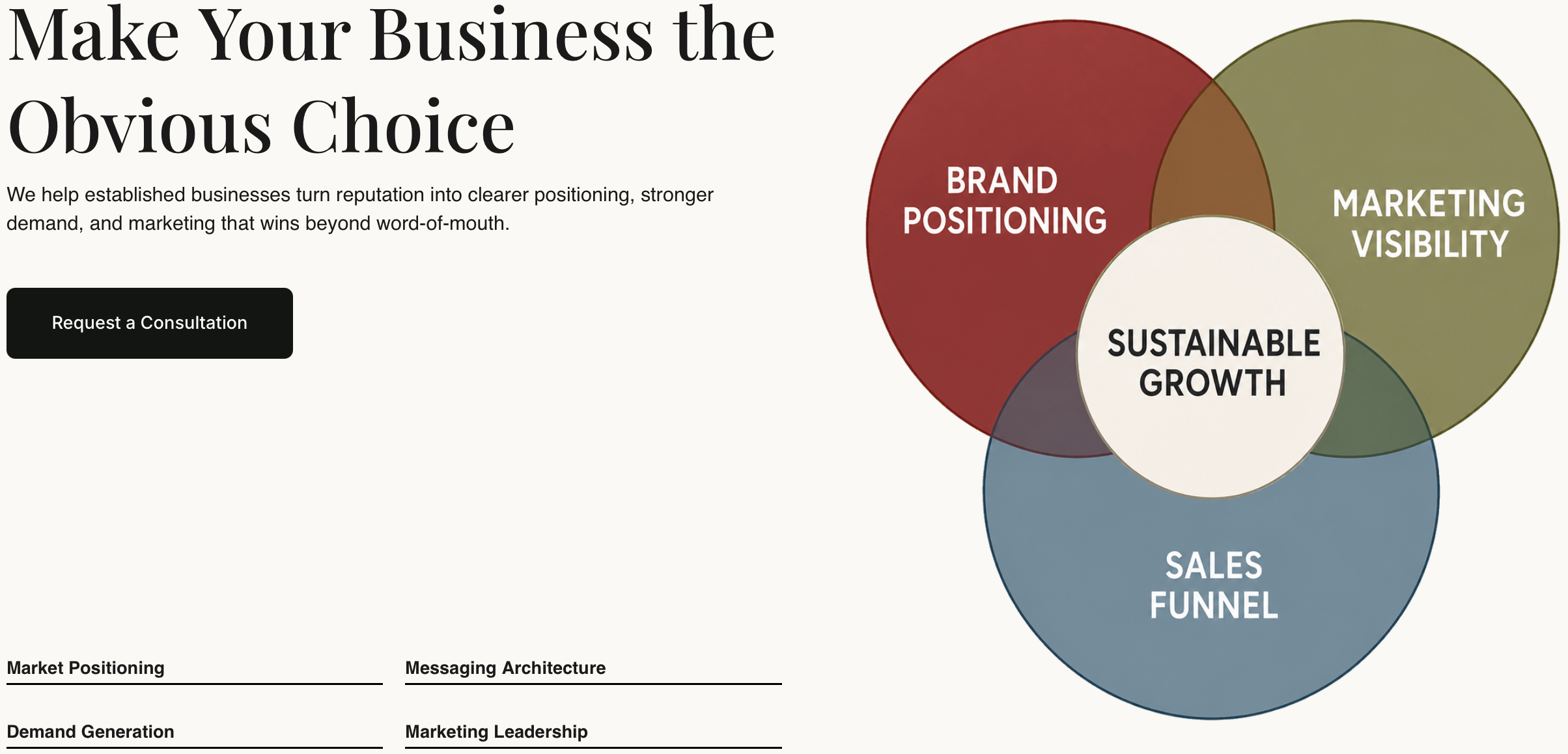
Reasonate Studio works with independently owned businesses generating $2M–$10M in revenue that have outgrown referral-based growth and need senior marketing leadership without building a full internal department. Through Brand Strategy and Fractional CMO support, Reasonate Studio applies the same organizational alignment logic that underpins McKinsey’s frameworks: diagnose the gap, define the position, build the message, and activate the strategy with a system that holds.
The result is marketing that reflects the actual quality of the business, not a disconnected collection of campaigns and contractors. If your marketing is not keeping pace with the reputation you have built, explore Reasonate Studio’s services to see how the Aligned Impact Model™ can close that gap.