September 22, 2026
Why Update Brand Messaging: Essential Guide for Growth


Unlock predictable growth with a solid B2B marketing framework. Connect your ideal customer, messaging, and measurement for sales success.
A B2B marketing framework is the operating system that connects your ideal customer profile, messaging, channel mix, and measurement into a repeatable system for predictable pipeline. It is not a campaign plan or a content calendar. It is the architecture that sits above both.
Two actions to take this week: First, validate a single Tier-1 ICP and name every buying-committee role involved in a typical deal. Second, schedule a 60-minute alignment session with Sales and Customer Success to agree on measurement ownership before any campaign launches.
Why this matters now: B2B buying committees commonly involve multiple stakeholders. A framework built around a single decision-maker misses most of the people who actually control the deal.
Reasonate Studio’s Aligned Impact Model™ is one applied example of this kind of architecture, moving through Diagnose, Define, Build, and Activate in sequence. The sections below cover every component you need to build or sharpen your own.
Most marketing teams are not short on tactics. They are short on structure. A framework performs four specific functions: it aligns the ICP across every team, focuses messaging by buying-committee role, sequences the channel mix so spend lands in the right order, and locks measurement before activation begins.
The tangible benefits, when the framework is built and operated correctly:
Committee-based buying invalidates single-person lead scoring. When six to ten stakeholders share a purchase decision, a framework that scores only one contact misses the majority of influence. Role-specific messaging and multi-stakeholder nurture sequences are not optional features. They are the baseline.
No single model covers everything. The right choice depends on sales cycle length, deal size, and organizational maturity.

| Framework | Core components | Best for | Primary outcomes | Implementation complexity | Measurement focus |
|---|---|---|---|---|---|
| 4P (Positioning, Pipeline, Process, Performance) | Strategic positioning + revenue operations | Mid-market, growth stage | Pipeline clarity, revenue alignment | Medium / 60–90 days | Pipeline velocity, conversion rates |
| 4-Layer (Audience → Messaging → Channel → Measurement) | Sequenced activation model | Any size with defined ICP | Execution discipline, predictable pipeline | Low–Medium / 30–60 days | Channel contribution, pipeline sourced |
| ABM | Account-specific campaigns, sales-marketing alignment | Enterprise, high-ACV deals | Account penetration, deal acceleration | High / 90 days | Account engagement, pipeline by account |
| Flywheel | Closed loop across Marketing, Sales, CS | Recurring revenue, SaaS | Expansion revenue, retention | Medium / ongoing | Net revenue retention, advocacy rate |
| Classic sales funnel (TOFU-MOFU-BOFU) | Stage-based content and lead routing | SMB to mid-market | Lead volume, content coverage | Low / 30 days | MQL volume, stage conversion |
Best-for guidance:
Hybrid approaches almost always outperform single-model adoption. Use one framework for strategic planning and a second for tactical execution. A repeatable marketing operating system requires both layers.
Step 1: Revenue alignment. Start with the number. What pipeline coverage ratio does Sales need? What is the target customer acquisition cost? Marketing strategy that does not begin with revenue targets produces activity, not outcomes.
Step 2: ICP and buying-committee mapping. Document firmographic, technographic, and behavioral signals for your Tier-1 ICP. Then name every role in a typical buying committee and their primary job-to-be-done. “Mid-market SaaS companies” is not an ICP. “B2B SaaS companies with 50–300 employees, $5M–$30M ARR, selling to enterprise buyers, with an active CRM and a VP of Sales who owns quota” is.

Step 3: Messaging hierarchy. Build one core positioning statement, then branch into role-specific proof points. Economic buyers need ROI framing. Technical evaluators need integration and risk evidence. End users need workflow clarity.
Step 4: Channel-role assignment. Assign each channel a specific job: awareness, consideration, or conversion. Do not run every channel at every stage. LinkedIn organic builds awareness for the vast majority of buyers who are not yet in-market, following the Ehrenberg-Bass 95-5 rule. Email nurture handles consideration. Direct outreach and demos close.
Step 5: Offer-delivery motion. Map the sequence of offers a buyer encounters from first touch to signed contract. Each offer should advance the buying job, not just generate a lead.
Step 6: Measurement model. Define metrics before campaigns launch, not after. Agree on pipeline-sourced revenue, SQL acceptance rate, and channel contribution as the primary signals.
Sample 12-month roadmap:
Budget split: allocate roughly 60% toward demand generation (awareness and consideration) and 40% toward conversion and retention. Predictable pipeline requires a 6–9 month investment horizon. Leaders who optimize for quarterly MQL counts typically undermine long-term velocity.
Pro Tip: Map buying jobs, not funnel stages. Instead of “awareness content,” ask what job the buyer is trying to complete at this moment. “Help me build the business case for my CFO” is a buying job. A one-pager with ROI benchmarks answers it. A blog post about your product does not.
Your ICP has four signal layers: firmographic (industry, size, revenue), technographic (current stack, integration needs), intentographic (active research signals, competitor review visits), and behavioral (content engagement, event attendance). Combining all four produces a target list you can actually act on. A documented GTM system answers five questions: who you sell to, where you win, how you win, who owns each move, and how you measure progress.
Persona matrix by buying-committee role:
| Role | Job-to-be-done | Proof they need |
|---|---|---|
| Economic buyer (CFO, CEO) | Justify spend, protect margin | ROI case, payback period, peer benchmarks |
| Technical evaluator (IT, RevOps) | Assess risk and integration | Security docs, API specs, implementation timeline |
| End user (sales rep, marketer) | Reduce friction in daily work | Workflow demos, before/after comparisons |
| Procurement | Reduce vendor risk | Contract terms, compliance certs, references |
| Champion (internal advocate) | Win internal support | Talk tracks, one-pagers, exec summary |
Prioritization rule: Win the champion first. Without an internal advocate who can carry your message into rooms you will never enter, even the best economic-buyer pitch stalls. Equip the champion with materials built for their audience, not yours.
Role-based messaging frameworks matter because a single homepage message cannot serve a CFO and an end user simultaneously. Each role has a different definition of risk, value, and urgency.
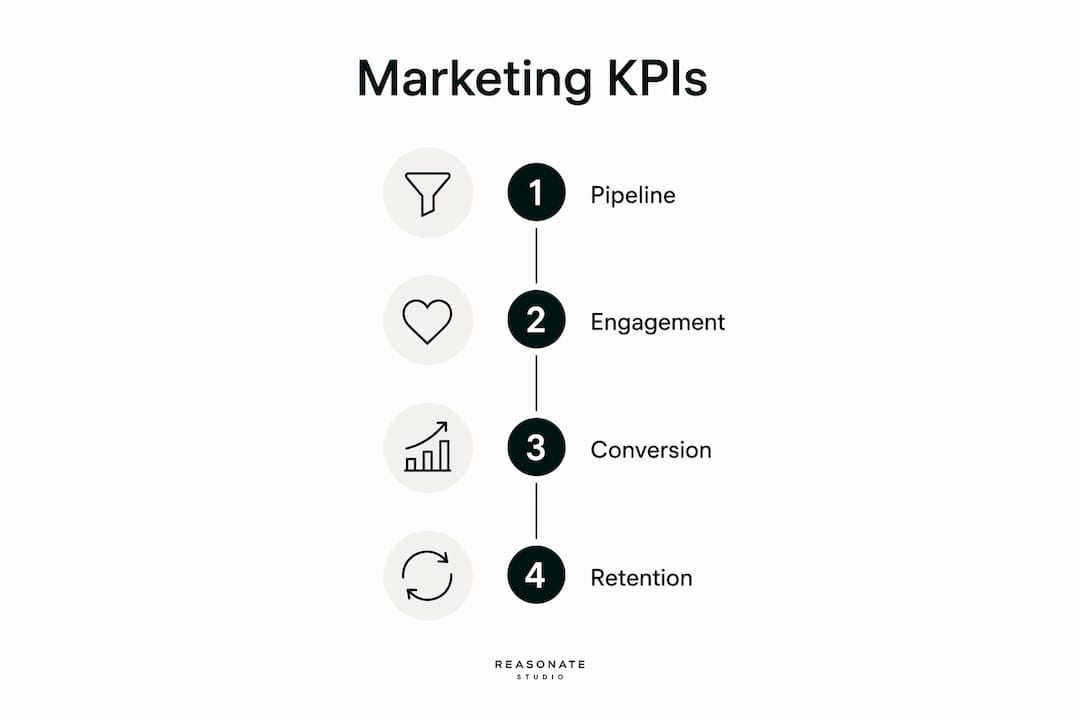
Vanity metrics look good in slides and tell you nothing about pipeline. Replace them with a three-tier model.
| Tier | Metric | Why it matters |
|---|---|---|
| Tier 1: Pipeline | Pipeline-sourced revenue | Connects marketing spend to closed revenue |
| Tier 1: Pipeline | Pipeline coverage ratio | Shows whether enough pipeline exists to hit quota |
| Tier 1: Pipeline | SQL acceptance rate | Measures marketing-sales alignment quality |
| Tier 2: Channel | Channel contribution to pipeline | Identifies which channels produce real opportunities |
| Tier 2: Channel | Cost per SQL by channel | Guides budget reallocation decisions |
| Tier 3: Operational | Time from MQL to SQL | Flags handoff friction between teams |
| Tier 3: Operational | Content-to-pipeline attribution | Shows which assets influence deals |
Attribution guidance: Multi-touch attribution gives a more accurate picture of how channels work together across a long sales cycle. Last-click attribution is faster to implement but systematically undervalues awareness channels. Use last-click when you need a quick baseline. Move to multi-touch once your CRM data is clean enough to support it.
Reporting cadence:
Leaders who measure share-of-voice and pipeline velocity at a 12-month horizon consistently outperform teams chasing monthly MQL counts. The metric shapes the behavior.
90-day phased rollout:
Role responsibilities:
Common red flags and recovery steps:
One architecture that demonstrates this in practice is Reasonate Studio’s Aligned Impact Model™, applied with established businesses that have built credibility but whose marketing does not yet reflect it.
| Stage | Practical activity |
|---|---|
| Diagnose the Gap | Brand audit, messaging review, competitive positioning assessment, customer journey mapping |
| Define the Position | ICP refinement, differentiation strategy, offer architecture, audience segmentation |
| Build the Message | Messaging hierarchy, brand voice, website copy direction, sales communication, content themes |
| Activate the Strategy | Content cadence, email nurture, SEO, campaign execution, reporting setup, vendor direction |
The model’s sequencing matters. Activation without a defined position produces content that is busy but not persuasive. Messaging without a diagnosed gap produces positioning that sounds good internally but does not resonate externally.
Reasonate Studio’s reported client outcomes include significant partnership successes shortly after brand repositioning, substantial increases in website traffic through Fractional CMO leadership, and high client retention following the development of a branded service pathway. These are specific client results, not projections or guarantees.
A framework is not one-size-fits-all. The architecture stays consistent; the calibration changes.
By company size:
By vertical:
The product marketing alignment question also shifts by vertical. In SaaS, the product itself generates demand signals. In professional services, the practitioner is the product, and the framework must reflect that.
Cross-functional alignment is where most frameworks break. The structure exists on paper; the execution fragments by team.
Three practices that actually hold it together:
Shared ICP ownership. Marketing does not own the ICP alone. Sales validates it against closed-won data. Product validates it against activation and retention patterns. A quarterly ICP review with all three functions prevents drift and keeps targeting sharp.
Joint pipeline reviews. A weekly or biweekly pipeline review that includes both Marketing and Sales leadership closes the feedback loop faster than any reporting dashboard. When Sales flags that a segment is not converting, Marketing can adjust messaging or channel mix within days rather than quarters. Marketing and sales alignment is the operational backbone of a functioning framework.
Product feedback as a demand signal. Product teams see what features customers actually use and where they struggle. That data informs content themes, objection handling, and ICP refinement. A monthly sync between Product and Marketing to review usage patterns and support tickets is one of the highest-leverage, lowest-cost alignment practices available.
The framework defines the architecture. Technology executes it at scale.
CRM (Salesforce, HubSpot): The CRM is the system of record for pipeline data. Every framework metric, from SQL acceptance rate to pipeline-sourced revenue, depends on clean CRM data. Before adding any other tool, get the CRM configured to reflect your actual sales stages and attribution model.
Marketing automation (HubSpot, Marketo, Pardot): Handles lead routing, nurture sequences, and behavioral scoring. The automation should reflect the buying-committee model, not just individual contact scoring. Set up account-level scoring alongside contact-level scoring.
Intent data platforms (Bombora, G2 Buyer Intent): Surface accounts showing active research signals before they fill out a form. Feeding intent data into your ICP filter sharpens ABM targeting and improves SQL quality.
Content and SEO tools (Semrush, Ahrefs, Clearscope): Support the demand generation content engine. Use them to identify the questions buyers are asking at each stage of the buying job, not just keyword volume.
Analytics and attribution (Google Analytics 4, Dreamdata, Rockerbox): Multi-touch attribution requires a dedicated analytics layer beyond the CRM. GA4 handles web behavior; a revenue attribution platform connects it to pipeline and closed revenue.
Technology without a documented framework produces data without decisions. The B2B content strategy and the tech stack should be built in parallel, not sequentially.
The decision is not philosophical. It comes down to four variables: revenue band, scope gap, speed requirement, and in-house capability.
Hire fractional senior leadership when:
Build an internal team when:
Fractional leadership pros and cons:
What to require from any senior hire or fractional partner:
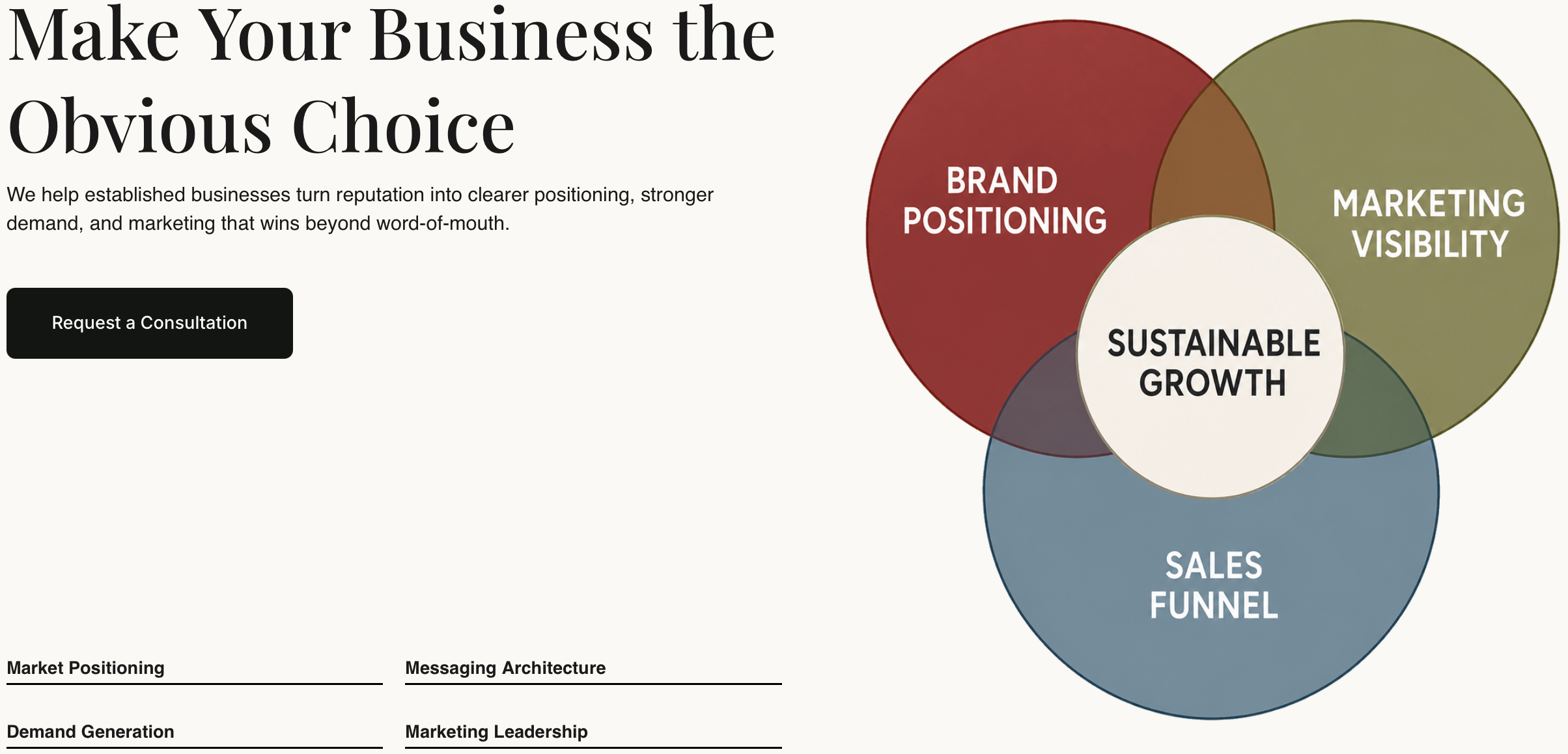
Reasonate Studio works with established businesses generating $2M–$10M in annual revenue that have outgrown referral-only growth but do not yet have a complete internal marketing department. Through Brand Strategy and Fractional CMO support, guided by the Aligned Impact Model™, Reasonate Studio connects positioning, messaging, demand generation, and execution into one system.
The work is senior-led. Clients work directly with Kaitlyn Cole, Founder and Principal Strategist, with a specialist team supporting implementation. Strategy does not get handed to a junior account manager.
Outcomes clients have seen include a 454% increase in sales, a 283% increase in order volume within 30 days, and a $46.3 million partnership secured after a brand repositioning. Results vary by engagement and are not guaranteed.
If your marketing is producing activity but not predictable pipeline, the starting point is a diagnostic conversation. See the full services overview or go directly to visibility and lead generation planning to request a discovery call.
The conventional wisdom says pick a framework, document it, and train the team. That is where most implementations stop, and it is exactly why most frameworks collect dust within six months.
A framework is not a document. It is a set of decisions that get made consistently, by the right people, at the right cadence. The ICP review happens quarterly whether or not it feels urgent. The pipeline review happens weekly whether or not the numbers are comfortable. The measurement model gets agreed before the campaign launches, not after the results disappoint.
The other thing most guides understate: the framework has to be built around how your buyers actually buy, not how your team prefers to sell. Committee buying is the norm in B2B, not the exception. A framework that scores one contact, nurtures one persona, and measures one conversion event is not a framework. It is a lead generation process dressed up with a name.
The shift from campaign-led to architecture-led marketing is uncomfortable because it requires saying no to tactics that feel productive. A new channel, a new content format, a new campaign idea all feel like progress. But progress without a framework is just motion. The architecture is what turns motion into pipeline.