September 22, 2026
Why Update Brand Messaging: Essential Guide for Growth


Discover a proven marketing plan framework that helps small business owners align their goals and strategies for measurable success. Build yours today!
TL;DR:
- A marketing plan framework organizes business goals into clear, measurable marketing activities to ensure strategic alignment. The GSTIC model enhances effectiveness by aligning goals, strategies, tactics, and controls to prevent failures and optimize performance. Small businesses should review and update their plans quarterly, using metrics and customer feedback to stay adaptable and grow.
A marketing plan framework is the structured blueprint that converts your business goals into organized marketing activities with measurable outcomes. Without one, you spend money on tactics that don’t connect to a strategy, and you have no way to know what’s working. Marketing plans connect your mission, audience, channels, and goals into one clear system. Reasonate Studio’s Aligned Impact Model™ is built on exactly this principle: clarity before execution, always. This article walks small business owners and entrepreneurs through the core components of a working framework, introduces the GSTIC model as a proven planning structure, and gives you a practical step-by-step process to build your own.
An effective marketing plan requires eight core components to deliver clarity and structured execution. Each one serves a specific function, and skipping even one creates gaps that show up later as wasted budget or missed targets.

| Component | Role in Your Plan |
|---|---|
| Executive summary | Captures the plan’s purpose, goals, and scope at a glance |
| Target market and personas | Defines who you are reaching and what motivates them |
| Competitive analysis | Identifies where you stand relative to others in your market |
| SMART goals | Sets specific, measurable, achievable, relevant, and time-bound targets |
| Channel strategy | Determines which platforms and formats carry your message |
| Budget allocation | Assigns spending to each channel and campaign |
| Execution timeline | Maps activities to dates and owners |
| Measurement and KPIs | Tracks whether the plan is delivering results |
The executive summary is not just a formality. It forces you to articulate the plan’s purpose in plain language, which reveals whether the strategy is actually clear or just busy. Target market personas go deeper than demographics. They capture the emotional drivers behind a purchase decision, which is what separates messaging that converts from messaging that gets ignored.
SMART goals are the component most small business owners underinvest in. A goal like “grow our Instagram following” is not a SMART goal. “Increase Instagram followers by 500 in 90 days through three posts per week and a lead magnet campaign” is. The difference is that the second version tells you exactly when you’ve succeeded and what actions drive the result.
Quarterly plan reviews keep the framework relevant as market conditions shift. A plan written in january that hasn’t been touched by april is already outdated. Build the review into your calendar as a non-negotiable appointment, not an afterthought.
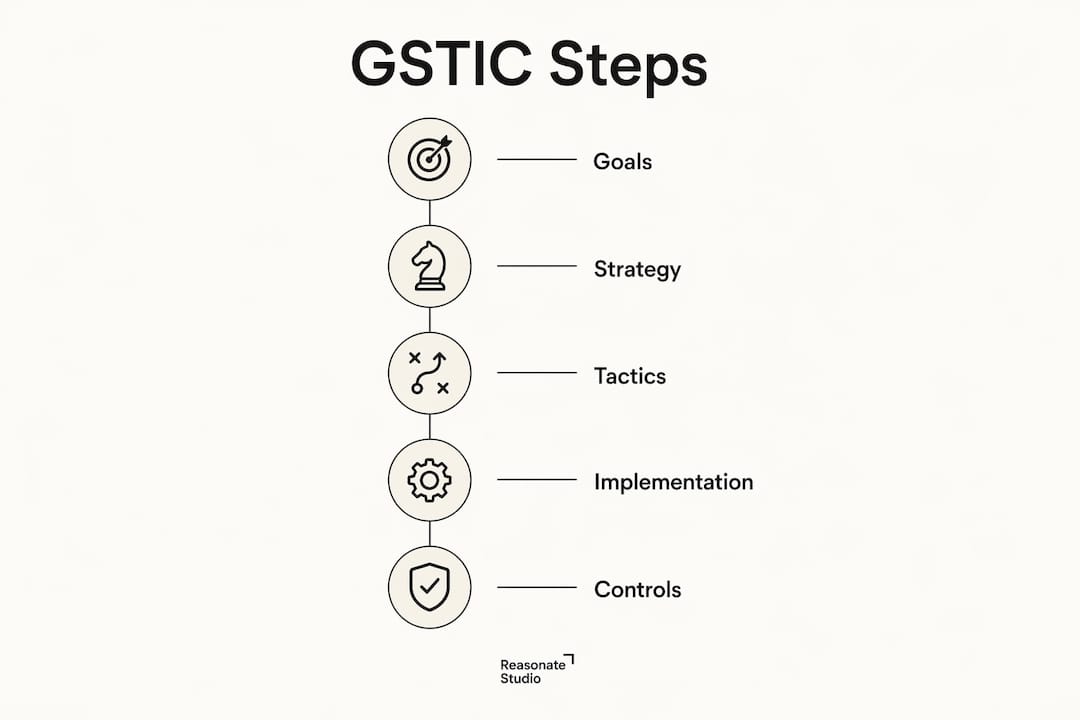
The GSTIC framework prevents marketing failures by ensuring alignment across five sequential steps: Goals, Strategy, Tactics, Implementation, and Controls. Most marketing initiatives fail due to internal misalignment rather than product issues. That finding reframes the problem entirely. The product is rarely the reason a campaign underperforms. The reason is usually that the team never agreed on what success looked like or who they were trying to persuade.
| Without GSTIC | With GSTIC |
|---|---|
| Tactics chosen before goals are clear | Goals define which tactics make sense |
| Value proposition is assumed, not stated | Value proposition is written and tested |
| Budget spent on disconnected activities | Budget allocated to aligned priorities |
| No one owns implementation steps | Clear ownership at every stage |
| Results reviewed only when things go wrong | Controls monitor performance continuously |
The GSTIC model starts with Goals because every other decision flows from them. If your goal is brand awareness, your tactics look different than if your goal is direct sales. Defining the persuasion task explicitly, meaning what you need your audience to believe or feel before they buy, reduces wasted spend by eliminating tactics that don’t serve that task.
Controls are the most underused step in the model. Controls are the checkpoints you set in advance to evaluate whether the plan is on track. They are not the same as reporting. Reporting tells you what happened. Controls tell you whether what happened is acceptable and what to do next.
Pro Tip: Write your GSTIC steps in order and do not move to Tactics until Goals and Strategy are locked. Founders who skip ahead to tactics first spend money before they have a direction.
Applying GSTIC to a small business marketing plan means starting every planning session with a written goal statement, not a channel discussion. The channel conversation comes after you know what you’re trying to accomplish and who you need to reach.
A stepwise method improves marketing plan development by reducing the chance of skipping critical elements. The sequence matters because each step informs the next. Jumping ahead creates plans that look complete but fall apart in execution.
Write your mission and value proposition. Your mission states why your business exists. Your value proposition states why a customer should choose you over every other option. Both must be written in plain language, not corporate speak. If you cannot say your value proposition in one sentence, it is not clear enough yet.
Define your buyer personas. Go beyond age and income. Document what your ideal customer fears, what they want most, and what objections they raise before buying. One well-built persona is more useful than five shallow ones. Reasonate Studio’s brand intelligence work starts here because everything else depends on knowing exactly who you are talking to.
Set SMART goals linked to KPIs. SMART goals linked to KPIs drive real business growth and clarify marketing focus. Each goal should have one primary KPI attached to it so you always know the number you’re chasing.
Conduct competitive research. Identify three to five businesses that serve the same audience. Note what channels they use, what messaging they lead with, and where they appear weak. You are not copying them. You are finding the gap where your value proposition has room to stand out.
Choose your channel strategy. Marketing strategy frameworks guide prioritization by linking business outcomes to channel decisions. Pick two or three channels you can execute consistently rather than spreading thin across six. Consistency on fewer channels outperforms sporadic presence on many.
Allocate your budget. Assign a dollar amount to each channel and campaign. Include production costs, not just ad spend. A social media strategy that requires professional photography has a real cost that belongs in the budget, not as a surprise later.
Build your execution timeline. Map every campaign, content piece, and launch to a specific date. Assign an owner to each item. A timeline without owners is a wish list.
Define your measurement system. Decide in advance how you will track results. Set a reporting cadence, weekly for active campaigns, monthly for overall performance, and quarterly for plan-level review. Know which metrics signal success and which signal a need to adjust.
Pro Tip: The most common mistake small business owners make is writing a plan and then filing it away. Print it. Post it. Review it monthly. A plan you don’t look at cannot guide your decisions.
The framework for marketing strategy works best when it is treated as a living document, not a one-time deliverable. Every decision you make about content, channels, and budget should trace back to a component in the plan.
A marketing plan that never changes is a plan that stops working. Markets shift, customer behavior evolves, and what performed well in one quarter may underperform in the next. The framework itself stays consistent. The inputs inside it get updated regularly.
Quarterly plan reviews help adjust strategies based on KPI data and market feedback for sustained growth. The review is not a judgment of past performance. It is a decision-making session about what comes next.
The feedback loop between measurement and planning is what separates businesses that grow consistently from those that plateau. When your KPIs inform your next quarter’s tactics, the plan gets sharper over time instead of stale.
Working directly with founders, coaches, and consultants for years has taught me one thing above all else: the plan is not the problem. The problem is that most small business owners write a plan once, feel accomplished, and then go back to doing whatever feels urgent that week.
A marketing plan framework only works if it governs your daily decisions. That means when someone pitches you a new social platform, you check it against your channel strategy before saying yes. When you’re tempted to run a last-minute promotion, you check it against your execution timeline and budget. The plan is your filter, not your to-do list.
The second thing I see constantly is founders who skip the persona work because it feels abstract. They want to get to the content and the campaigns. But every time I’ve seen a small business struggle with messaging that doesn’t convert, the root cause is the same: they never got specific enough about who they were talking to. A persona is not a demographic. It is a person with a specific fear, a specific desire, and a specific reason to trust you or not.
The third pattern is treating measurement as optional. Founders who track their KPIs consistently make better decisions faster. They don’t debate whether a campaign worked. They look at the number and decide. That discipline compounds over time into a marketing system that actually grows the business instead of just keeping it busy.
The Aligned Impact Model™ at Reasonate Studio is built around these exact lessons. Foundation, audience, and message are not phases you complete and move past. They are the lens through which every marketing decision gets made.
— Kaitlyn Cole
Building a solid marketing plan framework is one thing. Executing it consistently while running a business is another challenge entirely.
Reasonate Studio works with founders, coaches, and consultants who have the vision but need a partner to build and run the marketing engine behind it. From social media management that keeps your brand visible week after week, to SEO keyword research that connects your content to the searches your ideal customers are already making, every service is built to support a real marketing plan, not replace one. The work starts with strategy and ends with results you can measure. If you’re ready to move from scattered efforts to a plan that actually runs, Reasonate Studio is built for exactly that.
A marketing plan framework is a structured set of components that organizes your marketing activities around clear goals, defined audiences, and measurable outcomes. It converts high-level business goals into specific marketing strategies and execution steps.
The eight core components are: executive summary, target market and personas, competitive analysis, SMART goals, channel strategy, budget allocation, execution timeline, and measurement with KPIs. Each component connects to the others to form a complete plan.
The GSTIC framework is a five-step marketing planning model covering Goals, Strategy, Tactics, Implementation, and Controls. It prevents marketing failures by ensuring every tactic connects to a stated goal and every campaign has defined checkpoints for performance review.
Quarterly reviews are the standard recommendation for keeping a marketing plan relevant. Monthly channel performance checks and continuous customer feedback collection keep the plan responsive between full reviews.
SMART goals give each marketing objective a specific target, a timeline, and a measurable KPI. They are the mechanism that connects your marketing activities to real business outcomes and tells you objectively whether the plan is working.