September 22, 2026
Why Update Brand Messaging: Essential Guide for Growth


Product marketing strategy framework demystified for entrepreneurs—brand alignment, actionable pillars, implementation tips, and measurable outcomes explained.

Many early-stage entrepreneurs struggle to move beyond ideas and transform them into real market impact. The journey from concept to sustainable venture depends on having a clear plan that connects vision with measurable progress. A strong product marketing strategy framework does more than organize your goals—it becomes your foundation for data-driven growth, competitive advantage, and alignment across every team. Discover how a structured approach can give your business the clarity and confidence it needs to thrive.
A product marketing strategy framework represents a comprehensive roadmap that transforms a business idea into a structured, actionable plan for product success. This strategic blueprint connects your product vision with practical market execution, serving as a critical navigation tool for entrepreneurs and side hustlers seeking meaningful growth.
The framework typically encompasses several key dimensions that work together to create a holistic approach to product development and market positioning. These core components include:
At its core, a robust product marketing strategy framework acts as a strategic alignment mechanism, ensuring that every team and stakeholder understands the product’s direction. Strategic market research techniques help validate assumptions and create data-driven approaches that minimize risk and maximize potential market impact.

Successful frameworks integrate multiple perspectives, bridging the gap between product design, engineering, marketing, and sales. They provide a structured yet flexible approach that allows businesses to adapt quickly while maintaining a clear strategic vision. This means creating a living document that can evolve with market changes and emerging opportunities.
Pro tip: Treat your product marketing strategy framework as a dynamic roadmap, not a static document. Review and adjust it quarterly to stay aligned with market shifts and emerging customer needs.
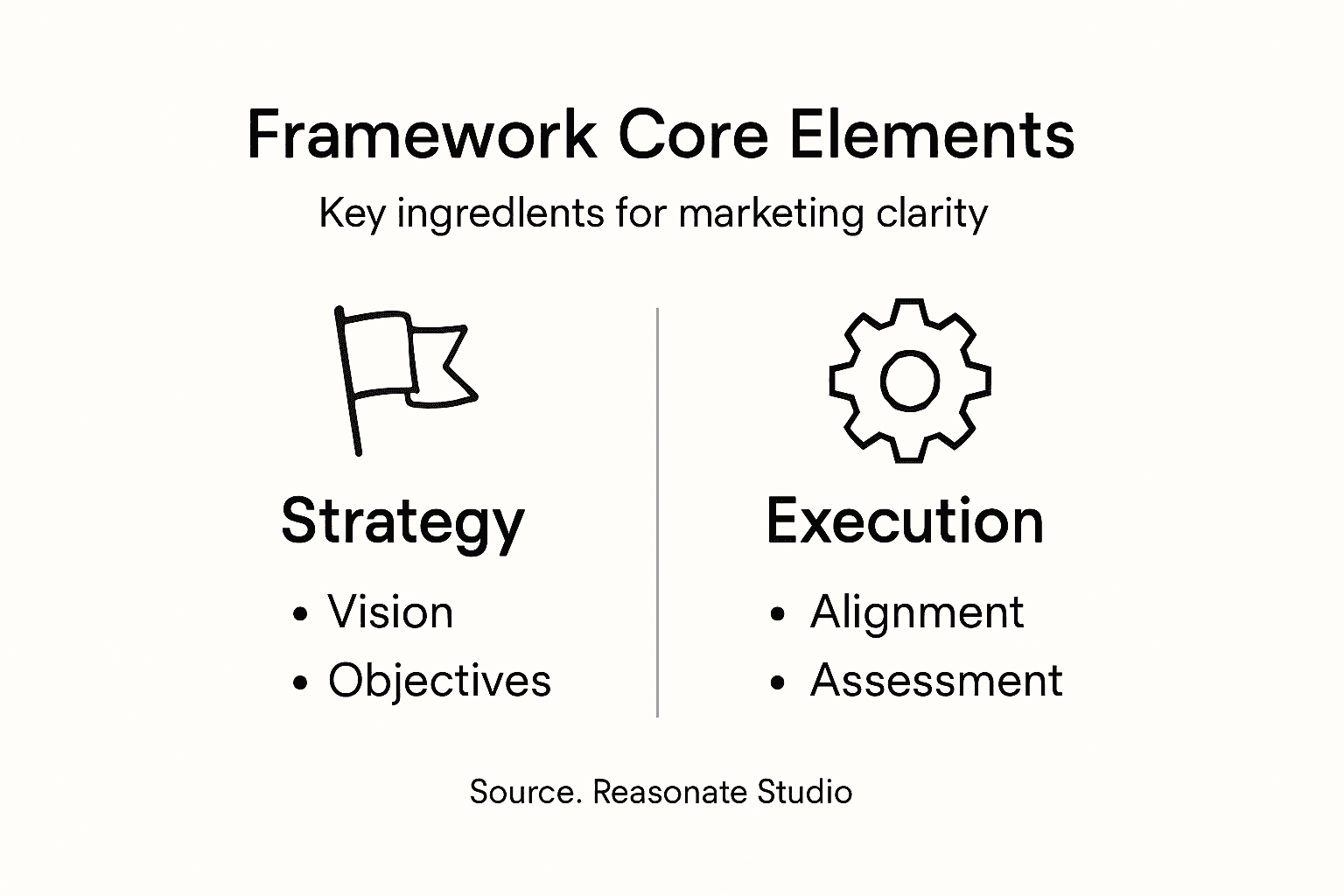
Building a robust product marketing strategy framework requires careful integration of several critical elements that work together to drive strategic success. These core components serve as the foundational building blocks that transform abstract business ideas into executable, measurable plans for entrepreneurs and side hustlers seeking sustainable growth.
The most essential elements of an effective framework include:
Strategic market positioning techniques enable businesses to develop frameworks that not only outline potential pathways but also provide adaptive mechanisms for navigating complex market environments. This approach transforms strategic planning from a static document into a dynamic tool for continuous improvement.
Successful frameworks also emphasize continuous assessment and communication. They create transparent mechanisms for tracking progress, gathering stakeholder feedback, and making data-driven adjustments. By integrating cross-functional perspectives and maintaining flexibility, entrepreneurs can develop frameworks that evolve alongside their business, ensuring long-term relevance and competitive advantage.
Pro tip: Create a quarterly review process for your product marketing strategy framework, involving key stakeholders to validate assumptions and recalibrate goals based on emerging market insights.
Product marketing strategy frameworks offer diverse modeling approaches that enable entrepreneurs to navigate complex market landscapes with precision and adaptability. Strategic modeling transforms abstract business concepts into structured, actionable plans that align with specific organizational goals and market dynamics.
The most prominent framework types include:
Strategic product positioning techniques help entrepreneurs select and customize frameworks that best match their unique business context. Each approach offers distinct advantages, allowing businesses to choose models that align with their specific market challenges and organizational capabilities.
Successful implementation requires understanding the nuanced strengths of different frameworks. Entrepreneurs should view these models as flexible tools rather than rigid templates, adapting them to reflect evolving market conditions, customer insights, and organizational capabilities. The most effective strategies combine elements from multiple frameworks, creating hybrid approaches that leverage diverse strategic perspectives.
Here’s a summary of core product marketing strategy frameworks and when each is most effective:
| Framework Type | Primary Strength | Best Use Case |
|---|---|---|
| Vision-Led | Long-term strategic direction | Products needing clear differentiation |
| Market-Driven | Adapting to customer insights | Markets with shifting consumer demands |
| Jobs-to-be-Done (JTBD) | Uncovering deep customer motivations | Launching new, disruptive offerings |
| Lean Product | Speed and learning through iteration | Startups or early-stage validation |
| Objective & Key Results (OKR) | Alignment with measurable goals | Scaling established products rapidly |
Pro tip: Conduct an annual framework audit to assess which strategic modeling approach delivers the most meaningful results for your specific business context and market segment.
Building a powerful brand alignment strategy requires more than surface-level marketing tactics. It demands a holistic approach that connects your product’s core identity with the genuine needs and emotional landscape of your target audience. This alignment transforms marketing from a transactional process into a meaningful conversation that resonates deeply with potential customers.
The key dimensions of effective brand alignment include:
Brand voice development techniques help entrepreneurs create a distinctive voice that cuts through market noise and establishes genuine connections. Successful brand alignment means understanding that customers don’t just buy products—they invest in stories, experiences, and identities that reflect their own values and aspirations.
Audience resonance goes beyond demographic targeting. It requires deep empathy, active listening, and a commitment to understanding the nuanced psychological triggers that motivate customer decisions. By aligning your product’s narrative with your audience’s core desires and challenges, you transform marketing from a broadcast mechanism into a collaborative dialogue that feels personal and authentic.
Pro tip: Conduct quarterly audience listening sessions to continuously refine your brand messaging and ensure ongoing alignment with evolving customer perspectives.
Developing a product marketing strategy is fraught with potential missteps that can derail even the most promising business initiatives. Entrepreneurs often fall into predictable traps that compromise strategic effectiveness, transforming what should be a powerful roadmap into a vague, ineffectual document that fails to drive meaningful progress.
The most critical strategic pitfalls include:
Marketing strategy fundamentals reveal that successful entrepreneurs approach strategic planning as a dynamic, collaborative process. The most effective strategies are living documents that balance structured thinking with the flexibility to pivot when market conditions shift. This means creating frameworks that are both comprehensive and adaptable, allowing for continuous refinement and real-world responsiveness.
Pitfalls often emerge from a top-down approach that treats strategy as a static blueprint rather than an evolving conversation. Successful entrepreneurs recognize that strategy is not about creating a perfect plan, but about developing a shared understanding that enables rapid, intelligent decision-making. This requires continuous communication, cross-functional collaboration, and a willingness to challenge existing assumptions.
Pro tip: Conduct monthly strategy review sessions that include team members from different departments to ensure your strategic approach remains dynamic, inclusive, and aligned with changing market realities.
Transforming a product marketing strategy from theoretical framework to operational reality requires a systematic approach that balances rigorous implementation with continuous learning and adaptation. Successful entrepreneurs understand that strategy is not a destination but an ongoing journey of refinement, measurement, and strategic pivoting.
Key implementation stages include:
Marketing goal setting techniques reveal that effective measurement goes beyond surface-level metrics. Successful implementation demands a holistic view that captures both quantitative performance data and qualitative strategic learnings. This means developing a nuanced dashboard that tracks not just outcomes, but the underlying drivers of those results.
Measurement is most powerful when it transforms raw data into actionable insights. Entrepreneurs should view their strategic framework as a living document that evolves through continuous testing and refinement. This requires creating a culture of transparency, where data is not used for blame, but for collaborative learning and strategic adaptation. By embracing a mindset of continuous improvement, businesses can turn their marketing strategy from a static plan into a dynamic growth engine.
The following table outlines how strategic implementation elements help drive success:
| Implementation Stage | Contribution to Success |
|---|---|
| Phased Rollout | Reduces risk through incremental launches |
| Cross-Functional Alignment | Boosts team buy-in and cohesive execution |
| Performance Tracking | Identifies improvement areas with real metrics |
| Feedback Mechanisms | Enables fast response to market signals |
| Iterative Optimization | Sustains growth with continuous improvement |
Pro tip: Implement a quarterly strategy review process that combines hard performance metrics with team and customer feedback to ensure your marketing approach remains agile and responsive.
If navigating the complexities of building a product marketing strategy framework feels overwhelming, you are not alone. This article highlights common challenges like lacking a clear vision, inflexible planning, and disconnects between strategy and execution. Whether you are working to define your product vision, engage your target audience effectively, or implement a strategy that adapts with your business, these pain points can stall your growth and impact.
At Reasonate Studio, we understand that strategic clarity and audience resonance are not optional—they are essential for sustainable success. Our proprietary Aligned Impact Model™ is designed to help entrepreneurs and small businesses create frameworks that connect brand identity, storytelling, and market positioning with real, measurable growth. By combining strategic guidance with empathetic support, we eliminate the guesswork and build confidence in every marketing decision.
Our approach is tailored so you can avoid pitfalls like rigid planning and disconnected execution while adopting a dynamic, living framework aligned with your unique goals and customer insights. Discover how to transform your product marketing efforts into a cohesive system with results you can track and trust.
Begin your journey to intentional growth with Reasonate Studio today.
Ready to build a product marketing strategy that drives meaningful outcomes and resonates deeply with your audience Explore how Reasonate Studio’s strategic process can be your partner in creating clarity and growth. Visit Reasonate Studio now to learn more and take the next step toward transforming your marketing strategy into a powerful advantage.
A product marketing strategy framework is a structured plan that connects your product vision with practical market execution, serving as a roadmap for achieving product success and meaningful growth.
The core elements include product vision, target market definition, competitive landscape analysis, measurable objectives, and an execution roadmap. Together, these components create a solid foundation for driving strategic success.
It is recommended to treat your framework as a dynamic roadmap. Review and adjust it quarterly to stay aligned with market shifts and emerging customer needs.
Common pitfalls include lack of clear vision, overreliance on intuition, rigid planning, incomplete stakeholder engagement, and disconnection between strategy and execution. Avoiding these can enhance the effectiveness of your strategy.