September 1, 2026
Understanding B2C Business to Consumer Dynamics


Master the essential brand positioning components to elevate your marketing strategy. Get a clear checklist to strengthen your market presence.

Effective brand positioning rests on eleven core components. Get all eleven right and you control how your market thinks about you. Miss even two or three and you’re leaving that perception to chance — or to competitors. Here’s the working checklist marketing and brand leaders use to build or audit a position:
NielsenIQ defines brand positioning as the process of defining a brand’s place in consumers’ minds relative to alternatives — and notes it should guide messaging, product decisions, and customer experience, not just advertising copy. Kevin Lane Keller’s framework, widely taught at Harvard Business School, identifies four structural requirements for a superior competitive position: a competitive frame of reference, points of difference, points of parity, and a brand mantra. Reasonate Studio’s Aligned Impact Model™ builds on that foundation with a strategy-to-execution layer most frameworks skip entirely.
Brand positioning is the deliberate act of occupying a specific place in a buyer’s mind relative to every alternative, including doing nothing. It’s not the same as branding (the visual and verbal expression) or messaging (the words you use). Positioning is the strategic decision that sits upstream of both: it determines what you stand for, for whom, and why that matters more than any other option.

The business case is direct. When positioning is clear, buyers self-qualify faster, sales cycles shorten, and price resistance drops because the value is already understood. When it’s vague, marketing spend works harder for worse results — every channel has to compensate for the confusion the position should have resolved.

Brand perception drives sustainable growth in ways that most leaders underestimate until they’ve watched a well-funded competitor with weaker positioning lose to a smaller, clearer brand. Positioning also determines pricing power. A brand that owns a specific, credible, and valued position can charge a premium because buyers aren’t comparing it on price alone — they’re comparing it on fit.
Each component requires a specific decision and produces a specific artifact. Treating them as a vague checklist is how positioning work stays theoretical. Here’s what each one actually demands.

The decision: which category are you competing in, and which alternatives are you asking buyers to choose between? This is the most consequential call in positioning because it sets the comparison set. A perceptual map — plotting two attributes buyers actually use to decide, then locating competitors — helps validate whether the empty quadrant you’re targeting is genuinely defensible or just unoccupied for a reason.
The decision: who specifically benefits most from what you do, and who should you stop trying to serve? A tight audience brief names the segment, describes the buying trigger, and identifies what the segment currently uses instead of you. Broad audiences produce weak positioning because the key benefit can’t be specific enough to resonate.
The decision: what is the real underlying tension your audience is trying to resolve? Not the surface-level problem, but the friction beneath it. A sharp insight statement sounds like something the customer would say, not something a marketer would write. Audience plus insight is what generates a single, defensible key benefit.
The decision: what one thing do you own that is strong, favorable, and unique? Per Keller’s framework, points of difference must be structurally defensible — if a competitor can replicate it within a quarter, it cannot anchor the position. The artifact here is the positioning sentence itself.
The decision: what table-stakes attributes must you credibly meet to even be considered? These are not differentiators — they’re the “greens fees” of the category. Claiming a point of parity as a differentiator is one of the most common and costly positioning mistakes. The parity checklist keeps those claims where they belong: in the background.
The decision: what evidence makes the key benefit credible to a skeptical buyer? Proof can be structural (a proprietary process, a certification, a supply chain), experiential (client outcomes, case results), or social (third-party validation). A proof deck organizes this evidence by claim so sales and marketing can deploy it consistently.
The decision: if the brand were a person, how would it speak and behave? Personality governs tone of voice, content style, and the emotional register of every customer touchpoint. Without a defined personality, different team members and vendors produce inconsistent expressions of the same brand.
The decision: what is the hierarchy of claims, from the core benefit down to supporting messages and proof points? A messaging framework prevents every piece of content from trying to say everything at once. It also ensures that sales, marketing, and leadership are drawing from the same source.
Visual identity is not the position — it’s the signal that makes the position recognizable. The name, tagline, color palette, and typography should all reinforce the frame of reference and key benefit, not contradict them. For a deeper look at how visual identity supports positioning, the relationship between the two is more strategic than most identity projects treat it.
Price is a positioning statement. A premium price signals quality and exclusivity; a value price signals accessibility. The decision is whether your price is consistent with the position you’re claiming. Misalignment here — premium claims at commodity prices, or vice versa — creates cognitive dissonance that undermines trust before a conversation starts.
A position that lives in a document and never reaches the market isn’t a position — it’s a hypothesis. The activation plan defines how the position will be expressed across channels, who owns each touchpoint, and which KPIs will confirm it’s landing.
| Component | Artifact | Why it matters |
|---|---|---|
| Frame of reference | Category brief | Sets the comparison set buyers use |
| Target audience | Segment map / audience brief | Focuses the benefit so it resonates |
| Customer insight | Insight statement | Connects audience need to key benefit |
| Key benefit (USP) | Positioning sentence | The single claim you own |
| Points of parity | Parity checklist | Prevents table stakes from diluting the USP |
| Reasons to believe | Proof deck | Makes the key benefit credible |
| Personality/tone | Voice and tone guide | Keeps expression consistent across teams |
| Messaging architecture | Messaging framework | Aligns sales, marketing, and leadership |
| Visual identity | Identity system brief | Makes the position recognizable |
| Pricing/value signal | Pricing rationale | Confirms price supports the claimed position |
| Activation/measurement | 90-day activation roadmap | Turns strategy into market reality |
A positioning statement is a single sentence that forces four decisions simultaneously: who you serve, what category you compete in, what you deliver, and why a buyer should believe it. Two templates do most of the heavy lifting in practice.
Template 1 — Geoffrey Moore / Crossing the Chasm variant: For [target audience] who [need or opportunity], [brand] is the [category] that [key benefit] because [reason to believe].
Template 2 — Simplified For/Who/Is/Because: For [audience] who [problem], [brand] is [category] that [benefit]. Unlike [status-quo alternative], [brand] [key differentiator].
The second template adds one critical element most positioning statements omit: the status-quo alternative. Buyers compare you to doing nothing as often as they compare you to a direct competitor. Failing to address inertia is a structural gap.
Validation checklist — four steps before you launch:
Example: For independent professional services firms generating $2M–$10M in revenue who are growing through referrals but can’t explain what makes them worth choosing, [Brand] is the brand strategy partner that turns existing reputation into a clear market position because [specific proof].
Does it survive the Subtraction Test? Remove “independent professional services firms” and the statement becomes too broad to be credible. Remove the proof and the key benefit becomes an unsubstantiated claim. Both elements are load-bearing — the statement holds.
Concrete examples make the components tangible. Each of the following illustrates which component created the defensible position.
The rental car that owned second place. Avis built an entire positioning around being number two in the car rental market with the line “We Try Harder.” The frame of reference (car rental) was shared with the market leader. The point of difference was effort and service, not size. The reason to believe was the implicit logic: when you’re not number one, you have to work harder for every customer. Personality and tone did the heavy lifting — honest, self-deprecating, and direct. Price was not the lever.
The computer that said no to the crowd. Apple’s “Think Different” campaign didn’t lead with product features. It led with personality and values, positioning Apple as the brand for people who see themselves as creative nonconformists. The frame of reference shifted from “personal computer” to “tool for people who change the world.” Visual identity and tone were the primary signals. The pricing premium followed from the identity, not the other way around.
The law firm that stopped competing on credentials. A boutique firm in a credential-saturated market stopped listing partner experience and bar admissions as differentiators — every competitor had the same. Instead, it repositioned around a specific client type (founders navigating first-time M&A) and a specific outcome (closing without surprises). The insight was that founders feared the unknown more than they feared the cost. Points of parity (credentials, experience) moved to the background. The key benefit became clarity and predictability. Conversion improved because the right clients recognized themselves immediately.
The healthcare practice that priced as a signal. An independent dental practice in a market dominated by insurance-driven volume players positioned itself explicitly as a fee-for-service, relationship-based practice. The higher price was not a barrier — it was the signal. It told the right patients (those who valued continuity and time with their provider) that this was the practice for them, and it told price-sensitive patients to look elsewhere. Pricing as a positioning tool, not just a revenue decision.
The advisory firm that named the category. Rather than competing in “financial planning,” a firm created its own category name: “life-stage wealth strategy.” The frame of reference shifted the comparison set entirely. Competitors were no longer other financial planners — they were the absence of a structured approach to wealth at life transitions. Category choice was the leverage. For more on types of brand positioning and how category framing shapes competitive advantage, the range of strategic options is wider than most leaders realize.
Most positioning failures are predictable. Here are the eight red flags that signal a position won’t hold, and the corrective for each.
Pro Tip: To test for status-quo resistance — the inertia test — present your positioning statement to five target buyers and ask: “What would have to be true for you to keep doing what you’re doing now instead of choosing this?” Their answers reveal exactly which objections the position needs to preempt.
A signed positioning statement is the starting line, not the finish. Activation is where most positioning work either compounds or collapses.
Activation checklist:
Measurement framework:
| KPI | What it measures | How to collect | Cadence |
|---|---|---|---|
| Branded search share | Awareness of the brand by name | Google Search Console, SEMrush | Monthly |
| Aided recall | Whether buyers recognize the brand when prompted | Survey (target segment) | Quarterly |
| Feature-tradeoff preference | Whether buyers choose your key benefit over alternatives | Conjoint survey or win/loss interviews | Quarterly |
| Conversion lift | Whether the position improves lead-to-close rate | CRM pipeline data | Monthly |
| Average deal size | Whether positioning supports premium pricing | CRM revenue data | Monthly |
| NPS / loyalty score | Whether existing customers experience the position as promised | NPS survey | Quarterly |
| Sales cycle length | Whether clearer positioning accelerates decisions | CRM pipeline data | Monthly |
| Internal adoption rate | Whether teams are using the positioning in their work | Messaging audit / manager review | 90-day sprint |
The internal adoption rate is the one most leaders skip. Internal alignment is often the gating factor: a position that isn’t adopted internally will never be expressed consistently externally, regardless of how well the strategy was built.
Most positioning frameworks stop at the strategy document. The Aligned Impact Model™ is built around the recognition that positioning succeeds only when internal identity aligns with external associations — and that alignment requires a structured execution layer, not just a well-written brief.
The model moves through four stages, each producing specific artifacts:
Stage 1 — Diagnose the Gap: Assess the brand, messaging, website, market position, customer experience, and current marketing. The output is a gap analysis that identifies where the business’s reputation is not translating into clear market perception.
Stage 2 — Define the Position: Determine the frame of reference, target audience, key benefit, points of parity and difference, and reasons to believe. The output is a validated positioning sentence and proof deck.
Stage 3 — Build the Message: Translate the position into messaging architecture, brand voice, website language, sales communication, and content themes. The output is a messaging framework and updated customer-facing materials.
Stage 4 — Activate the Strategy: Build the marketing rhythm through content, email, SEO, campaigns, reporting systems, and ongoing leadership. The output is a 90-day activation roadmap with defined KPIs.
Reasonate Studio’s client outcomes illustrate what activation looks like when all four stages connect: a $46.3 million partnership secured one month after a brand launch, 98% client retention following the development of a branded service pathway, and 1,000% website-visitor growth through ongoing Fractional CMO leadership.
When to use Fractional CMO support versus an internal program: If the business has a positioning strategy but no one with the seniority to activate it consistently across channels, Fractional CMO support closes that gap without the cost or timeline of a full-time hire. At 30 days, success looks like internal alignment and updated materials. At 90 days, it looks like consistent channel execution and early KPI movement. At 180 days, it looks like measurable conversion lift and a marketing system that operates without founder involvement in every decision.
Positioning decisions are leadership decisions, not marketing department decisions. Category choice, audience prioritization, and the trade-offs involved in repositioning all have consequences that extend well beyond a campaign or a quarter. When those decisions get delegated entirely to a marketing team without executive input, the result is usually positioning that’s safe, consensus-driven, and forgettable.
Leadership should intervene at three specific moments: when the category choice is being set (because it determines the comparison set for years), when the key benefit is being selected (because it requires honest assessment of what the business can actually defend), and when the activation plan is being resourced (because underfunded activation is the most common reason good positioning never reaches the market).
The markers of a position that’s actually working are specific. The positioning sentence should be clear enough that any team member can recite it without looking it up. There should be at least one demonstrable reason to believe that a skeptical buyer would find credible. The activation plan should have named KPIs, owners, and a review cadence. And internal adoption should be measurable — not assumed.
Pro Tip: Governance matters more than most leaders expect. The positioning sentence should be signed by the most senior decision-maker in the organization, then locked into quarterly OKRs so that every team’s priorities connect back to it. Without that anchor, positioning drifts the moment a new campaign, hire, or channel opportunity pulls attention in a different direction.
Established businesses generating $2M–$10M in annual revenue face a specific challenge: the quality of the company is real, but the positioning, messaging, and marketing don’t reflect it. Growth still depends on referrals. The website doesn’t explain the difference. Marketing is a collection of disconnected activities rather than a system.
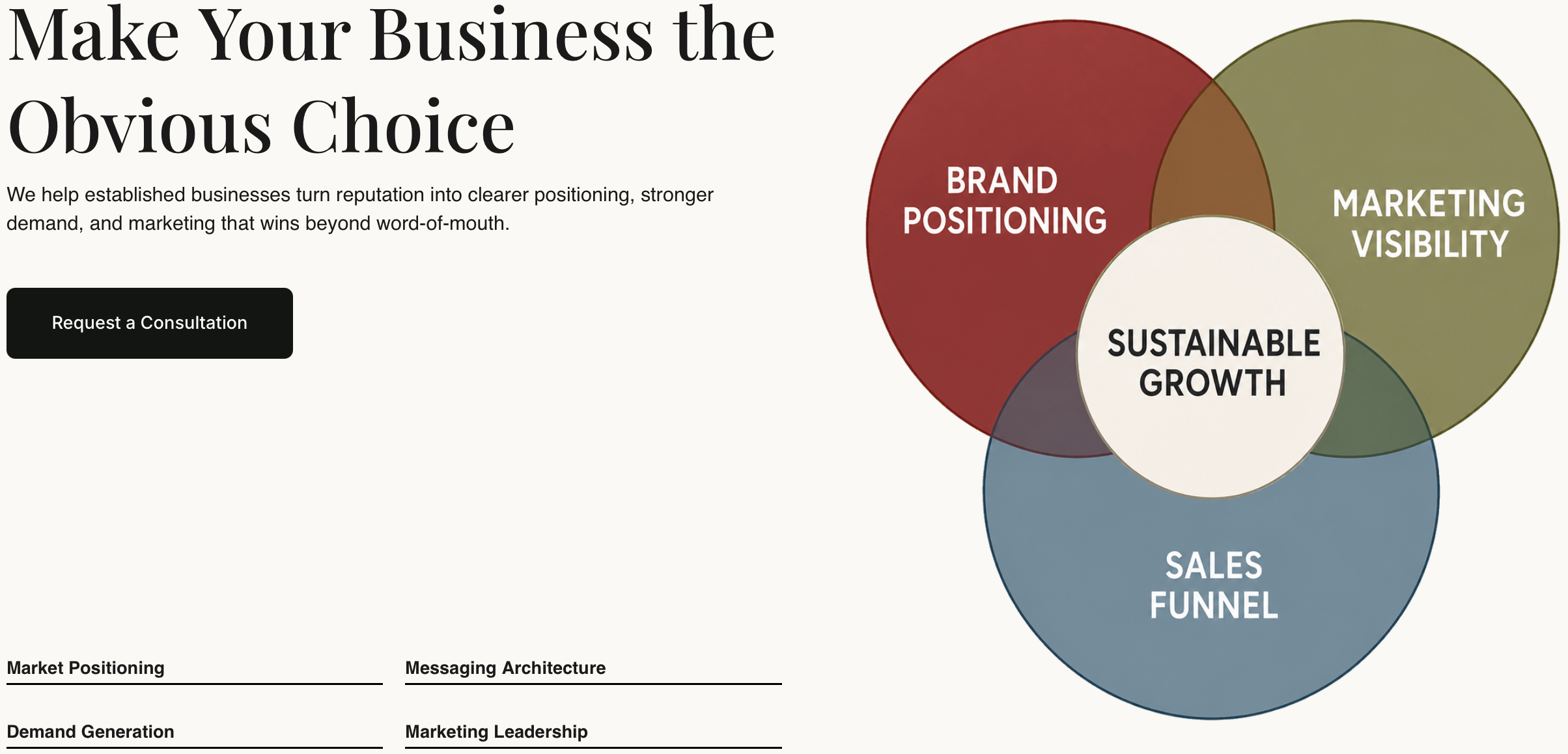
Reasonate Studio’s Brand Strategy and Fractional CMO support are built for exactly that situation. The work delivers a validated positioning sentence, a proof deck, a messaging framework, and a 90-day activation roadmap — then connects that strategy to ongoing execution so it reaches the market consistently. Clients don’t get a document and a handoff. They get senior-level direction and the implementation support to make it stick.
If your business has outgrown referral-only growth and needs positioning that reflects what you’ve actually built, see how Reasonate Studio works and take the first step toward a clearer market position.