September 22, 2026
Why Update Brand Messaging: Essential Guide for Growth


Discover what a positioning strategy in marketing is and how it shapes your brand's image. Maximize your marketing impact today!

TL;DR:
- A positioning strategy creates a distinct and favorable image of a brand in the customer’s mind relative to competitors. It guides marketing decisions, shapes messaging, and influences pricing and product development. Regularly revising the strategy ensures it remains aligned with market changes and competitive dynamics.
A positioning strategy in marketing is defined as the deliberate process of creating a distinct, favorable image of your brand or product in the mind of your target customer, relative to competitors. This foundational concept sits at the top of the STP model (Segmentation, Targeting, Positioning) and directly shapes your pricing, product development, and messaging decisions. Without a clear positioning strategy, every marketing tactic you run operates without direction. This guide breaks down the types, frameworks, and real-world application of market positioning so you can build a brand that earns the right customers and repels the wrong ones.
A positioning strategy) is a deliberate process to create a distinct, favorable brand image in the target customer’s mind relative to competitors. It is foundational in marketing frameworks such as STP and directly guides pricing, product development, and messaging. That definition matters because it tells you what positioning is not. It is not your tagline, your logo, or your brand colors. Those are outputs of positioning, not the strategy itself.

Positioning answers one core question: why should your ideal customer choose you over every other option available to them? When you answer that question with clarity and specificity, every marketing decision becomes easier. Your content has a point of view. Your pricing reflects a value claim. Your sales conversations stop feeling like pitches and start feeling like confirmations.
The importance of positioning in marketing becomes obvious when you look at what happens without it. Brands without clear positioning tend to chase every customer, dilute their message, and compete on price by default. That is a race no small business wins. A well-defined market position gives you a competitive frame where you are clearly the winner, not just another option.
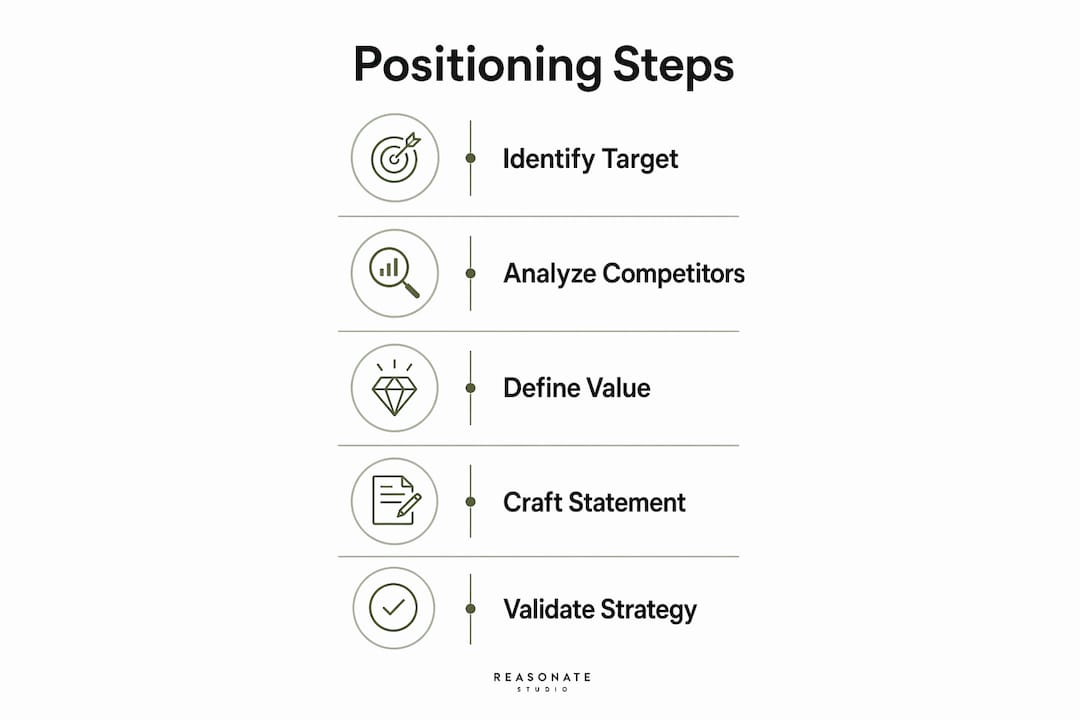
Common positioning types include price-based, quality-based, benefit-based, feature-based, and competitive-based strategies. Each anchors a company’s market approach to a different kind of competitive advantage. Choosing the right type depends on your audience, your offer, and the gap you see in the market.
Here is how each type works in practice:
Pro Tip: Pick one primary positioning type and build everything around it. Trying to be the most affordable, highest quality, and most feature-rich option at the same time sends no clear signal to anyone.
The industry-standard positioning statement uses a five-part template developed from foundational texts like Al Ries and Jack Trout’s 1981 book Positioning: The Battle for Your Mind. That framework has held up for decades because it forces clarity on the exact questions that matter most.
The five components are:
Here is a simplified template you can fill in: “For [target customer] who [need or situation], [brand name] is the [market category] that [key benefit] unlike [primary alternative] because [differentiator].”
| Component | Weak version | Strong version |
|---|---|---|
| Target customer | Small business owners | Service-based founders selling $3,000+ offers |
| Key benefit | Better marketing | More clients without more content |
| Primary alternative | Other agencies | Doing it yourself |
| Differentiator | We care more | Strategy-first, done-for-you execution |
Pro Tip: Before you write a single word of your positioning statement, interview your best customers and ask them why they chose you over the alternatives. Their language will be more accurate and more persuasive than anything you invent internally.
The most common mistake at this stage is writing a positioning statement that sounds good but says nothing specific. Vague differentiators like “we are passionate” or “we deliver results” do not create a competitive frame. They describe what every brand claims. A strong differentiator names a specific mechanism, a specific audience, or a specific outcome that competitors cannot credibly claim.
Positioning is distinct from messaging. Positioning is the internal strategic decision about where you compete and why you win. Messaging is the external communication of that decision. Treating them as the same thing is one of the most common and costly mistakes marketing professionals make. When you write your positioning statement as if it is ad copy, you end up with language that sounds polished but lacks strategic clarity.
“Misguided efforts often market wishful attributes instead of true competitive strengths. Finding the competitive wedge, the unique aspect that makes competitors irrelevant, is critical for effective positioning. Brands that skip this step end up competing on price by default, because they have given customers no other reason to choose them.”
The second major pitfall is trying to appeal to everyone. Effective positioning prioritizes specificity and exclusion. It attracts ideal customers and deliberately repels others. A position that resonates with everyone resonates with no one. The goal is not broad appeal. The goal is deep resonance with the exact customer who will buy, stay, and refer others.
Positioning is also not a one-time exercise. Successful companies treat positioning as a living strategy, revising it in response to market shifts, competitor evolution, and product changes. A position that was accurate two years ago may no longer reflect your actual competitive advantage today. Build a habit of reviewing your positioning at least once a year, or any time a major market shift occurs.
Pro Tip: Run a simple test. Ask five people outside your company to describe what you do and who you do it for. If you get five different answers, your positioning is not clear enough to be working.
Positioning only creates value when it shows up consistently across every customer touchpoint. Here is how to put it into practice:
Positioning must be validated with market data, not internal opinions. A/B testing messaging variants on landing pages, tracking conversion rates by audience segment, and monitoring which content attracts your best customers are all practical ways to test whether your position is landing. If your conversion rate improves when you narrow your message, that is evidence your position is working.
| Signal | What it means |
|---|---|
| High traffic, low conversions | Positioning attracts wrong audience |
| Strong referrals from existing clients | Positioning resonates with ideal customers |
| Frequent price objections | Positioning does not justify the price point |
| Customers describe you differently than you describe yourself | Positioning is unclear or misaligned |
Warning signs that your positioning needs revision include a sudden drop in referrals, increased price sensitivity from new leads, or a competitor gaining ground with a message that sounds like yours. When any of these appear, treat it as a signal to revisit your competitive frame, not just your marketing tactics. You can also explore common branding mistakes that often trace back to weak or undefined positioning.
Most founders I work with come to Reasonate Studio thinking they have a content problem or a social media problem. What they actually have is a positioning problem. Their marketing is not working because it is not clear enough to attract the right person and repel the wrong one. Once we fix the position, the content gets easier, the sales conversations get shorter, and the clients who show up are a much better fit.
The mistake I see most often is founders positioning around what they wish were true about their business instead of what is actually true. They want to be known for transformation, for premium quality, for innovation. But when I ask their best clients why they hired them, the answers are almost always more specific and more practical. “She was the only one who understood my industry.” “He responded within the hour and no one else did.” “Their process was the only one that did not require me to do everything myself.” Those are real competitive wedges. They are not glamorous, but they are true, and truth converts.
The other pattern I see constantly is founders treating positioning as a one-time branding exercise. They write a positioning statement in a workshop, put it in a Google Doc, and never look at it again. Meanwhile, their market shifts, a new competitor enters, and their offer evolves. Their positioning stays frozen. Positioning should evolve continually as the market and competitive environment change. Static positioning leads to a slow, quiet loss of advantage that most founders do not notice until it has already cost them.
My honest advice: treat your positioning statement as a hypothesis, not a declaration. Test it. Talk to your customers. Watch your conversion data. Refine it every six to twelve months. The brands that stay sharp are the ones that stay curious about why their best customers chose them, and keep building from that truth.
— Kaitlyn Cole
Clear positioning is the foundation of every marketing system that actually generates revenue. Reasonate Studio works with founders, coaches, and consultants to build that foundation through strategy-first brand work, including sales page optimization that translates your position into copy that converts, and SEO keyword research that aligns your online presence with the exact search intent of your ideal customer.
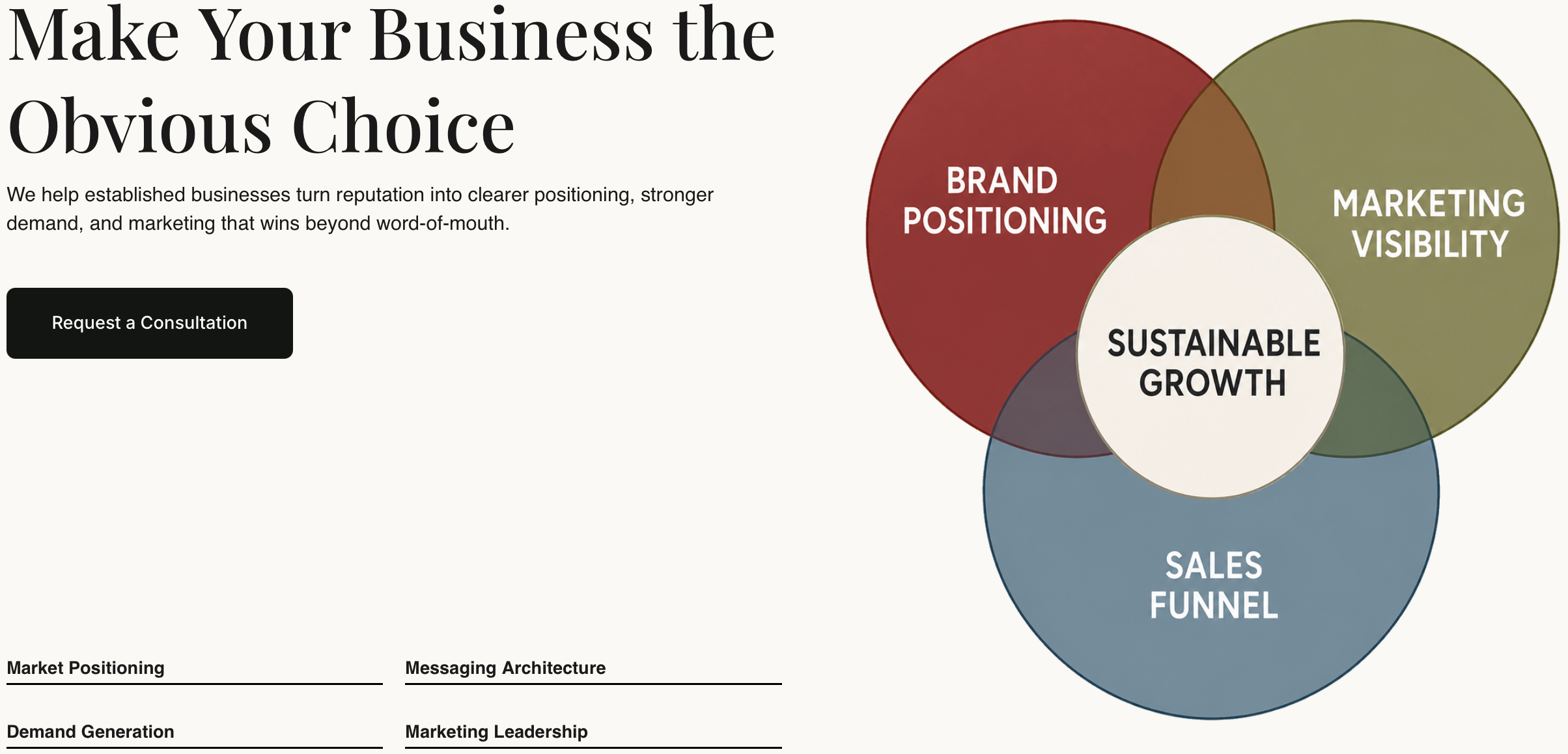
When your positioning is clear, every piece of content, every sales conversation, and every page on your website pulls in the same direction. Reasonate Studio’s Aligned Impact Model™ is built to get you there. If you are ready to stop guessing and start marketing from a place of real clarity, on-page SEO optimization and brand strategy support are available now.
A positioning strategy in marketing is the deliberate process of creating a distinct, favorable image of a brand or product in the target customer’s mind relative to competitors. It sits above branding and messaging as the core strategic decision about where and how a brand competes.
The main types of positioning strategies include price-based, quality-based, benefit-based, feature-based, competitive-based, category-based, and use-case-based approaches. Each creates a different competitive advantage depending on the audience and market gap.
A positioning statement uses a five-part template covering target customer, market category, key benefit, primary alternative, and unique differentiator. The statement should be grounded in customer interviews, not internal assumptions.
Positioning is the internal strategic decision about where you compete and why you win. Messaging is the external communication of that decision. Treating them as the same thing produces copy that sounds polished but lacks strategic clarity.
Positioning should be reviewed at least once a year and any time a major market shift, new competitor, or significant product change occurs. Treating positioning as a living strategy protects your competitive advantage over time.