September 22, 2026
Why Update Brand Messaging: Essential Guide for Growth


Discover essential brand positioning tips for entrepreneurs. Master distinct strategies to effectively connect with your target customers in 2026.

TL;DR:
- Effective brand positioning involves claiming a unique, memorable space in the customer’s mind by focusing on specific attributes, value, and target segments. Entrepreneurs must create a clear positioning statement and regularly test and refine their position to maintain differentiation and consistency across marketing channels. Narrow audience targeting, proof of differentiation, and daily use of the positioning statement are key to building a durable, recognizable brand.
Brand positioning is defined as the strategic process of claiming a distinct, ownable space in your target customer’s mind relative to every alternative they could choose. For entrepreneurs and small business owners, getting this right is not optional. Vague positioning leads directly to messaging drift, wasted ad spend, and customers who cannot explain why they chose you. The best brand positioning tips share one thing in common: they force specificity. Frameworks like April Dunford’s five-component model and tools like perceptual mapping give you a repeatable way to find and hold that specific space. This guide walks you through every step, from building your foundation to testing and refining your position over time.

A solid brand positioning strategy is built on five components, and skipping any one of them creates a gap that shows up later in your marketing. April Dunford’s framework identifies these as competitive alternatives, unique attributes, value, target market, and market category. Each component answers a specific question your customer is already asking, even if they never say it out loud.
Here is what each brand positioning element covers:
One component that entrepreneurs frequently overlook is the positioning statement itself. A positioning statement is an internal alignment tool, not a tagline or ad copy. It is the document your marketing, sales, and content decisions should all trace back to. Think of it as a compass rather than a headline.
Pro Tip: Write your positioning statement in one sentence using this structure: “For [target customer] who [key need], [your brand] is the [market category] that [key benefit] because [reason to believe].” Test it by asking whether every piece of content you publish is consistent with that sentence.
Differentiation is the heart of every effective brand positioning strategy, and most small business owners get it wrong in the same way. They describe what they do rather than what makes them the only logical choice for a specific customer with a specific problem. Real differentiation is not about being better in general. It is about being the best option for a clearly defined situation.
Start by mapping the alternatives your customers actually consider. Competitive mapping must honestly assess customer perception, because brands consistently overestimate how unique they appear to buyers. What you think sets you apart and what customers actually notice are often two different things. The gap between those two views is where your real positioning work begins.
Strong differentiation usually lives at the intersection of three qualities:
Generic claims like “we provide great service” or “we are passionate about what we do” fail all three tests. Every competitor says the same thing. Instead, get specific. A health coach who positions around a 90-day protocol for women recovering from burnout is far more differentiated than one who offers “holistic wellness support.”
Pro Tip: Use a perceptual map to visualize where your brand sits relative to competitors on two key dimensions your customers use to make decisions, such as price versus specialization or speed versus depth. This visual often reveals a gap no competitor is currently occupying.
Functional benefits describe what your product or service does. Emotional benefits describe how the customer feels after using it. The most durable brand positions combine both. Reasonatestudio’s own positioning, for example, combines the functional benefit of done-for-you marketing execution with the emotional benefit of finally feeling like your brand reflects who you actually are.
Documentation is where most small business positioning efforts fall apart. Founders do the hard thinking, land on a clear position, and then never write it down in a way that guides actual decisions. Businesses without documented positioning frameworks experience diluted marketing ROI within 6–12 months due to messaging drift. That means your Instagram captions start sounding different from your website, which sounds different from your sales calls, and customers lose confidence in what you actually stand for.
A well-built positioning framework connects four layers:
The table below shows the difference between strong and weak documentation in practice:
| Element | Poor Documentation | Strong Documentation |
|---|---|---|
| Target audience | “Small business owners” | “Coaches and consultants with 1–5 years in business who are generating revenue but feel invisible online” |
| Differentiation | “We offer personalized service” | “Every client works directly with the founder, not a junior account manager” |
| Reasons to believe | “We get results” | “454% sales increase for a health coach within 60 days” |
| Positioning statement | None exists | Written, shared with the team, and reviewed quarterly |
| Messaging consistency | Varies by channel | All content traces back to the same positioning statement |
Embedding a well-documented framework into every marketing decision improves message consistency and campaign results. That means your positioning document should live somewhere your team actually uses, not in a folder no one opens. Share it in your content briefs, your social media strategy, and your onboarding materials for any freelancer or contractor who touches your brand.
You can explore real-world positioning examples to see how other small businesses have translated this kind of documentation into consistent, growth-driving messaging.
Brand positioning is not a one-time decision. Markets shift, competitors copy your language, and your own offer evolves. The entrepreneurs who maintain strong positions are the ones who treat positioning as a living document, not a finished product. Testing positioning with real customers and adjusting based on feedback increases the likelihood of commercial success. Skipping this step is how brands end up speaking to a customer who no longer exists.
Here are the most effective methods for validating and refining your position:
Pro Tip: Schedule a positioning review every six months, not just when something feels off. Tie it to a natural business rhythm like a product launch, a new campaign, or your annual planning cycle. This keeps your position current without requiring a full rebrand every time the market shifts.
Positioning and value proposition are related but distinct. Positioning defines your market placement while your value proposition defines the specific exchange benefit for the customer. Both must align for your brand foundation to hold. If your positioning says you serve burnout-recovery coaches but your value proposition leads with general productivity, the two are working against each other.
Aligning your positioning with your business objectives is equally important. If you are moving upmarket, your positioning needs to reflect that shift before your pricing does. If you are entering a new geographic market, your frame of reference may need to change even if your core differentiation stays the same. Learn more about building this kind of brand strategy for growth to see how positioning connects to every other business decision you make.
Trying to position for everyone is the fastest way to connect with no one. The most effective brand differentiation techniques start with a narrow, specific audience definition and then build outward from there. A brand that speaks directly to a specific person in a specific situation will always outperform one that tries to appeal broadly.
Audience segmentation for positioning goes deeper than demographics. You need to understand the following:
That last point is more important than most entrepreneurs realize. If your positioning uses language your customer does not recognize, they will not feel seen. They will scroll past. The goal is for your ideal customer to read your positioning and think, “This is exactly for me.”
Reasonatestudio’s Aligned Impact Model™ is built on this principle. The agency does not position itself as a general marketing firm. It speaks directly to founders, coaches, and consultants who are excellent at their work but overwhelmed by the marketing side of their business. That specificity is what makes the positioning credible and the messaging magnetic.
You can also explore the 7 types of brand positioning to identify which positioning approach fits your audience and offer best.
A positioning statement earns its value not when it is written but when it is used. Most small business owners write one during a brand strategy session and never look at it again. The ones who build strong, recognizable brands use their positioning statement as a filter for every marketing decision they make.
Here is what that looks like in practice. Before publishing a piece of content, ask whether it speaks to the target audience named in your positioning statement. Before launching a campaign, ask whether the message reinforces the differentiation you have claimed. Before accepting a new client, ask whether they fit the customer profile your positioning was built around. These are not abstract questions. They are the daily discipline that keeps your brand coherent over time.
Messaging clarity directly boosts brand trust and long-term growth. Inconsistency, even small inconsistency, erodes the confidence customers need to choose you and refer others. A positioning statement used as a daily filter prevents that erosion before it starts.
The internal alignment function of a positioning statement is also worth emphasizing. When your team, your freelancers, and your agency partners all understand your positioning, every piece of work they produce reinforces the same brand. Without that shared reference point, every new hire or contractor introduces a new interpretation of who you are.
The most common positioning mistake I see from founders is confusing their offer with their position. They describe what they sell rather than the specific place they occupy in the customer’s mind relative to every other option. Those are two completely different things, and conflating them produces marketing that sounds busy but converts poorly.
The second mistake is writing a positioning statement once and treating it as permanent. I have worked with coaches who built their entire brand around an audience that evolved, and they kept speaking to who their customer used to be instead of who they are now. Positioning requires the same ongoing attention you give your offer and your pricing.
What actually works is combining a proven framework with direct customer input. You cannot think your way to a strong position from behind your desk. You have to talk to the people you serve, listen to the language they use, and let their words shape your message. The frameworks give you structure. The customer conversations give you truth.
The entrepreneurs I have seen build the most durable brands are the ones who commit to specificity even when it feels risky. Narrowing your audience, making a bold differentiation claim, and backing it up with real proof points takes courage. But that specificity is exactly what makes a brand memorable, referable, and worth paying for.
— Kaitlyn
Clear positioning means nothing if your marketing does not consistently reflect it. That is where execution becomes the deciding factor. Reasonatestudio’s social media management service is built to translate your brand position into content that shows up consistently, speaks directly to your ideal customer, and builds the kind of recognition that drives real revenue.
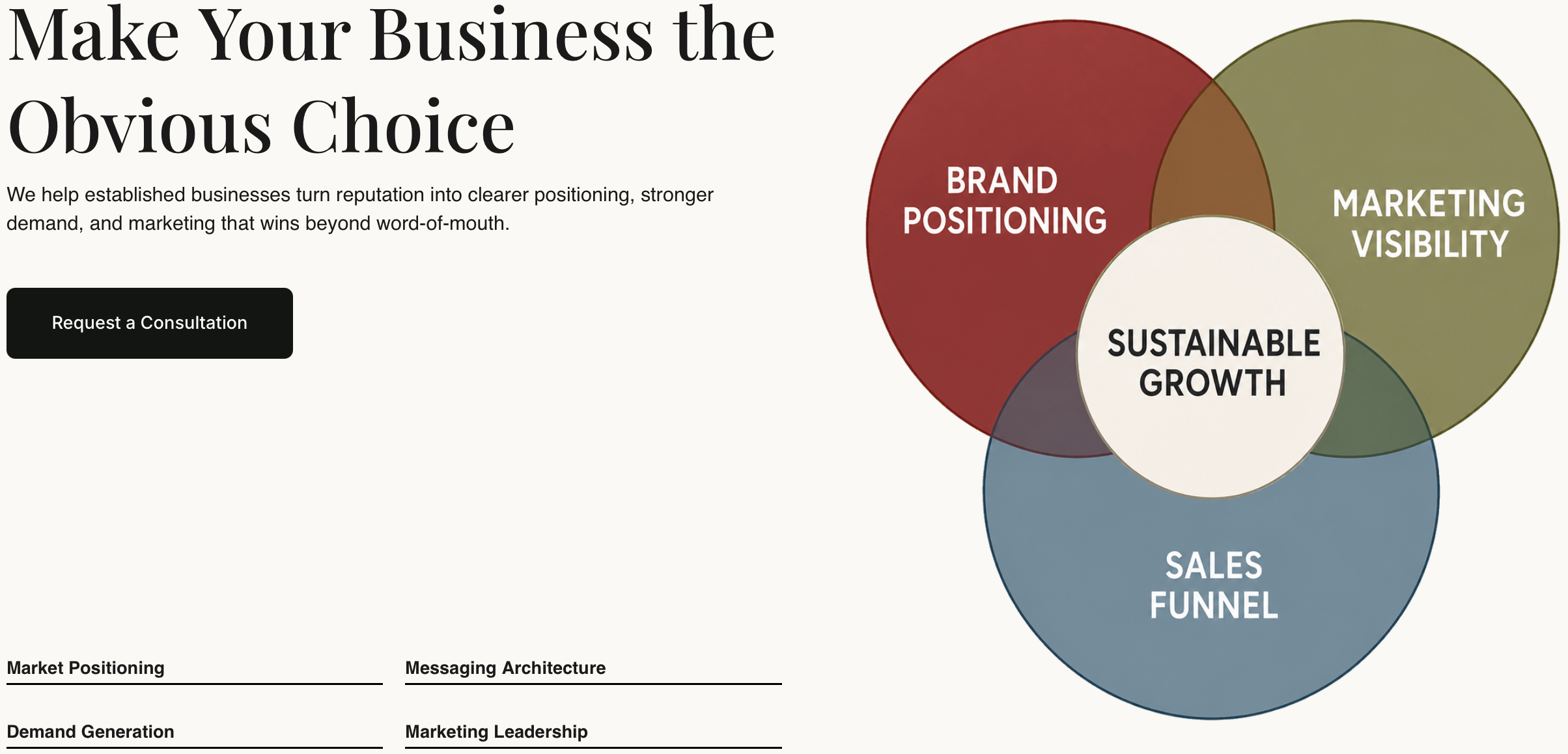
Every post, caption, and campaign Reasonatestudio produces is grounded in your brand’s specific positioning, not generic content templates. If you are ready to stop guessing and start showing up with clarity, explore how Reasonatestudio can build and manage a social presence that actually reflects who you are and what makes you the only logical choice.
Brand positioning is the process of defining the specific place your brand occupies in your customer’s mind relative to competitors. It answers the question: why should this specific person choose you over every other option available to them?
A positioning statement is an internal tool used to align your team’s marketing, sales, and product decisions. A tagline is external-facing copy. The two serve different purposes and should never be confused.
Review your positioning every six months or whenever a significant market shift occurs, such as a new competitor entering your space or a change in your core offer. Iterative validation prevents costly mispositioning and keeps your messaging aligned with current market conditions.
Positioning defines where your brand sits in the market relative to alternatives. A value proposition defines the specific benefit a customer receives from choosing you. Both must align for your brand foundation to work effectively.
Most small businesses struggle because they describe their services rather than the specific outcome they deliver to a specific customer in a specific situation. Generic claims like “great service” or “quality work” fail the exclusivity test because every competitor says the same thing.