September 22, 2026
Why Update Brand Messaging: Essential Guide for Growth


Discover why brand perception matters for sustainable growth. Learn how emotional marketing drives customer loyalty and boosts revenue for your business.

TL;DR:
- Brand perception shapes trust, loyalty, and purchase decisions more than brand identity or value.
- Emotional associations formed through intentional marketing drive customer spending and long-term loyalty.
- Consistent, perception-focused strategies help founders build meaningful connections that fuel sustainable growth.
Most founders spend years building expertise and then wonder why their marketing still feels like shouting into a void. The answer is rarely a tactics problem. It is almost always a perception problem. Recent research shows that brand associations predict and drive customer spending and loyalty far more powerfully than generic brand value scores. In other words, what your audience feels and thinks when they encounter your brand is not a soft, fuzzy concept. It is a direct driver of revenue. This guide breaks down what brand perception really means, what the science says, and exactly how founders, coaches, and consultants can use emotionally intelligent marketing to build brands that earn trust, loyalty, and consistent income.
| Point | Details |
|---|---|
| Brand perception drives growth | Customer associations and emotional responses directly impact spending and loyalty. |
| Evidence over value | Recent research shows associations matter more than abstract brand value measures. |
| Emotionally intelligent marketing | Strategic emotional messaging helps shape positive brand perception for sustainable growth. |
| Actionable improvement steps | Founders can audit, build, and measure brand perception using proven frameworks. |
| Expert support accelerates impact | Professional guidance and optimization unlock faster, more reliable growth outcomes. |
Brand perception is the sum of every thought, feeling, and association a person holds about your brand at any given moment. It is not what you say about yourself. It is what your audience believes after every touchpoint, every post, every conversation, every experience. Think of it as the running narrative your audience writes about you, whether you guide that narrative or not.
This is where a lot of founders get confused. They conflate brand perception with brand identity (what you intentionally project) or brand value (an abstract financial measure of a brand’s worth). These are three different things, and mixing them up leads to real strategic mistakes.
Brand identity is what you design. Brand value is what analysts calculate. Brand perception is what your customer actually holds in their mind when they decide whether to buy from you, refer you, or scroll past you entirely. And understanding why branding matters at this level is the starting point for any growth strategy that lasts.
Here is a simple way to visualize the difference:
| Concept | Who controls it | What it measures | Business impact |
|---|---|---|---|
| Brand identity | You | Visual and verbal design choices | Consistency and recognition |
| Brand value | Analysts and markets | Financial worth of brand assets | Investor and M&A relevance |
| Brand perception | Your audience | Feelings, trust, associations | Purchase decisions, loyalty, referrals |
The column that matters most for day-to-day revenue? Brand perception. Every time.
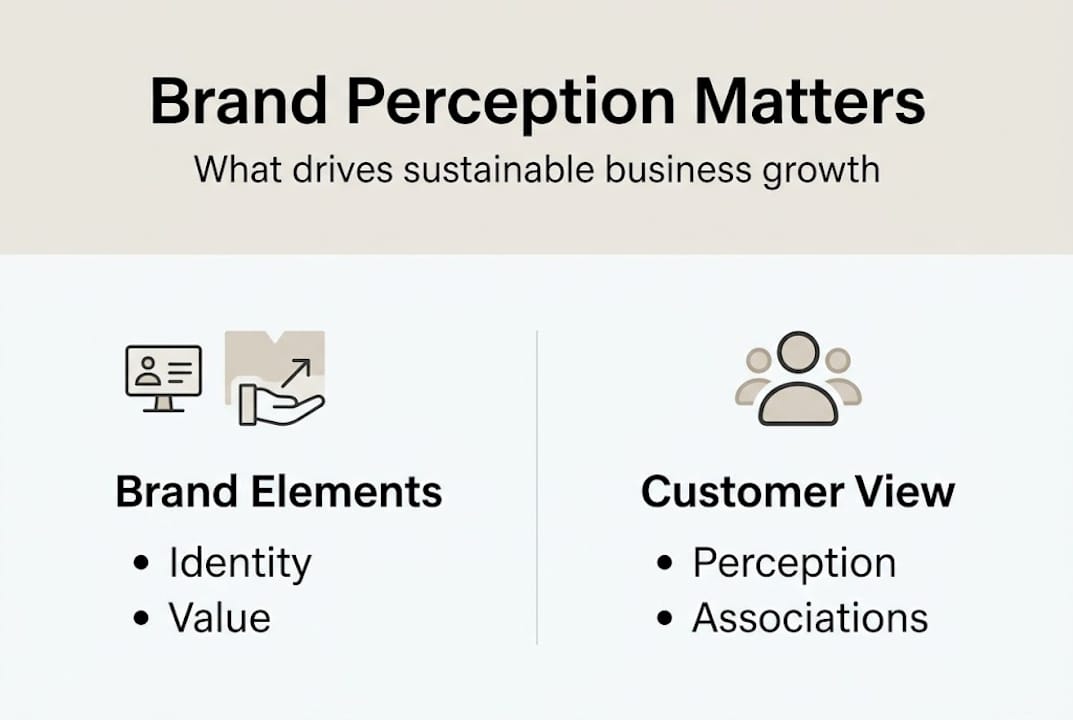
Recent findings confirm this in a way that is hard to ignore. Brand associations tied to specific emotional qualities and experiences drive customer spending in ways that simple brand value scores cannot predict. A customer might acknowledge that a brand is well-known and yet still choose a competitor because the competitor feels more aligned with their values, their aspirations, or their sense of self.
Here is what makes brand perception so powerful and so urgent for founders to understand:
“Your brand is not what you say it is. It is what your customer says it is when you are not in the room.” This is not a cliché. It is the most actionable insight a founder can internalize.
The business stakes here are real. Founders and coaches who invest in shaping their brand perception are not just doing creative work. They are building a commercial asset that compounds over time. Every positive association your audience forms is a data point in their subconscious purchasing algorithm. Stack enough of those data points in your favor, and you stop competing on price and start winning on connection.

Brand perception is not just a marketing talking point. There is measurable, research-backed evidence that it directly shapes how much customers spend and how long they stay loyal.
Harvard Business Review published research in 2026 showing that brand associations are a stronger predictor of customer spend compared to generic brand value. This is a significant finding because most businesses still treat brand-building as a brand awareness exercise rather than a revenue lever. The research reframes the entire conversation.
The key distinction the research makes is between generic brand value and specific brand associations. Generic brand value is the broad recognition a brand has in the market. Brand associations are the specific emotional and cognitive connections customers form. Think of associations as the answers to questions like: “Is this brand trustworthy?” “Does this brand understand me?” “Does buying from this brand say something good about who I am?”
Here is how these two approaches compare in practice:
| Approach | Focus | Limitation | Business outcome |
|---|---|---|---|
| Generic brand value | Awareness and reach | Does not predict individual spending | Weak loyalty, price sensitivity |
| Specific brand associations | Emotional and cognitive connections | Requires deeper strategy | Higher spend, stronger retention |
Emotionally intelligent brands do something most founders overlook. They do not just try to be visible. They deliberately engineer the associations they want customers to form. Every content decision, every brand voice choice, every client interaction is treated as an opportunity to reinforce the right perception.
Here are the indicators that a brand is building strong, growth-driving perception:
The strategy of improving brand perception is not about chasing trends or flooding every social platform. It is about identifying the two or three associations you most want to own and building every marketing decision around reinforcing those associations deliberately.
Statistic worth noting: Research consistently shows that customers who form strong emotional associations with a brand spend significantly more over their lifetime and are far less likely to switch to a competitor, even when a cheaper option is available.
The practical implication for building a marketing campaign is clear. Before you plan the content calendar or the promotional schedule, you need to define the associations you want your brand to own. Otherwise, your campaigns are generating awareness without direction, which is one of the most expensive mistakes a small business can make.
Emotionally intelligent marketing is the practice of designing your messaging, content, and client experience to intentionally shape how your audience feels about your brand at every stage of the relationship. It is not manipulation. It is empathy at scale.
When you understand what your ideal client fears, desires, values, and aspires to, you can create content and experiences that resonate at a deeper level than information alone. This is exactly where most founder-led brands fall short. They focus on what they do rather than how it makes their clients feel. Prospects do not buy services. They buy the version of themselves they believe your service will help them become.
Brand associations drive measurable outcomes for spending and loyalty. That means the emotional connections your marketing creates are not just feel-good moments. They are commercial decisions with a direct line to your revenue.
Here is how to put emotionally intelligent marketing into practice:
“The brands that win long-term are not the loudest ones. They are the most recognizable at an emotional level. Their audience knows how it feels to encounter them before a single word is read.”
Pro Tip: One of the most common emotional marketing mistakes is trying to appeal to everyone’s emotions at once. Warmth and edginess do not coexist well. Choose your emotional lane and stay in it. Your most aligned clients will find you faster, and you will stop attracting clients who are not a good fit.
Increasing brand recognition through emotionally intelligent marketing is not about posting more. It is about creating content that leaves the right emotional residue. After someone reads your caption, watches your video, or reads your email, what do they feel? If you cannot answer that question, your content is likely informing without connecting, and connection is what drives the buying decision.
Understanding is not enough. You need a repeatable system for auditing, shaping, and measuring your brand perception. Here is a founder-friendly approach that does not require a large team or a massive budget.
Step 1: Conduct a perception audit. Before you can improve anything, you need an honest baseline. Send a short survey to five to ten current or past clients with two questions: “What three words would you use to describe working with me?” and “What made you decide to choose me over other options?” The patterns in those answers will reveal your current perception reality, which may be different from what you intended.
Step 2: Define your target associations. Based on your audit results and your brand goals, choose two or three specific associations you want to own. Write them down. Every marketing decision going forward should be filtered through these associations. Ask yourself: does this post, this offer, this email reinforce the associations I want to own?
Step 3: Audit your existing content. Review your last 30 days of social posts, your website homepage, and your email sequences. For each piece, ask: does this reinforce my target associations or dilute them? This exercise often reveals a significant amount of content that is neither harmful nor helpful, just neutral. Neutral content is a missed opportunity.
Step 4: Build a consistent execution rhythm. Sustainable brand perception is built through consistency, not campaigns. Inconsistent posting, long gaps in communication, and sudden shifts in tone all erode the associations you have worked to build. Increasing brand visibility naturally starts with showing up predictably rather than perfectly.
Step 5: Measure what matters. Most founders track vanity metrics like follower counts and likes. For brand perception, the metrics that matter most are: referral rate, client retention rate, the language clients use when they describe you, and conversion rate from warm leads to clients. These numbers tell you whether your perception work is actually translating into commercial outcomes.
Brand perception can be leveraged to drive sustainable growth outcomes, but only when it is tracked and refined over time. Perception is not a set-it-and-forget-it asset. It requires the same intentional management as any other part of your business.
Here is a quick checklist for your brand perception audit:
Pro Tip: The fastest way to improve brand perception is to look at your best clients and reverse-engineer why they chose you. Their decision-making process contains the exact emotional triggers your marketing should be amplifying. Use their words in your copy and watch conversion rates improve within weeks. Exploring marketing ideas for sustainable growth becomes much easier once you understand the perception you are already creating.
Here is something most brand strategy advice gets wrong: founders are told that brand perception is built primarily through visual consistency. Same fonts, same colors, same logo placement. That is brand identity work, not perception work. Perception lives in the emotional layer underneath the visual one.
In 2026, the market is more saturated than it has ever been. Every niche has more coaches, more consultants, more founders offering variations of the same service. Visual consistency alone cannot cut through that noise. What cuts through is emotional specificity, the ability to make a specific type of person feel unmistakably seen and understood by your brand.
The uncomfortable truth is that most founders are still setting marketing goals around reach and impressions when they should be setting goals around perception shifts. Instead of “I want 10,000 Instagram followers,” the goal should be “I want my audience to associate my brand with clarity and confidence so strongly that they choose me without comparing my price to competitors.”
Emotional intelligence in marketing is often dismissed as soft. It is not. It is the most commercially significant skill a founder can develop in the current market. Brands that earn loyalty earn it because they make people feel something specific and repeatable. They are not just memorable. They are meaningful to the people they serve.
The founders who are scaling sustainably right now are not the ones with the biggest ad budgets or the most followers. They are the ones who have made their ideal clients feel deeply understood, consistently and intentionally. That is the real competitive advantage of brand perception work, and it is one that compounds with every piece of content, every client interaction, and every promise kept.
If this article has made one thing clear, it is that brand perception does not build itself. It takes intentional strategy, consistent execution, and a clear understanding of the emotional associations you want your brand to own.

At Reasonate Studio, we help founders, coaches, and consultants move from scattered marketing to a focused, perception-driven brand strategy through our Aligned Impact Model™. Whether you need sales page optimization to close more clients or a complete brand strategy consulting overhaul that aligns your message, your marketing, and your revenue goals, we build the engine that makes your expertise visible and your brand impossible to ignore. Start with a free Brand Audit Report and get a clear picture of where your perception stands and exactly what to do next.
Brand perception can be measured through client surveys, qualitative feedback, and tracking changes in purchase behavior and loyalty, since brand associations drive measurable spending and loyalty outcomes over time.
Brand value is an abstract financial measure of a brand’s worth, while brand perception is built from customer associations and emotional responses, and brand associations are more predictive of actual customer spending than brand value scores.
Emotional associations create the psychological conditions for loyalty and repeat spending, which is why brand associations drive measurable customer loyalty and make them central to any sustainable growth strategy.
Start by identifying your current brand associations through client feedback, then audit your content and messaging to ensure alignment, because brand associations drive real business outcomes only when they are intentionally shaped.
Absolutely. Small businesses often have a significant advantage because they can build highly personal, emotionally specific associations with their audience, and brand associations predict spending and loyalty for brands of any size.