September 22, 2026
Why Update Brand Messaging: Essential Guide for Growth


Unlock your business potential with a solid general marketing plan. Discover essential elements for success and streamline your marketing efforts.
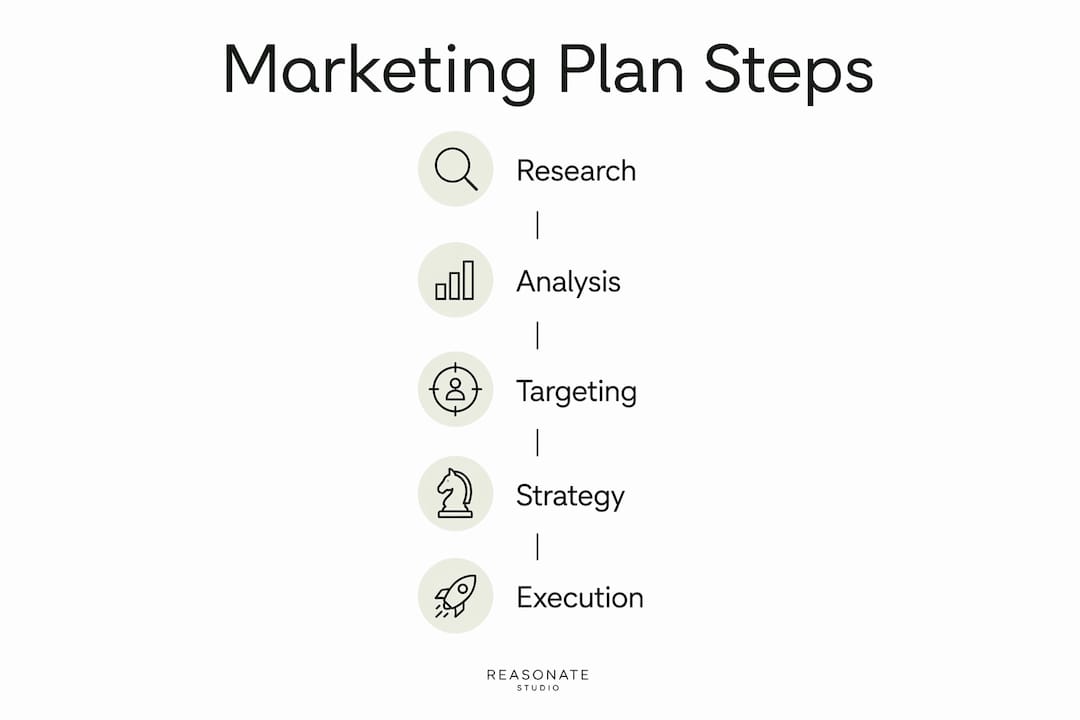
A general marketing plan is a documented blueprint that connects your business goals to specific marketing activities, budgets, timelines, and measurable outcomes. Think of it as the operating system for your marketing: without it, you have tactics without direction. The FDIC’s marketing guidance identifies ten core elements every plan needs: business description, market research, pricing analysis, customer profiling, competitive analysis, marketing goals, marketing strategies, marketing methods, marketing budget, and success measurements. Use this checklist for a fast self-audit.
The plan owner is typically the most senior marketing leader in the business, whether that is a CMO, a fractional marketing director, or the founder. The expected output is a one-page strategic summary backed by tactical appendices. If your plan cannot be summarized on one page, it is not yet a plan; it is a collection of ideas.

Before you decide where to go, you need an honest picture of where you stand. A situation analysis does three things: it surfaces the market conditions shaping your category, it maps the customer behaviors driving purchase decisions, and it names the competitive moves you need to respond to.
What to include:
The SWOT is the synthesis layer. Fill it in after you have gathered the inputs above, not before.
| SWOT Quadrant | Questions to answer | Strategic options it generates |
|---|---|---|
| Strengths | What do we do better than anyone? | Double down; use as positioning anchor |
| Weaknesses | Where do we lose deals or customers? | Fix before scaling; or reposition away |
| Opportunities | What market shifts favor us? | Prioritize in next 90-day sprint |
| Threats | What could erode our position? | Build contingency into budget |

Convert each quadrant into a strategic option before moving on. A SWOT that sits in a slide deck and never informs a decision is wasted effort.
Pro Tip: Most situation analyses miss customer friction points across the buying journey. Map the five to seven steps a prospect takes from first awareness to signed contract, then identify where drop-off is highest. That friction point is usually your biggest marketing opportunity and your most defensible differentiator once fixed.
Segmentation works when it is built on axes that predict behavior, not just demographics. For an established B2B or professional services firm, the most useful axes are behavioral (how they buy), value-based (what outcome they are paying for), and revenue potential (lifetime value and referral multiplier).
Persona template fields that matter most:
Worked example persona for an established B2B services firm:
| Field | Detail |
|---|---|
| Name / Role | Operations Director at a professional services firm |
| Job-to-be-done | Reduce founder dependence on sales by building a repeatable pipeline |
| Purchase trigger | A key referral source retires or a growth target is missed two quarters in a row |
| Channel habits | LinkedIn, peer referrals, industry associations, Google search for specific problems |
| Decision criteria | Senior-level contact, proven methodology, clear deliverables |
| Primary objection | “We’ve tried agencies before and got junior staff and no results” |
Once you have a working persona, your positioning statement follows a simple formula: For [audience], [brand] is the [category] that [primary benefit] because [reason to believe]. A clear positioning statement changes which channels you prioritize, which messages you lead with, and which proof points you put in front of prospects first. Segmentation and positioning are not branding exercises; they are marketing strategy decisions that filter every downstream tactic.
Strategy without measurable targets is a wish list. The SBA’s marketing guidance is direct on this: a marketing plan must link to sales forecasts, budgets, and measurable results. Limit yourself to three to five SMART objectives per planning period. More than five and accountability diffuses.
Converting strategic goals into SMART objectives:
| Objective type | Primary KPI | Supporting KPIs | Review cadence |
|---|---|---|---|
| Lead generation | Marketing-qualified leads (MQLs) | Cost per lead, conversion rate to SQL | Weekly |
| Customer acquisition | Customer acquisition cost (CAC) | Pipeline velocity, close rate | Monthly |
| Retention | Churn rate | Net Promoter Score, repeat purchase rate | Monthly |
| Revenue growth | Revenue from marketing-sourced deals | Average deal size, LTV | Quarterly |
| Brand visibility | Organic traffic, share of voice | Branded search volume, referral traffic | Monthly |
Paste this table into your reporting dashboard and assign an owner to each row. A KPI without an owner does not get tracked. For setting goals that drive growth, the discipline is in the review cadence, not the goal-setting meeting.
Marketing strategy centers on your value proposition and the four Ps: product, price, place, and promotion. The plan translates that strategy into channel choices and campaign priorities. Before you allocate a dollar, decide your primary marketing approach for the next 12 months.
Four primary approaches (choose one as your anchor):
Most established businesses need a retention-led or margin-led approach first, because they already have customers worth keeping and upselling. Chasing acquisition before fixing retention is expensive.
Channel prioritization matrix:
| Channel | Impact | Effort | Priority tier | Best for |
|---|---|---|---|---|
| Email to existing list | — | 2 | Tier 1 | Retention, upsell |
| SEO / organic content | 4 | 3 | Tier 1 | Long-term acquisition |
| LinkedIn (B2B) | 4 | 3 | Tier 1 | Thought leadership, referrals |
| Paid search | 4 | 4 | Tier 2 | Acquisition, testing |
| Referral program | — | 2 | Tier 1 | High-LTV acquisition |
| Social media (organic) | 2 | 3 | Tier 3 | Brand awareness |
| Paid social | 3 | 4 | Tier 2 | Retargeting, event promotion |
Start with Tier 1 channels and prove ROI before funding Tier 2. For practical strategy examples across different business models, the pattern is consistent: fewer channels executed well outperform many channels executed poorly.
A campaign brief keeps execution aligned when multiple people or vendors are involved. Keep it to six fields: objective, audience, offer, channels, success metric, and owner. Anything longer gets ignored.
Sample 90-day rollout (established B2B services firm):
Days 1–30 (Test phase): Audit existing content and email list. Launch two email nurture sequences to warm segments. Publish two long-form SEO articles targeting high-intent queries. Run one LinkedIn thought-leadership campaign with the founder. Track open rates, click-throughs, and inbound inquiries.
Days 31–60 (Scale phase): Double down on the email sequence with the highest open-to-reply rate. Expand LinkedIn to include case study posts and a lead magnet. Begin a referral outreach sequence to top ten past clients. Add one paid search campaign targeting the highest-converting keyword cluster.
Days 61–90 (Optimize phase): Review CAC and MQL data. Cut or pause the lowest-performing channel. Reallocate budget to the top two performers. Prepare a quarterly review deck with findings and the next 90-day priorities.
RACI responsibilities checklist:
Handoff points matter. Strategy to execution breaks down most often at the brief-to-build stage, when a strategist hands a campaign concept to a designer or copywriter without a written brief. Write the brief before the work starts, not after.
Tie every budget line to a forecasted outcome: leads, revenue, or retention improvement. The FDIC’s planning guidance recommends calculating cost-per-customer and cost-per-acquisition as the anchors for budget decisions, then working backward from your revenue target to set spend levels.
Budget template structure:
| Line item | Type | Monthly spend | Forecasted output | Cost per outcome |
|---|---|---|---|---|
| Email platform | Fixed | — | 500 nurture touches | — |
| SEO content | Variable | — | 4 articles, organic visits | $10 per visit |
| LinkedIn ads | Variable | — | 30 MQLs | — |
| Paid search | Variable | — | — | — |
| Referral program | Variable | $500 | — introductions | — |
| Fractional CMO | Fixed | — | Strategy + oversight | N/A (overhead) |
When budget is constrained, apply two decision rules: protect channels with a proven cost-per-acquisition below your target, and pause channels where you have fewer than 60 days of performance data. Never cut a channel in the first 30 days.
On resourcing: in-house staff handle brand consistency and institutional knowledge best; fractional or agency support handles execution volume and specialist skills. For most established businesses in the $2M–$10M revenue range, a fractional marketing leader plus two to three specialist contractors outperforms a single generalist hire. For optimizing your marketing budget, the principle is the same regardless of total spend: allocate to signal, not to hope.
Pro Tip: Set aside 10–15% of your total marketing budget as a test reserve. Run experiments with this pool only. When a test beats your control by a meaningful margin, shift budget from the test reserve to that channel. This keeps your core spend stable while you generate real performance data.
A plan without a reporting rhythm is a plan that drifts. The SBA recommends reviewing plans at least annually and updating them based on ROI, but annual reviews alone are not enough for active campaigns.
| Report type | Frequency | What it covers | Decision authority |
|---|---|---|---|
| Campaign pulse | Weekly | Spend, impressions, clicks, MQLs | Campaign manager |
| Performance review | Monthly | CAC, conversion rates, pipeline contribution | Marketing lead |
| Strategy check | Quarterly | KPI vs. target, channel mix, budget reallocation | CMO / founder |
| Plan rewrite | Annually | Full SWOT refresh, new objectives, budget reset | Leadership team |
Test plan template:
Optimization checklist:
Treat every test outcome as a budget decision, not just a creative preference. A 20% improvement in email open rate has a dollar value when you calculate it against pipeline contribution.
The one-page format forces prioritization. If a strategic choice cannot be stated in one sentence, it is not yet a decision.
One-page template:
| Section | What to write |
|---|---|
| Business summary | One sentence: what you sell, to whom, and your primary differentiator |
| Objectives (3–—) | SMART statements tied to revenue, retention, or visibility |
| Target audience | Primary segment name, job-to-be-done, and top purchase trigger |
| Key strategies | Primary approach (acquisition/retention/margin/brand) + top two channels |
| 90-day priorities | Three to five specific campaigns or projects with owners |
| Budget snapshot | Total monthly spend and allocation by channel |
| KPIs | Three to five metrics with targets and owners |
| Review cadence | Monthly metric review, quarterly strategy check |
Filled example: Meridian Advisory Group (hypothetical B2B financial advisory firm):
To convert this one-page summary into a full tactical appendix, add a campaign brief for each 90-day priority, a channel-level budget breakdown, and the RACI chart from the action plan section. For a ready-made starting point, Reasonate Studio publishes a marketing plan template you can download and adapt.
A plan that is not reviewed is not a plan; it is a document. Governance is what keeps the plan connected to real business conditions. As Business Queensland’s planning guidance notes, a marketing plan should be a dynamic roadmap updated based on performance metrics, not a static deliverable.
Governance model:
Review schedule:
Ad hoc update triggers:
Pro Tip: Keep a lightweight change log: a simple spreadsheet with date, what changed, why, and the budget impact. Link every plan update to a budget reallocation decision. This creates accountability and gives you a clean audit trail when the founder asks why spend shifted.
Referrals are a sign of a healthy business, not a marketing strategy. The moment a key referral source retires, moves on, or simply stops sending work, a referral-dependent business discovers it has no pipeline of its own. The U.S. Chamber of Commerce is direct: as businesses grow, they must shift to a proactive, cohesive presence across all customer touchpoints to maintain loyalty and generate demand.
The three most common execution traps in established businesses are disconnected tactics with no unifying strategy, measurement that stops at vanity metrics, and unclear ownership where everyone is responsible and no one is accountable. Each has a clear fix. Disconnected tactics require a written strategy that every campaign must trace back to. Vanity metrics require replacing reach and impressions with pipeline contribution and CAC. Unclear ownership requires a RACI and a named plan owner with authority to make budget decisions.
The harder organizational shift is treating marketing with the same discipline as finance and operations. Founders who manage marketing as a collection of tasks, approving every piece of content and coordinating vendors themselves, create a ceiling on growth. The business cannot scale marketing faster than the founder’s available attention. Formalizing a marketing rhythm, with weekly reviews, monthly reports, and quarterly strategy checks, removes that ceiling.
One more thing worth saying plainly: a strong reputation does not automatically create clear positioning. Many established businesses are trusted by the clients they have and invisible to the clients they want. The plan is how you close that gap.
Most established businesses do not need more marketing activity. They need a clearer strategy, sharper messaging, and a system that connects the two without requiring the founder to manage every detail.
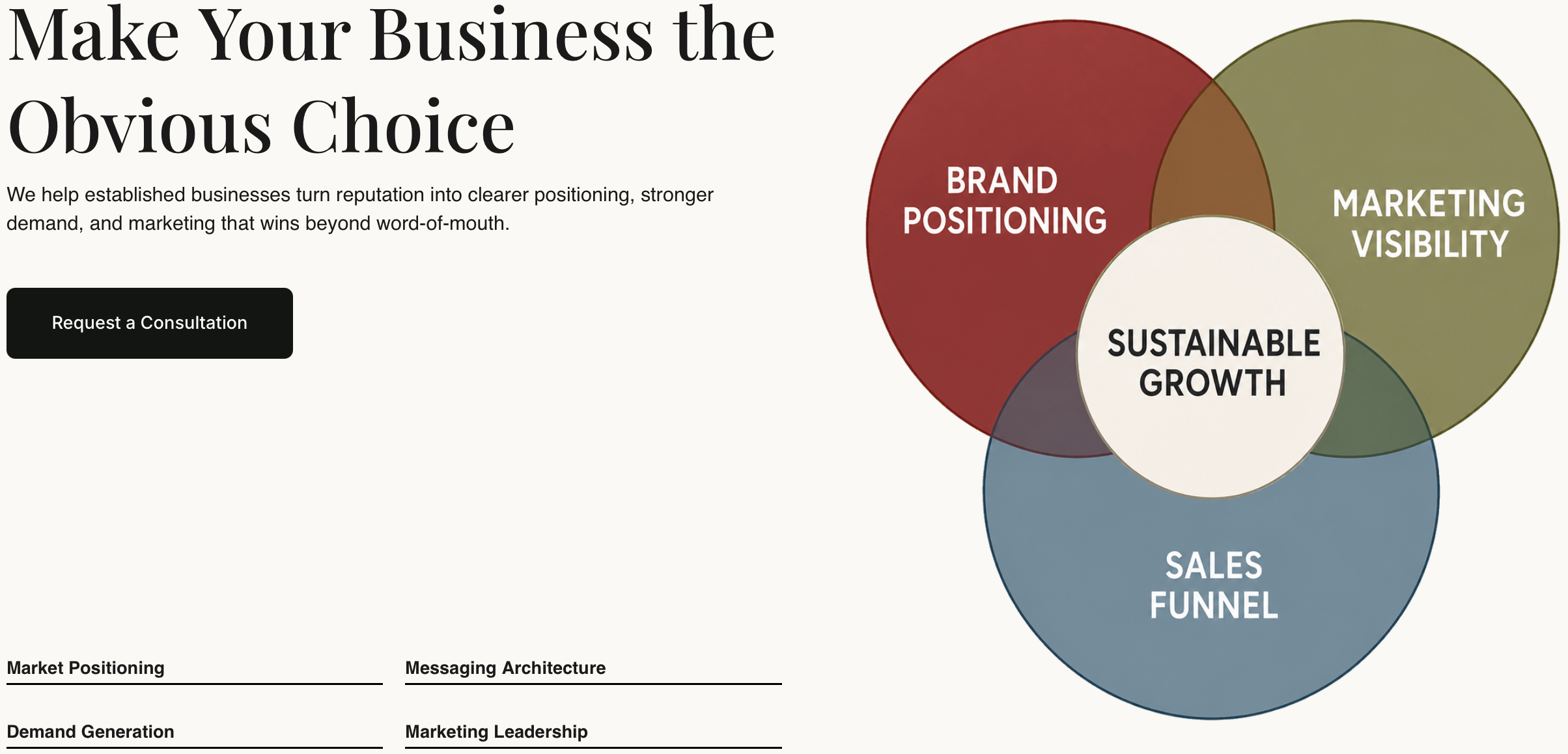
Reasonate Studio works with independently owned businesses generating $2M–$10M in revenue that have outgrown referral-only growth. Through Brand Strategy and Fractional CMO support, guided by the Aligned Impact Model™, Reasonate Studio connects positioning, messaging, and execution into one cohesive system. One client secured a multi-million dollar partnership within a month of a brand repositioning. Another achieved significant website traffic growth through ongoing Fractional CMO leadership. These are not typical outcomes, but they reflect what becomes possible when marketing is led with senior-level direction rather than managed as disconnected tasks.
If you are ready to move from a patchwork of campaigns to a plan with real structure, explore Reasonate Studio’s services or book a scoping conversation to discuss where your marketing plan needs the most work.
The sources below are worth bookmarking. Each serves a specific purpose in the planning process.
| Source | What it is useful for |
|---|---|
| FDIC Marketing Plan Module | Checklist of ten core plan elements; budget calculation guidance; two-level strategic/tactical framework |
| SBA: Marketing and Sales | Linking marketing budgets to sales forecasts; ROI-based review guidance |
| U.S. Chamber: Evolving Your Marketing Strategy | Practical guidance on scaling marketing beyond referrals; consistency across touchpoints |
| Investopedia: What Is a Marketing Strategy? | Clear explanation of the 4 Ps and how strategy informs channel choices |
| Reasonate Studio: Marketing Plan Template | Downloadable one-page template for established businesses; practical starting point |
Additional reads: