September 22, 2026
Why Update Brand Messaging: Essential Guide for Growth


Discover how to create a successful marketing strategy for a business plan. Align your efforts with goals to attract and retain customers!

TL;DR:
- A marketing strategy for a business plan aligns marketing efforts with business goals to attract and retain customers. A good plan connects customer behavior, channel choices, and financial outcomes for predictable growth. Regular updates and clear goals ensure marketing remains effective and responsive to market changes.
A marketing strategy for a business plan is a purposeful blueprint that aligns your marketing efforts with business objectives to attract, convert, and retain customers efficiently. Without this blueprint, marketing spending becomes unpredictable and inefficient, leaving founders guessing which efforts actually drive revenue. The standard industry term for this section of your business plan is the “marketing plan,” and it goes far beyond a list of tactics. A well-built marketing plan connects customer behavior, channel performance, and financial outcomes into one system that produces predictable growth. This guide walks entrepreneurs and small business owners through every component, from reading your market and profiling your ideal customer, to choosing channels, setting goals, and building a budget that holds up in the real world.
Before writing a single tactic, you need to understand the difference between a marketing strategy and a marketing plan. A marketing strategy defines your positioning, your audience, and the logic behind how you compete. A marketing plan translates that strategy into specific channels, campaigns, timelines, and budgets. Both live inside your business plan, and both must connect directly to your business goals. Founders who skip the strategy layer and jump straight to tactics end up with a list of activities that look busy but produce little. The marketing strategy framework that works is one built on four pillars: customer clarity, defensible positioning, focused channel selection, and measurable goals.

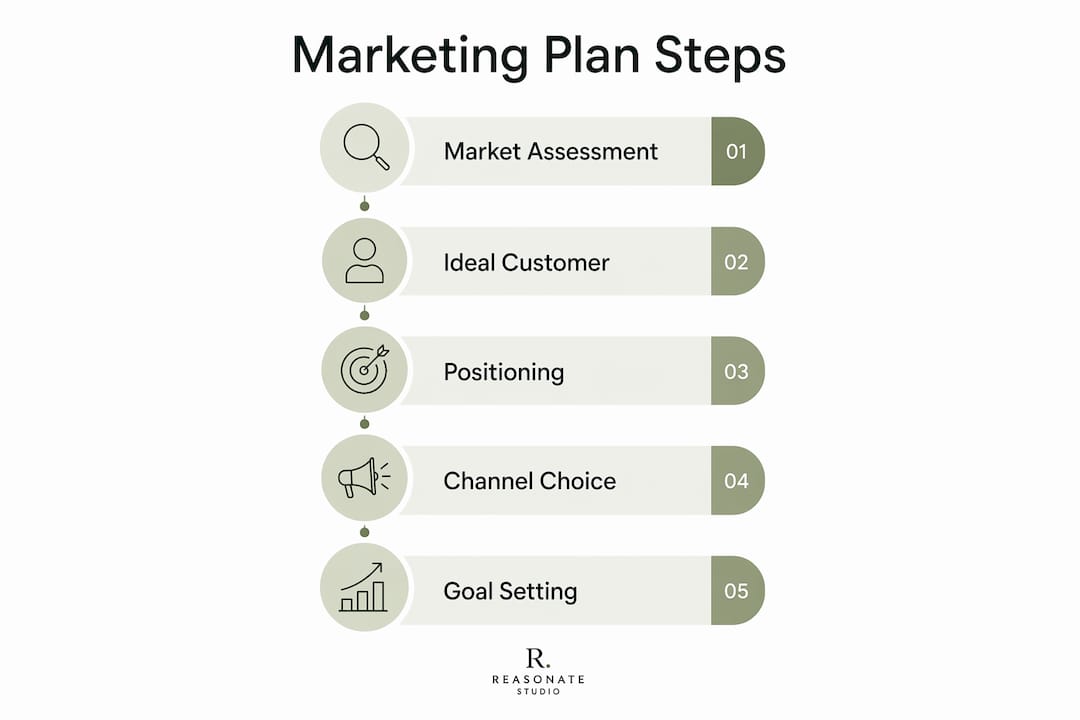
Your market assessment is not a paragraph about industry size. It is a clear-eyed look at current buyer behavior, budget realities, and competitive dynamics in your specific segment. Ask who is actually buying right now, what they are spending, and what is making them hesitate. A health coach targeting burned-out corporate professionals in 2026 faces a very different buyer psychology than one targeting new mothers. The market read shapes every decision that follows, so vague answers here create vague marketing everywhere else.
Moving away from vague personas toward highly specific ICPs aligned with real buyer behaviors improves message effectiveness. That specificity is the difference between “female business owner, 35–50” and a profile that actually drives decisions. A strong ideal customer profile (ICP) includes:
This level of detail shapes your messaging, your channel choices, and your content topics. Without it, you are writing copy for a fictional average person who does not actually exist.
Pro Tip: Interview three to five real past or current customers and ask them to describe the moment they knew they needed help. Their exact words become your most powerful marketing copy.
Once your ICP is written, every marketing message should speak directly to that person’s trigger event and frustration. If your ICP’s trigger is “just lost their biggest client,” your messaging should acknowledge instability and speak to building a more reliable revenue base. Generic messaging like “grow your business” misses the emotional context entirely. Specificity in your ICP produces specificity in your copy, and specific copy converts.
Positioning is the internal logic that explains why your specific buyer should choose you over the specific alternatives they are actually considering. A tagline is the public-facing expression of that logic. Founders often confuse the two and end up with a catchy phrase that means nothing to a buyer who is comparing options. A defensible positioning statement answers four questions: Who is the buyer? What problem do you solve? What alternatives did they consider? What is your unique advantage?
Write your positioning as a paragraph, not a slogan. Work through these four steps in order:
This paragraph is not for your website homepage. It is the internal compass that guides every external message you write. When your team debates whether to run a certain campaign or write a certain post, the positioning statement is the filter.
Pro Tip: Test your positioning statement by reading it aloud to someone who fits your ICP. If they say “that’s exactly my situation,” you have it right. If they look confused, rewrite the problem statement.
Your positioning statement tells you where to show up. If your buyer is a solo service provider who searches for answers on LinkedIn and listens to business podcasts, your channels should reflect that. If your positioning emphasizes speed and done-for-you delivery, your content should demonstrate that speed through case studies and client timelines. Positioning and channel selection are not separate decisions. One informs the other.
Listing all possible channels is a plan with no strategy. Early-stage businesses that spread efforts across too many channels consistently underperform compared to those that focus. The goal is to select 3–5 channels that produce the majority of your results, justified by your ICP behavior, your positioning, and your market read. Every channel in your plan should have a written rationale explaining why it fits your specific buyer.
Use these criteria to evaluate each channel before including it in your plan:
| Channel type | Best for | Primary metric | Excluded when |
|---|---|---|---|
| Organic social media | Brand awareness, community building | Reach, engagement rate | ICP is not active on social platforms |
| Email marketing | Nurturing warm leads, retention | Open rate, click rate | No existing list or lead magnet |
| SEO and blog content | Long-term search visibility | Organic sessions, keyword rankings | Budget requires faster results |
| Paid social ads | Rapid audience testing, lead generation | Cost per lead, ROAS | Positioning is not yet clear |
| Podcast or PR | Authority building, referral traffic | Mentions, referral sessions | Brand story is not yet defined |
Naming the channels you are not pursuing is as important as naming the ones you are. It prevents scope creep and keeps your team focused.
AI search visibility in 2026 requires earned press, structured site information, and presence on third-party sources. This is distinct from traditional SEO and requires its own budget line and ownership. If your ICP uses tools like ChatGPT or Perplexity to research solutions, your brand needs to appear in those results. That means getting cited in industry publications, maintaining consistent business information across directories, and creating content that answers specific buyer questions in a format AI systems can extract and cite. Ignoring this channel in 2026 means becoming invisible to a growing segment of buyers who never visit a search engine results page.
A well-constructed goal stack aligns efforts and reveals issues quickly. The stack has three layers. The business outcome sits at the top: “Generate $300,000 in revenue this year.” The marketing goal sits in the middle: “Produce 120 qualified leads at a cost of $250 per lead.” The activity targets sit at the bottom: “Publish 3 blog posts per month, send 2 email newsletters per month, run 1 paid campaign per quarter.” When results fall short, the stack tells you exactly where the breakdown occurred. Is it a traffic problem, a conversion problem, or an offer problem? The stack makes that visible.
Tracking layered KPIs around visibility, engagement, and intent improves your understanding of real marketing impact. Not every metric ties directly to revenue, and that is expected. Brand awareness metrics like reach and impressions tell you whether your message is spreading. Engagement metrics like email open rates and social saves tell you whether your content resonates. Intent metrics like demo requests and sales page visits tell you whether buyers are moving toward a decision. Review paid media metrics weekly. Review organic metrics monthly. Review overall strategy performance quarterly.
| Goal layer | Example metric | Review cadence |
|---|---|---|
| Business outcome | Revenue, new clients | Monthly |
| Marketing goal | Qualified leads, cost per lead | Monthly |
| Activity target | Posts published, emails sent | Weekly |
| Visibility | Reach, impressions | Monthly |
| Engagement | Open rate, saves, comments | Weekly |
| Intent | Sales page visits, demo requests | Weekly |
60–70% of marketing budgets are people costs, a figure executives consistently underestimate. Program costs cover paid ads, tools, and contractors. Build both into your budget from the start. Reserve 10–15% of your total marketing budget as unallocated. That reserve is not laziness. It is the fund that lets you respond when a campaign outperforms expectations or when a new channel opportunity appears mid-quarter. Founders who allocate 100% of their budget upfront have no room to adapt, and marketing always requires adaptation.
Pro Tip: Build your quarterly calendar before finalizing your budget. Map out your campaigns, launch windows, and content milestones first. Then assign costs to each. This prevents the common mistake of budgeting in the abstract and running out of money before your biggest campaign of the quarter.
After working with over 100 small business owners and founders at Reasonate Studio, I have seen the same pattern repeat itself. Founders mistake activity for strategy. They fill their marketing plan with channel names and budget percentages, but they never answer the harder question: why will your specific buyer choose you over the specific alternatives they are actually considering?
The second pattern I see constantly is treating the marketing plan as a static document. You write it in January, file it away, and revisit it in December to see how far off you were. Marketing plans treated as living tools, updated regularly with real performance data, consistently outperform plans written once and forgotten. I recommend a weekly check on paid metrics, a monthly review of organic performance, and a full strategy review every quarter.
The third pattern is the one that costs founders the most money. They pour budget into top-of-funnel awareness without building a clear conversion path underneath it. Over-investing in top-of-funnel traffic without a strong conversion experience wastes acquisition spend. If someone clicks your ad and lands on a page that does not speak directly to their trigger event, you have paid for a visitor who will not become a client. The middle of your funnel, the moment between first contact and first purchase, deserves as much attention as your content calendar.
The founders who build marketing plans that actually work are the ones who treat the plan as a decision-making tool, not a document to satisfy investors. They use it to say no to channels that do not fit their ICP. They use it to prioritize the one campaign that matters most this quarter. They use it to catch problems early, before they become expensive. That is the version of a marketing plan worth building.
— Kaitlyn Cole
Building a clear marketing plan is one thing. Turning it into a system that actually generates revenue is another challenge entirely.
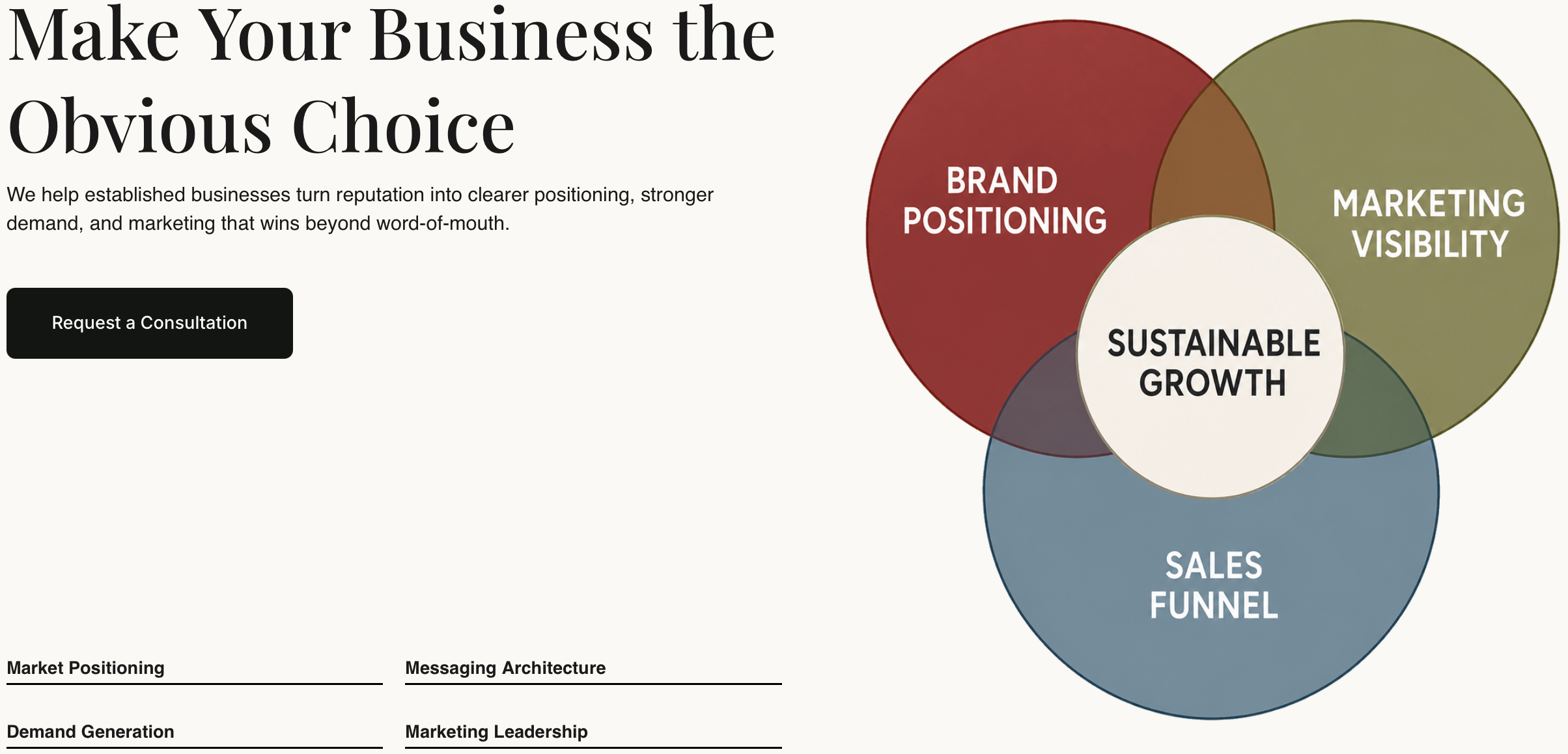
At Reasonate Studio, the sales page optimization service is built specifically for founders who have done the strategy work but are losing buyers at the conversion point. If your traffic is growing but your inquiries are not, the problem is almost always the page where buyers make their decision. Reasonate Studio audits your sales page against your ICP, your positioning, and your offer, then rewrites and restructures it to close the gap. You can also explore the full range of marketing services for founders to find the right entry point for where your business is right now.
A marketing strategy in a business plan is the section that defines your target customer, your positioning, your chosen channels, and your goals. It connects your business objectives to the specific marketing actions that will help you reach them.
Start with a market assessment and a specific ideal customer profile, then write a positioning statement, select 3–5 channels that match your ICP’s behavior, and build a goal stack with measurable KPIs at each level.
Focus on 3–5 primary channels that produce the majority of your results. Spreading efforts across more channels dilutes execution quality and makes it harder to identify what is actually working.
A marketing strategy defines the logic: who you serve, how you are positioned, and why buyers should choose you. A marketing plan translates that logic into specific campaigns, timelines, budgets, and metrics.
Review paid media metrics weekly, organic performance monthly, and overall strategy quarterly. Treating your marketing plan as a living document, not an annual report, is what separates founders who adapt quickly from those who discover problems too late.