September 22, 2026
Why Update Brand Messaging: Essential Guide for Growth


Streamline your marketing with our marketing project plan template. Achieve intentional growth and measurable results for your small business.
TL;DR:
- A marketing project plan template organizes goals, audience, channels, and metrics into a clear roadmap for execution.
- It includes seven core sections such as goals, target audience, competitive analysis, and measurement framework to ensure consistent decision-making.
A marketing project plan template is a structured document that organizes your goals, audience, channels, budget, and metrics into a clear roadmap for execution. For small business owners, coaches, and consultants, it is the difference between reactive posting and intentional growth. Without one, marketing decisions pile up without direction, and budgets disappear without measurable results. The right template connects your big-picture strategy to daily activities, so every action you take moves the needle on something that actually matters.
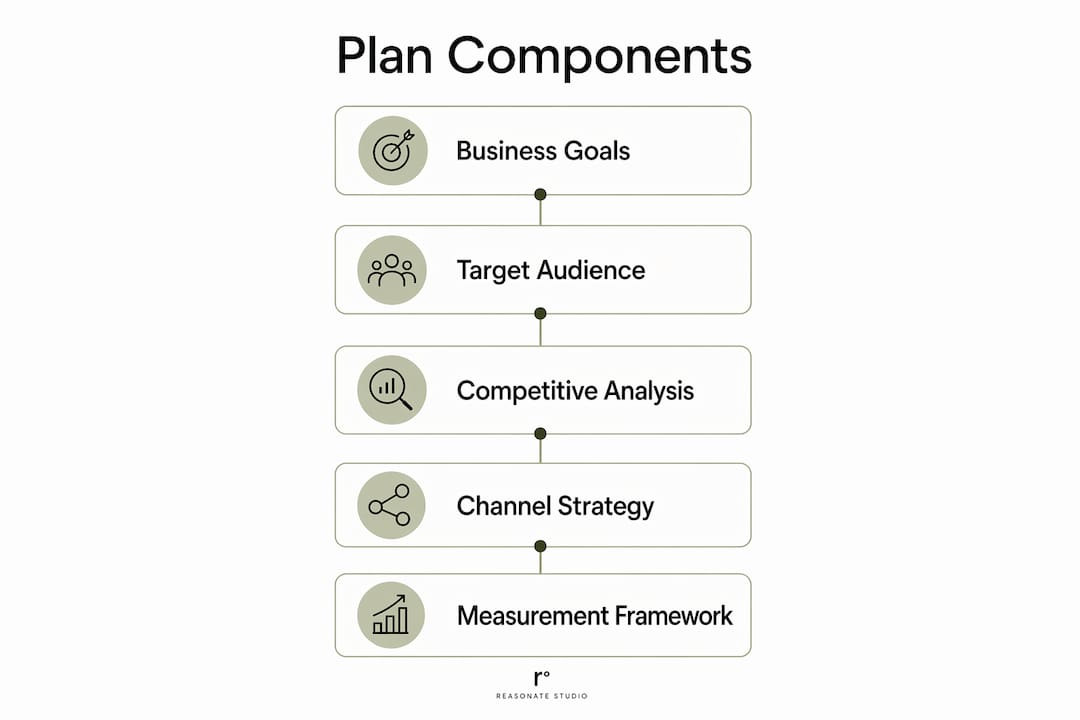
A solid marketing project plan template contains seven core sections: business goals, target audience, competitive analysis, positioning, channel strategy, budget, and a measurement framework. Each section plays a specific role. Together, they prevent reactive decisions and create the conditions for consistent execution.
The table below breaks down each component and its purpose:
| Section | Purpose |
|---|---|
| Business goals | Define what success looks like in concrete, measurable terms |
| Target audience | Identify who you are reaching and what motivates their decisions |
| Competitive analysis | Understand where you stand relative to others in your market |
| Positioning | Clarify why your audience should choose you specifically |
| Channel strategy | Decide which platforms and formats will carry your message |
| Budget | Allocate resources across fixed costs, variable spend, and testing |
| Measurement framework | Track the metrics that connect marketing activity to revenue |
The measurement framework deserves extra attention. Selecting 3–5 high-impact KPIs before a campaign launches prevents analysis paralysis and keeps your focus on metrics tied directly to revenue. That means choosing between conversion rate, cost per lead, email open rate, and revenue per channel, not tracking all of them at once.
Competitive analysis and positioning are the two sections most small business owners skip. Skipping them is a mistake. Without knowing how competitors show up, you cannot clearly articulate why a client should choose you instead. Positioning is not a tagline. It is the specific reason your offer fits your audience better than any alternative.
The channel strategy section should also name the formats you will use, not just the platforms. “Instagram” is not a channel strategy. “Instagram Reels focused on client results, posted three times per week” is. That level of specificity makes the plan executable rather than aspirational.
Setting up a marketing project plan template works best when you follow a clear sequence. Skipping steps or filling in sections out of order creates a plan that looks complete but falls apart during execution.
Choose your format based on how you will use it. Google Sheets and Excel work well for day-to-day task tracking and budget management. Word documents and presentation decks are better suited for stakeholder reporting and client-facing deliverables. Working files and presentation files serve different purposes, and mixing them creates confusion. Keep your live plan in a spreadsheet and export a clean summary when you need to share it.
Define your business goals first, before anything else. Goals should be specific and tied to a number. “Grow my business” is not a goal. “Generate 15 new coaching clients in 90 days through Instagram and email” is. When you set goals that drive growth, every other section of the template gets easier to fill in because you have a clear target to work backward from.
Segment your audience precisely. Go beyond age and location. Describe the problem your audience is actively trying to solve, the language they use to describe it, and the moment they realize they need help. A life coach targeting burned-out corporate managers needs different messaging than one targeting new college graduates. The more specific your audience profile, the more effective your channel and content choices become.
Build a realistic budget with three categories. Fixed costs cover tools, subscriptions, and recurring expenses. Variable costs cover paid ads, freelancers, and content production. Testing budget covers small experiments you run to validate a new channel or format before committing more resources. The 90-day sprint model recommends a $500–$1,000 testing budget for the middle 30 days of a cycle. That range gives you enough data to make decisions without overcommitting.
Set your timeline using a 90-day sprint structure. Annual plans sound thorough, but they become outdated within weeks. A 90-day framework keeps your plan current and forces you to prioritize. Divide the quarter into three phases: 30 days to build your foundation, 30 days to test and execute, and 30 days to analyze results and adjust. This structure works for a yearly marketing plan too. You simply run four consecutive sprints across the calendar year.
Select your KPIs last, not first. Once your goals, audience, channels, and budget are defined, the right metrics become obvious. If your goal is lead generation through email, your KPIs are list growth rate, open rate, and click-to-lead conversion. If your goal is sales through Instagram, your KPIs are profile visits, link clicks, and direct message inquiries.
Pro Tip: Create two versions of your plan. Keep a working file in Google Sheets with task owners, due dates, and budget tracking. Build a separate one-page summary in a presentation format for sharing with partners or accountability contacts. Never use the same document for both purposes.

Execution is where most marketing plans fail. The template gets built, shared once, and then ignored. Avoiding that outcome requires treating your plan as a living document that the whole team, or just you, checks and updates regularly.
The 90-day sprint framework divides execution into three distinct phases. Each phase has a different focus:
Task ownership matters more than most small business owners expect. Every item in your plan needs a name attached to it and a due date. “Post three times per week” is not an assigned task. “Kaitlyn drafts three Instagram captions by Monday, schedules them by Wednesday” is. That level of specificity removes ambiguity and creates accountability.
Marketing plans work best as living documents shared in collaborative workspaces rather than static PDFs. A shared Google Sheet or project management board lets you update task status, flag blockers, and adjust timelines in real time. A PDF sitting in someone’s email inbox does none of that.
For day-to-day management, the following tools support plan execution effectively:
The goal is not to use every tool available. Pick one place to track tasks, one place to track performance, and check both weekly.
Most marketing plans underperform not because the strategy was wrong, but because the plan was built with habits that undermine execution from the start. These are the most common mistakes, and they are all avoidable.
Pro Tip: When you start a new sprint, write your 2–3 priority channels and your 3–5 KPIs at the top of your working file. Keep them visible every time you open the document. That single habit prevents scope creep and keeps your execution aligned with your actual goals.
Working with small business owners and consultants over the years has taught me one thing clearly: the gap between a good plan and a useless one is almost never the strategy. It is the connection between the strategy and what actually happens on a Tuesday afternoon.
Marketing plans that tie high-level goals to specific daily activities achieve better execution and measurable impact. That sounds obvious, but most plans I see are either all vision with no execution detail, or all tasks with no strategic direction. Neither works. The vision without tasks never gets done. The tasks without vision get done in the wrong direction.
The templates that actually move businesses forward are not the most beautiful or the most complex. They are the ones that get opened every week, updated honestly, and used to make real decisions about where to spend time and money. Simplicity is not a limitation. It is a feature.
I also want to push back on the idea that you need a perfect plan before you start. A 90-day sprint framework gives you permission to start imperfectly and improve fast. You learn more from 30 days of real execution than from 90 days of planning. Build the foundation, launch, and let the data tell you what to do next. That is not reckless. That is how effective marketing actually works.
— Kaitlyn Cole
Building a solid marketing project plan is the first step. Getting it to perform is where expert support makes a real difference.
Reasonate Studio works with founders, coaches, and consultants who have a plan but need help turning it into consistent results. From SEO keyword research that sharpens your content targeting to sales page optimization that converts more of the traffic your plan generates, Reasonate Studio’s services are built to plug directly into your existing marketing structure. The studio also offers on-page SEO optimization and local SEO for small businesses that want stronger visibility in their market. If your plan is ready but your execution needs traction, Reasonate Studio is built for exactly that.
A marketing project plan template is a structured document that organizes your business goals, target audience, channel strategy, budget, and KPIs into a single, executable roadmap. It replaces scattered, reactive marketing with a clear system for consistent action.
Selecting 3–5 focused KPIs before launching a campaign prevents analysis paralysis and keeps your attention on metrics directly tied to revenue and growth. More than five KPIs typically dilutes focus rather than improving results.
A 90-day sprint is the most effective planning horizon for small businesses and consultants. Annual plans become outdated quickly, while quarterly frameworks provide enough time for meaningful results and enough flexibility to adjust based on real data.
Use a spreadsheet like Google Sheets or Excel for day-to-day task tracking and budget management. Reserve presentation formats like slides or PDFs for stakeholder reporting and client-facing summaries. Keeping these two file types separate prevents confusion and keeps your working plan current.
Update your working plan at least once per week. Weekly check-ins catch performance issues early, keep task ownership clear, and allow budget reallocation before a full sprint cycle ends. A plan reviewed only monthly loses its value as an execution tool.