September 1, 2026
Understanding B2C Business to Consumer Dynamics


Discover how a strong framework digital marketing can drive growth for established businesses. Start with a 90-day diagnostic today!
TL;DR:
- A digital marketing framework connects brand positioning, audience, channels, and measurement into a cohesive system. Established businesses benefit from standardizing messaging, optimizing channels, and reducing dependence on paid spend through senior-led governance. Starting with a diagnostic, they can build and scale a system that aligns strategy with execution, leading to predictable growth.
For an established, independently owned business, the right digital marketing framework is a positioning-first system that connects brand clarity to a balanced media mix governed by senior marketing leadership. Start today by running a 90-day diagnostic: audit your current positioning, channel spend, and messaging consistency before touching a single campaign.
That one step separates businesses that grow predictably from those that stay trapped in referral dependency. If your company has built real credibility over five or more years but still relies on word of mouth for most new revenue, the problem is rarely effort. It is the absence of a repeatable system that turns your reputation into visible, measurable demand.
A digital marketing framework is a structured system that connects your positioning, audience, channels, content, and measurement into a single operating model. Without one, marketing becomes a collection of disconnected tasks: a freelancer here, a campaign there, content that reflects whoever approved it last week.
For established businesses, the stakes are higher than for startups. You have a reputation to protect and a revenue base to defend. A well-built framework standardizes lead handling, campaign execution, and reporting, which frees leadership from day-to-day marketing decisions and creates consistent delivery speed.
The core business benefits for leaders at the $2M–$10M revenue level:
Stat to know: Mature programs that maintain a balanced capture/create/own budget split tend to reduce customer acquisition costs over a 12–24 month horizon compared to programs that over-allocate to paid capture alone.
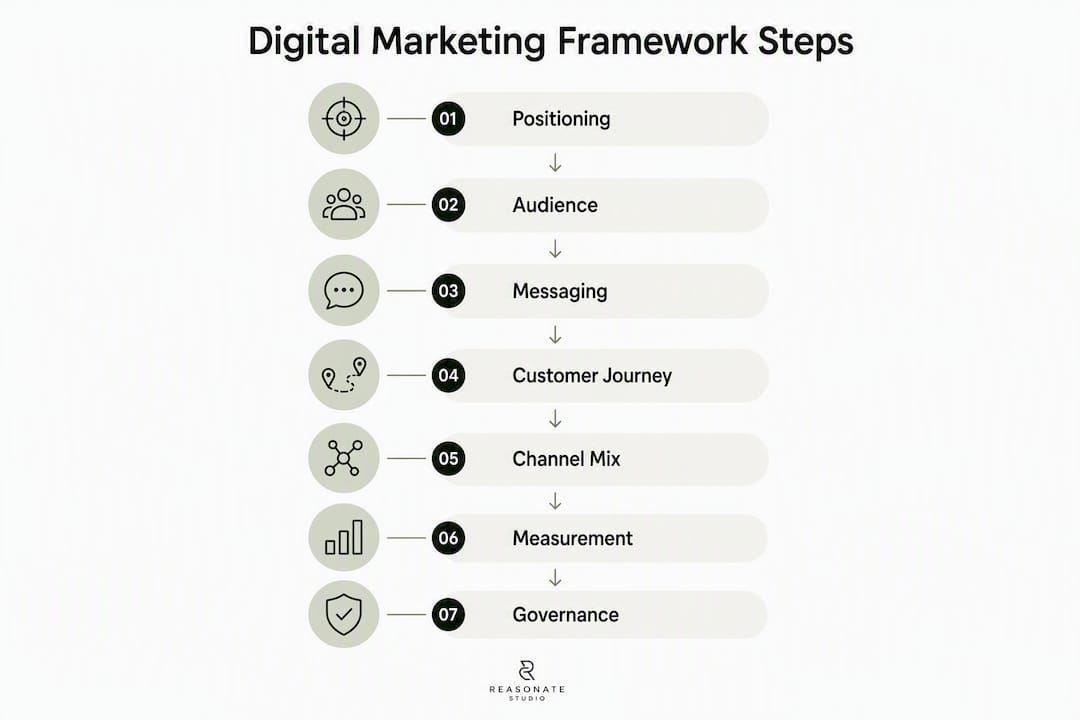
Seven components are non-negotiable: positioning, audience definition, messaging, customer journey, channel mix, measurement, and governance. Miss any one and the others underperform.

| Component | Who owns it | Primary output |
|---|---|---|
| Positioning | Senior strategist / Fractional CMO | Positioning statement, competitive distinction |
| Audience | Strategy lead + CRM | Segmented profiles, ICP definition |
| Messaging | Strategist + copywriter | Messaging pillars, brand voice guide |
| Customer journey | Strategy + sales | Journey map, touchpoint inventory |
| Channel mix | Fractional CMO + channel specialists | Channel plan, budget allocation |
| Measurement | Analytics lead | KPI dashboard, reporting cadence |
| Governance | Fractional CMO / founder | Operating rhythm, approval workflow |
A messaging-pillars template gives your team a decision filter for every piece of content. Draft three to five pillars in this format: “We help [audience] achieve [outcome] by [differentiator], which means we always communicate [proof point].” That single template eliminates most off-brand content before it gets created.
Pro Tip: Before selecting channels, write your positioning statement first. Channel decisions made without a clear position produce content that sounds like everyone else in your category.
The RACE framework (Reach, Act, Convert, Engage) from Smart Insights organizes activity across the full customer lifecycle and pairs well with month-to-month KPI improvement cycles. SOSTAC (Situation, Objectives, Strategy, Tactics, Action, Control) is a full planning discipline useful when you need to document strategy for a leadership team or board. The Inbound methodology from HubSpot centers on attracting, engaging, and delighting customers through content and owned channels. The flywheel model replaces the linear funnel with a momentum-based loop where customer success feeds acquisition.
Each has a place. The right choice depends on your measurement maturity and whether you need planning discipline or lifecycle management.
| Framework | Best for | Strategic vs. tactical | Time to impact | Resources needed | Measurement clarity |
|---|---|---|---|---|---|
| SOSTAC | Full planning cycle, board-ready strategy | Strongly strategic | 3 months | Senior strategist | High |
| RACE | Lifecycle KPIs, continuous improvement | Balanced | 1–3 months | Marketing manager + analyst | High |
| Inbound | Content-led, long-cycle B2B or professional services | Tactical-heavy | 6 to 12 months | Content team + CRM | Medium |
| Flywheel | Customer-retention-led growth, high repeat purchase | Customer-centric | 6 to 12 months | CS + marketing alignment | Medium |
| Aligned Impact Model™ | Established businesses needing brand-to-demand integration | Senior-led, strategic | 90 days to first results | Fractional CMO + specialists | High |
Use SOSTAC when you need a full planning discipline. Use RACE for campaign-to-continuous measurement. Use the Aligned Impact Model™ when you need senior-led integration across brand strategy and demand generation, built specifically for businesses that have outgrown patchwork marketing.
The practical approach moves through four phases: diagnose, decide, activate, optimize. Most established businesses can complete the first phase in 90 days and reach a functioning system within six to twelve months.
Days 1–30: Diagnostic
Days 31–60: Decision and design
Days 61–90: Initial activation
Months 4–12: Scale and optimize
Pro Tip: A Fractional CMO is most valuable in the diagnostic and design phases. Bring one in before you activate channels, not after a campaign has already underperformed.
The minimal KPI set that ties directly to revenue and customer acquisition cost covers five funnel stages: awareness, consideration, conversion, retention, and efficiency.
A sample dashboard for an established business includes:
The RACE framework’s OSA process (Opportunity, Strategy, Action) gives a practical structure for monthly reviews: compare actuals to targets, identify the one metric furthest from goal, and assign a specific action to close the gap before the next review.
A healthy CAC-to-LTV ratio for professional services and premium consumer businesses typically sits above 3:1. If yours is below that, the framework is either targeting the wrong audience or converting at the wrong funnel stage.
Predictable execution comes from a clear operating rhythm, defined ownership, and a senior decision-maker who holds the strategy accountable week to week. Without that, even a well-designed framework drifts into random activity within a quarter.
Operating cadence:
A Fractional CMO typically replaces a combination of a marketing coordinator and a strategy consultant, at a fraction of the cost of a full-time VP of Marketing. In the first 90 days, the Fractional CMO runs the diagnostic, sets the framework, hires or briefs channel specialists, and builds the reporting infrastructure. Ongoing, they own the operating rhythm and hold vendors accountable to strategy.
Pro Tip: Budget guardrails matter. Set a rule that no more than 50% of your marketing budget goes to demand capture channels (paid search, paid social) until your owned assets generate at least 20% of your leads organically.
The single most common failure mode is treating a marketing plan as a strategy. A plan lists what to do. A strategy declares where to play and how to win, and explicitly names what you will sacrifice to stay focused.
Red flags to watch for in the first 90 days:
Each of these signals the same underlying problem: execution is running ahead of strategy. The fix is always the same. Stop, run the diagnostic, and write the positioning statement before touching another campaign.
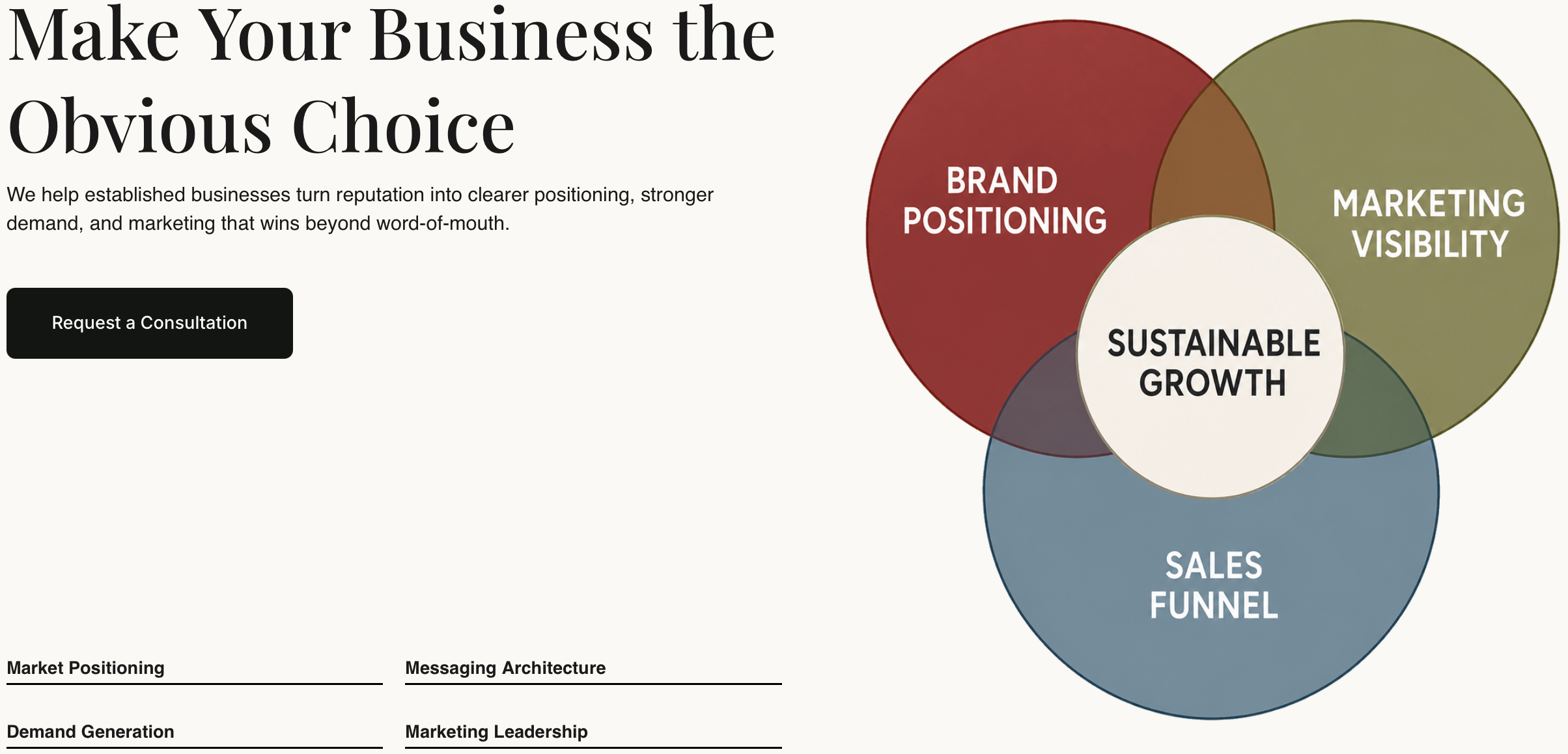
The Aligned Impact Model™ is Reasonate Studio’s strategy-to-execution framework built specifically for established, independently owned businesses that have outgrown referral-driven growth. It moves through four stages: Diagnose the Gap, Define the Position, Build the Message, and Activate the Strategy.
The Aligned Impact Model™ starts where most frameworks skip: it assesses what the business has already earned in reputation, then identifies exactly where that reputation is failing to translate into clear positioning, consistent messaging, and repeatable demand.
The process is direct. The diagnostic surfaces the gap between how the business sees itself and how the market experiences it. Positioning work defines the specific audience, the competitive distinction, and the deliberate trade-offs. Messaging translates that position into website language, sales communication, and content themes. Activation builds the marketing rhythm: content, email, SEO, campaigns, and reporting, all governed by a senior strategist.
Client outcomes from this model include a $46.3 million partnership secured within one month of a brand repositioning, 98% client retention after a branded service pathway was developed, and 1,000% website-visitor growth through ongoing Fractional CMO leadership. A 454% increase in sales and a 283% increase in order volume within 30 days are among the documented results. These are not typical outcomes, but they reflect what becomes possible when strategy and execution are connected rather than siloed.
Senior leadership on strategy is the multiplier. Tactics without strategic direction produce activity. Strategy without execution produces plans that sit in folders. The combination, senior-led direction connected to governed execution, is what produces compounding results for established businesses.
Most independently owned businesses at the $2M–$10M revenue level do not need more marketing. They need someone who can look at everything they have built, identify what is worth amplifying, and build a system that does not require the founder to be the default decision-maker for every campaign.
Three questions worth asking before you invest in senior-led marketing:
If the answer to any of these is no or unclear, a marketing strategy framework built around senior leadership is not a luxury. It is the prerequisite for everything else.
Reasonate Studio works with established, independently owned businesses that are ready to grow beyond referrals and build a marketing system that reflects the quality of what they have already built.
The engagement starts with a diagnostic: a structured assessment of your positioning, messaging, channel mix, and current marketing performance. From there, Reasonate Studio delivers the Aligned Impact Model™ implementation, Fractional CMO leadership, and the operating rhythm to keep execution aligned with strategy. You get senior-level direction without the cost of a full-time marketing executive, and a system that reduces founder involvement in day-to-day marketing decisions.
If you are ready to connect your reputation to repeatable demand, explore Reasonate Studio’s services or start with a positioning and offer strategy conversation to identify where your framework should begin.