September 22, 2026
Why Update Brand Messaging: Essential Guide for Growth


Learn how scalable messaging frameworks help Texas founders, coaches, and consultants drive brand clarity, consistent marketing, and measurable business growth.

Your elevator pitch is not a messaging framework. Neither is the brand document you wrote two years ago and haven’t touched since. Many founders, coaches, and consultants in Texas build their marketing on static messaging that made sense at launch but quietly stops working as their audience evolves and their offers grow. The result is scattered content, inconsistent positioning, and a brand that feels vague even to people who are ready to buy. This guide breaks down how living, scalable messaging frameworks actually work, what separates the ones that drive growth from the ones that collect digital dust, and how to build one that works for your business right now.
| Point | Details |
|---|---|
| Frameworks drive clarity | Messaging frameworks help founders, coaches, and consultants communicate clear and consistent value for business growth. |
| Living systems outperform static docs | Continuously tested and updated frameworks lead to stronger results than set-and-forget messaging. |
| Choose executable structures | Dynamic hub-spoke models enable practical, real-time use and scalability, avoiding the pitfalls of rigid hierarchies. |
| Measure and iterate messaging | Track results using hard data like ROI and engagement, and refine your framework frequently for ongoing improvement. |
| Expert help accelerates impact | Partnering with specialists can elevate and operationalize your messaging strategy for faster business growth. |
A messaging framework is not just a branding exercise. It is the connective tissue between your brand identity, your marketing, and your sales conversations. When that tissue is strong, every touchpoint reinforces the same story. When it is weak or outdated, you end up with a website that says one thing, social posts that say another, and sales calls where you are improvising from scratch.
The problem most founders run into is treating messaging like a one-time deliverable. You write the copy, finalize the tagline, and move on. But your audience changes. Your offers evolve. New competitors enter your market. A static document cannot keep up with any of that.
What actually works is a scaling with clarity framework that treats messaging as a living system rather than a finished product. Here is what that kind of framework solves:
“Great messaging starts with identifying urgent problems, building an ideal customer profile, conducting real customer research, developing core pillars, and committing to iteration and consistency.”
That process, as outlined in effective messaging systems research, is what separates brands that grow from brands that plateau. Understanding why brand messaging matters at a foundational level is the first step toward building something that actually scales.
Pro Tip: If your messaging document lives in a folder no one opens, it is not a framework. It is a file. A real framework gets referenced weekly, updated regularly, and used in actual conversations.
So what does a real messaging framework actually include? The answer depends on your business model, but the core structure is consistent across industries. Here is a practical step-by-step breakdown:
The messaging for product growth approach and the way you align content and messaging both depend on this foundation being solid before you build anything else.
Here is a quick comparison of two common framework structures:
| Framework type | Best for | Weakness |
|---|---|---|
| Hierarchical | Long-term brand strategy | Rigid, hard to update in real time |
| Hub-spoke | Active campaigns and sales | Requires ongoing maintenance |
Pro Tip: Use AI tools to generate first drafts of messaging variations, but always validate them against real customer language. AI can speed up the process, but it cannot replace what you learn from an actual sales conversation.
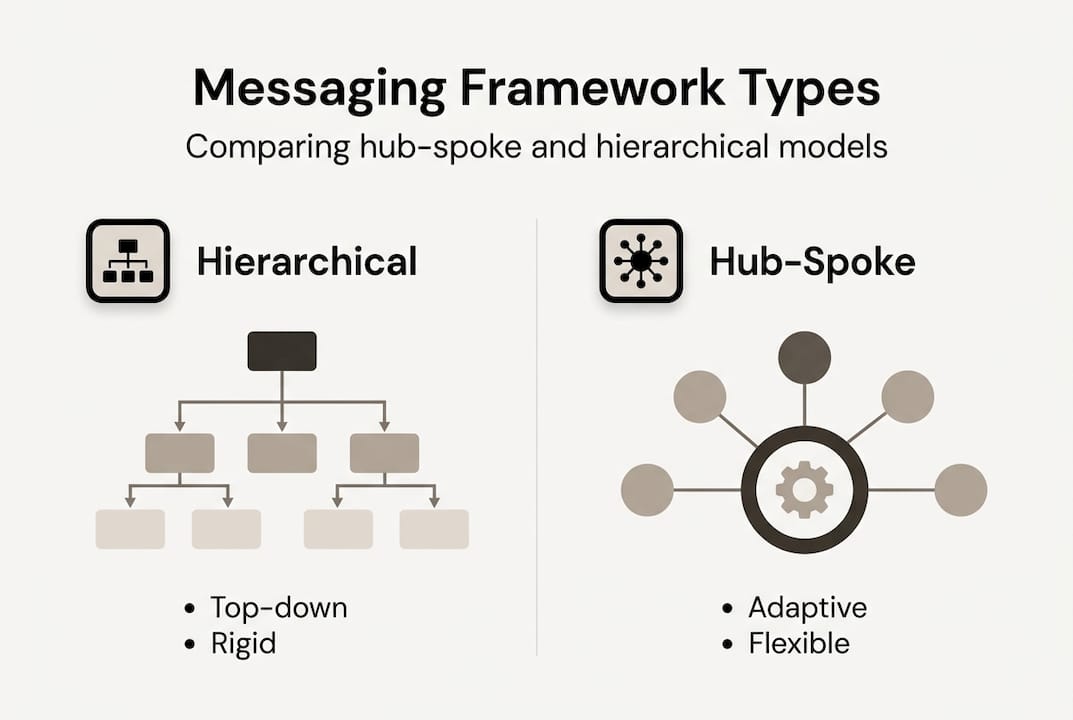
Most traditional messaging frameworks are built like org charts. There is a top-level brand promise, a few supporting pillars underneath, and sub-messages branching below those. It looks clean on paper. In practice, it often becomes a rigid document that no one can update quickly enough to keep pace with real business needs.

The hub-spoke model works differently. Your core brand message is the hub. Every campaign, channel, and content format is a spoke that connects back to it. When you need to update a spoke, you do it without rebuilding the entire structure. This makes the framework scalable and executable in ways that hierarchical models simply are not.
Here is where each model tends to succeed or struggle:
| Situation | Hierarchical | Hub-spoke |
|---|---|---|
| Launching a new offer quickly | Slow, requires full review | Fast, update one spoke |
| Running A/B tests on ad copy | Difficult to track | Built for iteration |
| Onboarding a new team member | Clear but inflexible | Adaptable and practical |
| Long-term brand positioning | Strong | Requires anchor discipline |
The data behind this is worth paying attention to. Only 25% of product marketers test their messaging regularly, and 40% have no formal testing process at all. That means most brands are running on assumptions, not evidence.
Scenarios where hierarchical frameworks break down include fast-moving sales cycles, frequent offer updates, and multi-platform campaigns that need real-time adjustments. Hub-spoke models handle all of these better because they are built for growth messaging examples and practical execution rather than theoretical structure. If you want to get serious about aligning messaging with sales, the hub-spoke approach gives you the flexibility to do it without starting over every quarter.
If you are wondering whether investing in a real messaging framework actually moves the needle, the numbers are clear. A Forrester study on Twilio Messaging found a 132% ROI, a 3% improvement in message delivery rates, $1.4 million in margin gains, and a 15% increase in team productivity. Businesses that committed to continuous testing consistently outperformed those that did not.
“Organizations that test messaging continuously and adopt structured frameworks see compounding gains in engagement, conversion, and operational efficiency.”
The digital engagement benchmarks research supports this too. Continuous testing and structured digital tool adoption drive measurable increases in audience engagement over time. This is not a coincidence. It is the result of treating messaging as a system rather than a static asset.
Here is a snapshot of what measurable framework impact can look like:
| KPI | Without framework | With active framework |
|---|---|---|
| Message delivery rate | Baseline | Up to 3% improvement |
| Team productivity | Baseline | Up to 15% increase |
| ROI on messaging investment | Variable | Up to 132% documented |
| Customer engagement | Inconsistent | Measurably stronger |
To get there, follow these steps:
The goal is not perfection on day one. It is a system for optimizing marketing ROI that improves with every iteration.
You do not need a massive team or a big budget to build a framework that works. You need a clear process and the discipline to follow it. Here is how to start:
The framework process that actually works prioritizes customer language, consistent testing, and executable scripts over polished brand decks that never get used.
Here are the most common mistakes to avoid:
Pro Tip: After every sales call or client conversation, spend five minutes asking yourself: did my messaging land? What question did they ask that I was not prepared for? That reflection is how your framework gets sharper over time.
For solo founders and small teams in Texas, the key is keeping it lightweight. You can find sustainable marketing growth ideas and practical guidance on planning effective campaigns that work within your actual capacity, not some idealized version of it.
Here is what most framework guides will not tell you: the reason most messaging frameworks fail is not because they were built wrong. It is because they were built once and never touched again. They become shelfware. Over-designed, under-tested, and completely disconnected from the real conversations happening with real customers.
The actual leverage in a messaging framework is not the document itself. It is the habit of returning to it. The brands that grow are the ones where the founder, the marketer, and the sales team are all looking at the same living document and updating it based on what they are hearing in the field. Not annually. Weekly.
For solo founders, this means building something lightweight enough that you will actually use it. A one-page doc you reference every Monday beats a 40-slide brand bible you open twice a year.
Pro Tip: If you have not rewritten at least one message based on a live customer conversation in the last 30 days, your framework is already out of date.
Message-market fit is not a milestone you reach. It is a living process. The real-world framework clarity that drives growth comes from treating your messaging the same way you treat your offers: as something that evolves with your audience.
If reading this made you realize your current messaging is more static document than living system, you are not alone. Most founders we work with at Reasonate Studio come to us with a brand that has real potential but messaging that is holding it back.
We specialize in helping founders, coaches, and consultants in Texas build messaging frameworks that are clear, strategic, and actually usable in the real world. Whether you need a full brand clarity intensive or a focused strategy session to sharpen your positioning, our Marketing Jump Start is designed to get you moving fast. You bring the expertise. We help you build the system that gets it seen, understood, and chosen.
A messaging framework is a structured system that organizes your brand’s core messages to ensure clarity and consistency across every channel. Without one, your audience receives mixed signals about who you are and why they should choose you, which directly undermines brand identity, marketing, and sales alignment.
You should revisit your framework any time customer feedback shifts, your market changes, or your offers evolve. Continuous testing and living frameworks consistently outperform static documents, so monthly reviews are a strong baseline.
Organizations that implement and actively test messaging frameworks report stronger ROI, better delivery rates, and improved team productivity. The Twilio Messaging TEI study documented a 132% ROI and a 15% productivity gain as direct outcomes.
A hub-spoke framework is flexible and built for real-time execution, making it easier to update individual campaigns without overhauling your entire strategy. A hierarchical framework is more rigid and often fails in fast-moving sales or marketing environments where speed and adaptability matter.