September 22, 2026
Why Update Brand Messaging: Essential Guide for Growth


Discover why positioning is critical for business owners and founders. Learn how strategic positioning shapes success in your market.
TL;DR:
- Positioning is a strategic act that defines your brand’s unique market space, influencing messaging, pricing, and customer attraction. Clear, niche-focused positioning enhances customer relevance, allows premium pricing, and guides targeted product development. Maintaining consistent, authentic positioning builds trust, recognition, and sustainable growth over time.
Positioning is the strategic act of defining your brand’s unique place in the market so customers immediately understand why they should choose you over every available alternative. This is not a branding exercise or a tagline decision. It is the upstream strategic choice that shapes your pricing, your messaging, your product roadmap, and the customers you attract or repel. For business owners and founders, understanding why positioning is critical means understanding why some brands command premium prices while others compete on discounts, why some companies grow loyal audiences while others chase clicks, and why the same product can succeed or fail based entirely on how it is framed in the market.
Positioning shapes customer perception and drives key decisions across marketing, sales, and product development. That single fact has enormous downstream consequences. When your positioning is clear, every piece of content, every sales conversation, and every pricing decision reinforces the same message. When it is unclear, your team fills the gap with guesswork, and customers fill the gap with confusion.

The formal industry term for this discipline is market positioning, a concept introduced by Al Ries and Jack Trout in their landmark 1981 book Positioning: The Battle for Your Mind. Their core argument still holds: positioning is not what you do to a product. It is what you do to the mind of the prospect. The goal is to occupy a specific, credible, and memorable category in your buyer’s thinking before a competitor does.
Three core components define strong market positioning:
Unclear positioning causes fragmented messaging and downstream business problems like low conversion rates and price sensitivity. This means that if you cannot answer those three questions in one clear sentence, your marketing spend is working against a structural problem, not a creative one.
Pro Tip: Write your positioning statement before you write a single word of copy. The format is simple: “For [target customer] who [key need], [your brand] is the [category] that [differentiated benefit] because [reason to believe].” If you cannot complete that sentence without hedging, your positioning needs work before your messaging does.
Positioning reduces cognitive load for buyers making choices by creating clear, compelling mental categories. Buyers are not analysts. They make fast decisions based on the clearest available signal. If your brand sends a muddled signal, they default to the competitor who sends a clearer one, even if your product is objectively better.
Competitive markets punish ambiguity. When buyers have many options, they need a fast, reliable way to sort them. Without clear positioning, buyers compare alternatives based on what is easy to see, which means price and surface-level features. That is a race to the bottom that no founder wants to run.
The contrast between niche positioning and generic positioning is stark and measurable. Consider two health coaches. The first markets herself as “a certified health coach helping people feel their best.” The second positions herself as “a metabolic health coach for women over 40 managing perimenopause symptoms through nutrition.” The second coach attracts a specific, motivated buyer who feels immediately understood. The first attracts everyone and converts no one at a premium price.
| Positioning type | Customer response | Pricing power | Conversion rate |
|---|---|---|---|
| Generic (“we help everyone”) | Low resonance, high price sensitivity | Weak, races to discount | Low |
| Niche (“we solve X for Y”) | High resonance, strong relevance | Strong, commands premium | High |
| Purpose-led with clear differentiation | Deep trust, emotional loyalty | Premium, with retention | Highest |
Trying to appeal to everyone results in generic positioning that resonates with no one. This is the most common and costly mistake founders make. The fear of narrowing down feels like leaving money on the table. The reality is the opposite. Specificity attracts. Generality repels.
Strong positioning also guides product development. When you know exactly who you serve and why they choose you, every feature decision, every pricing tier, and every content topic has a clear filter. You stop building for hypothetical customers and start building for the real ones who already pay you. This is how positioning strategies for growth translate into actual product and revenue decisions, not just marketing language.
Brand purpose has become a major factor in how buyers evaluate companies, but it is frequently misunderstood as a positioning strategy on its own. Purpose is not positioning. It is a component of positioning when it is authentic, specific, and consistently communicated.
More than half of US consumers find brands that actively communicate their purpose more attractive, and nearly 60% are influenced by leadership values and actions. For founders and coaches who build personal brands, this is significant. Your values and your visible behavior are part of your positioning whether you intend them to be or not.
The critical nuance is that purpose must be internally owned before it is externally marketed. Purpose signals resonate only if perceived as authentic and owned internally, not just promoted in campaigns. A founder who claims to prioritize client transformation but runs a high-volume, low-touch service model creates cognitive dissonance. Buyers notice. That dissonance erodes trust faster than no stated purpose at all.
There is also a sobering data point about awareness. Even leading purpose brands average about 18% consumer awareness of their stated purpose in the US. That means purpose must be reinforced continuously and consistently, not announced once on an About page and forgotten. The implication for business owners is direct: stating your purpose is not enough. You need to build it into your content, your client experience, your pricing philosophy, and your public communication on a repeating basis.
Four practices that make purpose work as part of your positioning:
Purpose-led positioning alone rarely drives growth unless supported by increased brand availability and evidence-based marketing. Purpose without visibility is invisible. Purpose without proof is just a claim.
Developing strong market positioning is a process, not a one-time declaration. The businesses that get it right treat positioning as a living document they test, refine, and protect over time. Here is a practical framework for building it.
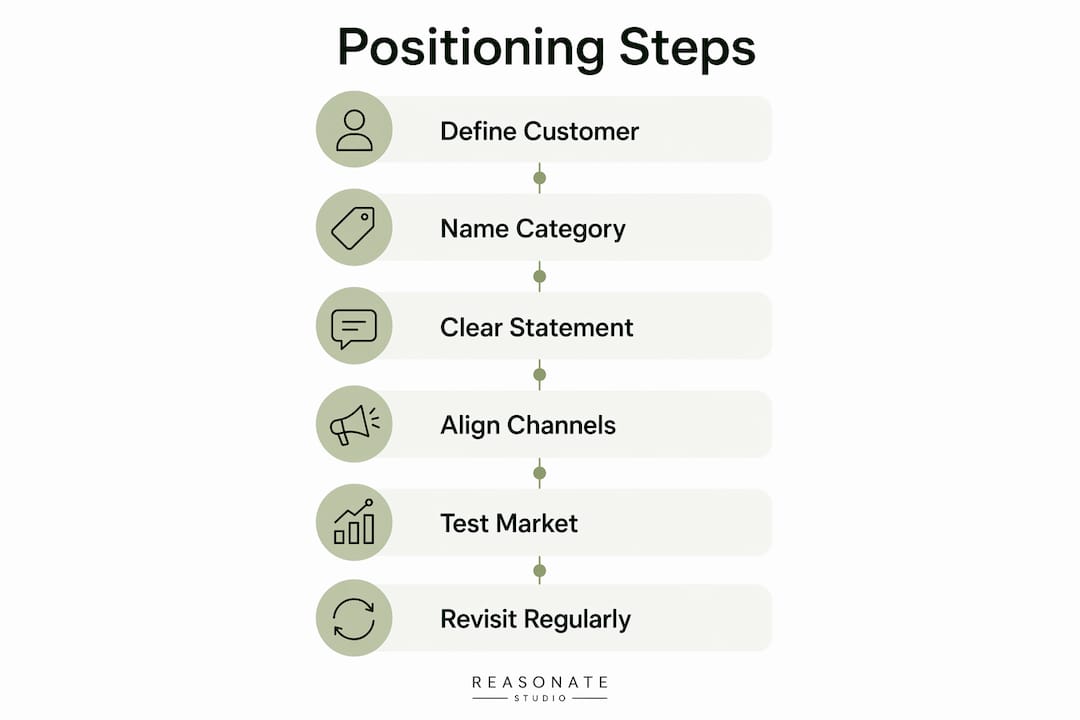
1. Define your target customer with precision. Go beyond demographics. Identify the specific situation your buyer is in when they need you most. What has just happened in their business or life? What have they already tried? What outcome do they need in the next 90 days? The more specific your customer definition, the more magnetic your positioning becomes.
2. Name your competitive category honestly. Your category is not your industry. It is the set of alternatives your buyer considers when they are deciding whether to hire you. A business coach competes with online courses, peer masterminds, and doing nothing, not just other coaches. Naming your real category helps you position against the actual decision your buyer is making.
3. Write a single, clear positioning statement. One sentence. No qualifiers. No “and also.” The statement should answer who you serve, what category you compete in, and why you win. If it takes three sentences to explain your positioning, it is not positioned yet.
4. Align every marketing channel with that statement. Your website headline, your social media bio, your email subject lines, your sales conversations, and your pricing structure should all reinforce the same core message. Competitive messaging that elevates brand positioning requires consistency across every touchpoint, not just your homepage.
5. Test with market data, not internal opinions. Testing positioning with market data and conversion metrics instead of internal opinions produces measurable improvements in conversion, sales, and competitive win rates. Track which messages generate the most qualified inquiries. Monitor which content attracts the buyers who convert fastest. Let real buyer behavior tell you what is working.
6. Revisit positioning every six to twelve months. Markets shift. Competitors copy your language. New buyer needs emerge. Positioning that was sharp two years ago can become generic as the market catches up. Schedule a positioning review the same way you schedule a financial review. It is that important to your growth.
Pro Tip: Run a simple positioning test by asking five recent clients to describe what you do and why they hired you in their own words. If their answers vary widely, your positioning is not landing consistently. Their language, not yours, is often the clearest signal of where your message needs tightening.
Positioning is earned through consistently communicating a “why choose us” logic tied to buyer-relevant outcomes, not just product features. That is the difference between a positioning statement that lives in a strategy document and one that actually drives revenue. The seven types of brand positioning available to founders range from value-based to quality-based to niche-based, and choosing the right one depends entirely on your specific competitive context and customer.
Brand associations drive customer spending and loyalty in ways that go beyond product features. This 2026 Harvard Business Review finding confirms what experienced marketers have long argued: positioning creates the mental associations that make customers return, refer, and pay more. It is not a soft benefit. It is a measurable driver of retention and revenue.
Most founders I work with come to Reasonate Studio thinking they have a content problem or a social media problem. They post consistently, they have a decent website, and they show up regularly. But the results are flat. Inquiries are inconsistent. Sales feel like a grind. After digging in, the real issue is almost always the same: their positioning is either too broad, too generic, or completely absent.
The uncomfortable truth is that most teams treat positioning as a branding or messaging exercise, which leads to weak outcomes. I see this constantly. A founder spends weeks perfecting their Instagram aesthetic or rewriting their bio, when the actual problem is that no one can tell from their content who they specifically serve or why that person should choose them over anyone else. Tweaking the surface does not fix a structural gap.
What I have found actually works is treating positioning as the first decision, not the last. Before we write a single caption or design a single graphic, we nail down who the client is for, what specific problem they solve, and what makes their approach genuinely different. Everything else flows from that. When positioning is clear, content becomes easier to write, sales conversations become shorter, and the right clients start showing up without as much effort.
The other thing I want founders to hear is this: specificity is not a risk. It feels like one. Narrowing your positioning feels like you are closing doors. But in practice, the more specific you are about who you serve and how you help them, the more that exact person feels seen and chooses you with conviction. Generality is the actual risk. It is what keeps good businesses invisible in crowded markets.
Positioning also requires consistency over time. You cannot state your positioning once and expect it to stick. Purpose positioning requires repeated, category-consistent messaging and distinct branding cues to build consumer memory and meaning. The same is true for any positioning claim. Say it clearly, say it often, and say it the same way across every channel.
— Kaitlyn
If you have read this far and recognized that your positioning needs work, the next step is not more content. It is clarity. At Reasonate Studio, we help founders, coaches, and consultants define their positioning with precision, then build the marketing systems that communicate it consistently across every channel.
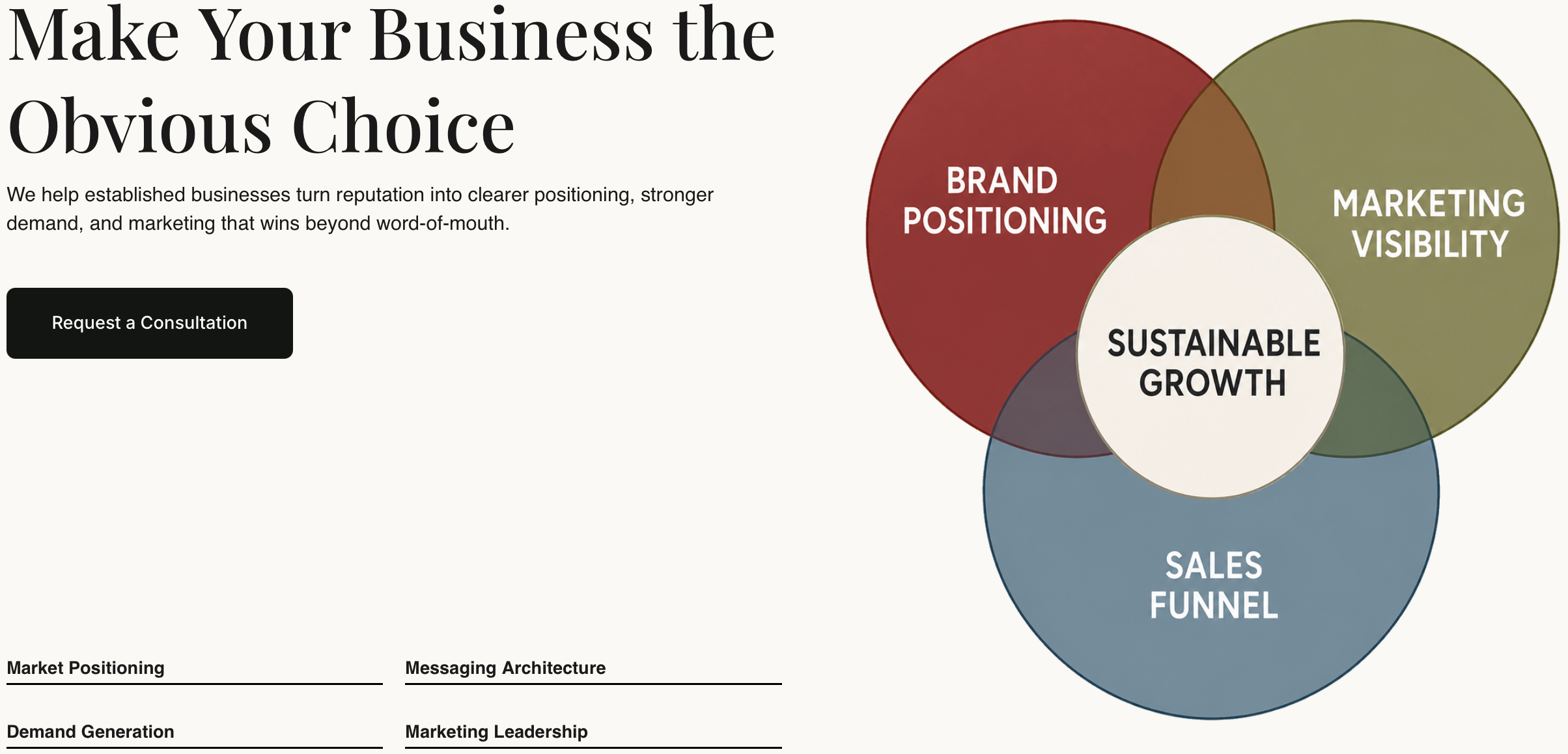
Our sales page optimization service is specifically designed to translate your strategic positioning into a high-converting page that makes the right buyers say yes faster. A strong positioning strategy only generates revenue when it is communicated clearly at the moment a buyer is deciding. We make sure that moment works in your favor. Whether you are starting from scratch or refining what you already have, Reasonate Studio builds the clarity and execution that turns positioning into consistent, sustainable growth.
Positioning defines who your business serves, what category you compete in, and why buyers should choose you over alternatives. For small business owners, it is the strategic foundation that makes every marketing decision more focused and effective.
Clear positioning attracts the right buyers and reduces friction in the sales process. Testing positioning with real market data and conversion metrics produces measurable improvements in sales and competitive win rates.
Branding covers visual identity, tone, and personality. Positioning is the strategic decision about where and how you compete in the market. Positioning comes first and informs branding, not the other way around.
Positioning should be reviewed every six to twelve months, or whenever the competitive market shifts significantly. Markets evolve, competitors copy your language, and buyer needs change, so positioning that was sharp two years ago can become generic without regular updates.
Niche positioning speaks directly to a specific buyer’s situation, making them feel immediately understood. Generic positioning tries to appeal to everyone and ends up resonating with no one, which leads to price sensitivity and lower conversion rates.