September 22, 2026
Why Update Brand Messaging: Essential Guide for Growth


Discover what is business clarity and how it can elevate your entrepreneurial journey. Learn the key principles to drive success!

TL;DR:
- Business clarity is the ability to explain what your business does, who it serves, and the transformation it offers in under 20 seconds. It forms the foundation for strategic decisions, marketing, and operations, preventing confusion and misaligned efforts that hinder growth. Achieving and maintaining clarity involves deliberate reflection, regular resets, and ensuring alignment between purpose, messaging, and daily execution.
Business clarity is defined as the ability to articulate in under 20 seconds what problem your business solves, who it serves, and the transformation it offers. For entrepreneurs and small business owners, this precision is not a branding exercise. It is the foundation every strategic decision, hiring choice, and marketing message must rest on. Without it, growth fades quietly through confusion and misaligned effort rather than collapsing in a single visible moment. The good news is that clarity is buildable. It follows a structure, and this guide walks you through exactly what that structure looks like.
Business clarity is the precise articulation of what your business does, who it serves, and the specific transformation it delivers. In practice, it functions as the operating system underneath every decision you make, from which clients to take on to how you write a social media caption. The standard industry term for this concept is strategic clarity, though “business clarity” captures the full scope more usefully for founders because it spans operations, brand, and vision simultaneously.
The 20-second articulation rule is the clearest diagnostic tool available. If you cannot explain your business purpose in under 20 seconds, you lack true operational clarity, even if you feel confident about your direction. That gap between what you understand internally and what you can communicate externally is where most small business growth problems originate.
Clarity also functions as a filter. When you know exactly what your business is for and who it serves, you can evaluate every opportunity, partnership, or pivot against a fixed reference point. Without that reference point, every new idea looks equally valid, and you end up chasing directions that scatter your energy rather than concentrate it.
Confusion is the most expensive bottleneck in any business. Clarity creates power by concentrating effort toward a specific, defined goal. That is not a motivational statement. It is a measurable operational reality.
Clarity does not arrive as a single breakthrough moment. It shows up layered as aligned decisions accumulate over time. Recognizing what clarity looks like in daily operations helps you know whether you have it or whether you are operating on assumption.
Here are the most reliable indicators that a founder has genuine business clarity:
Pro Tip: Ask yourself this question right now: “What does my business do, for whom, and what changes for them after working with me?” If your answer takes longer than 20 seconds or shifts depending on the day, that is your starting point.
The energy shift that comes with clarity is real and practical. Founders who have worked through a structured clarity process consistently report that decision fatigue drops significantly. When the filter is clear, fewer decisions feel genuinely difficult. The mental load of running a business decreases not because the work gets easier, but because the direction stops being a question.

Clarity also changes how you show up in conversations with potential clients. Instead of over-explaining or hedging, you speak with confidence about what you offer and who it is right for. That confidence is not manufactured. It comes directly from knowing your purpose well enough to defend it.
Clarity is not a soft skill. It is a leadership discipline essential to scaling and reducing management overhead. The benefits are measurable across operations, team performance, and revenue consistency.
“Growth rarely collapses overnight. It fades through confusion and lack of alignment.” — Cameron Herold
The table below summarizes the core benefits of business clarity and the corresponding outcomes entrepreneurs can expect when it is implemented deliberately.
| Benefit of clarity | Business outcome |
|---|---|
| Fewer repeated explanations to team members | Reduced meeting time and faster execution |
| Defined decision-making criteria | Faster approvals and less founder bottlenecking |
| Aligned hiring and onboarding | Lower employee turnover and reduced recruitment costs |
| Consistent messaging across channels | Stronger brand recognition and higher conversion rates |
| Clear offer positioning | Easier sales conversations and better client fit |
| Reduced strategic drift | More consistent revenue and fewer costly pivots |

Effectively implemented clarity reduces employee turnover and administrative costs by minimizing excessive meetings and approvals. Reduced turnover alone can save tens of thousands of dollars annually in recruitment and onboarding expenses. That number makes clarity one of the highest-return investments a small business owner can make.
Beyond cost savings, clarity directly affects revenue consistency. When your messaging is aligned with your actual offer and your actual audience, marketing stops feeling like guesswork. Every piece of content, every sales conversation, and every campaign has a clear job to do. The result is a business that grows more predictably because every action points in the same direction.
Strategic drift is one of the quietest killers of small business momentum. It happens when a founder keeps adjusting the offer, the audience, or the positioning in response to short-term feedback without a stable foundation to return to. Clarity prevents drift by giving you a reference point that holds even when external pressure pushes you to change course.
Achieving clarity requires deliberate structure and protected time for reflection. It does not come from doing more tasks or consuming more content. The practical methods below are drawn from frameworks used by working founders and business coaches.
Step 1: Schedule a dedicated clarity session. A 60 to 90 minute reset session is the recommended starting point. Use this time to answer three core questions in writing: What problem does my business solve? Who specifically experiences that problem? What does their life or business look like after working with me?
Step 2: Audit your current messaging against your answers. Pull up your website homepage, your social media bio, and your most recent sales conversation. Do they reflect the answers you wrote down? Gaps between what you believe and what you communicate are where confusion enters.
Step 3: Define your operational clarity layer. Operational clarity means knowing what needs to happen, how it happens, and who is responsible. Document your core workflows, your decision-making criteria, and your client delivery process. This layer allows you to delegate without losing quality.
Step 4: Align your business clarity with your personal goals. Misalignment between business goals and lifestyle aspirations causes burnout and strategy friction. Building a business that does not match your desired lifestyle results in motivation driven by fear rather than vision. Before finalizing your clarity framework, confirm that the business you are building actually supports the life you want.
Step 5: Set a 90-day reset rhythm. Clarity is not a one-time exercise. A 90-day strategic reset prevents misalignment from accumulating quietly. Each reset asks whether your current actions still reflect your defined purpose, audience, and transformation.
Step 6: Watch for the illusion of clarity. Leaders often mistake their own understanding for organizational alignment. If your team cannot articulate your business purpose as clearly as you can, you have an illusion of clarity, not the real thing. True clarity demands repeated reinforcement and visible shared understanding.
Pro Tip: After your clarity session, test your articulation with someone outside your industry. If they understand what you do and who it is for within 20 seconds, your clarity is working. If they look confused, keep refining.
The most common mistake founders make is treating clarity as a one-time deliverable. You write a mission statement, feel good about it, and move on. But clarity is a practice. The role of clarity in marketing and operations requires ongoing attention as your business evolves, your audience shifts, and your offers develop.
Business clarity is the parent concept. It encompasses and informs several related but distinct clarity types that entrepreneurs encounter as they build their strategy. Understanding the differences prevents you from treating one layer as a substitute for the others.
| Clarity type | Primary focus | Key question it answers | How it connects to business clarity |
|---|---|---|---|
| Business clarity | Purpose, audience, and transformation | What do we do, for whom, and why? | The foundation all other clarity types build on |
| Brand clarity | Perception, voice, and positioning | How do we want to be seen and remembered? | Expresses business clarity outward to the market |
| Operational clarity | Workflows, roles, and responsibilities | Who does what, how, and by when? | Translates business clarity into daily execution |
| Strategic clarity | Vision, goals, and long-term direction | Where are we going and how do we get there? | Aligns business clarity with future growth targets |
Brand clarity, which covers clarity in branding and customer perception, cannot be built without business clarity underneath it. If you do not know who you serve and what transformation you provide, no amount of visual identity work or copywriting will produce a brand that resonates consistently.
Operational clarity is the execution layer. It answers the question of who does what and how, which is what allows a founder to step back from day-to-day management without the business losing direction. Businesses that lack operational clarity feel owned by their operations instead of controlled by their owners. That feeling is not a personality trait. It is a structural problem with a structural solution.
Strategic clarity sits at the top. It connects your current business purpose to your long-term vision and ensures that the goals you set actually move you toward the business and life you want to build. All four types work together, but business clarity is the starting point. Get that right first, and the others become significantly easier to develop.
The pattern I see most often is this: a founder comes to us with a marketing problem, but the real issue is a clarity problem. The content is inconsistent because the message is inconsistent. The message is inconsistent because the purpose has never been fully defined. We can write the most compelling social media captions in the world, but if the founder cannot tell me in one sentence who they serve and what changes for that person, the content will never land the way it should.
What surprises most founders is how uncomfortable the clarity process feels at first. Defining your audience precisely means excluding people. Committing to a specific transformation means saying no to work that falls outside it. That feels like shrinking, but it is actually the opposite. Specificity is what makes a brand magnetic. Vague positioning attracts vague interest. Clear positioning attracts the right clients, and those clients stay longer, refer more often, and push back less on pricing.
I have also seen what happens when business clarity and personal clarity are not aligned. A founder builds a business that is technically successful but personally exhausting because it was designed around what they thought they should want rather than what they actually want. The business grows, but the founder feels trapped by it. That is not a marketing problem. It is a clarity problem that started before the first strategy session.
The habit I recommend to every founder I work with is the 90-day reset. Not a full rebrand. Not a new offer. Just 90 minutes every quarter to ask whether what you are doing still reflects what you set out to build. Most of the time, small adjustments are all that is needed. But without that protected time, drift accumulates until a much larger correction becomes necessary.
Clarity is not a destination. It is a discipline. The founders who treat it that way build businesses that feel intentional, not accidental.
— Kaitlyn
If you have read this far and recognized your own business in the sections on strategic drift, inconsistent messaging, or the illusion of clarity, the next step is not another planning session on your own. It is working with someone who can see your brand from the outside and help you build the foundation that makes every marketing decision easier.
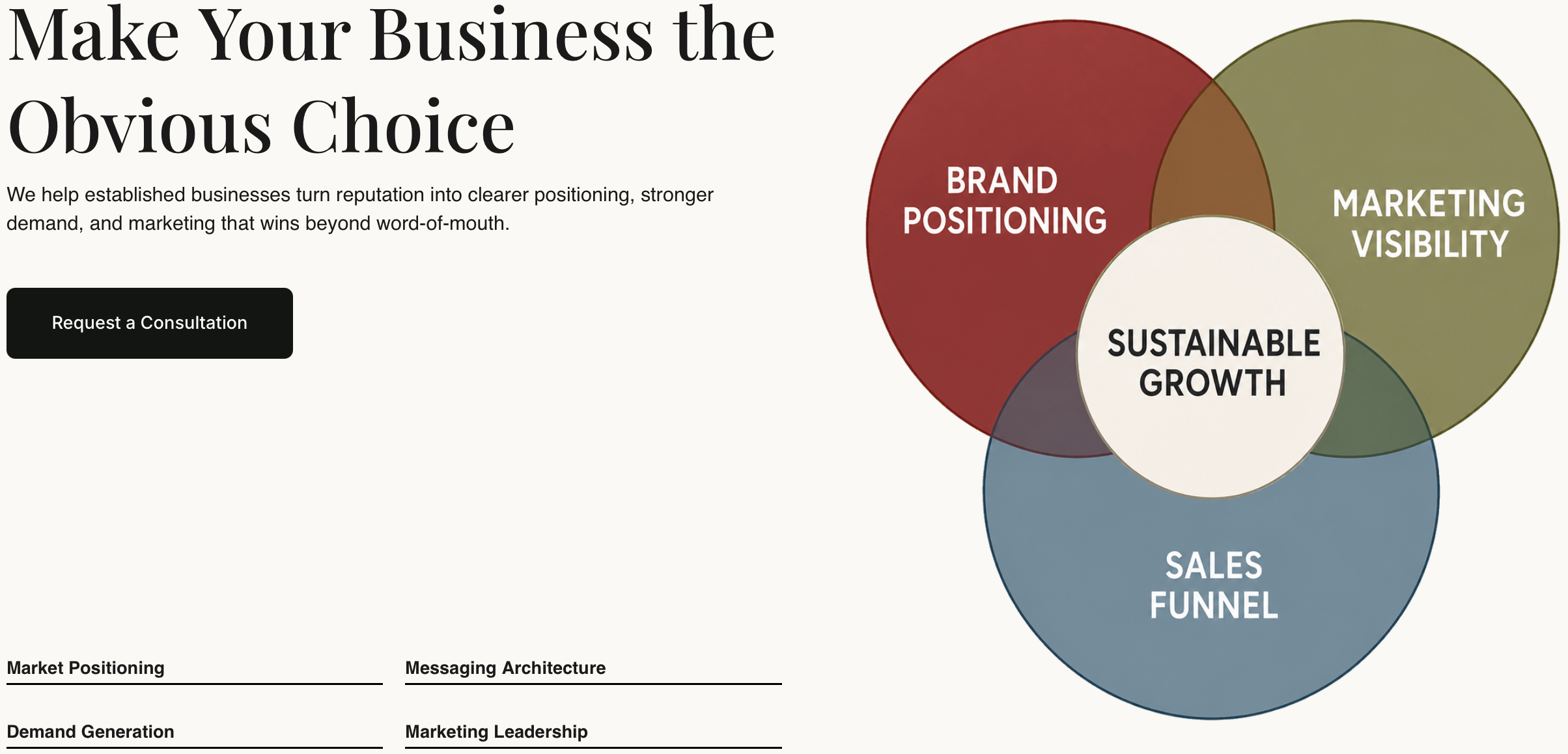
At Reasonate Studio, we start every client engagement with a deep brand clarity process before we write a single caption or publish a single post. Our social media management service is built on that foundation, which is why our content consistently performs where other agencies’ content falls flat. We also offer sales page optimization that translates your clarified message directly into conversion-focused copy. When your purpose is clear, your marketing stops being a cost center and starts being a growth engine. Start with a free Brand Audit Report and see exactly where your clarity gaps are.
Business clarity is the ability to state what your business does, who it serves, and what outcome it creates, all in under 20 seconds. It is the foundation that guides every strategic and operational decision a founder makes.
Clarity reduces wasted effort, lowers employee turnover, cuts unnecessary meetings, and produces more consistent revenue by aligning messaging, operations, and strategy around a single defined purpose.
A 90-day strategic reset session of 60 to 90 minutes is the recommended frequency. Regular resets prevent strategic drift and keep your actions aligned with your defined purpose as your business evolves.
Business clarity defines what you do, for whom, and why. Brand clarity defines how that purpose is expressed outward through voice, visuals, and positioning. Brand clarity cannot be built effectively without business clarity as its foundation.
The clearest signal is the inability to articulate your business purpose in under 20 seconds. Other indicators include frequent strategy rewrites, inconsistent messaging across platforms, and a team that requires constant direction to make basic decisions.