September 22, 2026
Why Update Brand Messaging: Essential Guide for Growth


Discover the vital role of clarity calls for coaches and consultants. Unlock effective solutions and better client relationships today!

TL;DR:
- A clarity call is a focused, diagnostic conversation that identifies a client’s core challenges and produces an actionable next step. It is structured around the client’s problem, with open questions and clear boundaries, rather than pitching solutions or showcasing expertise. Properly run, these calls build trust, improve decision-making, and set standards for effective ongoing communication.
A clarity call is a focused, one-on-one conversation designed to identify a client’s real challenges and produce a concrete next step. It is not a sales pitch, a casual chat, or a therapy session. For small business owners, coaches, and consultants, understanding the role of clarity calls means recognizing them as diagnostic tools that cut through confusion, save time, and create the conditions for better service delivery. Platforms like Expert On Your Life and Christine Rich Clarity have built entire service models around structured clarity calls, and the results speak for themselves. When run well, these conversations protect both parties from wasted effort and set the foundation for a working relationship built on mutual understanding.
A clarity call functions as a diagnostic conversation, not a discovery session dressed up with a friendlier name. The distinction matters. Discovery calls are often structured around a provider’s sales process. Clarity calls are structured around the client’s problem. The provider’s job is to ask sharp questions, listen carefully, and help the client articulate what they actually need, not to pitch a solution before the problem is fully understood.

Christine Rich Clarity offers a useful model here. Her clarity call format is time-boxed to approximately 60 minutes, ends with a written next step, and operates with clear boundaries to prevent the conversation from drifting into unfocused territory. That structure is not accidental. Without it, clarity calls become expensive venting sessions that leave both parties more confused than when they started.
The most common mistake providers make is treating a clarity call like a Q&A session where they answer questions and demonstrate expertise. That approach inverts the purpose. The call exists to surface the client’s situation, not to showcase the provider’s knowledge. Mixing diagnostic conversation with premature pitching weakens downstream delivery because the provider never fully understands the client’s real need before proposing a solution.
Here is what separates a clarity call from a standard consultation:
Pro Tip: Send a short pre-call questionnaire before every clarity call. Three to five questions about the client’s current situation, their biggest obstacle, and what they hope to walk away with will cut your warm-up time in half and let you ask sharper questions from the first minute.
Clarity builds trust more reliably than charm does. Research on phone-based customer service confirms that clients respond better to honest, direct communication than to vague friendliness, even when the news is unfavorable. This finding applies directly to clarity calls. A provider who tells a client plainly what they can and cannot help with earns more trust than one who hedges and over-promises.
The communication mechanics of a strong clarity call rely on three techniques: active listening, confirming understanding, and prompting elaboration. Effective call communication requires the provider to confirm what they heard before moving forward, ask follow-up questions that go one level deeper, and resist the urge to fill silence with their own talking. Each of these behaviors signals to the client that they are being heard, which is the foundation of a productive working relationship.
The downstream benefits of this approach are concrete. Clients who feel genuinely understood during an initial call are less likely to send repeated follow-up emails asking for clarification. They are less likely to misinterpret the scope of a service. They are more likely to show up prepared for subsequent sessions. All of this reduces the administrative friction that drains time and energy from service-based businesses.
“Clarity is not just a communication style. It is a leadership skill that must be engineered through specificity. Vague instructions and vague conversations produce vague outcomes.” — Alain Hunkins
Consider what happens when a coach delivers difficult feedback during a clarity call. A provider who communicates clearly, even when the message is hard, demonstrates that they prioritize the client’s actual progress over the client’s momentary comfort. That kind of honesty, delivered with care, builds the sort of trust that turns a single call into a long-term client relationship. Vague reassurances do the opposite. They feel good in the moment and create confusion later.
The importance of clarity calls extends beyond the individual conversation. Each well-run call sets a standard for how the entire working relationship will operate. Clients learn what to expect, how to prepare, and how to communicate with their provider. That standard compounds over time into fewer misunderstandings and stronger results.
Clarity calls give clients a structured space to untangle confusion and access their own thinking. The best providers do not arrive with answers. They arrive with questions designed to help the client find their own. Expert On Your Life frames this well: a clarity call is a guided conversation that helps clients articulate goals and challenges they may not have been able to name on their own. That articulation is itself a form of progress.
For the provider, the clarity call serves a different but equally important function. It reveals whether the client is a genuine fit before any commitment is made. This protects both parties. A coach who takes on a client whose real need falls outside their area of expertise will underdeliver. A client who hires a consultant before either party understands the actual problem will feel disappointed. The clarity call is the mechanism that prevents both outcomes.
Here is a practical framework for structuring the decision-making output of a clarity call:
Ending with explicit ownership of next steps prevents handoff failures and stalled client journeys. “I’ll send you some information” is not a next step. “I will send you the proposal by Thursday and you will review it by Friday” is a next step.
The table below shows how clarity calls compare to standard consultation calls across the dimensions that matter most for coaches and consultants:
| Dimension | Clarity call | Standard consultation |
|---|---|---|
| Primary goal | Diagnose the client’s situation | Demonstrate provider expertise |
| Talk ratio | Client 70%, provider 30% | Often provider-led |
| Output | Written next step with owner and date | General recommendations |
| Fit assessment | Explicit, before commitment | Often assumed or skipped |
| Time structure | Time-boxed, typically 60 minutes | Variable |
| Follow-up | Structured artifact or action plan | Often informal |
Role clarity also matters on the provider’s side. SHRM identifies unclear roles as a direct cause of degraded performance and accountability. When a coach or consultant uses a clarity call to define exactly what they will and will not do for a client, they are practicing the same discipline. Clear expectations set during the call become the standard against which the entire engagement is measured.
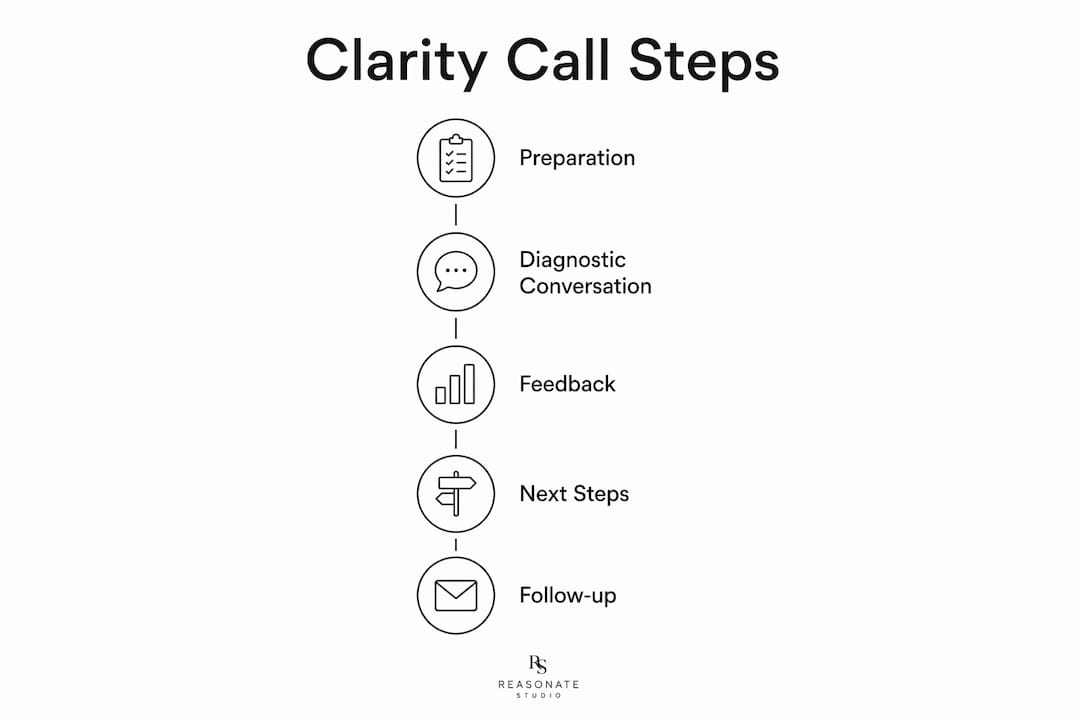
Running a strong clarity call is a skill, and like any skill, it improves with a repeatable structure. The following steps reflect best practices for clarity calls drawn from both coaching methodology and sales research.
Pro Tip: Silence is a tool, not a problem. When a client pauses after a question, resist the impulse to fill the gap. That pause often precedes the most honest and useful thing they will say in the entire call.
The comparison below shows the difference between a well-structured clarity call and a common unstructured alternative:
| Element | Well-structured clarity call | Unstructured call |
|---|---|---|
| Agenda | Shared in advance | Improvised on the spot |
| Opening | Framing question from provider | Small talk or provider overview |
| Questions | Open-ended, diagnostic | Mixed, often closed or leading |
| Talk ratio | Client-led | Provider-led |
| Closing | Specific next step with date | Vague follow-up promise |
| Documentation | Written summary sent after | None or informal notes |
The benefits of clarity calls compound when the structure is consistent. Clients begin to trust the process, not just the person. That trust transfers to the broader working relationship and makes every subsequent conversation more productive.
I have sat on both sides of the clarity call, and the most consistent mistake I see providers make is treating the call as a chance to prove themselves. I understand the impulse. You have expertise, you want the client to see it, and the call feels like an audition. But that mindset produces the opposite of what you want.
The providers who run the best clarity calls are the ones who show up genuinely curious. They are not performing competence. They are actually trying to understand the person in front of them. That shift, from performing to listening, changes the entire energy of the conversation. Clients feel it immediately.
I have also noticed that the calls that end without a clear next step almost never convert into strong working relationships. Not because the conversation was bad, but because vagueness signals to the client that the provider does not have a clear process. Clients hire coaches and consultants because they want structure and direction. If the very first call lacks both, the client has no reason to believe the engagement will be different.
The other thing I would push back on is the idea that clarity calls are only useful at the start of a relationship. I use them at inflection points throughout an engagement, when a client seems stuck, when a project scope starts to drift, or when a relationship needs a reset. A focused 30-minute conversation at the right moment can save weeks of misaligned effort.
If you want to understand how clarity in marketing connects to the clarity you create in client conversations, the two are more linked than most people realize. The same discipline that makes a clarity call effective is what makes a brand message land.
— Kaitlyn
If you are a coach, consultant, or small business owner who wants your client communication to be as sharp as your expertise, Reasonate Studio builds the marketing infrastructure that makes that possible.
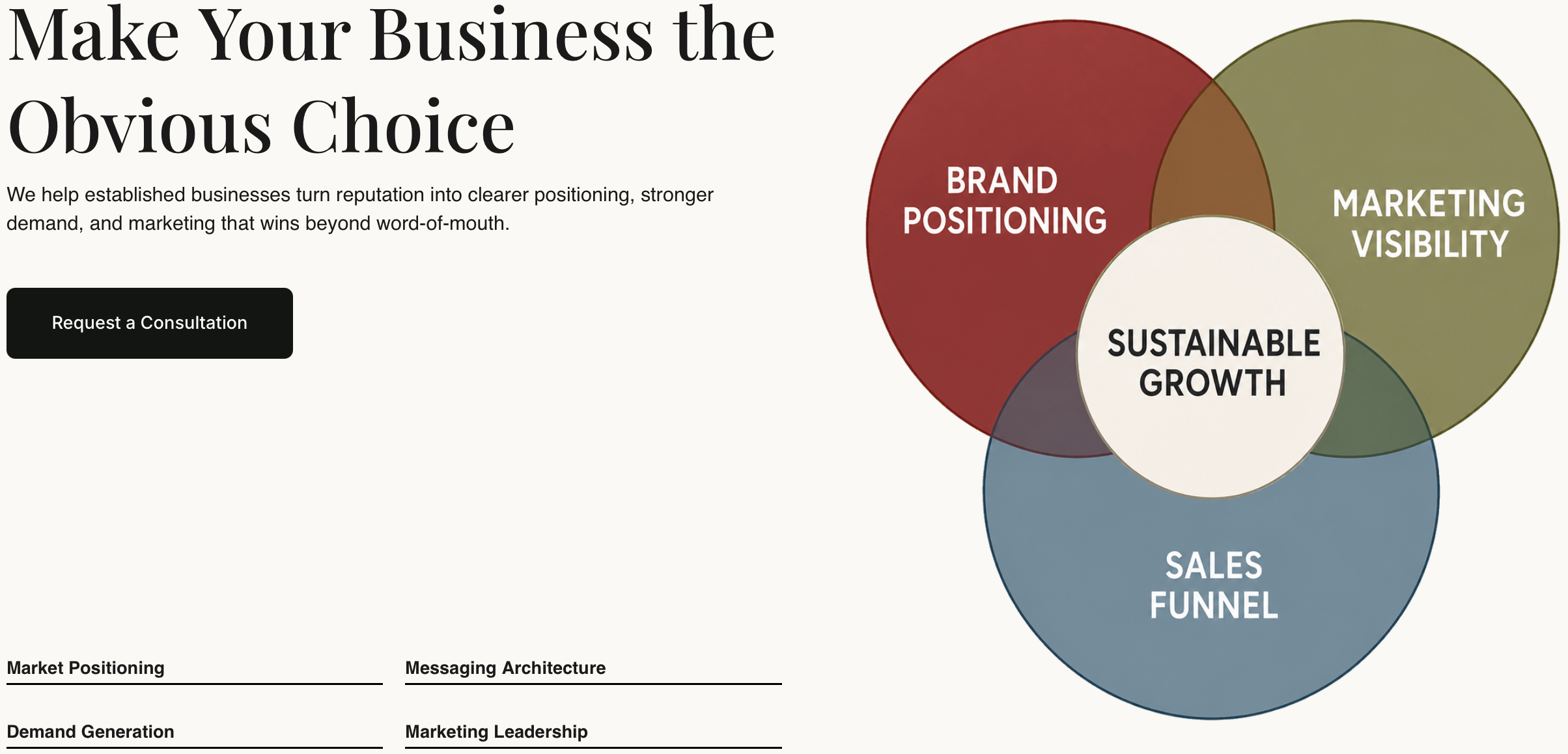
Clear client conversations start with a clear brand. When your messaging, sales pages, and positioning are aligned, clients arrive at your clarity call already understanding who you are and what you do. That alignment shortens the diagnostic phase and increases the quality of every conversation that follows. Reasonate Studio’s sales page optimization and brand intelligence services are built to create exactly that foundation. When your brand communicates with precision before the call even starts, the call itself becomes a confirmation rather than an introduction.
A clarity call is a focused, time-boxed conversation designed to identify a client’s core challenge and produce a specific, executable next step. It functions as a diagnostic tool, not a sales pitch.
Most clarity calls are structured around 60 minutes to maintain focus and prevent the conversation from drifting. Shorter calls of 20 to 30 minutes work for narrowly defined questions, but complex situations benefit from the full hour.
Best practice is for the client to speak approximately 70% of the time and the provider 30%. Prioritizing listening over talking allows the provider to diagnose the real problem rather than pitch a solution before understanding the situation.
Clarity calls create a structured space for clients to articulate their goals, obstacles, and desired outcomes. When both parties leave with a written next step and a shared understanding of the problem, decision making improves because it is grounded in specific, agreed-upon information rather than assumptions.
Every clarity call should end with a concrete next step that includes the action, the person responsible, and a specific date. Vague follow-ups like “I’ll be in touch” undermine accountability and reduce the likelihood of a productive next interaction.