September 22, 2026
Why Update Brand Messaging: Essential Guide for Growth


Discover why mission-driven branding boosts small business growth. Learn how a clear mission can transform your brand's success!

TL;DR:
- Most entrepreneurs launch without a clear brand mission, leading to scattered marketing and weak customer loyalty. Mission-driven branding aligns every business decision with a purpose, fostering trust, community, and higher growth. Building authentic, operationally integrated missions takes time but results in sustainable competitive advantage and stronger customer relationships.
Most entrepreneurs launch with a product idea, not a brand identity. Then they wonder why their marketing feels scattered, their content gets ignored, and their customers don’t stick around. The answer almost always comes back to the same root problem: no clear mission at the center of the brand. Why mission-driven branding matters is not a philosophical question. It’s a strategic one. Mission-driven brands grow revenue at 134% compared to 42% for product-focused competitors in years one and two. That gap does not happen by accident. It happens because mission changes everything, from how you hire to how customers talk about you.
Before you can use a mission to grow your business, you need to understand what mission-driven branding actually is. And more importantly, what it is not.
A mission statement is not a tagline. It’s not a sentence you write once for your website footer and never think about again. True mission-driven branding means your purpose shapes how your business operates every single day. It influences who you hire, which clients you take on, what products you build, and how your team makes decisions when leadership is not in the room. That last part matters more than most people realize. When a brand has a clear mission, it acts as a compass that guides decisions without constant oversight, which is a significant operational advantage for small businesses running lean teams.
The difference between a mission statement and a lived mission is authenticity. A lot of entrepreneurs write impressive-sounding purpose statements but then operate in ways that contradict them entirely. They say they are “committed to community” but never support other businesses. They claim to “put people first” but their onboarding process is impersonal and chaotic. Customers notice this. So do employees.
93% of Fortune 500 CEOs affirm the importance of balancing social goals with business operations, which signals that mission integration has crossed from trend to standard practice. But for small business owners, the application is even more direct. You don’t have departments insulating you from the consequences of misalignment. Your customers interact with the actual humans behind the brand.
Here’s what operational mission integration looks like in practice:
“Brand mission not only shapes external perception but fundamentally transforms internal culture and decision-making.” — Ramotion
Pro Tip: Before writing a mission statement, spend one week auditing your current business decisions. Ask yourself: if someone read this decision, would they know what my brand stands for? The gaps you find are your starting point.
The data on mission-driven brands is not subtle. The performance differences are large enough that ignoring them becomes a strategic liability, especially for small businesses competing against larger, better-funded competitors.

Let’s look at the numbers directly:
| Metric | Mission-Driven Brands | Product-Focused Brands |
|---|---|---|
| Revenue growth (years 1–2) | 134% | 42% |
| Customer lifetime value | 54% higher | Baseline |
| Net Promoter Score | 56 average | 18 average |
| Organic social engagement | 4.7% | 1.8% |
| Customer acquisition cost | 25% lower | Baseline |
| Employee retention (year 1) | 31% higher | Baseline |
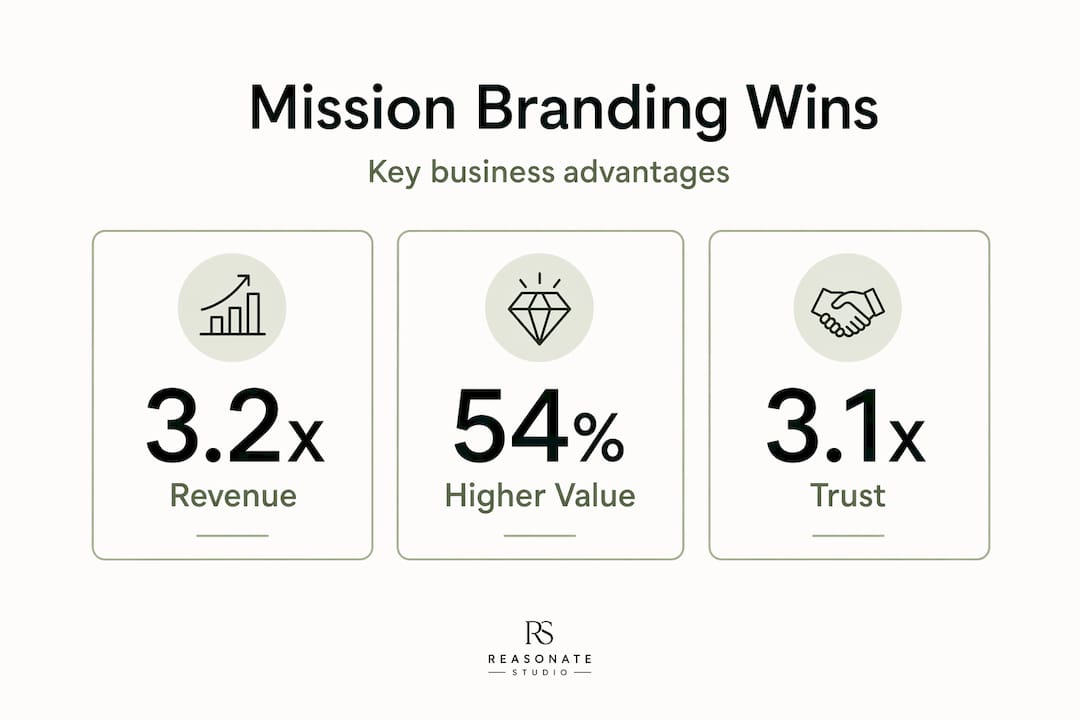
Every one of those numbers represents a compounding advantage. Lower acquisition costs mean your marketing budget goes further. Higher customer lifetime value means you need fewer new customers to hit revenue goals. A 3.1x higher Net Promoter Score means your existing customers are actively referring others, which is the cheapest growth strategy available to a small business.
The psychological mechanisms behind these numbers are worth understanding, because they tell you exactly what to lean into with your marketing.
People buy from brands whose values reflect their own. When your brand has a clear mission, customers who share that mission do not just buy from you. They feel represented by you. That feeling creates a loyalty that price competition cannot easily break. A competitor can undercut your price. They cannot undercut your customers’ sense of identity.
Mission positioning turns customers into a movement by appealing to shared purpose rather than product features alone. Think about brands you have personally felt connected to. That connection almost certainly did not start with a product specification. It started with a story or a belief you recognized in yourself.
Emotional storytelling in mission-driven brands generates 2.4x more content shares than purely informational content. For small businesses with limited paid media budgets, this organic amplification is not just nice to have. It’s a core distribution strategy.
Pro Tip: When you write content, lead with the “why” behind what you do before explaining the “what.” A fitness coach who opens with “I help women stop punishing themselves with exercise” will outperform one who opens with “I offer 12-week training programs” every single time.
One of the most practical benefits of mission branding is what it does to your positioning. When your mission is clear, your positioning becomes almost automatic. You know exactly who you are for, and just as importantly, who you are not for.
Small businesses succeed when they have clear answers to three core questions. Brand positioning is a filter that shapes pricing, messaging, partnerships, and builds consistent reputation over time. Here are the three questions every entrepreneur needs to answer:
When these answers are sharp, your messaging writes itself. Your pricing makes sense. Your partnerships filter naturally. Without them, you end up with vague copy that tries to appeal to everyone and connects with no one.
Here is how mission clarity compares to positioning confusion across key business functions:
| Business Function | With Mission Clarity | Without Mission Clarity |
|---|---|---|
| Pricing | Justified by values and audience fit | Defaulting to competitor pricing |
| Content strategy | Consistent point of view across all platforms | Random topics, inconsistent tone |
| Partnership decisions | Filtered by shared values | Driven by reach alone |
| Sales conversations | Attract aligned buyers, repel mismatches | Time wasted on wrong-fit clients |
| Employee alignment | Team makes good decisions independently | Requires constant oversight |
There is also a trust dimension that goes beyond positioning mechanics. Purpose-driven companies build stronger trust especially with Gen Z customers, who expect brands to take credible stances rather than performing values for marketing purposes. Performative marketing, statements not backed by behavior, actively damages trust with this audience. The antidote is not better copywriting. It is genuine alignment between what you say and what you do.
Knowing why mission-driven branding works is one thing. Building it into your business is another. Here is a structured approach that actually works for small businesses and solo operators.
Write your mission as a plain-language answer, not a corporate statement. Start with three internal questions: Who is this for? What gap does it fill? Why should they trust me? Write your answers in the most direct language possible. “I help first-generation college students navigate financial aid without getting buried in jargon.” That is a mission. It is not fancy. It does not need to be. You can refine the language later. Start with the truth.
Embed the mission into your hiring process. Even if you only hire one contractor, share your mission explicitly before bringing someone on. Ask how they connect with it. A mismatch here costs far more than the time spent screening. Mission-aligned teams are the reason employee retention is 31% higher at purpose-driven companies.
Build your content strategy around the mission, not the platform. Most small business owners create content by asking “What should I post on Instagram?” Start instead by asking “What does my mission-driven audience need to understand, believe, or feel?” Then decide which platform delivers that best. The importance of brand mission shows up most clearly in content that takes a consistent point of view over time.
Use the stable core and adaptive layer model. Your mission, values, and positioning form the stable core that never changes. Your tone, format, and messaging adapt depending on whether you are writing an email, a social post, or a sales page. This brand architecture approach lets you stay true to your mission while flexibly communicating across different contexts and audiences.
Track mission alignment alongside marketing metrics. Set up a simple quarterly review where you ask: Does our content reflect our mission? Are we attracting the clients we said we wanted? Are our partnerships consistent with our values? These qualitative checks prevent the slow drift that turns a clear brand into a vague one.
Set realistic timeline expectations. Mission-driven marketing builds brand awareness and community engagement over three to six months, with revenue impact typically showing up between six and twelve months. If you are expecting a mission refresh to produce immediate sales spikes, you will bail too early. The compounding benefits require sustained consistency.
Avoid the performative branding trap. The biggest execution mistake is treating mission as a marketing layer while operating with entirely different values internally. Ignoring operational integrity while branding a mission leads to performative perception, and that perception erodes trust faster than having no mission at all. Customers will notice when your actions contradict your words.
Pro Tip: Once you have drafted your mission statement, test it with five people who represent your ideal customer. Ask them to explain back to you what you do, who you do it for, and why they should care. If their answers match yours, you have clarity. If they do not, the problem is with the message, not the audience.
I have worked with founders across dozens of industries, and I can tell you that the ones who struggle most with marketing almost always have the same underlying problem: they skipped the foundation. They launched, they started posting, they hired someone to run ads. But they never got clear on what their brand actually stands for.
In my experience, most entrepreneurs know their mission somewhere deep down. The problem is they have never been pushed to articulate it in a way that actually functions as a business tool. They have a feeling, but not a framework. And without the framework, the feeling never translates into consistent messaging, strong positioning, or customer loyalty.
What I find counterintuitive for most people is that mission-driven branding is not about being altruistic. You do not need to be a nonprofit or a social enterprise for your brand mission to be real and powerful. A web designer whose mission is to make high-quality design accessible to small businesses has just as valid and effective a mission as a company donating proceeds to charity. The key is that it is specific, genuine, and operationally present in how you work.
The other thing I have learned is that mission-driven brands take longer to build than product-focused ones, but they are far harder to replicate. A competitor can copy your offer, your pricing, and your aesthetic. They cannot copy the community you built around a shared belief. That is the compounding asset that most small business owners underestimate until they see it working.
I also want to be honest about the failure modes. I have seen entrepreneurs write beautiful mission statements and then operate in ways that contradict them entirely within six months. The mission does not live in the document. It lives in your decisions. If you are not willing to turn down clients, partnerships, or revenue opportunities that conflict with your mission, then you do not actually have one. You have marketing copy.
— Kaitlyn
If reading this article made you realize your brand is missing a clear foundation, you are not alone. Most founders come to Reasonate Studio feeling exactly that way. They are good at what they do, but their marketing feels scattered, their messaging feels generic, and they are not attracting the right clients consistently.
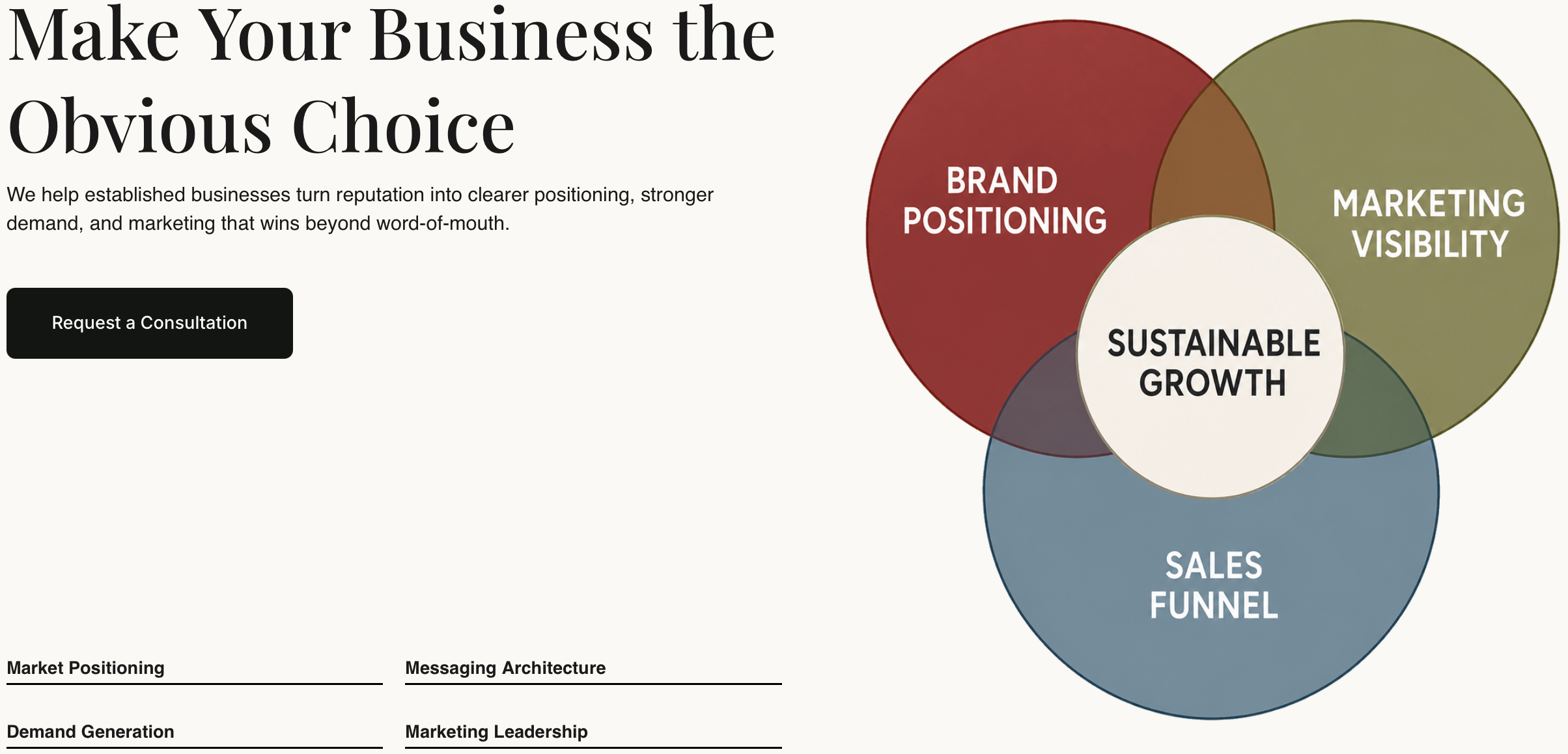
That is the exact problem Reasonate Studio was built to solve. Through the Aligned Impact Model™, we help founders, coaches, and consultants get clear on their mission, translate it into messaging that actually connects, and build a social media presence that reflects who they are and what they stand for. Every post, caption, and content piece we create carries your brand’s mission forward consistently, so your audience builds trust with you over time rather than scrolling past.
For entrepreneurs who want their sales pages and offers to reflect their mission as clearly as their content does, our sales page optimization service aligns your conversion copy with your brand story, so the people who land on your page feel seen and understood before they ever hit the buy button. When your mission runs through every touchpoint, marketing stops feeling like a chore and starts working like a system. That is what we build with you.
Mission-driven branding is the practice of building your entire brand identity around a clear, authentic purpose that shapes your messaging, operations, and customer relationships. It goes beyond a written statement to influence hiring, product decisions, and how you show up in the market every day.
Mission-driven brands grow revenue up to 3.2x faster, achieve a 54% higher customer lifetime value, and have a 3.1x higher Net Promoter Score compared to product-focused brands. They also benefit from lower customer acquisition costs and stronger employee retention.
Start by answering three plain-language questions: Who is your brand for? What gap does it fill? Why should that person trust you? Write your answers directly and honestly before refining the language. Your mission statement should function as an internal decision-making tool before it becomes a marketing asset.
Brand awareness and community engagement typically build over three to six months, while revenue impact tends to show up between six and twelve months of consistent execution. Sustained effort and patience are required for the compounding benefits to materialize.
No. Any small business can build a powerful mission around serving a specific audience exceptionally well. The mission does not need to be philanthropic. It needs to be specific, genuine, and consistently reflected in how you operate and make decisions.