September 22, 2026
Why Update Brand Messaging: Essential Guide for Growth


Discover why brand foundations matter for business success. Learn how they drive trust, growth, and effective marketing strategies.
TL;DR:
- Most businesses mistakenly believe branding is just a logo and color palette, but a strong foundation is essential for trust and growth. A brand foundation includes purpose, values, positioning, voice, and messaging pillars, which guide consistent and coherent external communication. Skipping this strategic core leads to fragmented messaging, wasted content, and slower conversions, costing significant future revenue and decision-making efficiency.
Most business owners think branding means having a polished logo and a color palette they love. That thinking is exactly why brand foundations matter and why so many businesses struggle to convert visibility into real revenue. Your logo is not your brand. It is the surface. What sits underneath it, your purpose, your positioning, your voice, your values, is what actually shapes whether a stranger decides to trust you enough to buy. This article breaks down what a brand foundation truly is, how it drives consumer trust and long-term growth, what happens when you skip it, and how to build one that works.
A brand foundation is the strategic core that gives every marketing decision its direction. Think of it as the internal operating system your business runs on. Before a single social post goes live or a dollar gets spent on ads, your brand foundation determines what you say, how you say it, who you are saying it to, and why they should care.
This is where a lot of business owners get tripped up. They confuse their brand assets with their brand foundation. A logo, a font, a color palette, these are the outputs of a foundation. They are how the foundation gets expressed visually. But without the foundation underneath, those assets are just decoration.
The key elements of brand foundations that actually drive growth look like this:
When these elements are clearly defined, every team member, every content piece, and every marketing campaign pulls in the same direction. That internal alignment is not just good for culture. It is directly responsible for how coherent, trustworthy, and memorable your brand feels to the people on the outside. Exploring the role of clarity in marketing shows just how much that coherence affects lead quality and conversion rates over time.

Here is where the stakes become concrete. Brand foundations are not a philosophical exercise. They are a revenue driver. The data on this is hard to ignore.
Trust drives purchase decisions for 68% of consumers, and brands with high predictive brand metrics see an 8-point lift in key sales indicators. That means the emotional and functional trust your brand generates, built directly on your foundation, is actively influencing who buys from you and who scrolls past.
“Brand value rose 11% to USD 10.4 trillion in combined global brand valuations in 2026, with functional and relational trust identified as the primary drivers of brand consideration.” — Brand Finance
That number is not an abstraction. It reflects what happens when businesses consistently show up with clarity, conviction, and a coherent story. Trusted brands become central to consumer choice, especially in an environment where misinformation is high and skepticism is the default. Buyers are not just comparing features or prices. They are asking, “Do I trust this company enough to give them my money?”
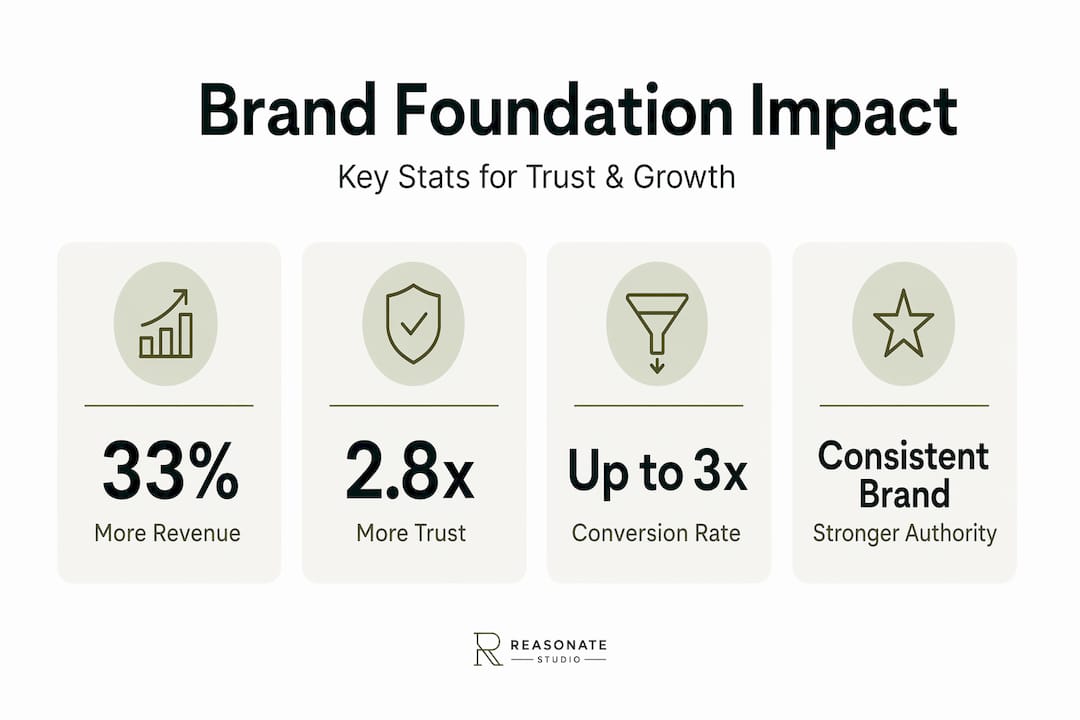
Third-party proof points play a significant role here too. Independent award credentials generate 2.8x more trust and increase perceived legitimacy by 45 points compared to businesses without any recognition. Meanwhile, editorial coverage creates 3.2x more trust than paid advertising, with 41% of readers recalling an editorial feature after six months compared to just 3% for paid ads.
The practical implication is this: a strong brand foundation creates the conditions for these trust signals to actually land. If your messaging is inconsistent or your positioning is unclear, an award or press feature will not move the needle the way it should. But when your foundation is solid, every external proof point amplifies what you have already built internally.
Consistent brand presentation increases revenue by up to 33% by reducing confusion and reinforcing authority across every customer touchpoint. That figure comes from real business outcomes, not theory. When your audience sees the same voice, the same positioning, and the same level of professionalism everywhere you show up, they stop second-guessing you. That reduced friction directly translates to more qualified leads and faster buying decisions.
Investing in brand trust strategies is not a nice-to-have. It is the upstream work that determines how well everything else performs.
Skipping your brand foundation does not mean nothing gets built. It means the wrong things get built, fast and expensively.
The most common pattern looks like this: a business hires a designer who creates a beautiful logo, then hires a content creator who posts consistently, then wonders why engagement is high but conversions are low. The issue is not the design or the content. The issue is that neither the designer nor the content creator had a clear brief rooted in strategy. They were executing without direction.
Here are the four most expensive consequences of missing or weak brand foundations:
Consider a health coach who has been posting five times a week for a year. Her content is educational, well-designed, and consistent in frequency. But her bio says “helping women feel their best,” her website says “functional health for busy professionals,” and her newsletter is mostly personal stories. Three different audiences, three different promises, no clear positioning. Her audience is confused about who she really serves, and confused audiences do not buy.
Pro Tip: Before investing in paid ads, audit your messaging across every platform and ask: does everything say the same thing about who I serve and what I do? If the answer is no, fix the foundation before you scale the spend.
Understanding what brand marketing actually is helps clarify why consistency at this level is not optional. It is the mechanism through which trust and conversion happen.
Building a brand foundation is not a one-afternoon task. But it is also not as complicated as some agencies make it sound. Here is how to approach it practically and in the right order.
Write down, in one to two clear sentences, why your business exists and who it exists for. Not the mission statement version written for a pitch deck. The honest, direct version. Why does this business need to exist? What would your ideal customer lose if you were not here? That answer is your purpose. Your positioning follows directly from it: you serve a specific person, with a specific problem, in a way that a competitor cannot easily replicate.
Messaging pillars are the two to four central themes you return to consistently across all content and communication. A business coach might anchor everything in themes like self-trust, sustainable growth, and measurable momentum. Every post, email, and sales page connects back to one of those pillars. This is how you build authority over time rather than just volume.
Your voice is how your foundation sounds in the real world. It shows up in word choices, sentence length, humor level, and the emotional tone of everything you publish. A clear brand voice makes content creation faster, freelancer onboarding easier, and audience recognition stronger. The impact of consistent brand voice on audience connection is one of the most underrated benefits of building a solid foundation.
Practically, a useful exercise is to write down three to five adjectives that describe how your brand sounds, followed by three to five that describe what it does not sound like. “Warm, direct, and confident” paired with “not corporate, not casual to the point of vague” gives anyone writing for your brand a real framework.
One of the most overlooked key elements of brand foundations is proof. Self-claims do not carry the same weight as external validation. 84% of C-suite respondents reported increased trust after editorial features, and 56% said they would pay a premium to a business featured editorially versus one that was not. Actively pursuing awards, editorial coverage, and expert recognition is not vanity. It is a foundational investment in how credible your brand appears to new audiences.
The First-Fast Response (FFR) metric measures the immediate cognitive associations consumers have with a brand name. It is 2.6 times more responsive and four times more predictive of sales than unaided awareness. Rather than obsessing over follower counts, start tracking what people immediately think of when they hear your brand name. Are those associations aligned with your positioning? If not, your foundation needs sharpening.
Pro Tip: Conduct a quick perception test by asking five to ten of your ideal clients: “When you hear my brand name, what is the first word that comes to mind?” If the answers do not match your intended positioning, you have found your most urgent brand work.
Building a strong brand foundation is not a one-time event. It is an ongoing practice of checking whether your internal strategy still matches the way your audience perceives you externally, then closing the gap.
I have worked with founders who spent tens of thousands of dollars on ads, content, and website redesigns before they ever defined their brand positioning. Every single time, the downstream work underperformed, and the fix always circled back to the same place: the foundation was not there.
What I have learned is that skipping foundations does not feel expensive in the moment. It feels like moving fast. You tell yourself you will get to the “strategy stuff” once you have more traction. But here is what that actually costs: cutting brand marketing investment costs companies $1.92 in future spend to recover the market share they lost. You do not save money by skipping the foundation. You borrow against your future marketing budget.
The other thing I have seen consistently is that founders with clear brand foundations make better decisions faster. When a new opportunity shows up, a partnership, a collaboration, a new offer idea, the question is not “could this work?” but “does this align with what we stand for?” That clarity alone saves hours every week and prevents the kind of scattered, off-brand moves that slowly erode the trust you have built.
My honest opinion is this: brand foundations are not the boring groundwork you do before the exciting marketing starts. They are the reason the marketing works at all. Every business I have seen grow with consistency and confidence had one thing in common. They knew exactly who they were, who they served, and what they stood for before they asked anyone else to pay attention.
— Kaitlyn
If this article has you realizing your brand might be missing a clear strategic core, you are not alone. Most founders reach a point where the content is consistent but the conversions are not, and the answer is almost always upstream in the messaging and positioning.
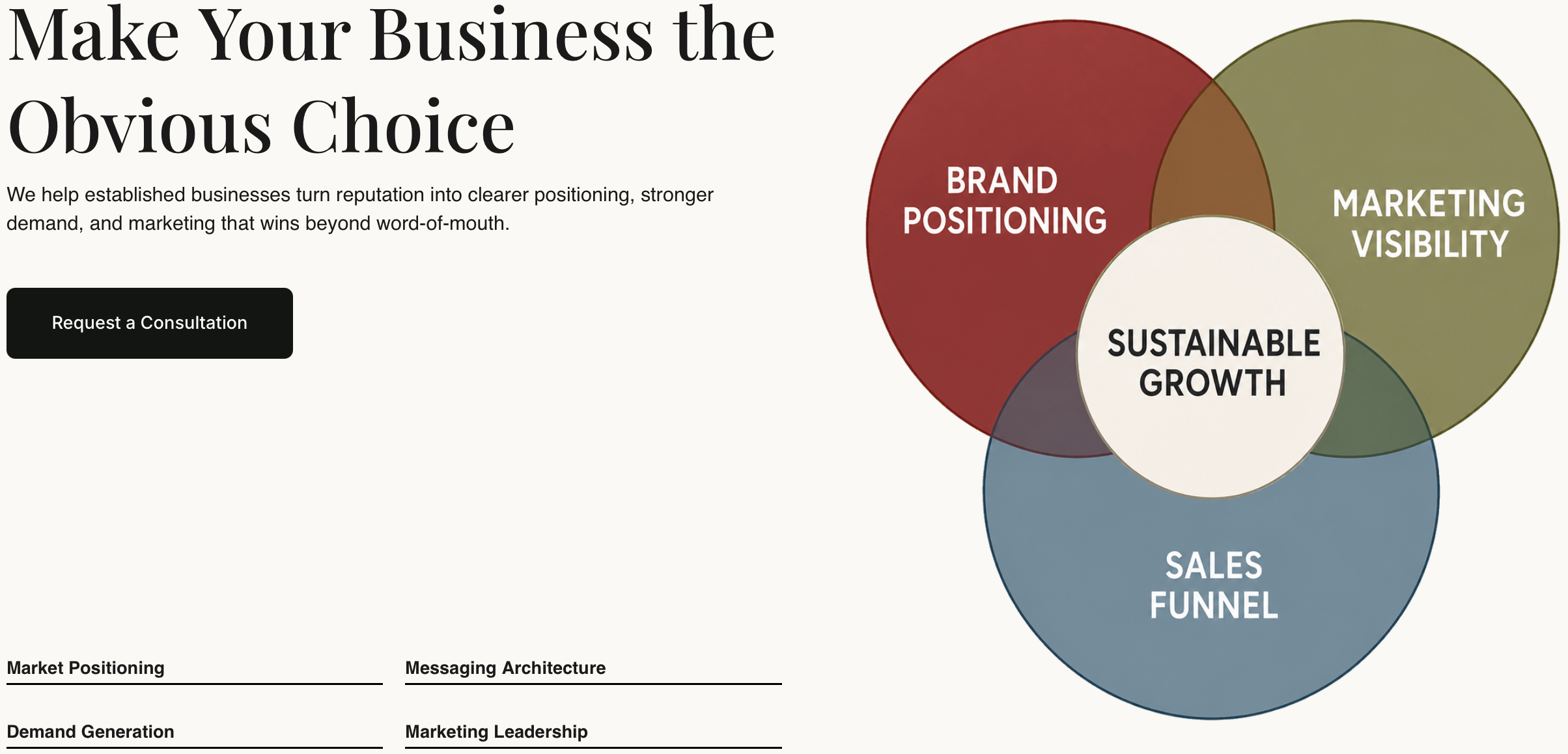
At Reasonate Studio, we work directly with founders, coaches, and consultants to clarify exactly that. One of the highest-impact places that shows up is your sales page. When your brand foundation is clear, your sales page stops feeling like a pitch and starts feeling like a natural continuation of everything your audience already believes about you. Our sales page optimization service is built specifically to align your messaging, voice, and offer positioning into a page that converts because it is grounded in who you actually are. If your page is not pulling its weight, your brand foundation is likely the reason.
A brand foundation is the strategic core of your business, encompassing your purpose, values, positioning, voice, and messaging pillars. It is the internal framework that guides every marketing decision and customer-facing communication.
Brand foundations create the consistency and clarity that build consumer trust over time. Research shows that consistent brand presentation increases revenue by up to 33%, and trust is the top purchase driver for 68% of consumers.
The core elements include brand purpose, core values, market positioning, brand voice and personality, and messaging pillars. Visual identity elements like logo and color follow from these strategic decisions, not the other way around.
When your foundation is clear, every piece of content, every campaign, and every sales conversation pulls in the same direction. This coherence reduces audience confusion, increases authority, and produces more qualified leads with less wasted spend.
Scaling without a clear brand foundation amplifies inconsistency, not growth. Without it, more traffic and more spend produce diminishing returns. With it, every new marketing effort builds on something real and compounds over time.
| Key Takeaway | Details |
|---|---|
| Brand foundations go beyond visuals | Purpose, values, positioning, and voice are the real foundation. Logos and colors are expressions of that strategy, not substitutes for it. |
| Trust is a measurable revenue driver | 68% of consumers list trust as their top purchase motivator, and consistent brand presentation can lift revenue by up to 33%. |
| Missing foundations create hidden costs | Fragmented messaging, wasted content spend, and slower conversions are direct results of skipping foundational brand work. |
| Third-party credibility amplifies your foundation | Editorial features and independent awards dramatically increase perceived legitimacy and willingness to pay. |
| Brand health requires ongoing measurement | Tracking immediate consumer associations (not just follower counts) tells you whether your foundation is actually landing with your audience. |