September 22, 2026
Why Update Brand Messaging: Essential Guide for Growth


Discover what is the brand promise and how it shapes customer loyalty. Learn to craft a promise that enhances every business interaction.

TL;DR:
- A brand promise is a deep-rooted commitment that influences every customer interaction, not just a slogan.
- Fulfilling this promise builds trust, loyalty, and competitive advantage by aligning operations with customer expectations.
Most business owners think their brand promise is a tagline. Something short, catchy, and clever enough to put on a homepage. But what is the brand promise really? It is not a slogan. It is a commitment, and it touches every single thing your business does. From how your team answers the phone to how your checkout process feels, your brand promise is either being kept or broken in every interaction. Get it right and you build the kind of customer loyalty that no ad budget can manufacture. This article breaks down exactly what it is, why it matters, how to build one that holds up, and what it looks like in practice.
A brand promise is the consistent value or experience a customer can expect from every single interaction with your business. Not just from your marketing. Not just from your product. From everything. It is the answer to the question your customer is silently asking: “If I give you my trust and my money, what do I reliably get back?”
That definition already separates it from three concepts that entrepreneurs often confuse it with. Here is how they actually differ:
| Concept | What it does | Who it’s for |
|---|---|---|
| Brand promise | Commits to a consistent customer experience | Customers and internal team equally |
| Tagline | Communicates personality or positioning | External marketing audience |
| Mission statement | States internal purpose and direction | Internal stakeholders and culture |
| Value proposition | Explains functional benefits of a specific offer | Prospects evaluating a purchase |
Your tagline might be memorable. Your mission statement might inspire your team. Your value proposition might close a sale. But none of those are your brand promise, because none of them carry the same operational weight. A brand promise is both an internal and an external contract. Internally, it tells every employee how to make decisions. Externally, it sets the expectation customers will hold you to.
Think of it this way. If a customer says, “I chose this brand because I always feel like they genuinely get me,” that feeling did not come from a website headline. It came from dozens of consistent experiences across email, support, product quality, and content. The promise created the expectation. The operations fulfilled it.
Pro Tip: Write your brand promise down and then ask a different question: “Does every person on my team make decisions that honor this commitment?” If the answer is no, you have a messaging document, not a brand promise.
Learning more about brand clarity and growth can sharpen how you translate this commitment into every marketing decision you make.
Brand credibility is the perception customers have that your business is honest, competent, and reliable. And according to research, delivering on your promise is one of the primary drivers of that credibility. Without it, potential customers stay skeptical no matter how polished your marketing looks.

Here is what makes this so consequential for small business owners: you do not get the same benefit of the doubt that large, established brands do. Every interaction either builds or erodes trust. When a customer experiences a gap between what you promised and what you delivered, that gap does not just cause disappointment. Trust erodes permanently in a way that rarely recovers, especially when your audience is active online and willing to talk.
The business case for brand promise comes down to a few compounding effects:
The risk of ignoring this is not abstract. Consider any brand that once had a strong reputation and then changed its service quality, pricing model, or product standards without acknowledging it. Customers do not forget. They leave, and they tell others why. The brand promise is the standard customers compare every future experience against.
Pro Tip: Audit your last ten customer service interactions. Ask honestly: did each one reinforce or undercut the promise you claim to stand for? That gap is your real brand problem.
Most brand promises fail not in the writing but in the operating. Before you craft a single sentence, you need to answer a harder question: what do you actually do better than anyone else, and does that genuinely matter to the people you want to serve?

A brand promise must live at the intersection of your core strengths and your customers’ real needs. Not the needs you assume they have. The ones they express when they describe what they were looking for before they found you, and what made them stay.
Here is a step-by-step process for building a brand promise that holds:
The most common pitfall is treating the promise as a marketing output. Something to workshop in a brand session and then publish. The moment it lives only on paper, it stops functioning as a promise and becomes decoration. Developing a strong brand identity starts with this kind of honest, operational clarity.
Pro Tip: Before you finalize your brand promise, share it with three current customers and ask them if it sounds like you. If they hesitate or say “sort of,” your promise does not yet match their lived experience of your brand.
Looking at how established brands have built and kept their promises reveals patterns that entrepreneurs at any scale can apply. The details of each example matter more than the names themselves.
Consider a brand built around the promise of radical transparency in pricing. Every fee visible. No surprises at checkout. That is not just a marketing message. It requires the entire pricing infrastructure, customer service scripts, and billing system to support it. When customers experience that consistency, they do not just feel satisfied. They feel respected. That emotional response drives both loyalty and word of mouth.
Now contrast that with a brand that promises premium service but routes support tickets through an offshore call center with no context on the customer’s history. The promise is in the marketing. The operations tell a different story. That gap is exactly what treating a promise as merely a marketing construct looks like in practice, and it costs market differentiation even when the product itself is strong.
Here is a comparison of how different promise approaches perform across key dimensions:
| Promise type | Example approach | Loyalty impact | Risk level |
|---|---|---|---|
| Functional | “Fastest delivery in your city” | Moderate, easily switched | High if speed is ever compromised |
| Emotional | “You will always feel understood” | High, hard to replicate | Medium, requires culture investment |
| Paradox-resolving | “Premium quality at accessible prices” | Very high if executed consistently | High, requires operational investment |
| Values-driven | “We only sell what we would give our own family” | Very high among aligned customers | Low if values are genuine |
The brands that build the deepest loyalty are often the ones whose promises resolve a contradiction. Affordable and premium. Fast and personalized. Simple and powerful. These promises require business-wide investments to deliver. But when they do deliver, competitors cannot easily copy them because the differentiation is embedded in the operation, not just the messaging.
The lesson for founders: do not pick the promise that sounds best in a pitch. Pick the one you can prove with receipts, reviews, and consistent behavior at every touchpoint. Read more about standing out through competitive messaging to see how a clear promise becomes your strongest positioning tool.
Writing a brand promise is the easy part. The harder work is making sure it stays alive as your business grows, your team expands, and your market shifts. Here is how you build systems around it:
The goal is not perfection. No brand delivers on its promise every single time. The goal is consistency strong enough that customers trust the promise even when one interaction falls short, because the overall pattern earns that trust.
I have worked with enough founders to see a clear pattern. The brand promise gets written in a strategy session, it sounds great, and then it gets published on the about page and forgotten. Meanwhile, the actual business makes decisions based on revenue pressure, convenience, and speed, not the promise.
What I have seen work is something different. The founders whose brands genuinely resonate with their customers treat the promise as a filter. Before a new offer, a new hire, or a new content direction, they ask: does this honor what we told our customers they could count on us for? That question slows things down in the best way. It creates consistency that customers notice even when they cannot name it.
The uncomfortable truth is that a brand promise you cannot operationalize is worse than no promise at all. It creates a gap between expectation and experience, and customers feel that gap even before they can articulate it. I have watched brands spend heavily on content and ads while quietly undermining their own promise at the service level. The marketing cannot save what the operations are breaking.
What I always tell the founders I work with: your brand promise is not what you say. It is what your customers would say you reliably deliver. Start there. Get honest about the gap, if there is one. Then build the marketing around the real thing, not the aspirational version.
— Kaitlyn
Understanding your brand promise is the first step. The next step is making sure your sales pages, content, and messaging actually reflect that commitment in a way that converts.
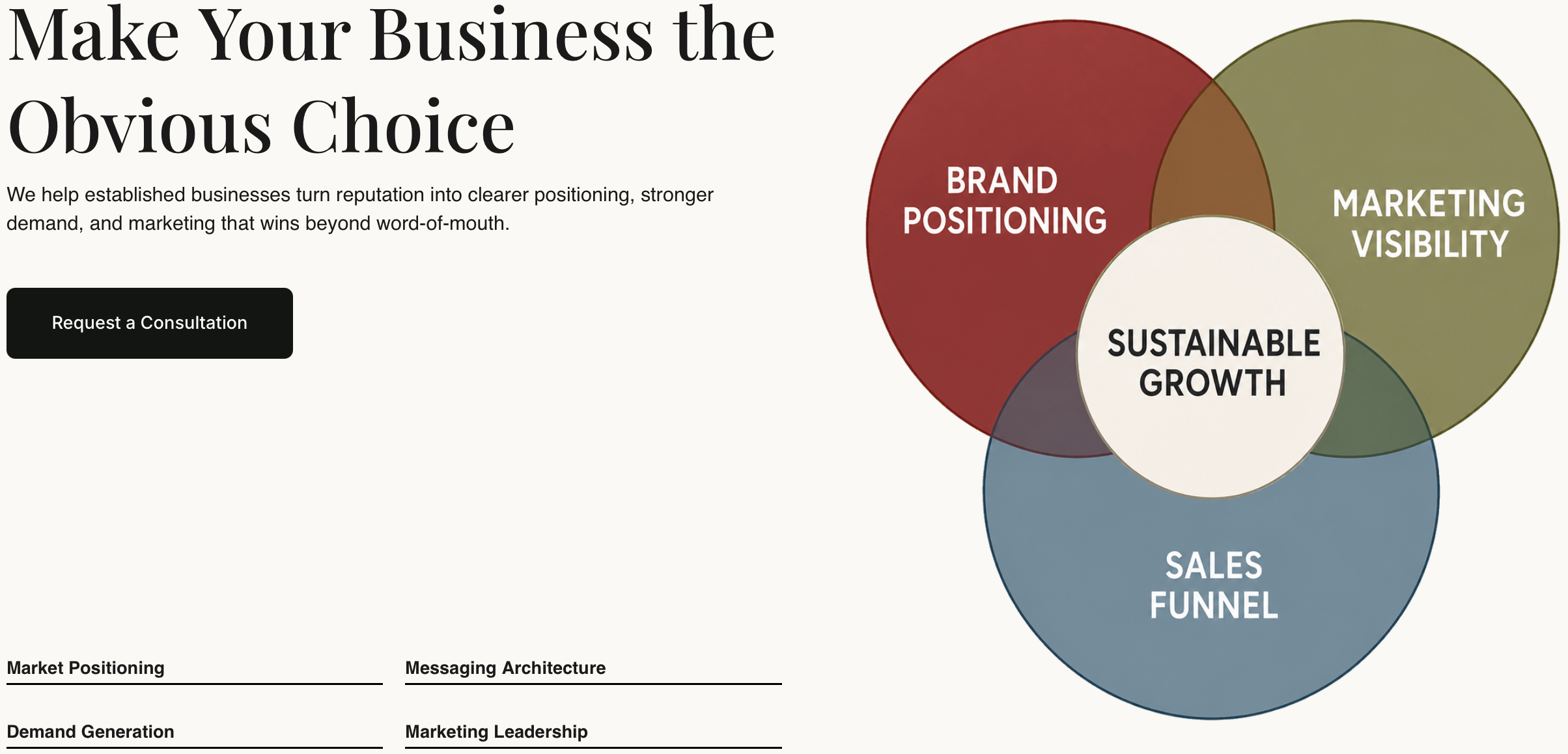
At Reasonate Studio, we help founders, coaches, and consultants close the gap between what they stand for and how they show up online. If your messaging does not yet match the quality and clarity of your actual work, our sales page optimization service is built for exactly that. We take what makes your brand genuinely valuable and translate it into words that build trust and drive decisions. You bring the expertise. We build the engine that gets it seen, believed, and chosen.
A brand promise is the consistent experience or value a customer can count on receiving every time they interact with your business. It is a commitment that shapes both your marketing and your operations.
A tagline is a marketing phrase designed to communicate personality or positioning. A brand promise is a deeper commitment that guides internal decisions, customer experience, and how your entire team behaves.
For small businesses, trust is built interaction by interaction. A clear brand promise gives customers a reliable expectation to hold onto, which builds loyalty faster and reduces the effort required to convert new buyers.
A brand promise that works lives at the intersection of what your business genuinely does best and what your customers genuinely value most. It must be backed by operations, not just messaging, to create real credibility.
Brand values are the principles your business believes in. Your brand promise is the specific commitment those values translate into for the customer. Values are internal. The promise is the external, lived expression of those values in every customer interaction.