September 22, 2026
Why Update Brand Messaging: Essential Guide for Growth


Discover what hybrid marketing is and how it can elevate your business in 2026 by blending digital and traditional strategies effectively.
TL;DR:
- Hybrid marketing intentionally integrates digital and traditional channels into cohesive campaigns that reinforce each other. This approach yields up to 35% higher engagement by expanding reach, strengthening brand recall, and diversifying budgets for greater resilience. Effective implementation involves strategic planning, team collaboration, tracking, and balancing AI with human oversight to optimize results.
Most marketing advice forces a false choice. Either you go all-in on digital, chasing algorithms and ad spend, or you stick with the traditional channels that built your brand in the first place. What is hybrid marketing? It’s the answer to that false choice. Hybrid marketing is an integrated strategy that deliberately combines digital and traditional channels into a single, coordinated campaign system. It’s not a compromise. It’s a more sophisticated approach, and the data increasingly shows it outperforms either method on its own. This article breaks down exactly how it works, why it matters, and how to put it into practice.
Hybrid marketing is the practice of weaving together digital channels and traditional channels into campaigns where each element reinforces the others. It’s not about running a Facebook ad and mailing a flyer at the same time. It’s about designing those two touchpoints to work together, share a consistent message, and move the same person through a coherent experience.
The digital side of a hybrid marketing strategy typically includes:
The traditional side pulls from equally powerful channels:
What separates hybrid marketing from simply “doing both” is the intentional integration of messaging and timing. A well-designed hybrid campaign might use a direct mail piece to drive traffic to a personalized landing page, then retarget those visitors with a social media ad, and follow up with an email sequence. Each channel amplifies the last. The consumer journey feels continuous and coherent, not like they’re encountering three disconnected brands.
This is where the term omnichannel often comes up. Omnichannel focuses on providing a consistent customer experience across all channels. Hybrid marketing is a closely related concept, but it specifically emphasizes the strategic mixing of digital and traditional media to reach broader audiences and create stronger impact. Think of omnichannel as the user experience goal and hybrid marketing as the channel strategy that gets you there.
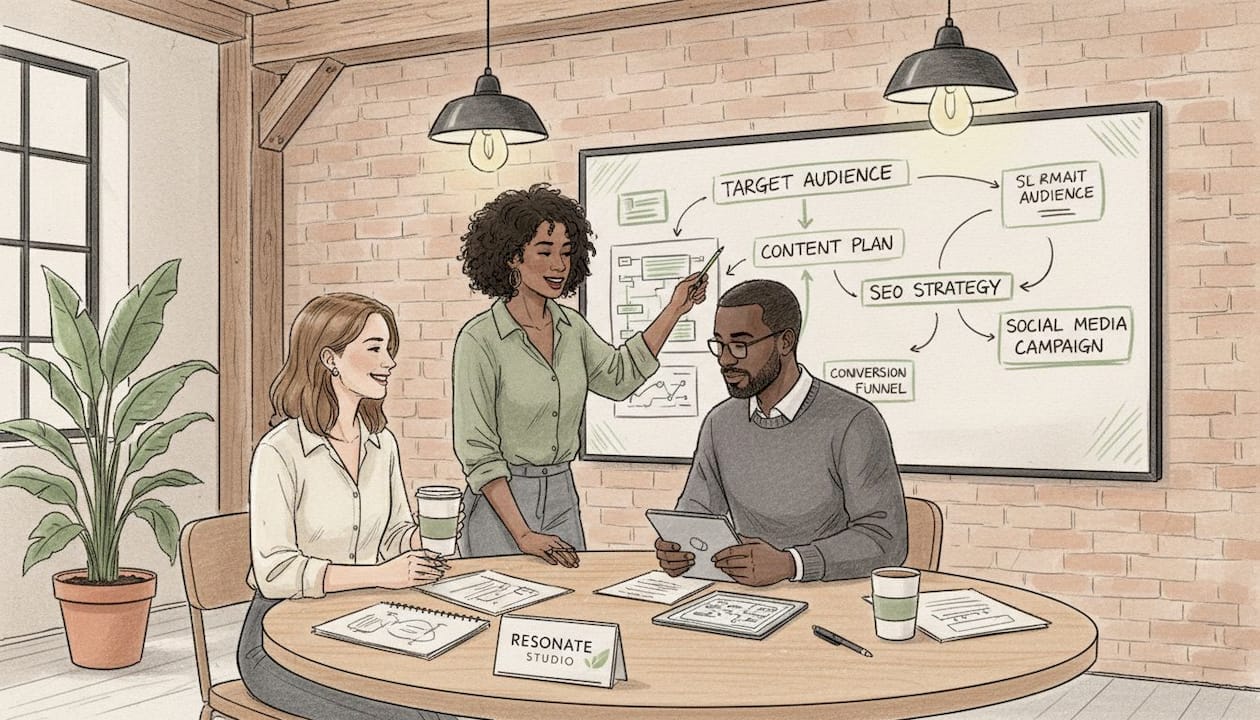
The case for a hybrid marketing strategy goes well beyond theory. The performance numbers are compelling, and the strategic advantages compound over time.
The most striking data point: campaigns using multiple channels that blend at least three offline and two online touchpoints see up to 35% more engagement than single-channel approaches. That’s not a marginal improvement. That’s a structural advantage built into the campaign from the start.
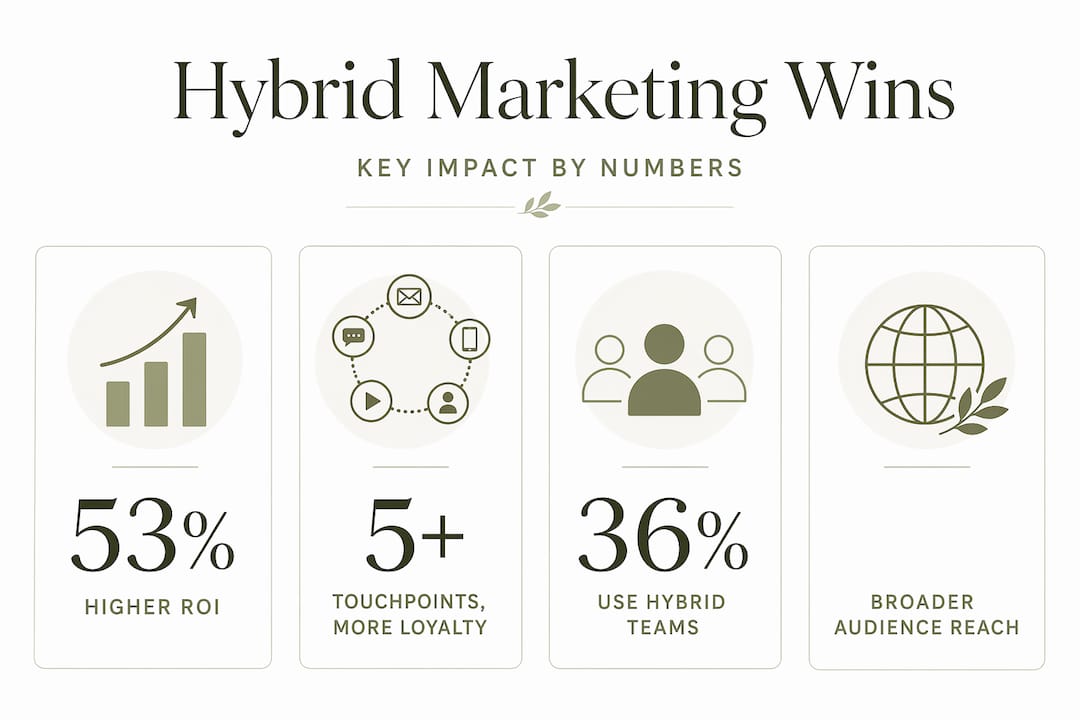
Broader reach without sacrificing depth. Digital channels give you targeting precision and scale. Traditional channels give you physical presence and emotional impact. A billboard can’t be scrolled past. A handwritten postcard can’t be blocked by an ad filter. Together, they catch people in more moments and create a fuller picture of your brand.
Brand recall and loyalty. Consistent exposure across multiple formats reinforces brand recognition far more effectively than repetition within a single channel. When someone hears your message on the radio, sees it in their email, and encounters it again at a live event, it stops feeling like advertising and starts feeling like familiarity.
Budget resilience. Diversifying spend across media types reduces reliance on any single channel and creates more resilient campaigns when market conditions shift. If one platform changes its algorithm or raises ad costs, your pipeline doesn’t collapse.
Better ROI through integrated data. Digital channels generate trackable data. When you layer that data onto traditional campaign performance, attribution becomes clearer and messaging becomes sharper. You learn which offline channels drive online conversions, and you can allocate budget accordingly. For a deeper look at building campaigns that pay off, the guide to marketing ROI for small businesses covers the measurement side in practical detail.
Pro Tip: Before launching a hybrid campaign, map out a simple channel matrix that shows which digital action each traditional touchpoint is meant to trigger. If you can’t draw that connection, the touchpoints are probably not truly integrated.
Understanding the concept is one thing. Running it is another. The operational side of hybrid marketing involves decisions about team structure, campaign architecture, and how digital automation and human creativity actually coexist.
36% of companies used a hybrid marketing model combining in-house and external support in 2025, with projections rising to 46% in 2026. The reason is practical. No single team can do everything well. Internal teams understand the brand deeply but may lack bandwidth or specialized skills for every channel. External agencies and freelancers bring fresh thinking and specific expertise but need direction.
The most effective hybrid marketing teams operate on a model that blends in-house brand mastery with external innovation in a networked ecosystem. Brand strategy, voice, and campaign oversight stay internal. Execution, creative production, and channel-specific work flow to external partners as needed.
One structure worth knowing: the modular pod. Hybrid teams often use agile, cross-functional pods that combine internal and external experts for specific projects like product launches. A pod might include an internal brand manager, an external creative director, a freelance copywriter, and a paid media specialist. They assemble for the campaign, then disband. It’s a model built for speed and specificity.
This is where hybrid marketing gets genuinely interesting. Organizations combining machine intelligence with human judgment exceed ROI expectations at a rate of 73%, versus only 22% for those not integrating both. AI handles data analysis, ad optimization, audience segmentation, and content personalization at a speed no human team can match. But the most effective hybrid organizations don’t just layer AI on top of existing workflows. They redesign processes to blend AI with human creativity rather than simply buying new tools. That’s a meaningful distinction.
| Approach | Strength | Limitation |
|---|---|---|
| AI-only marketing | Speed, scale, optimization | No brand voice, emotional depth, or context |
| Human-only marketing | Creativity, nuance, relationship | Slow at scale, expensive, limited data use |
| Hybrid AI-human marketing | Speed and depth, scale and nuance | Requires intentional workflow design |
Pro Tip: Assign AI to the mechanical tasks in your campaign: bid adjustments, A/B test analysis, audience segmentation, and scheduling. Keep humans in charge of messaging, brand tone, and anything that requires empathy or judgment.
Seeing hybrid marketing techniques in action makes the concept far more concrete. These are the patterns that show up repeatedly in high-performing campaigns.
A fitness brand partners with three local influencers who create social content around an in-person pop-up event. The social content drives registration. The physical event creates an experience worth photographing and sharing. That user-generated content then fuels the next round of digital ads. The loop is self-reinforcing. Each element feeds the next, and hybrid events incorporating physical and digital elements create richer brand experiences than either format alone.
A consultant runs a live workshop for 40 people in the room and streams it to 400 online attendees. The in-room experience is premium and relationship-focused. The digital experience is accessible and scalable. Attendees in both formats are routed into the same email nurture sequence afterward. The reach of digital meets the intimacy of in-person. For more creative campaign examples that pair physical and digital tactics, the results can be dramatic.
In ecommerce, balancing automated campaigns with manual oversight maximizes efficiency and conversion consistency. A Performance Max campaign handles broad reach and algorithmic optimization. A manually managed branded search campaign protects the most valuable, high-intent traffic. The two work together without cannibalizing each other.
Here’s a snapshot of common hybrid marketing techniques and where they fit:
| Tactic | Digital element | Traditional element | Best use case |
|---|---|---|---|
| Influencer-driven event | Social content, stories | In-person experience | Brand launches, community building |
| Direct mail with QR codes | Landing page, email capture | Physical mail piece | Local businesses, high-value offers |
| Hybrid webinar or workshop | Live stream, email follow-up | In-room attendance | Coaches, consultants, educators |
| Podcast sponsorship with promo code | Trackable promo code URL | Audio placement | Product launches, service offers |
| Trade show with retargeting | Post-event digital retargeting | Booth presence, print materials | B2B, high-consideration purchases |
The consistent thread across all of these hybrid marketing examples is measurement. Every traditional touchpoint should have a digital mechanism attached to it, whether that’s a promo code, a QR code, a dedicated URL, or a post-event email capture. Without that, you can’t close the attribution loop. And without attribution, you can’t build a marketing strategy that improves over time.
| Point | Details |
|---|---|
| Hybrid marketing definition | Integrating digital and traditional channels into coordinated campaigns where each touchpoint reinforces the others |
| Engagement advantage | Multi-channel campaigns combining offline and online touchpoints drive up to 35% more engagement than single-channel approaches |
| Organizational model | Effective hybrid teams blend in-house brand oversight with external specialists through modular, project-based pods |
| AI-human balance | Organizations that pair AI tools with human judgment exceed ROI expectations at 73%, compared to 22% for those using neither or one alone |
| Measurement requirement | Every traditional touchpoint needs a digital tracking mechanism to close the attribution loop and improve future campaigns |
I’ve watched a lot of businesses treat hybrid marketing as a checklist. They run some Instagram ads. They mail a postcard. They sponsor a local event. And then they wonder why none of it seems to add up to anything. That’s not hybrid marketing. That’s scattered marketing with more channels.
What I’ve learned from working with founders and small business owners is that the most important shift is mental, not tactical. You have to stop thinking about channels as separate buckets of activity and start thinking about the customer’s experience as a single, continuous thread. Every touchpoint is a chapter in the same story. If the chapters don’t connect, the story doesn’t land.
The other thing I push back on is the assumption that hybrid marketing is primarily an enterprise game, something for companies with eight-figure budgets and dedicated marketing departments. That’s not what the data shows, and it’s not what I’ve seen in practice. A small business owner with a modest budget can run a genuinely integrated hybrid campaign. Direct mail to a warm list, a matching landing page, two weeks of retargeting ads, and a follow-up email sequence. That’s four coordinated touchpoints with a clear through-line. It works.
Where I see the real pitfall is in the AI conversation. People are adopting AI tools rapidly, but the organizations that actually win with AI are the ones that redesign their workflows around it rather than just adding it on top. The tool is not the strategy. The thinking behind the tool is the strategy. Only 11% of major brands believe their current marketing model is fit for the future. That statistic should be a wake-up call, not a comfort. The window to build a genuinely hybrid, adaptable marketing system is open right now, and it won’t stay open indefinitely.
— Kaitlyn
Understanding hybrid marketing is the starting point. Turning it into consistent revenue requires that every channel you’re using points back to a sales experience that actually converts. That’s where a lot of campaigns quietly fall apart: the channel strategy is solid, but the landing page or sales page at the end of the funnel doesn’t match the promise the campaign made.
At Reasonate Studio, we help founders, coaches, and consultants build the full picture, from brand clarity and channel strategy to sales page optimization that turns hybrid campaign traffic into real revenue. If you’re running a mix of digital and traditional channels but not seeing the conversions your efforts deserve, the problem is usually in the messaging and the page, not the traffic. We specialize in fixing exactly that. Reach out to Reasonate Studio to get a strategy built around how your audience actually buys.
Hybrid marketing is the practice of combining digital channels like social media and email with traditional channels like print, events, and radio into a single coordinated campaign. The goal is to create a consistent customer experience across both online and offline touchpoints.
The key benefits of hybrid marketing include broader audience reach, stronger brand recall, more resilient budgets through channel diversification, and improved ROI through integrated campaign data. Campaigns using both offline and online channels see up to 35% more engagement than single-channel campaigns.
Small businesses can apply a hybrid marketing strategy by pairing a modest direct mail campaign with a matching landing page, retargeting ads, and an email follow-up sequence. The channels don’t need to be expensive. They need to be connected and consistent in their messaging.
A hybrid marketing team combines internal staff who manage brand strategy and oversight with external agencies, freelancers, or specialists who handle specific channels or projects. 36% of companies used this model in 2025, and adoption is projected to grow significantly through 2026.
Measure hybrid marketing by attaching a digital tracking mechanism to every traditional touchpoint. This includes QR codes on print materials, dedicated landing page URLs for each offline channel, promo codes for audio placements, and UTM parameters on all digital links, so you can attribute conversions across the full channel mix.