September 22, 2026
Why Update Brand Messaging: Essential Guide for Growth


Discover the vital role of small agencies in driving brand growth for small business owners. Learn how they can maximize your marketing outcomes!

TL;DR:
- Small agencies often deliver more personal, flexible, and faster marketing results than larger firms for small businesses. They focus on strategic partnership, rapid iteration, and authentic messaging, reducing waste and improving engagement. Operational discipline and clear communication are essential for a small agency to be a reliable growth partner.
Most small business owners assume that bigger means better when it comes to marketing agencies. It’s an understandable assumption. Large agencies have impressive client rosters, polished decks, and names you recognize. But the role of small agency partners in driving real brand growth is often more powerful, more personal, and more profitable for small businesses than the larger alternative. If you’re a founder, coach, or consultant trying to grow a sustainable brand without burning through your budget, understanding what small agencies actually do and how they operate could be the clearest decision you make this year.
The role of a small marketing agency goes well beyond posting content or running ads. At its core, a small agency functions as a strategic partner that takes co-ownership of your marketing outcomes, not just your marketing outputs. That distinction matters more than most business owners realize.

A large agency delivers a report. A small agency asks why the numbers moved and adjusts the strategy the next week. The relationship is fundamentally different, and so is the accountability.
Here is what small agency functions typically cover in practice:
One of the most underrated small agency functions is rapid iteration. Small agencies are built to move. They test a concept, see how the market responds, and pivot without a committee meeting or a six-week approval chain. That speed is not a side benefit. It is a structural advantage that directly affects your results.
A good small agency also operates with commercial sensitivity. They understand that your budget is finite and that every dollar needs a clear purpose. That means they prioritize the strategies most likely to generate returns for your specific business, not just the strategies that look impressive in a proposal.

This is where the data gets interesting and where a lot of conventional thinking falls apart.
| Factor | Small agency | Large agency |
|---|---|---|
| Time to first creative test | ~10 days on average | 30 to 45 days |
| Client communication | Direct access to strategist | Account manager layers |
| Messaging approach | Tailored to your audience and story | Templated and scaled |
| Flexibility | High, pivots happen fast | Low, process-heavy |
| Budget sensitivity | High, every dollar is scrutinized | Lower priority at scale |
| Accountability | Agency-wide ownership | Distributed across teams |
Speed is a real competitive advantage. When a small agency can launch and test a campaign in 10 days compared to 30 to 45 days for a larger firm, you get three times more learning cycles in the same time window. For a small business, that means faster clarity on what resonates with your audience before you commit serious spend.
The wasted spend problem is just as important. Up to 30% of digital marketing spend is lost on poorly targeted campaigns globally. A small business cannot absorb that margin. The focused, audience-specific approach that small agencies use directly reduces that waste.
Then there is the authenticity factor. Authentic messaging can boost engagement by up to 50% compared to overly produced content, especially for local and niche brands. Small agencies are built to tell real stories. They don’t have a production machine that homogenizes every brand into the same polished, faceless tone. That specificity is exactly what local and niche audiences respond to.
The other major small agency advantage is access. When you work with a small agency, you are typically communicating directly with the strategist making decisions about your brand. There is no middleman diluting your feedback or translating your goals into a brief before it reaches the person doing the work. That directness shortens feedback loops, reduces miscommunication, and creates a working relationship built on real understanding of your business.
Pro Tip: When evaluating any agency, ask specifically who will handle your account day to day. If the answer is a junior account coordinator you have never met, that is a signal worth taking seriously.
Learning how to develop a marketing strategy before you hire an agency also puts you in a stronger position to evaluate whether an agency’s approach actually fits your goals.
Understanding the challenges faced by small agencies makes you a better client and helps you identify which agencies have their operations in order.
Here are the most common operational hurdles and how well-run small agencies solve them:
SaaS tool overload. Many small agencies accumulate 40 to 60 software subscriptions but actively use fewer than 10. The fix is a lean tech stack built around five core operational layers: project tracking, client management, delivery workflow, async communication, and reporting. When an agency has discipline around its tools, it moves faster and makes fewer errors.
Founder bottleneck syndrome. When everything runs through one person, capacity hits a ceiling and clients feel it. The practical solution is a weekly 20 to 30 minute dashboard review covering project status, milestone owners, last client contact, and next touchpoints. It sounds simple because it is. The agencies that do this consistently rarely drop the ball.
Revenue leakage from billing friction. This one surprises most business owners. 15 to 20% of billable revenue is lost in small agencies due to late invoicing and inconsistent payment terms. The biggest cause is not undercharging. It’s administrative friction like manual follow-up and delayed invoice delivery. Agencies that automate their billing process protect their margins and stay financially stable, which matters to you because financially unstable agencies take on too many clients to compensate.
AI adoption done wrong. Successful AI integration in small agencies is a human leadership challenge, not just a technology one. Agencies that buy AI tools without embedding them into existing processes create new inefficiencies instead of solving old ones. Look for agencies that use AI to extend human judgment, not replace it.
The operational health of an agency directly affects the quality of work you receive. A disorganized backend creates inconsistent output, missed deadlines, and communication gaps. When vetting a potential agency partner, it is worth asking directly how they manage projects, track deliverables, and handle client reporting.
Beyond the obvious operational layers, documented delivery workflows are what separate agencies that scale well from ones that plateau. When processes are written down and repeatable, you get consistent results regardless of which team member is executing.
For small business owners managing their own content operations alongside an agency relationship, understanding content marketing workflow tools can help you stay aligned without creating extra work for yourself.
Getting results from a small agency is not just about what the agency does. How you show up as a client shapes the outcome significantly. Here is what effective collaboration actually looks like:
Pro Tip: Before your first agency call, write down three specific business goals you want marketing to support over the next 90 days. Bring this list to the conversation. Agencies that respond to goals instead of just tasks are the ones worth working with.
The importance of small agencies is also clearer when you think about the marketing systems for sustainable growth that actually compound over time. A small agency that builds these systems with you creates assets that keep working long after any individual campaign ends.
I have been running a boutique agency for years, and I want to say something that most agency content will never admit: a lot of small agencies are poorly run. Not because the people are bad at marketing, but because the operations are held together with good intentions and spreadsheets that only the founder understands.
The agencies that are outperforming bigger players right now share one thing in common. They have built discipline into the mundane stuff. Consistent reporting. Clear project ownership. A lean tool stack. Automated billing. It is not glamorous, but it is what makes the creative and strategic work land reliably.
What I have seen time and again is that the biggest risk for a small business hiring a small agency is not getting bad strategy. It is getting good strategy delivered inconsistently. You hire someone you trust, you get excited about the vision, and then the execution falls apart because the agency does not have the infrastructure to support the relationship. That is a real pattern, and it is worth protecting yourself from it.
My honest advice: when you evaluate a small agency, ask to see how they track your project. Ask what you will receive each month and what format it will come in. Ask what happens if something underperforms. The answers will tell you more about whether they can actually deliver than any case study will.
The role of boutique agencies in 2026 is more important than ever for small businesses. But the best boutique agencies are not just creative. They are operationally disciplined, communicatively consistent, and commercially aware. Those three things together are what make a small agency a genuine growth partner instead of an expensive experiment.
— Kaitlyn
If everything you just read resonates with what you have been looking for in a marketing partner, Reasonate Studio was built specifically for this. We work with founders, coaches, and consultants who are done with patchwork marketing and ready for a focused strategy that actually connects with the right people and generates reliable revenue.
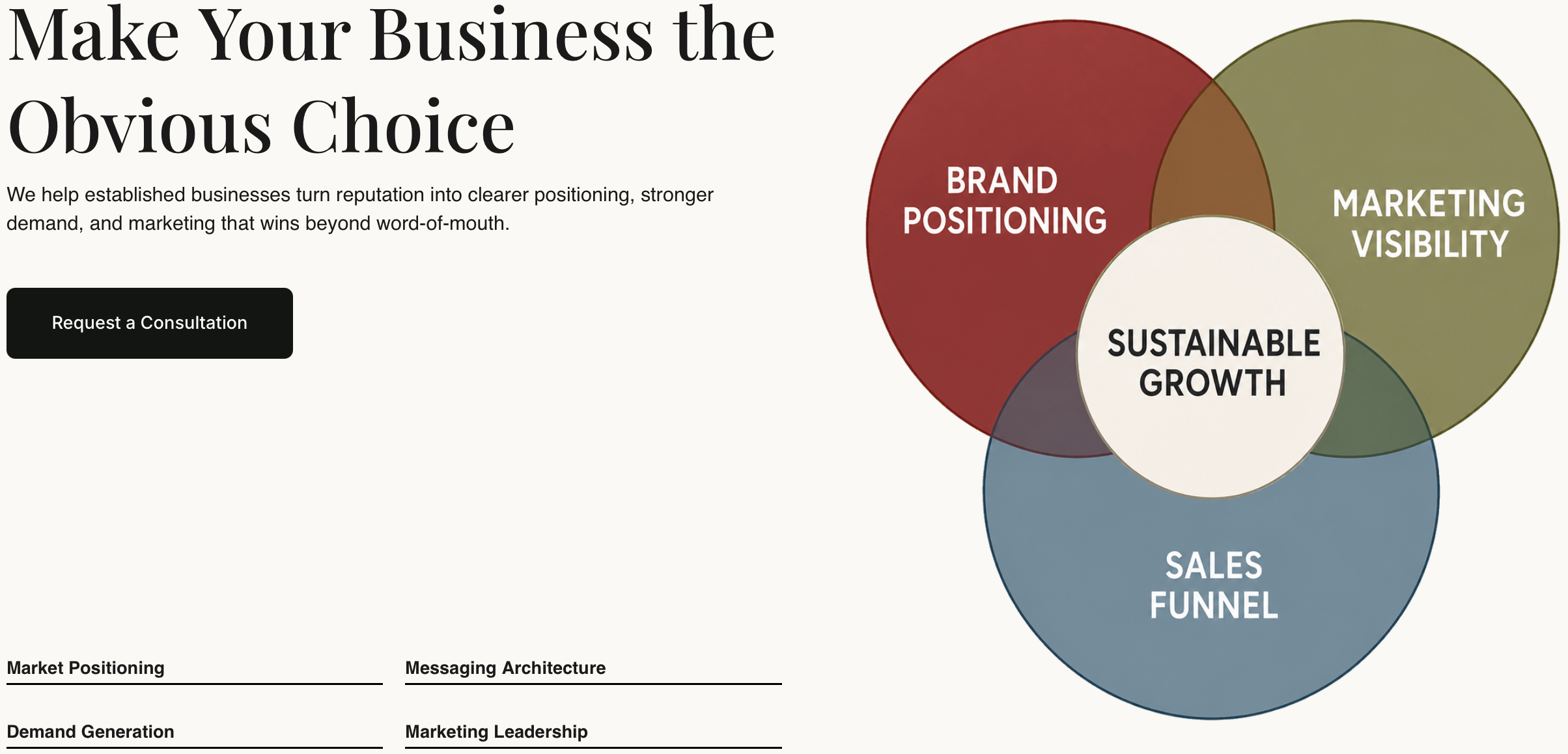
Our small agency approach is built on the Aligned Impact Model™, which means every service we offer connects back to your brand foundation, your audience, and your message. From social media management designed to build visibility and convert followers into buyers, to SEO keyword research that puts your business in front of people actively searching for what you do, every piece of the system works together. We also offer sales page optimization for founders who want to turn existing traffic into real revenue. If you want to see where your brand stands before committing to anything, start with our free Brand Audit Report and get a clear picture of exactly where to focus first.
A small agency acts as a strategic marketing partner that co-owns your brand’s growth goals, handles execution across content, social media, SEO, and campaigns, and provides the accountability and direct communication that larger firms rarely offer.
Small agencies offer faster execution, direct access to senior strategists, and audience-focused messaging. Research shows they can launch creative tests in about 10 days compared to 30 to 45 days at larger firms, which means faster learning and less wasted budget.
The most common challenges faced by small agencies include tool overload, founder bottlenecks, and billing inefficiencies. Studies show that up to 15 to 20% of billable revenue is lost through late invoicing and manual follow-up processes rather than undercharging.
Ask how they track your project, what monthly reporting looks like, and how they handle underperforming campaigns. Agencies with clear, documented answers to these questions have the operational discipline to deliver consistent results.
Authentic messaging that reflects real customer stories and a specific brand voice can increase engagement by up to 50% compared to generic, overly produced content. Small agencies are structurally better positioned to deliver this kind of tailored storytelling.