September 22, 2026
Why Update Brand Messaging: Essential Guide for Growth


Discover what is marketing foundation for entrepreneurs and transform your strategies. Build a solid base for impactful campaigns today!

TL;DR:
- Most entrepreneurs mistake marketing for running ads or posting on social media, which prevents effective growth.
- A marketing foundation is a strategic system encompassing customer understanding, value creation, and consistent messaging that guides all business activities.
- Building a strong, measurable marketing strategy on this foundation ensures long-term, sustainable success rather than scattered tactics.
Most entrepreneurs assume marketing means running ads, posting on social media, or sending emails. That assumption is exactly what keeps so many businesses stuck. Understanding what is marketing foundation changes everything, because it shifts your focus from random activity to purposeful strategy. Your marketing foundation is the system of principles, frameworks, and decisions that every campaign, post, and sales conversation should grow from. Without it, you are spending money and energy on tactics that cannot hold together. With it, every marketing move you make has direction, consistency, and a real chance of working.
Most people think of marketing as the visible stuff. The ads, the captions, the email subject lines. But marketing goes far deeper than communication. The American Marketing Association defines it as the activity and processes for creating, communicating, delivering, and exchanging offerings that have value for customers, clients, partners, and society. That definition covers a lot of ground, and deliberately so.
Marketing touches product development, pricing decisions, distribution choices, customer relationships, and the entire experience someone has with your business. It is not a department. It is a philosophy that runs through every part of how your business operates. Everyone in an organization contributes to marketing success, from the person answering customer emails to the person designing your product packaging.
For entrepreneurs, this matters in a specific and practical way. When you understand that marketing is organizational-wide, you stop treating it like a separate task you do after the “real work” is done. You start building it into how you develop offers, set prices, and talk to customers.
Here is what a genuine marketing foundation covers:
The marketing concept exists to find the right product-market fit based on customer needs, and then build the business around satisfying those needs profitably. That is the core of what every entrepreneur is really trying to do.
Pro Tip: Before you spend a dollar on advertising, write down in one clear sentence who your customer is and what specific problem your product solves for them. If you cannot do that cleanly, your marketing foundation needs work before your budget does.
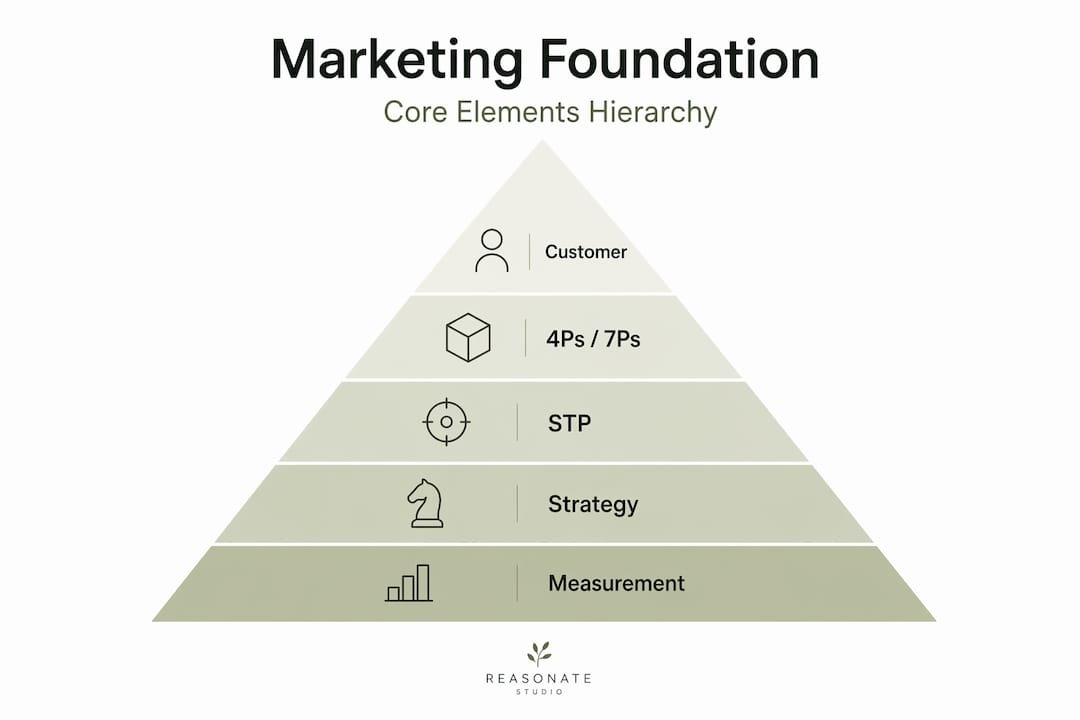
One of the most durable tools in understanding marketing basics is the marketing mix. Entrepreneurs typically build their marketing foundation around the 4Ps: Product, Price, Place, and Promotion. These four elements define how your offer reaches the market and how it is perceived by buyers.
The 4Ps work together as a system, not as separate checkboxes. Change your pricing strategy and it affects how your product is perceived. Change your distribution channel and it affects who can even find you. Shift your promotion strategy and it changes the type of customer who responds. Getting all four aligned is what creates a coherent marketing presence instead of a scattered one.
| Element | Original 4Ps | Extended 7Ps |
|---|---|---|
| Product | What you sell, its features and quality | Same, plus service design and experience |
| Price | What you charge and your pricing model | Same, plus perceived value alignment |
| Place | Where and how customers access your offer | Same, plus digital and hybrid channels |
| Promotion | How you communicate your offer | Same, plus content, SEO, and social |
| People | Not included | Everyone involved in delivering the experience |
| Process | Not included | How the service or product is delivered |
| Physical Evidence | Not included | Tangible proof of quality: packaging, reviews, website design |
The extended 7Ps became necessary as service businesses and digital companies grew. If you are a coach, consultant, or service provider, the original 4Ps leave out three of your most powerful differentiators. People refers to your team, your personal brand, and how customers experience interacting with your business. Process is the system you use to deliver results. Physical evidence covers everything from your website design to your client testimonials to the quality of your proposal documents.
Marketing mix frameworks have evolved considerably, but they remain central to how strong marketing foundations are built. Here is why this matters for your business specifically:
For service businesses especially, the People, Process, and Physical Evidence components often become the primary reason clients choose you over someone else at a similar price point.
If the 4Ps describe what you are offering and how, the STP framework describes who you are offering it to and why they should choose you. STP stands for Segmentation, Targeting, and Positioning, and it is one of the most underused tools in a founder’s toolkit.
The STP framework works by breaking markets into meaningful groups, selecting the groups worth pursuing, and then crafting a message and offer that resonates specifically with those people. Here is how to apply it practically:
Segmentation. Divide your potential market into distinct groups based on shared characteristics. These could be demographic (age, income, location), psychographic (values, lifestyle, goals), behavioral (purchase frequency, product usage), or situational (specific problem they are trying to solve). The goal is to find groups of people who share the same need or motivation, because the same marketing message will land very differently across different groups.
Targeting. Not every segment is worth pursuing with equal intensity. Evaluate each segment by its size, growth potential, competition level, and how well your offer actually fits their needs. Pick one or two primary segments where you have the strongest advantage and the clearest path to being the obvious choice.
Positioning. This is where you define how you want your brand to be perceived in the mind of your chosen segment compared to the alternatives. Your positioning statement is the strategic anchor for every message you write, every visual you create, and every offer you design.
Pro Tip: Most entrepreneurs skip straight to messaging without completing the segmentation and targeting steps first. When your message feels like it speaks to everyone, it connects with no one. STP forces you to make choices, and those choices are what make your marketing feel specific and magnetic.
The part of STP that most founders miss is using it operationally. STP outputs should act as real constraints on your decisions. Your targeting choice should influence which features you prioritize in your product. Your positioning should dictate your pricing tier. Your segmentation should determine which platforms you use and what content formats you create. Treating STP as a one-time thinking exercise rather than an ongoing decision-making tool is one of the most common marketing mistakes entrepreneurs make. To see how this connects to a full marketing strategy, the STP work should happen before you start building campaigns.
Understanding the fundamentals of marketing is only useful if you can convert that understanding into a plan that drives actual business outcomes. A marketing strategy integrates your goals, budget, target market research, positioning, and performance measurement into a long-term plan. It is not a collection of tactics. It is the logic that connects your daily marketing activity to your business growth.

Here is what separates a marketing strategy that works from one that just exists on paper:
| Component | What it looks like in practice |
|---|---|
| Clear objectives | Specific goals tied to revenue, leads, or customer retention, not vague aims like “grow awareness” |
| Budget allocation | Defined spend per channel based on where your target segment actually spends time |
| Competitor analysis | Knowing what others in your space are doing so you can differentiate, not copy |
| KPIs and metrics | Leading indicators (traffic, engagement, conversions) and lagging indicators (retention, revenue) set before launch |
| Review cadence | A scheduled rhythm for checking performance and adjusting, monthly at minimum |
One of the most important things measurement design teaches you is to set your KPIs during strategy-building, not after you have already launched. Most entrepreneurs measure what is easy to track rather than what actually tells them if their strategy is working. Tracking Instagram followers feels rewarding but tells you almost nothing about whether your marketing foundation is generating revenue.
The retention dimension is where many businesses leave significant money on the table. Increasing customer retention by just 5% can boost profits by 25% to 95%. That number exists because acquiring new customers costs significantly more than keeping existing ones, and existing customers tend to buy more often and refer others. A marketing strategy built on a strong foundation prioritizes the customer relationship, not just the acquisition funnel.
For practical next steps on turning these principles into a working plan, Reasonate Studio’s guide on building a marketing plan walks through the planning process in detail.
Knowing the theory is one thing. Applying it without falling into predictable traps is another. Here are the most costly mistakes founders make when building or ignoring their marketing foundation, along with what to do differently.
Confusing brand with campaigns. Your brand is your positioning, your values, and your promise to your customer. Your campaigns are how you express that brand in a given moment. Consistent positioning across product, pricing, and messaging is what builds brand equity over time. Campaigns come and go. Brand foundation compounds.
Letting pricing contradict your positioning. If you position yourself as a premium, high-touch service provider but price like a commodity, buyers get confused and trust breaks down. Every element of your marketing mix needs to tell the same story.
Using STP as a theory exercise only. Running a segmentation analysis and then ignoring the output when you make product decisions defeats the purpose. Your STP conclusions should actively constrain your marketing choices.
Designing measurement after launch. Most founders track performance reactively, looking at numbers only after something goes wrong. Building your KPIs into your strategy from the start means you know within weeks whether a campaign is working, not after you have spent the full budget.
Prioritizing acquisition over retention. It feels exciting to bring in new customers. But a marketing foundation built only around acquisition ignores the far more profitable work of keeping the customers you already have satisfied and coming back.
The pattern across all of these mistakes is the same. They all happen when marketing is treated as a series of tactics rather than a connected system built on a clear foundation. Learning to develop a marketing strategy from the foundation up is how you avoid the costly reset most entrepreneurs eventually face.
I have worked with over 100 small businesses, and I can tell you that the founders who struggle most with marketing are almost never struggling because they lack talent or a good offer. They struggle because they skipped the foundation and went straight to the tactics.
What I have learned is this: a flashy campaign built on a shaky foundation does not just underperform. It actively confuses your audience. When your messaging says one thing, your pricing says another, and your product experience delivers a third, buyers sense the disconnect even if they cannot name it. They just do not buy.
The uncomfortable truth I have seen play out over and over is that most entrepreneurs treat their marketing foundation as something to figure out later, after they start getting traction. But the foundation is what creates the traction. You cannot build clarity at the top of a funnel you built on ambiguity.
What I have found actually works is starting with the customer before you start with the message. Not in a theoretical way. In a real, specific way. Who is one person you want to help? What is the specific outcome they want? What do they believe right now that is standing between them and that outcome? When you can answer those questions, your marketing foundation practically writes itself. The 4Ps give you the structure. STP gives you the focus. But the honest human understanding of your customer is what makes both of those frameworks do real work.
The other thing I wish more founders knew is that marketing organization-wide alignment is not a big-company concept. Even as a solo founder or small team, the way you handle customer service, the way you describe your offer in a casual conversation, and the way you price your services all send marketing signals. Your foundation is only as strong as your least consistent touchpoint.
— Kaitlyn
If you have read this far, you understand the core marketing concepts that separate intentional growth from random effort. You know that your foundation includes your customer understanding, your marketing mix, your STP framework, and a strategy that is designed to measure and retain, not just acquire.
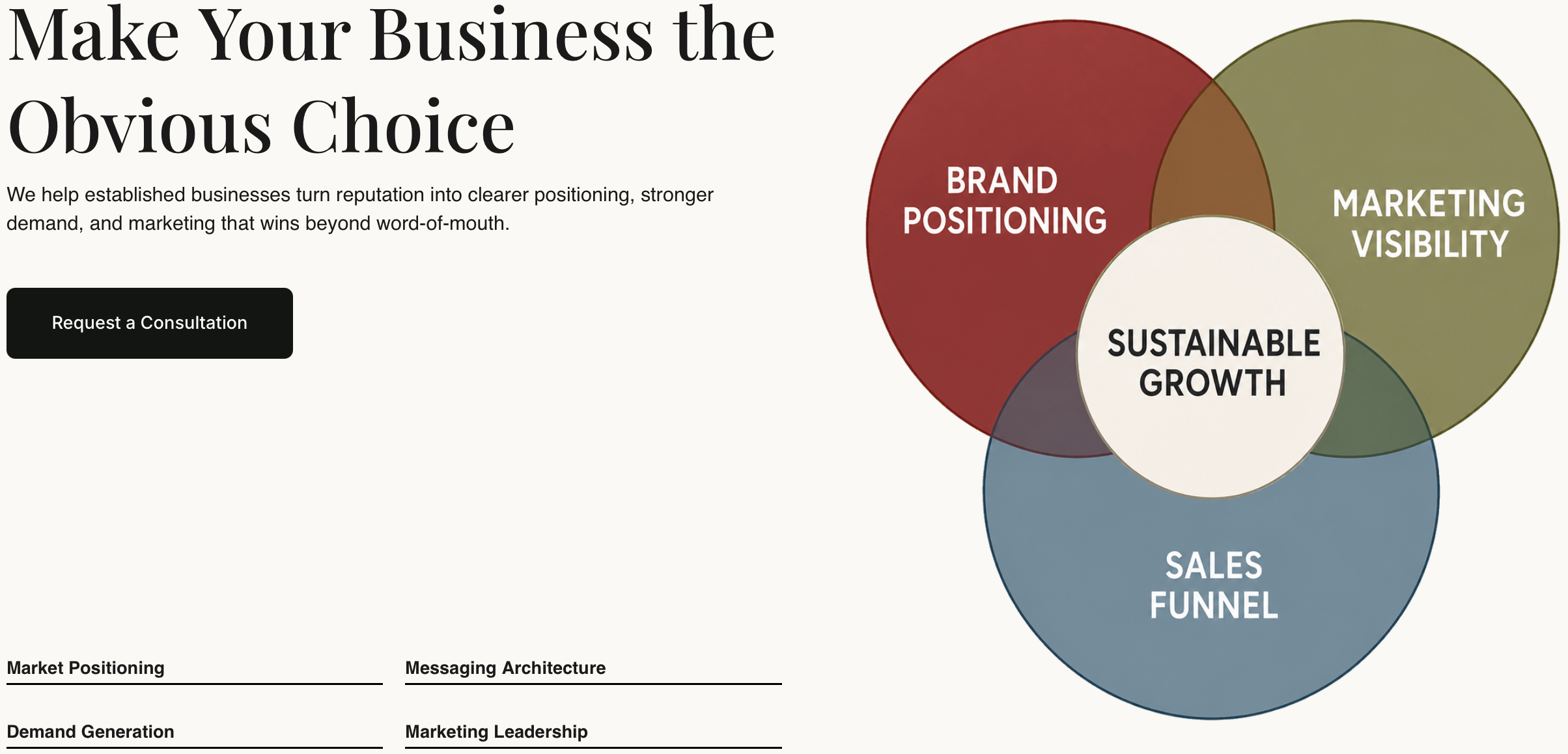
The next natural step is making sure that your marketing foundation actually converts. At Reasonate Studio, we work directly with founders, coaches, and consultants to build strategy-first marketing that turns brand clarity into consistent revenue. One of the highest-leverage places to start is your sales page, the place where your positioning, your offer, and your customer’s decision all meet. Our sales page optimization service is designed specifically for business owners who have the foundation in place and want to make sure their pages are doing the work of converting attention into income. If you are ready to stop leaving conversions on the table, this is where to start.
A marketing foundation is the set of principles, frameworks, and strategic decisions that guide every marketing activity in your business, including your customer understanding, your marketing mix, your positioning, and your performance measurement system.
The core elements include a clear customer definition, the 4Ps or 7Ps marketing mix, the STP framework for segmentation and positioning, measurable goals, and a strategy that connects your marketing activity to business outcomes.
Without a marketing foundation, campaigns lack direction and consistency, which means your messaging, pricing, and product experience can contradict each other and erode buyer trust rather than build it.
The STP framework helps you identify the most valuable customer segments, choose which to prioritize, and craft positioning that makes your offer the obvious choice for those specific buyers.
Your marketing foundation covers the core principles and frameworks that inform all decisions. Your marketing strategy is the specific plan built on top of that foundation, with defined goals, budgets, channels, and KPIs tied to measurable outcomes.