September 22, 2026
Why Update Brand Messaging: Essential Guide for Growth


Discover what is brand architecture and learn how it can streamline your brand strategy, enhance growth, and boost your marketing efforts.

TL;DR:
- Many small brands lack intentional brand architecture, leading to confused messaging and wasted marketing efforts.
- Choosing the right model clarifies customer perception, improves marketing efficiency, and enhances overall brand equity.
Most business owners assume brand architecture is something only Fortune 500 companies need to worry about. That assumption is exactly what causes smaller brands to grow into a tangled mess of inconsistent messaging, confusing sub-brands, and wasted marketing spend. Understanding what is brand architecture — and applying it intentionally — is one of the highest-leverage decisions you can make as a founder or marketing professional. This guide breaks down the core models, the real benefits, the common pitfalls, and a practical path forward for building a structure that actually serves your growth.
Brand architecture is the blueprint that defines how all the brands, products, and services within a company relate to one another. Think of it as the organizational chart for your brand. It determines how much equity each product or service borrows from the parent brand, how independently each offering is positioned in the market, and how customers experience the full range of what you offer.
“Brand architecture is the blueprint for interdependent relationships of a company’s brands, defining how much each brand should rely on the parent’s equity.”
This is not the same as a brand portfolio, though the two concepts are often confused. A brand portfolio is simply the collection of all brands a company owns. Brand architecture is the strategic system that governs how those brands are organized, named, positioned, and marketed in relation to each other. One is an inventory. The other is the strategy behind it.
Why does this matter in practice? Because the relationship between your parent brand and your individual products directly impacts how customers perceive value, trust, and relevance. If you launch a new service under a completely different name with no connection to your established brand, you are starting from zero with zero borrowed credibility. If you launch it under your main brand name, you get a head start on trust but take on reputational risk if the new offering underperforms.

Organizations that take this seriously see a measurable payoff. Companies with clear brand architecture achieve 3.5 times more market visibility than those without a deliberate structure. That is not a marginal gain. That is the difference between a brand that gets noticed and one that gets overlooked.
The four main brand architecture models are the branded house, house of brands, endorsed brands, and hybrid models. Each one comes with a different philosophy about how visibility, credibility, and risk should be distributed across your portfolio.
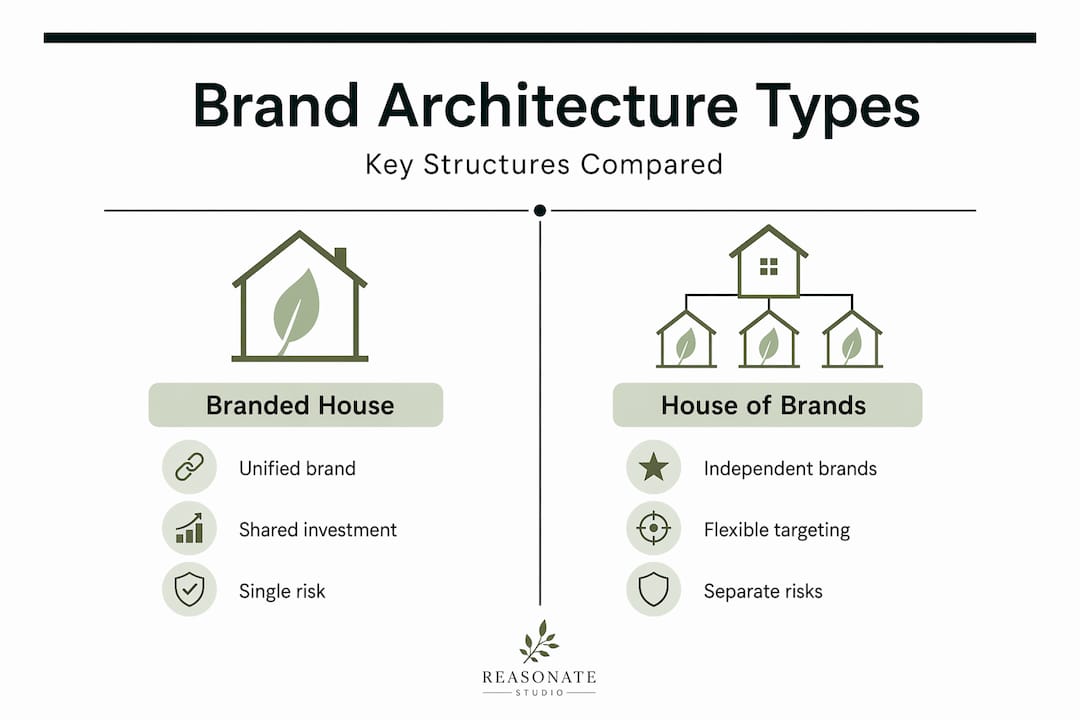
In a branded house, every product or service lives under one master brand. The parent brand carries all the weight, and individual offerings are extensions of that single identity. Apple is the textbook example. Whether you are buying an iPhone, a MacBook, or AirPods, you are buying Apple. The sub-product names are descriptive, not brand-building exercises in their own right.
The advantage is obvious: every marketing dollar you spend builds the same brand equity. The risk is equally clear: if one product has a crisis or underperforms, the entire brand feels it.
Here, a parent company owns multiple independent brands, each with its own identity, positioning, and audience. The parent company deliberately stays in the background. Customers may not even know that two products they love come from the same corporate owner.
This model offers significant market flexibility, letting each brand speak directly to a different segment without compromising the others. The cost of that independence is real, though. A house of brands strategy requires significantly more investment to build each brand independently. You are essentially running multiple brand-building operations at once.
This model sits between the two extremes. Each offering has its own distinct identity, but the parent brand’s name appears alongside it to lend credibility. Marriott’s hotel portfolio works this way. Brands like Courtyard by Marriott and Fairfield by Marriott maintain their own personality and price positioning, but the Marriott endorsement signals quality to customers who might not yet know the individual property.
This structure works well when you want to reach new audiences or market segments without abandoning the trust capital you have already built.
Hybrid brand architectures allow companies to balance parent brand credibility and brand independence efficiently. Large organizations often find that no single model works perfectly across every market or product category, so they combine elements of two or more structures. Google operates this way. Gmail and Google Maps are firmly inside the branded house. But Alphabet, Google’s parent company, quietly holds brands that operate with full independence.
Here is a comparison of the four models across the key decisions you will face:
| Model | Brand equity use | Marketing investment | Risk profile | Best for |
|---|---|---|---|---|
| Branded house | Fully shared | Centralized, efficient | High (all eggs, one basket) | Cohesive product lines |
| House of brands | Independent per brand | High across each brand | Contained per brand | Diverse markets, M&A growth |
| Endorsed brands | Shared with flexibility | Moderate | Medium | New offerings under trusted parent |
| Hybrid | Mixed | Variable | Depends on structure | Large, complex portfolios |
Pro Tip: Before choosing a model, map every product and service you currently offer and identify whether they are naturally connected in your customer’s mind. That map will reveal which structure you are already using by default and whether it is working for or against you.
Understanding brand architecture is one thing. Knowing why it matters strategically for your business is another conversation entirely.
The benefits come down to three areas.
The challenges are just as real, and they tend to catch companies off guard.
One of the most underestimated challenges is internal alignment. Brand architecture should function as an internal organizational tool, not just an external marketing framework. When PepsiCo undertook its first major structural rebrand in over 20 years, the company had to align thousands of employees across 30 countries and 60 product categories before anything went public. The external campaign was only possible because the internal work came first.
For smaller businesses, the fragmentation risk is different but just as damaging. If you add a new product line without thinking through how it fits your existing structure, you end up with a brand that feels scattered to your audience. Customers cannot figure out what you really do. Referrals become vague. Conversion suffers.
Pro Tip: When evaluating your current brand structure, ask your team members to explain the relationship between your offerings without looking at any marketing materials. If the answers are inconsistent, your architecture has a clarity problem that no amount of new content will fix.
Building or refining your brand architecture does not require a six-figure consulting engagement. It does require honest thinking and a structured process. Here is how to approach it.
Audit what you already have. List every product, service, and brand name your business operates under. Note which ones share visual identity, which have separate positioning, and which have no clear relationship to each other. You are looking for patterns and gaps.
Identify your growth direction. Are you planning to expand into new markets? Acquire other brands? Launch sub-products for different customer segments? Your architecture needs to accommodate where you are going, not just where you are today. Companies often evolve from one brand architecture model to another as they grow and acquire new brands.
Choose a model based on your business strategy. Use the comparison table above as a starting point. Then pressure-test your choice against your customer relationships. Would your existing customers be confused if two of your offerings had completely separate brand identities? Would they be more or less likely to trust a new offering if it carried your main brand name?
Create a visual brand hierarchy diagram. Draw a simple organizational chart for your brand portfolio. Place the parent brand at the top, then map every sub-brand, product line, and service beneath it. Indicate the relationship strength with lines or labels. This diagram will become a reference tool for every future naming, messaging, and creative decision you make. If you want a framework for building this out inside your broader marketing system, the marketing strategy framework at Reasonate Studio is a good place to start.
Align your team before you communicate externally. Decide who owns brand architecture decisions inside your organization. Make sure that sales, marketing, product, and leadership all understand the structure and can explain it consistently. This step is not optional. Internal confusion always leaks out into customer-facing messaging.
Document naming and visual identity conventions. Your architecture only holds together if everyone follows the same rules for naming new products and applying visual identity. Write these rules down in a brand guide that includes specific examples. A creative brand strategy that accounts for your architecture will make this documentation much easier to build and maintain.
Pro Tip: Treat your brand architecture diagram as a living document. Revisit it every time you consider launching a new product, entering a new market, or making a significant change to your positioning. The diagram is not just an org chart. It is a decision-making tool.
The most useful way to understand the four models is to see them operating in the real world, across different industries and different scales.
Apple (branded house): Every product Apple releases carries the Apple name and the same visual language. The architecture has stayed remarkably consistent for decades. When Apple launched Apple TV+, it did not need to build a new brand from scratch because the master brand already carried enormous trust in any category it entered.
Procter and Gamble (house of brands): P&G owns Tide, Pampers, Gillette, and dozens of other brands that have no visible connection to each other or to P&G’s corporate identity. A shopper buying Tide laundry detergent has no reason to know or care that P&G is behind it. This lets each brand speak exclusively to its own customer and compete freely in its category.
Courtyard by Marriott (endorsed brands): The Marriott endorsement gives each hotel brand immediate credibility with travelers who may be encountering the specific property name for the first time. The sub-brand handles its own personality. The parent brand handles the trust.
Google and Alphabet (hybrid): Google’s suite of tools lives inside a tight branded house. But Alphabet, the parent company, also holds Waymo, Verily, and other ventures that operate with full brand independence. This separation protects Google’s core identity from the reputational complexity of entirely unrelated businesses.
The lesson across all four examples is that the architecture choice is never arbitrary. It directly reflects the company’s growth strategy, its customer relationships, and how it thinks about risk. Brand architecture decisions influence critical factors including marketing resource allocation, product naming conventions, and crisis management within a portfolio.
I have worked with founders across dozens of industries, and the most common brand architecture mistake I see is not choosing the wrong model. It is having no model at all and then wondering why the marketing never quite coheres.
Most small businesses grow organically and intuitively. A founder launches a core service, then adds a workshop, then a course, then a done-for-you package. Each addition makes sense in isolation. But over time, without an intentional structure underneath all of it, the brand starts to feel scattered. The website has three different tones. The social media presence promotes things that seem unrelated. Potential clients cannot tell what you actually do at your best.
What I have found, again and again, is that the architecture conversation is really a clarity conversation. When a founder can draw a clean hierarchy of their offers and explain how each one relates to their core brand promise, the marketing almost writes itself. The messaging becomes specific. The positioning becomes defensible. The content has direction.
I also want to push back on the idea that brand architecture is static. It should evolve. The smartest brands I have studied treat their architecture as a living, narrative-driven framework that accumulates meaning over time, not a box they check once and forget. If your business is growing, your architecture should be growing with it.
The other thing most articles will not tell you: the internal version of your architecture matters just as much as the external one. Before you ever change how your brand looks or sounds to the world, the people inside your business need to understand the structure and believe in it. The brands that lose coherence during a growth phase almost always skipped this step.
— Kaitlyn
Knowing how your brand is structured is one thing. Translating that structure into messaging, sales pages, and marketing assets that actually convert is a different skill set entirely. At Reasonate Studio, we help founders, coaches, and consultants move from brand confusion to brand clarity, and then turn that clarity into income.
If you want your brand architecture to show up clearly on your website and in your sales materials, our sales page optimization service is built for exactly that. We take the strategic work you have done on your brand and make sure it lands with the right people in the right way. Your brand structure should drive revenue. We help you make that happen.
Brand architecture is the system that defines how a company’s brands, products, and services relate to one another. It determines how much each offering relies on the parent brand’s credibility and how independently each is positioned in the market.
The four primary types are branded house, house of brands, endorsed brands, and hybrid models. Each one distributes brand equity, marketing investment, and risk differently depending on the company’s portfolio and growth strategy.
A clear brand architecture improves customer clarity, makes marketing spend more efficient, and builds stronger, cumulative brand equity over time. Organizations with a defined structure achieve 3.5 times more market visibility than those without one.
Start by auditing your current offerings and mapping how customers already perceive their relationship to each other. Then match your architecture to your growth direction. If you are expanding into unrelated markets, a house of brands may protect your core identity. If your offerings share a consistent promise, a branded house will build equity faster.
Yes, and it often should. Companies frequently shift their architecture as they grow, acquire new brands, or enter new markets. The key is making those transitions deliberately, with internal alignment before any external changes are made.