September 22, 2026
Why Update Brand Messaging: Essential Guide for Growth


Discover what is brand narrative and how it sets your business apart. Learn to create a memorable narrative that drives growth!

TL;DR:
- Most small businesses mistake having a logo and tagline for a true brand narrative, which is a deeper, evolving framework.
- A brand narrative guides consistent messaging across all channels, creating emotional connections and competitive advantage.
Most small business owners think they have a brand narrative because they have a logo, a tagline, and a consistent color palette. They don’t. What they have is a visual identity. A brand narrative is something far more substantial, and understanding what it really means is the difference between a business that customers remember and one they forget the moment they close the tab. This article breaks down what brand narrative actually is, why it matters for your growth, and how to build one that works across every channel you show up on.
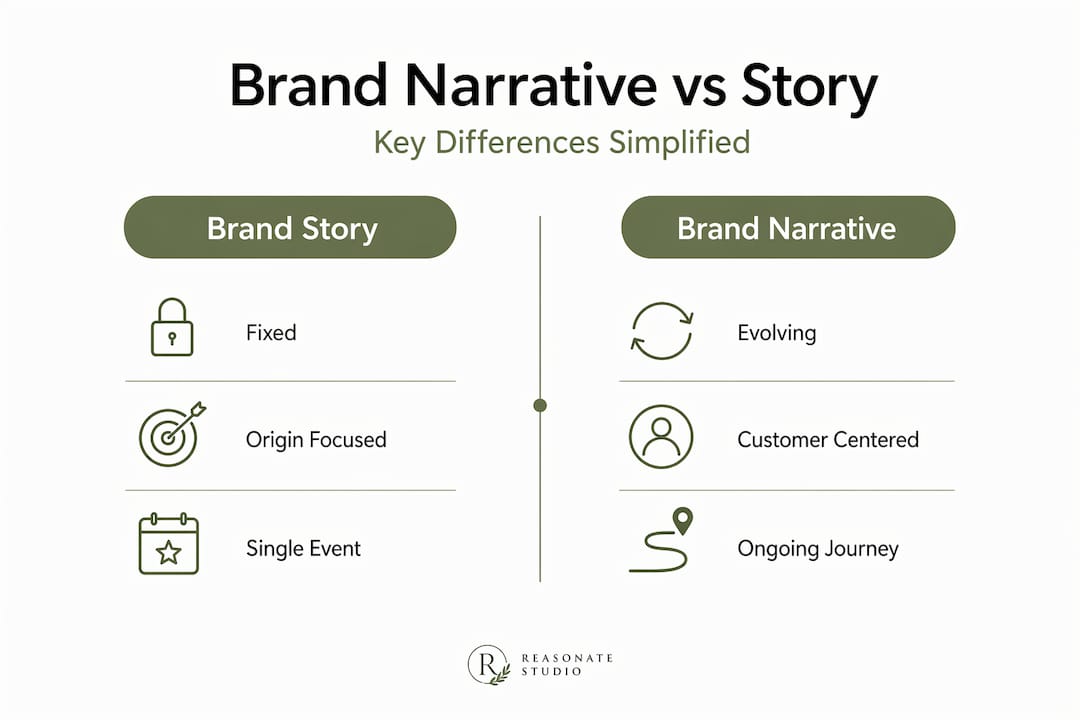
Let’s start by clearing up the most common confusion in this space. A brand story and a brand narrative are not the same thing. Your brand story is a chapter. Your brand narrative is the entire book.
More specifically, brand narrative is the overarching framework that contains your origin story, your messaging, your values, your customer relationships, and every campaign you ever run. It’s the lens through which everything you communicate is filtered. When done well, it creates consistency and recall across every single touchpoint, from a cold email subject line to a homepage headline to how your customer service team responds to a complaint.
Here’s how the three most commonly confused concepts actually differ:
Think of it this way. If Apple’s narrative is “we exist to challenge the status quo and give power back to the individual,” then every product launch story, every ad, and every keynote speech is a chapter inside that larger narrative. The narrative never changes. The stories and messages that live within it do.
For small business owners, this distinction matters because many founders spend enormous energy refining their “about page” or crafting the perfect origin story, while never actually defining the larger narrative that should be guiding all of it. The result is marketing that feels disjointed, even when the individual pieces look polished.
Here’s the honest truth: most small businesses lose customers not because their product is bad, but because their brand doesn’t give people a compelling reason to choose them specifically. A well-defined narrative changes that. Here’s how.
It creates emotional connection. Brand storytelling drives engagement by eliciting empathy and genuine emotion, moving customers from awareness all the way through to purchase. People don’t buy the best product. They buy the product from the brand they feel most aligned with.
It gives your marketing a filter. When you know your narrative, every content decision becomes easier. You stop asking “what should I post today?” and start asking “what story, right now, serves the larger narrative we’re building?”
It aligns your team. The importance of brand storytelling extends well beyond marketing. When your sales team, your customer success team, and your social media manager all understand the same narrative, your brand starts to sound like one coherent voice instead of three different companies.
It builds competitive advantage. Your competitors can copy your pricing, your product features, and your visual design. They cannot copy an authentic, well-constructed narrative rooted in your specific story and customer relationships.
It protects your positioning. If you don’t define your own narrative, the market will define it for you. Competitors, customers, and critics will fill the vacuum with their own interpretation of who you are and what you stand for.
Pro Tip: Write your brand narrative as a single, clear paragraph that anyone on your team could read and use to make a content decision. If it takes more than a paragraph to explain, it’s still a positioning document, not a narrative.
The risk of inconsistent storytelling across channels is real. When your Instagram sounds inspirational, your website sounds corporate, and your emails read like a discount newsletter, customers experience three different brands and trust none of them.

A narrative doesn’t come from thin air. It’s built from specific structural elements that work together to create something memorable, resonant, and repeatable. Here are the core building blocks.
Every strong brand narrative has what some strategists call a narrative spine. This is the central, unifying idea that all your stories and messages point back to. It’s not a tagline. It’s the underlying belief or tension that makes your brand meaningful. For Reasonate Studio, that spine is the belief that marketing should start with clarity, not chaos, and that every founder deserves a brand that actually reflects who they are.
This is where most small businesses go wrong. They put themselves at the center of their own narrative. “We started this company because…” “Our team has 20 years of experience…” Your customer needs to be the hero of the story. You are the guide. Think of the customer-centric structure that effective narratives use: protagonist (your customer), conflict (the problem they face), transformation (what changes when they work with you), and proof (real results that confirm the transformation is real).
| Element | Brand-centric (avoid) | Customer-centric (use) |
|---|---|---|
| Opening | “We’ve been in business since 2010…” | “You’re tired of marketing that doesn’t work…” |
| Core tension | “Our team is the best in the industry” | “Most founders are invisible online despite doing great work” |
| Transformation | “We offer premium services” | “You get a brand that attracts clients while you focus on your work” |
| Proof | “We have 100 clients” | “A health coach saw a 454% sales increase in 60 days” |
Your narrative should communicate what you and your customer both believe to be true about the world. Not just what you sell. When someone reads your brand and thinks “this is exactly how I see things,” you’ve created something much more powerful than a marketing message. You’ve created belonging.
Unlike a brand story, which has a fixed beginning and end, a narrative is always evolving. New customer stories get added. Your brand’s perspective deepens. The challenges in your industry shift. A strong narrative spine holds all of that together without requiring you to start from scratch every time something changes.
Understanding the concept is one thing. Building it is another. Here’s a practical approach to developing yours from the ground up.
Start with three core questions. Before writing a single word, answer these: Why does your business exist beyond making money? Who is your customer and what is the real problem they are trying to solve? What does transformation look like for someone who works with you? These answers form the raw material of your narrative.
Involve more than just marketing. Narrative ownership needs to extend beyond your marketing team to leadership, sales, and customer service. If your team can’t retell the narrative consistently, it isn’t working yet.
Use a structured storytelling framework. The brand storytelling process benefits from short, clear arcs with a setup, a turning point, and a payoff. Apply this to both your overall narrative and to the individual stories you tell within it.
Test for clarity before you scale. Ask outsiders to retell your narrative after reading it. If they can repeat it back accurately in their own words, you have clarity. If they struggle, simplify. This is the most underused quality check in the brand-building process. See more on proven storytelling approaches that help entrepreneurs make this work in practice.
Map it to every channel. Once your narrative is clear, audit your website, social media, email, and sales conversations against it. Does each channel reinforce the same core idea, or do they each tell a slightly different story?
Pro Tip: Build a one-page “narrative guide” that includes your spine, your customer protagonist, your core tension, and two or three example phrases that reflect your brand voice. Share it with every person who creates content for your brand.
Treating your narrative as living operational infrastructure rather than a document you create once and file away is the mindset shift that separates brands with staying power from those that plateau. The narrative guides decisions. It prevents your sales team and your marketing team from sounding like strangers to each other.
Knowing what not to do is just as useful as knowing what to do. Here are the most common mistakes founders make, alongside the practices that actually work.
Pitfalls to avoid:
Best practices that work:
“Brand storytelling encompasses everything a brand does; it must be grounded in team and customer experiences and expressed consistently across touchpoints.”
Small businesses actually have an advantage over large corporations when it comes to narrative. You have direct access to your customers. Your story is real and recent. The gap between your founding values and your current behavior is smaller. The best brand storytelling examples from small businesses work precisely because they’re specific, honest, and human in a way that most big brands simply cannot replicate.
I’ve worked with hundreds of small business owners, and the pattern is almost always the same. They come in thinking they need better content, better captions, or a new website design. What they actually need is a clear narrative to anchor all of it.
The word “narrative” tends to make founders nervous. It sounds abstract. It sounds like something a large brand with a full agency and a six-figure budget would have. In my experience, that belief is exactly what keeps small businesses stuck in scattered, patchwork marketing.
What I’ve learned from doing this work is that a narrative isn’t a creative exercise. It’s a strategic one. When a founder can tell me in two sentences what their brand stands for, who it’s for, and what changes for a customer who works with them, every other marketing decision gets dramatically easier. Content comes faster. Messaging gets sharper. Sales conversations feel more natural because the story the salesperson is telling matches the story the website already told.
I’ve also seen what happens when narrative ownership stays only in the marketing department. The website says one thing. The founder says something slightly different on a podcast. The sales team closes deals using language that doesn’t match either. Customers pick up on that incoherence even when they can’t name it. They feel like they’re dealing with a brand that doesn’t fully know itself. That feeling erodes trust slowly and consistently.
My advice: stop treating your brand narrative as something you’ll figure out once you’re “bigger.” The narrative is what gets you bigger. Start with the spine, make it customer-centric, and treat it as the operating system that every piece of your marketing runs on.
— Kaitlyn
A clear narrative is only the beginning. The real work is making sure that story shows up consistently across your website, your content, your sales pages, and your search presence. At Reasonate Studio, we help founders, coaches, and consultants build exactly that.
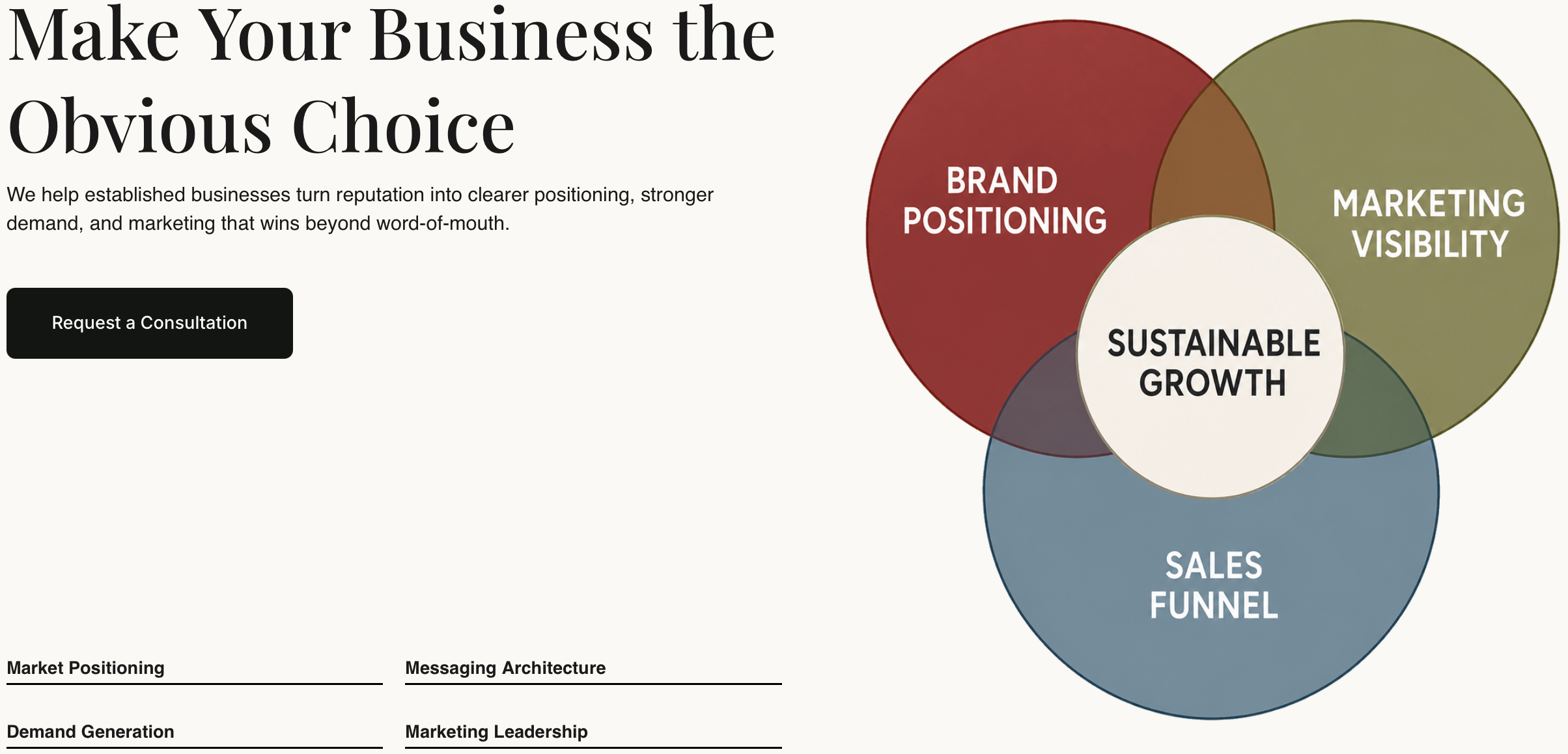
Our sales page optimization service is built specifically to align your messaging with your narrative so that the moment someone lands on your page, they feel like they’re in the right place. We also use SEO keyword research to make sure the story you’re telling is reaching the people who are already searching for exactly what you do. If you want to stop guessing and start building a brand that connects and converts, let’s talk.
A brand narrative is the overarching framework that defines your brand’s identity, purpose, and place in your customer’s world. It contains your origin story, values, messaging, and every campaign you run, creating consistency across all touchpoints.
Your brand story is one specific account, such as how you started your business. Your brand narrative is the larger, evolving framework that holds all your stories and messages together under one consistent idea.
Strong brand storytelling creates emotional connection and moves customers from awareness to purchase. For small businesses, it also builds competitive advantage that competitors cannot easily replicate, since it’s rooted in your specific story and customer relationships.
A strong brand narrative includes a narrative spine (your central unifying idea), a customer-centric structure that positions the customer as the hero, shared values, and proof of transformation. It also needs consistency across every channel where your brand appears.
Ask someone outside your business to read your key brand materials and retell your narrative in their own words. If they can do it accurately and simply, your narrative has clarity. If they struggle or give you a different version of your story, it needs refinement.