September 22, 2026
Why Update Brand Messaging: Essential Guide for Growth


Unlock growth with a website content strategist. Attract your audience and convert visitors into clients with expert content systems.
TL;DR:
- A website content strategist designs content systems that align brand messages with audience needs and measurable business goals. They audit existing content, set standards, map customer journeys, and build workflows that generate consistent growth. Implementing a strategic framework before content creation helps small businesses attract, engage, and convert the right audience effectively.
A website content strategist is a professional who designs and manages structured content systems that align your brand message, attract the right audience, and turn website visitors into paying clients. This role goes far beyond writing blog posts. A skilled content strategist audits your existing content, sets editorial standards, maps content to your customer journey, and builds repeatable workflows that keep your brand visible and consistent. For entrepreneurs and small business professionals, hiring or working with a content strategy expert is one of the highest-leverage decisions you can make. Reasonate Studio’s Aligned Impact Model™ is built on exactly this principle: brand clarity first, then content that converts.
A website content strategist, known in the industry as a content strategist or digital content strategist, is responsible for the architecture behind your content, not just the words on the page. The role combines editorial leadership, audience research, SEO planning, and workflow design into one function. Without this role, most small businesses end up with scattered blog posts, inconsistent messaging, and content that never compounds into real growth.

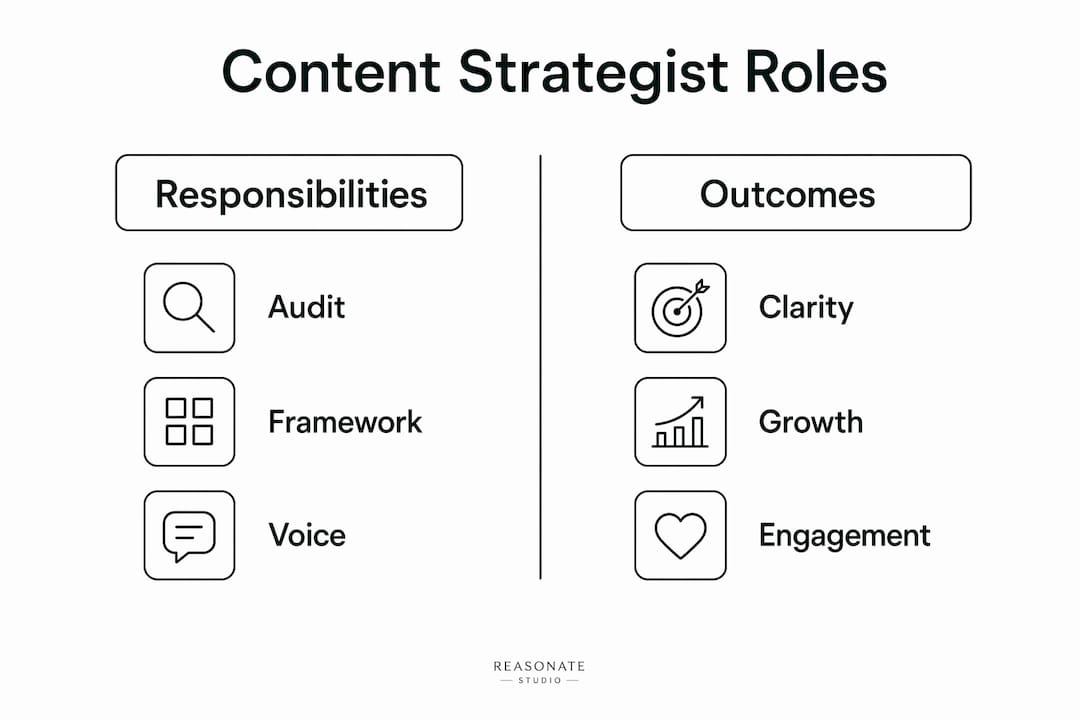
The day-to-day work of a content strategist covers several distinct areas:
One common misconception is that a content strategist is just a senior writer. The roles are different. A writer executes. A strategist decides what to create, why, for whom, and how it connects to your business goals.
Pro Tip: Before hiring a content strategist, ask to see a content audit they have completed. The quality of that audit tells you more about their strategic thinking than any writing sample.
Founders often make the mistake of hiring junior generalists to fill this role. Senior strategists install foundational brand operating systems, including editorial standards and KPI frameworks, that create pipeline consistency over time. A junior hire can write. A senior strategist builds the system that makes all future writing work harder.
A content framework is the structure that connects your brand message to your audience’s needs at every stage of their decision-making process. Without a framework, content becomes a series of disconnected efforts. With one, every piece you publish reinforces the last.
A structured, six-month hub-and-spoke strategy can increase organic demo requests by 15% for small businesses. That number matters because it shows content strategy producing pipeline, not just traffic.
| Approach | Primary focus | Best for | Typical outcome |
|---|---|---|---|
| Volume-first publishing | Quantity of posts | Short-term traffic spikes | High effort, low compounding |
| Pillar-based hub-and-spoke | Topical authority | Long-term SEO growth | Compounding search visibility |
| Journey-mapped content | Conversion at each stage | Lead generation and sales | Higher qualified traffic |
| Brand voice-led content | Emotional connection | Brand differentiation | Stronger audience loyalty |
The pillar-based and journey-mapped approaches are not mutually exclusive. The most effective content strategy frameworks combine both, using hub topics to build authority and journey mapping to ensure each piece moves readers toward a decision.
AI tools have changed what a small team can produce. A two-person business can now publish at the volume of a ten-person team. The risk is that speed without strategy produces generic content that erodes brand trust instead of building it.
The solution is what senior strategists call a human strategy layer. Building AI workflows that ensure output is compliant, on-brand, and audience-specific is the defining skill of a modern content strategist. AI handles drafting and ideation. The strategist handles judgment.
Pro Tip: Create a “brand voice prompt” you paste at the start of every AI session. Include your tone, your audience, two example sentences you love, and one phrase you never use. This single habit improves AI output quality immediately.
Standardized editorial workflows have been shown to increase daily content production capacity by 75% after CMS migrations and workflow implementation. That kind of output gain only holds its value when the human strategy layer keeps quality consistent.
Measurement is where most small business content efforts fall apart. Founders track followers and pageviews because those numbers are easy to see. A content strategist tracks metrics that connect directly to revenue.
| Metric type | Examples | What it tells you |
|---|---|---|
| Vanity metrics | Pageviews, followers, impressions | How much attention you are getting |
| Intent-based metrics | Demo requests, email signups, consultation bookings | Whether content is driving decisions |
| Activation metrics | Feature adoption, repeat visits, time on page | Whether content is educating and converting |
| Retention metrics | Return visitor rate, email open rate, client tenure | Whether your audience trusts and values your content |
Repurposing content into structured learning materials produced a 28% rise in feature adoption for one AI platform, while improving SOPs increased activation rates by 32%. Those results show content measurement working at the activation level, not just the traffic level.
A content measurement system has three parts. First, you set baseline numbers before any new strategy launches. Second, you track weekly or monthly against intent-based KPIs. Third, you run a quarterly content audit to identify which pieces are driving results and which need to be refreshed or retired.
Content refresh is one of the most underused tactics in small business marketing. Updating a high-performing post with new data, better internal links, and a stronger call to action often produces more traffic growth than publishing a brand-new piece. A sustainable content outline built around refresh cycles keeps your content working harder over time without doubling your workload.
The goal of measurement is not to generate reports. It is to make better decisions faster. When you know which content pillar drives the most consultation requests, you create more of it. When you know which page has a high exit rate, you fix it. Data without action is just noise.
Working with founders and small business owners over the years has shown me a pattern that costs businesses real money. They hire a writer first, then a social media manager, then maybe a part-time marketing coordinator. By the time they think about strategy, they have months of content that does not connect, does not convert, and does not reflect who they actually are.
The right order is the opposite. Strategy comes first. A senior content strategist installs what I think of as a brand operating system: the messaging framework, the editorial standards, the content pillars, and the KPI structure. Everything created after that point has a foundation to build on. Without it, you are just producing content and hoping something sticks.
I have seen this play out with coaches who had thousands of followers but no clear offer. With consultants who ranked on Google but attracted the wrong clients. With product founders who published weekly but never built an email list. In every case, the content was not the problem. The absence of a strategic system underneath it was.
The other thing I want founders to understand is that senior strategic leadership is not a luxury for bigger businesses. It is the thing that makes a small business look and feel bigger than it is. When your messaging is clear, your content is consistent, and your editorial standards are documented, your brand earns trust faster. That trust is what shortens sales cycles and increases client retention. At Reasonate Studio, this is the work we do before we write a single caption or publish a single blog post. The strategy layer is not optional. It is the whole point.
— Kaitlyn Cole
If you have read this far, you already understand that great website content starts with a clear strategy, not a content calendar. Reasonate Studio works with founders, coaches, and consultants to build exactly that: a brand-aligned content system that attracts the right audience and converts them into clients.
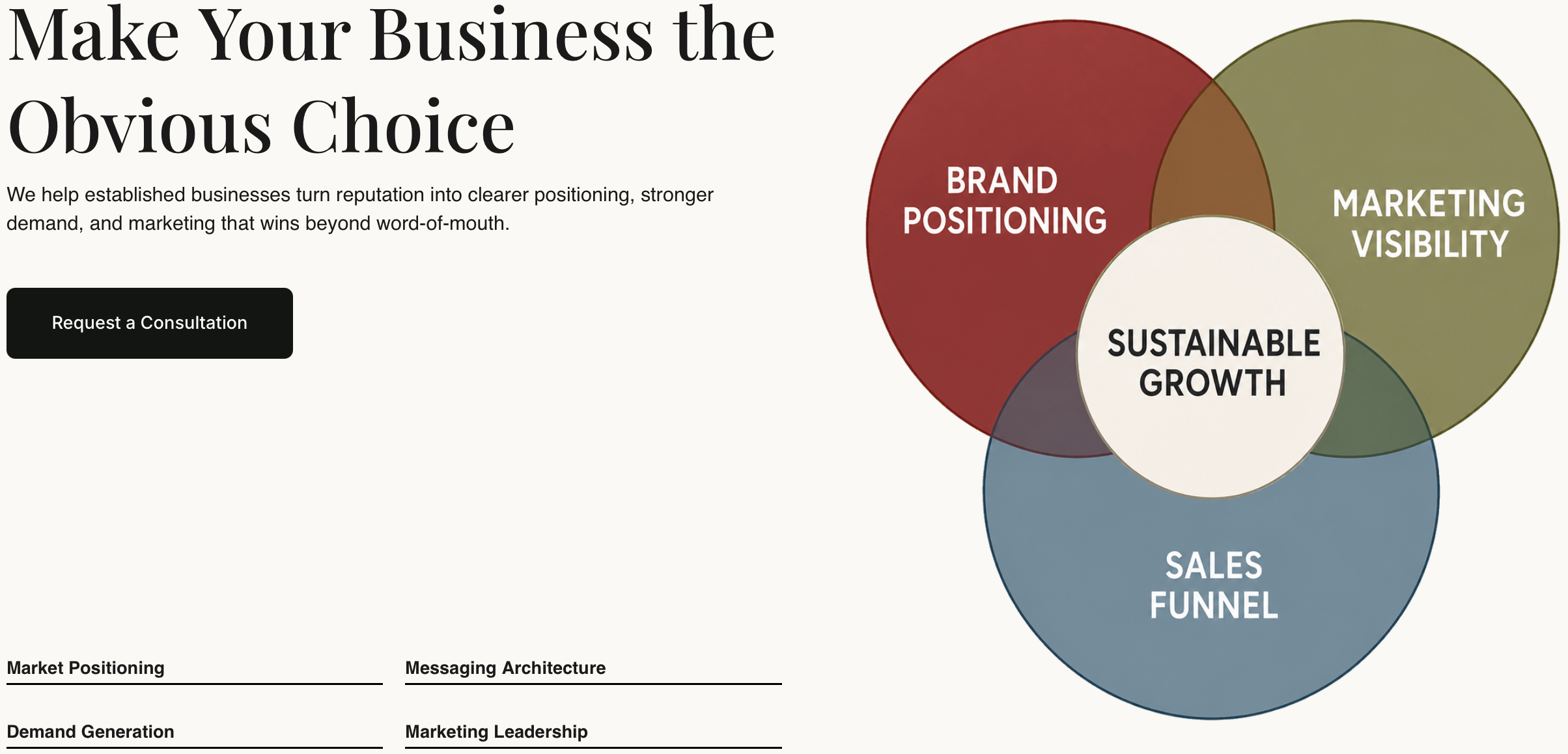
The Aligned Impact Model™ covers brand messaging, content pillars, customer journey mapping, and editorial workflow design, all built around your specific offer and audience. For entrepreneurs who are ready to turn their website into a real growth engine, Reasonate Studio’s sales page optimization service translates your strategic content into pages that convert. You can also explore the full content marketing strategy template built specifically for service-based entrepreneurs. The strategy work is the foundation. The results follow from there.
A website content strategist is a professional who designs content systems that align your brand message, serve your audience’s needs, and connect content to measurable business outcomes like leads and sales.
A copywriter writes. A content strategist decides what to create, for whom, and why, then builds the editorial framework that makes all future writing more effective.
A marketing content strategist audits existing content, sets brand voice guidelines, maps content to the customer journey, and builds repeatable workflows that turn content into a consistent source of qualified traffic and leads.
Effective content measurement tracks intent-based KPIs such as demo requests, email signups, and consultation bookings rather than vanity metrics like pageviews or follower counts.
A small business should bring in a content strategy expert before creating significant amounts of content, not after. The strategy layer is what ensures every piece of content serves a clear purpose and builds toward a measurable goal.