September 22, 2026
Why Update Brand Messaging: Essential Guide for Growth


Unlock the power of branding for small businesses. Discover how 'we are branding' transforms your strategy and customer experience.
TL;DR:
- Branding is a strategic, ongoing process that shapes how your business is perceived across every interaction. Small businesses and coaches should create systems for consistent messaging, product design, and brand monitoring to maintain trust and recognition. Regular audits and clear purpose define the foundation for building a brand that truly converts and supports long-term growth.
Branding is defined as the ongoing, strategic process of shaping how your business is perceived and experienced by the people you want to serve. When coaches, consultants, and small business owners say “we are branding,” they are claiming something bigger than a logo or a color palette. They are committing to a discipline that touches every customer interaction, every piece of content, and every business decision. Sources like Brandwatch, monday.com, and Young Urban Project all confirm the same truth: branding is a system, not a moment.
Effective brand management is a strategic, ongoing process that goes far beyond logos. It focuses on maintaining reputation and consistent messaging across every customer touchpoint to drive loyalty and reduce the cost of winning new clients. For small business owners and coaches, that definition has real teeth. It means your Instagram bio, your sales call tone, your onboarding email, and your website headline all need to tell the same story.
The four pillars of brand management for small businesses are:
Pro Tip: Set a recurring calendar reminder every six months to review your top five customer touchpoints: your website homepage, your social media bio, your email signature, your onboarding sequence, and your most recent sales conversation. Ask yourself whether they all sound like the same person.
Organizations lacking standardized brand systems struggle to scale their brand effectively. That finding applies directly to solo coaches and small teams. When there is no system, the brand only exists inside the founder’s head. The moment you bring on a virtual assistant, a content creator, or a second team member, the brand starts to fragment.
Brand management also means protecting your reputation proactively. Brand equity is fragile and requires vigilant monitoring, quality control, and rapid response to protect against reputation threats. A single viral complaint or a string of inconsistent posts can undo months of trust-building. Treating brand management as a long-term investment rather than a one-time project is the only approach that compounds over time.
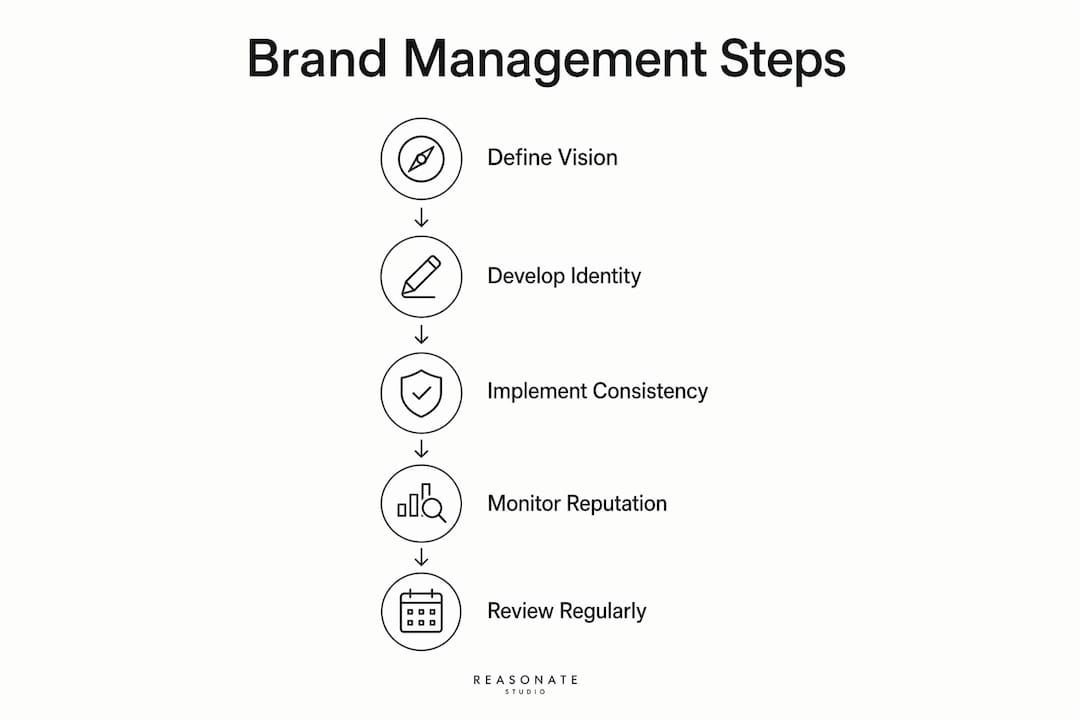
Branding is an operational framework that shapes behaviors and decisions across your entire business. That is the definition that most small business owners miss. They invest in a logo, pick a font, and call it done. The real work is in how the brand guides product development, service design, pricing decisions, and customer communication.
“Branding is the quiet, messy daily work to ensure messaging consistency across all touchpoints, which builds customer preference. Predictable experiences and stable messaging cause customers to prefer your brand without much comparison.” — Young Urban Project
Consider a health coach who positions herself as a high-touch, personalized wellness guide. Her brand promise is intimacy and care. If she then sends automated, generic onboarding emails, the brand breaks. The disconnect between marketing promises and customer experience erodes brand value quickly. That gap is not a marketing problem. It is a brand system problem.
Here is what a brand system actually governs:
Brands designed as strategic systems give businesses clarity and confidence to make decisions aligned with brand purpose and market trends. That clarity is practical. When a new opportunity appears, a well-defined brand system tells you immediately whether it fits or not. That saves time, money, and the kind of scattered energy that burns founders out.

Brand refinement is critical during business growth phases, market shifts, or when your positioning becomes unclear. Those three triggers cover most of the situations coaches and consultants face. You do not need to wait for a crisis to revisit your brand. You need a schedule and a set of signals.
The clearest signs that your brand needs attention are:
Pro Tip: Run a simple brand coherence test. Ask three recent clients to describe your brand in three words. Then ask three prospects who did not convert to do the same. The gap between those two sets of answers tells you exactly where your brand is breaking down.
Failing to adjust leads to obsolescence; changing too fast destroys recognition. That tension is real and worth sitting with. The goal is not to rebrand every year. The goal is to make small, intentional adjustments that keep the brand current without confusing the audience you have already built. A good brand positioning review covers your core message, your visual identity, your audience assumptions, and your competitive position. Done annually, it takes a few hours. Skipped for three years, it becomes a full rebuild.
Building a consistent brand requires systems, not willpower. The founders who maintain strong brands are not more disciplined than everyone else. They have built structures that make consistency the default.
| Tool or method | Best for | Key limitation |
|---|---|---|
| Brand style guide | Visual and voice consistency | Only works if the team actually uses it |
| monday.com work management | Cross-team brand approvals and planning | Overkill for solo operators |
| Content calendar | Messaging consistency over time | Does not address brand strategy gaps |
| Brand audit checklist | Annual alignment review | Requires honest self-assessment |
| Messaging framework | Sales and content alignment | Needs updating when the offer changes |
Modern brand management uses platforms like monday work management to centralize planning, approvals, and cross-functional collaboration for consistent execution. For a solo coach or a small team, a simpler version of that system works just as well. A shared Google Drive folder with your brand guide, messaging templates, and content examples gives any contractor or team member what they need to stay on brand.
The practical steps that matter most are:
Brand identity is company-defined; brand image is customer-perceived and influenced but not fully controlled. That distinction matters. You control the inputs. You do not control the output. The best you can do is make the inputs so clear and consistent that the customer’s perception lands close to your intention. That is the real work of brand management for small businesses and coaches.
Most founders treat branding as a launch event. They invest in a brand identity, feel the excitement of a new look, and then quietly let the brand drift as the day-to-day demands of running a business take over. I have seen this pattern repeat across every industry and every business size.
The uncomfortable truth is that branding is not glamorous work. It is the quiet discipline of saying the same thing, in the same way, to the right people, over and over again until it sticks. The founders who build strong brands are not the ones with the most beautiful logos. They are the ones who show up with the most consistency.
What I have also learned is that most small business owners underestimate how operational branding really is. It is not a marketing function. It is a business function. Your pricing, your hiring, your service design, and your client communication all either reinforce or undermine your brand. When I work with a coach who is frustrated that her marketing is not converting, the problem is almost never the content. It is almost always a gap between what the brand promises and what the client actually experiences.
The other thing I want coaches and consultants to hear is this: you do not need a perfect brand to start. You need a clear enough brand to move forward. Clarity compounds. The more consistently you show up with a defined message and a recognizable voice, the easier every marketing decision becomes. Start with your purpose, your positioning, and your core message. Build from there. The brand consistency work that feels tedious in month two is what creates the recognition that makes sales easier in month twelve.
— Kaitlyn Cole
Knowing what your brand should do and having the systems to make it happen are two different things. Reasonate Studio works with founders, coaches, and consultants who are ready to close that gap.
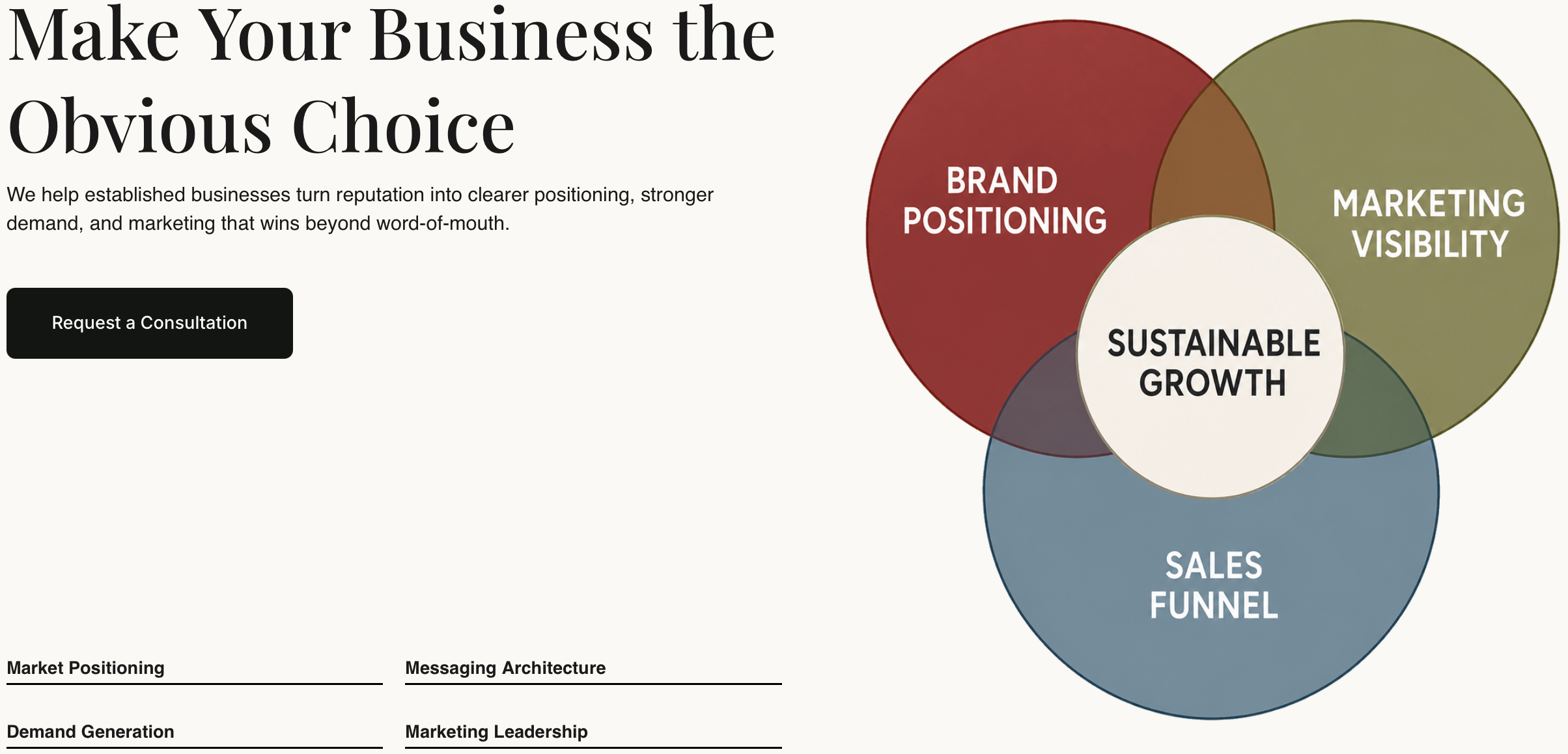
Reasonate Studio’s social media management service handles the daily execution of brand-consistent content, so your messaging stays sharp and your presence stays active without you carrying the load. For founders who need their brand to convert, Reasonate Studio’s sales page optimization aligns your brand story with what your audience needs to hear before they buy. Both services are built inside the Aligned Impact Model™, which means every piece of content and every page works together as one cohesive system. If you want to see where your brand stands right now, Reasonate Studio’s free Brand Audit Report is the clearest place to start.
“We are branding” is the declaration that branding is an active, ongoing business practice, not a one-time design project. It means your business takes responsibility for shaping how it is perceived across every customer touchpoint.
Branding defines who you are and what you stand for. Marketing communicates that identity to attract clients. Branding is the foundation; marketing is the execution built on top of it.
A formal brand audit should happen at least once a year. Smaller reviews of your core messaging and top customer touchpoints work well every quarter to catch drift before it becomes a bigger problem.
The two most common mistakes are treating branding as a one-time visual project and allowing a gap to grow between marketing promises and the actual client experience. Both erode trust faster than most founders realize.
Define your brand purpose and positioning before you create any content. Knowing exactly who you serve, what problem you solve, and why you are the right choice gives every marketing decision a clear direction.