September 22, 2026
Why Update Brand Messaging: Essential Guide for Growth


Discover how to build brand confidence for coaches and consultants. Enhance trust, increase customer loyalty, and drive sales effectively.
TL;DR:
- Brand confidence is the alignment between what your brand promises and what it delivers, which builds trust and increases sales.
- Small businesses can strengthen this confidence by ensuring messaging clarity, consistency, delivery integrity, and active reinforcement through social proof.
Brand confidence is the internal and external alignment between what your brand promises and what it actually delivers. For small business owners, coaches, and consultants, that alignment is not optional. 87% of consumers are willing to spend more when they trust a brand. That single number explains why learning how to build brand confidence is one of the highest-return investments you can make in your business. 92% of consumers also expect brands to actively build trust. Your clients are not waiting passively. They are watching how you show up, what you say, and whether your delivery matches your pitch. The good news is that brand confidence is a skill, not a personality trait. You can build it deliberately, step by step.
Brand confidence is defined by five components that work together as a trust architecture. Positioning clarity, narrative consistency, behavioral consistency, delivery integrity, and reinforcement loops must all align. When even one is out of sync, credibility leaks. For coaches and consultants, that leak often shows up as a prospect who seemed interested but never converted.

The table below breaks down each component and its function for service-based businesses.
| Component | What it means | Why it matters for coaches and consultants |
|---|---|---|
| Positioning clarity | You know exactly who you serve and why you are the right choice | Removes confusion at first contact |
| Narrative consistency | Your story reads the same across your website, social media, and sales calls | Builds recognition and reduces buyer hesitation |
| Behavioral consistency | You show up the same way every time, regardless of the channel | Creates predictability, which clients read as reliability |
| Delivery integrity | Your service matches or exceeds what you promised | Protects long-term reputation and drives referrals |
| Reinforcement loops | Happy clients refer others, reviews accumulate, and trust compounds | Turns satisfied clients into a growth engine |
Aligned branding reduces the cost of persuasion by reinforcing the same message at every touchpoint. That means every Instagram post, every email, and every discovery call does double duty. It sells and it confirms. When all five components are working together, your brand stops needing to convince people and starts attracting them.
Inconsistency is the most common trust leak for small business owners. A polished website paired with vague social posts sends a mixed signal. A strong sales call followed by a slow onboarding process does the same damage. Clients notice the gap between what you promised and what they experienced. Closing that gap is the core work of building brand authority that lasts.
Building brand credibility does not require a rebrand or a six-figure marketing budget. It requires clarity, consistency, and follow-through. The following six steps give you a practical path forward.
Audit your brand promise. Write down the single most important outcome you deliver for clients. Then check every page of your website and every social profile against that promise. If the language does not match, rewrite it until it does.
Simplify your messaging. Jargon creates distance. Plain language creates connection. Replace industry terms with the words your clients actually use when they describe their problem. If a prospect cannot explain what you do after reading your homepage, your messaging needs work.
Add social proof at every decision point. Video testimonials outperform written quotes because they are harder to dismiss. Place proof where hesitation lives: on your pricing page, inside your sales emails, and at the bottom of your service descriptions. User-generated content from clients on social media works the same way. It shows real results without you having to claim them yourself.
Lock in your visual and tonal identity. Choose three brand colors, two fonts, and one consistent voice. Apply them everywhere. Consistency in visuals is not about aesthetics. It is about recognition. When someone sees your content in a feed, they should know it is yours before they read a single word. A clear brand identity is one of the fastest ways to increase brand trust without spending more on ads.
Deliver before you have to. Send the welcome email before the client asks. Deliver the draft before the deadline. Follow up after a session without being prompted. Small acts of over-delivery compound into a reputation. That reputation is what generates referrals.
Ask for feedback and use it publicly. After every engagement, ask your client what changed for them. Then turn that answer into a case study, a testimonial, or a social post. You are not bragging. You are giving future clients evidence that your promise is real.
Pro Tip: The biggest confidence killer for coaches and consultants is inconsistency between platforms. Run a 15-minute audit once a month. Check your LinkedIn bio, Instagram profile, and website headline. If they tell three different stories, pick one and align the rest to it.
Brand confidence is best built through repeated action, not through waiting until everything feels perfect. Start with step one today. The clarity you gain from that single exercise will make every other step easier.
Monitoring brand confidence is not a one-time exercise. It is an ongoing feedback loop that tells you whether your positioning is landing and whether your delivery is holding up. Metrics like Net Promoter Score, customer satisfaction scores, referral traffic, and churn rates give you a clear picture of where confidence is strong and where it is slipping.
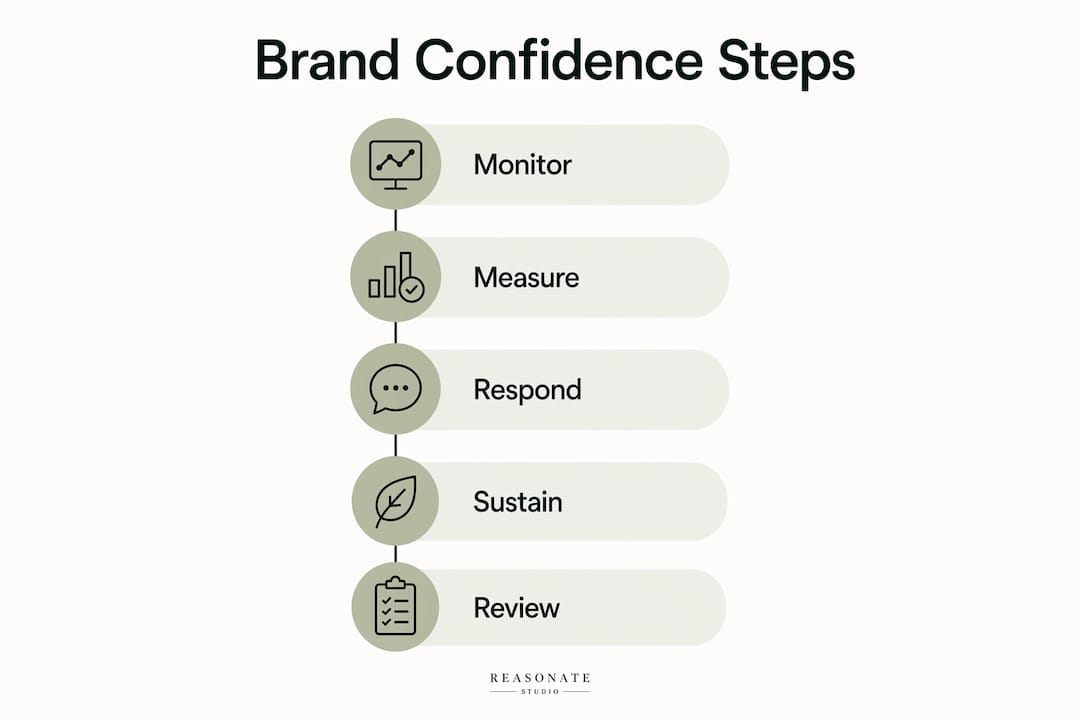
The table below shows each metric, what it measures, and what a change in that number actually signals.
| Metric | What it measures | What a drop signals |
|---|---|---|
| Net Promoter Score (NPS) | Likelihood of clients referring you | Delivery or experience gap |
| Customer Satisfaction Score (CSAT) | Satisfaction with a specific interaction | Messaging or expectation mismatch |
| Referral traffic | How many visitors arrive via word of mouth | Weakening brand reputation or reduced client advocacy |
| Churn rate | How many clients stop working with you | Broken promise or unmet expectations |
NPS is the most direct measure of brand confidence for service businesses. A score above 50 means your clients are actively promoting you. A score below 30 means something in the experience is falling short of the promise. Track it quarterly, not annually.
Social listening is a free and underused tool for coaches and consultants. Search your name and your business name on LinkedIn, Google, and any platform where your clients spend time. Read what people say about you when they think you are not watching. That feedback is more honest than any survey.
Direct client feedback is the most reliable source of all. A short three-question check-in after the first 30 days of working together gives you data you cannot get anywhere else. Ask what is working, what is not, and what they wish they had known before hiring you. The answers will sharpen your messaging and improve your onboarding at the same time.
Customer confidence follows a U-shaped trajectory, meaning new clients with low confidence are open to guidance, while experienced clients with high confidence become loyal advocates. That insight changes how you communicate. New clients need reassurance and clear expectations. Long-term clients need recognition and continued proof of value.
Pro Tip: You do not need expensive software to track brand confidence. A simple monthly spreadsheet with your NPS score, referral count, and churn number gives you a trend line within three months. Trends matter more than single data points.
Most brand confidence problems trace back to a small number of repeatable errors. Recognizing them early saves months of lost momentum.
Overpromising and underdelivering. The gap between promise and reality damages trust in ways that are hard to repair. Even well-intentioned effort does not compensate for a delivery gap. Promise less. Deliver more. Every time.
Inconsistent communication across channels. If your email newsletter sounds formal and your Instagram sounds casual, clients sense the disconnect. Pick one voice and use it everywhere. Your tone is part of your brand.
Ignoring negative feedback. One unhappy client who feels heard becomes a neutral or positive story. One unhappy client who feels ignored becomes a public warning to others. Respond to every piece of critical feedback, privately and promptly.
Rebranding instead of refining. When results stall, the instinct is to change the logo, redesign the website, or pick a new niche. Most of the time, the problem is not the brand’s look. It is the clarity of the message or the consistency of the delivery. Refine before you rebuild.
Waiting for perfection before showing up. Confidence in your brand grows through action, not preparation. Coaches and consultants who wait until their website is perfect or their offer is fully developed lose months of trust-building time. Show up with what you have. Improve as you go.
Recovering lost brand confidence takes longer than building it the first time. The fastest path back is direct acknowledgment, a concrete change, and visible follow-through. Clients forgive mistakes. They do not forgive silence.
For a deeper look at proven trust strategies that work specifically for service businesses, the Reasonatestudio blog covers the full framework in detail.
Brand confidence is not about sounding certain. It is about being consistent. I have worked with coaches and consultants who had impressive credentials and polished websites but still struggled to convert prospects. In almost every case, the problem was not their expertise. It was the gap between how they presented themselves and how they actually showed up in the work.
The most confident brands I have helped build were not the ones with the biggest budgets or the most followers. They were the ones where the founder had done the internal work first. They knew exactly who they served, why that person needed them specifically, and what they were willing to promise and protect. That clarity radiated outward. Prospects felt it in the first conversation.
Alignment in brand positioning and behavior creates reinforcement loops where referrals become inevitable. I have seen this play out with a health coach who went from inconsistent inquiries to a fully booked calendar within 60 days. Nothing changed except the clarity of her message and the consistency of her follow-through. No new platform. No new offer. Just alignment.
The advice I give every founder who comes to me feeling stuck is this: stop trying to fix your marketing and start fixing your message. Your marketing is only as strong as the clarity underneath it. When your positioning is sharp, your narrative is consistent, and your delivery matches your promise, confidence stops being something you perform. It becomes something your clients feel before they ever pay you.
Do not wait until you feel ready. Confidence is built through iteration, not preparation. Start with one clear promise. Deliver it exceptionally. Then let the results do the talking.
— Kaitlyn
Your sales page is where brand confidence either closes the deal or loses it. If your messaging is vague, your proof is buried, or your offer is unclear, even warm prospects will hesitate.
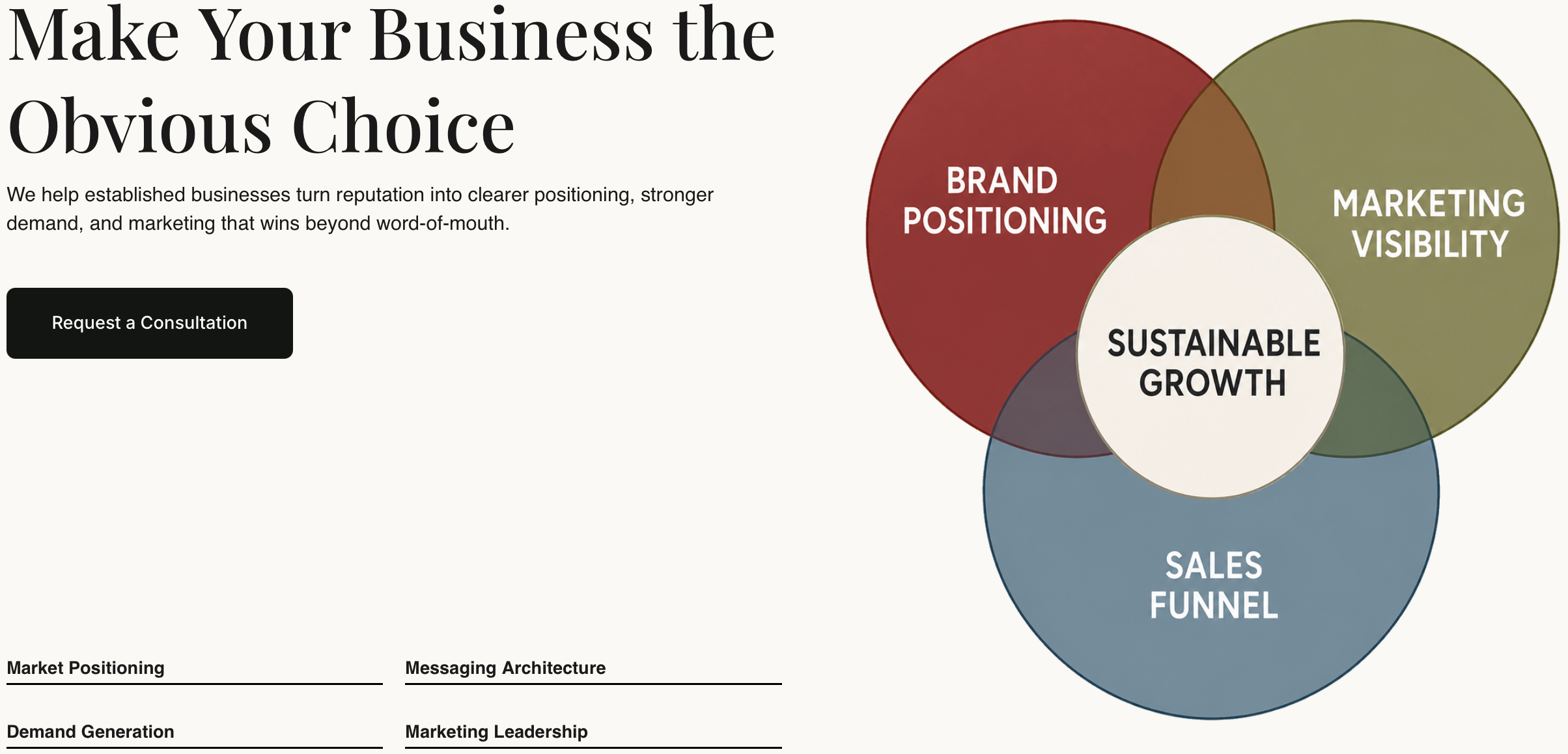
Reasonatestudio’s sales page optimization service is built specifically for founders, coaches, and consultants who know their offer is strong but are not seeing it convert. The team audits your current page, sharpens your positioning, restructures your proof, and rewrites your copy so it speaks directly to the client you want to attract. Every change is grounded in brand strategy, not guesswork. If you are ready to turn your brand confidence into consistent revenue, this is the place to start.
Brand confidence is the alignment between what your brand promises and what it consistently delivers. 87% of consumers are willing to spend more with brands they trust, making confidence a direct driver of revenue.
Confidence in marketing signals authority and reliability, which reduces hesitation and moves prospects toward action faster. Clients choose brands that feel certain over brands that feel scattered.
The fastest way to increase brand trust is to align your messaging across every touchpoint and deliver on your promise without exception. Social proof, such as video testimonials and case studies, accelerates that trust at every stage of the buyer journey.
Track your Net Promoter Score, referral traffic, and churn rate on a monthly basis. A drop in any of these metrics signals a gap between your brand promise and your client experience.
Brand confidence builds through repeated action and iteration, not a single campaign. Most coaches and consultants see measurable shifts in client trust and referral rates within 60 to 90 days of consistent, aligned execution.