September 22, 2026
Why Update Brand Messaging: Essential Guide for Growth


Discover effective service business growth tips to expand your client base, improve operations, and drive predictable revenue for sustainable success.
TL;DR:
- Effective growth for service businesses relies on customer retention, operational efficiency, and measurable KPIs. Standardized pricing and systematized delivery enable sustainable scaling without burnout or profit loss. Building reputation and automating marketing ensure a steady flow of qualified leads while maintaining quality.
Service business growth tips are actionable strategies that expand your client base, improve delivery, and build predictable revenue through proven systems and marketing. The most effective approach combines customer retention, operational efficiency, and targeted marketing into one cohesive plan. Acquiring a new customer can cost up to five times more than keeping an existing one, which means your retention rate is your most powerful growth lever. This article covers the specific tactics that service-based founders, coaches, and consultants use to grow sustainably, including tools like Google Business Profile, CRM systems, and marketing automation, alongside measurable KPIs like customer lifetime value and lead conversion rate.
Customer retention is the most cost-efficient growth strategy available to any service business. Retention costs far less than acquisition, with new customer costs running up to five times higher. That gap means every client you keep is money you do not have to spend winning someone new.

The first 90 days of a new client relationship are the most critical window you have. Proactive feedback loops during this period reduce churn more effectively than any reactive fix later. A simple check-in call at day 30 and a structured review at day 60 can catch dissatisfaction before it becomes a cancellation.
Here are the core retention tactics that work for service businesses:
Retention also creates predictable revenue. A client who stays 24 months is worth dramatically more than two clients who each stay 12 months, because you spend nothing on re-acquisition. Connect your customer retention strategy directly to your revenue forecast, and you will see why it belongs at the top of every growth plan.
Pro Tip: Set a 90-day client health score using three simple signals: response time, engagement with your deliverables, and whether they have referred anyone. If two of three are low, schedule a call immediately.
Operational efficiency is a direct growth strategy, not just a cost-saving exercise. Streamlining back-office operations can reduce overhead by approximately 10% without touching customer-facing services. That recovered margin funds marketing, hiring, or product development without requiring new revenue.
Start with a software audit. Most service businesses are paying for tools they no longer use or have duplicated across departments. Cancel redundant subscriptions, consolidate project management into a single platform like Asana or ClickUp, and standardize your invoicing through tools like FreshBooks or QuickBooks. The savings add up faster than most founders expect.
Automation is the second major lever. Marketing automation tools reduce repetitive tasks across marketing, sales, and administrative workflows, freeing your time for higher-value work. Automating appointment reminders, proposal follow-ups, and invoice delivery alone can recover several hours per week.
Key areas to audit for waste:
Balance is critical here. Cut costs in ways that make your business faster and cleaner, not in ways that make clients feel neglected. The goal is a leaner operation that still delivers at the same level or better.
Pro Tip: Run a 30-minute monthly expense review. Flag any recurring charge over $50 that you have not actively used in the past 30 days. Cancel or downgrade before the next billing cycle.
Vague goals produce vague results. Specific, trackable KPIs are what separate service businesses that grow predictably from those that grow accidentally. The right KPIs cover revenue growth, lead generation, and customer lifetime value, each with a defined monthly target.
A concrete example makes this clear. An estate planning firm sets a target of four new qualified leads per month rather than “grow the business.” That single number tells the team exactly what to optimize, measure, and report on each week. Vague ambitions cannot be tracked. Specific targets can.
The table below shows the KPIs most relevant to service-based businesses, what each measures, and a realistic starting benchmark.
| KPI | What it measures | Starting benchmark |
|---|---|---|
| Monthly recurring revenue (MRR) | Predictable revenue base | Track month-over-month change |
| Customer lifetime value (CLV) | Total revenue per client relationship | 3x your average project fee |
| Lead-to-client conversion rate | Sales efficiency | 20–30% for warm leads |
| Client churn rate | Retention health | Below 5% monthly |
| Average revenue per client | Pricing and upsell performance | Compare to prior 90 days |
| New qualified leads per month | Pipeline health | Set a specific number target |
Weekly tracking keeps you honest. Monthly tracking shows trends. Use a simple dashboard in Google Sheets or a tool like Databox to visualize movement. If you want a structured process for building these targets, the guide on setting marketing goals walks through exactly how to connect KPIs to real business outcomes.
Pricing is the first line of defense on margin in any people-heavy service business. Consistent pricing packages prevent the margin erosion that hits most service firms in the $5M–$25M revenue range. The fix is not raising prices. The fix is standardizing what you sell and at what price before you scale.
Segment your services into three to five core offerings with defined scope, deliverables, and target gross margin for each. This makes it easy to quote, easy to deliver, and easy to train new team members on. Bespoke work is fine, but it should be priced at a premium and treated as an exception, not the default.
The comparison below shows how a standardized model outperforms a custom-quote-every-time approach:
| Approach | Pricing clarity | Delivery consistency | Margin control | Scalability |
|---|---|---|---|---|
| Custom quotes for every client | Low | Variable | Difficult to protect | Hard to delegate |
| Standardized tiered packages | High | Repeatable | Built into the model | Easy to hand off |
| Hybrid (core packages + premium add-ons) | High | Consistent core | Protected on base, flexible on extras | Most scalable |
Tiered pricing also serves your clients better. When someone can see a clear difference between your core offer and your premium offer, they self-select based on budget and need. You spend less time in back-and-forth negotiations and more time delivering.
Monitor your utilization rate before you expand sales. If your team is already at 90% capacity, selling more without adding delivery resources will degrade quality. Capacity management and pricing standardization work together as a system, not in isolation.
Visibility without reputation is noise. Reputation without visibility is wasted. The most effective growth strategies for service businesses combine both into a system that runs with minimal manual effort.
Start with your Google Business Profile. A complete, regularly updated profile with accurate hours, photos, and service descriptions directly affects how you appear in local search results. Treat it like a second homepage, not an afterthought. Reputation management is now a systematic process of soliciting and responding to reviews, and search platforms increasingly use those signals to summarize and rank businesses.
Here is how to build a visibility and reputation system:
Combining SEO, social media advertising, and referral partnerships creates what Fast Company describes as growth and consistency engines that reduce uncertainty in service businesses. Each channel reinforces the others. A prospect who finds you through Google, sees your reviews, and then gets a referral from a trusted contact converts at a much higher rate than a cold lead from any single channel.
For a deeper look at building social visibility that supports this system, the guide on social media visibility covers the specific tactics that work for service-based entrepreneurs.
Systematizing delivery before scaling sales is the single most overlooked growth strategy in service businesses. Documenting processes and setting quality standards allow new hires to integrate without degrading service quality. Without that documentation, growth creates chaos instead of momentum.
Think of your business as a capacity system, not just a sales funnel. Every new client you add puts pressure on your delivery infrastructure. If that infrastructure is undocumented and founder-dependent, adding clients makes things worse, not better. The goal is to build a delivery system that runs at consistent quality whether you are in the room or not.
Start by mapping your core service delivery process from client onboarding to final delivery. Identify every step that currently lives only in your head. Document it in a standard operating procedure (SOP) using a tool like Notion or Google Docs. Then test it by having a team member follow the SOP without your guidance and note where it breaks down.
Transitioning from founder-led sales to pipeline metrics with stage conversion rates is the next step. Instead of personally managing every deal, you track deal speed, conversion rate by stage, and pipeline coverage. This shift is what makes growth scalable rather than dependent on your personal bandwidth.
Pro Tip: Before hiring your next team member, document the role they will fill as if writing a training manual. If you cannot describe the job in writing, you are not ready to hire for it.
Marketing automation reduces repetitive tasks and improves operational efficiency, freeing your attention for the work that actually requires your expertise. For service businesses, the highest-value automation targets are lead nurturing, follow-up sequences, and retargeting.
A lead who visits your website but does not contact you is not a lost lead. With a retargeting campaign through Meta Ads or Google Ads, you can serve that visitor relevant content for weeks after their first visit. Combined with an email nurture sequence triggered by a free resource download, you create a follow-up system that works without manual effort.
The core automation stack for a service business does not need to be complex. An email marketing platform like Mailchimp or ConvertKit handles nurture sequences. A CRM like HubSpot manages pipeline and follow-up tasks. A scheduling tool like Calendly eliminates the back-and-forth of booking calls. Together, these three tools cover most of the repetitive work that currently consumes your week.
Automation also supports your content distribution. Schedule social posts in advance using a tool like Buffer or Later, and set up automated email newsletters that repurpose your best blog content. Consistency in content distribution builds familiarity with your audience over time, and familiarity is what converts a follower into a paying client.
After working with over 100 service-based founders at Reasonatestudio, I have seen the same pattern repeat itself. Founders chase growth by adding more: more services, more clients, more content, more channels. Then they wonder why revenue is up but profit is flat and they are exhausted.
The businesses that grow sustainably do the opposite. They narrow before they expand. They document before they delegate. They measure before they market. The founders who scale well treat their business as a system with constraints, and they fix the biggest constraint before adding more pressure to the system.
The hardest mindset shift I see is moving from founder-led everything to metrics-led oversight. When you are the one closing every deal, you feel in control. When you hand that off to a pipeline dashboard and a trained team member, it feels like losing control. But that discomfort is exactly where real scale begins.
One more thing I want to say directly: do not let perfect be the enemy of documented. Your SOPs do not need to be polished. They need to exist. A rough process that someone else can follow is worth ten times more than a perfect process that lives only in your head. Start there, and the rest of the growth work becomes possible.
— Kaitlyn
Knowing the right tactics is one thing. Executing them consistently while running a business is another challenge entirely. Reasonatestudio helps service-based founders, coaches, and consultants build the marketing systems, brand clarity, and visibility that turn these strategies into real revenue.
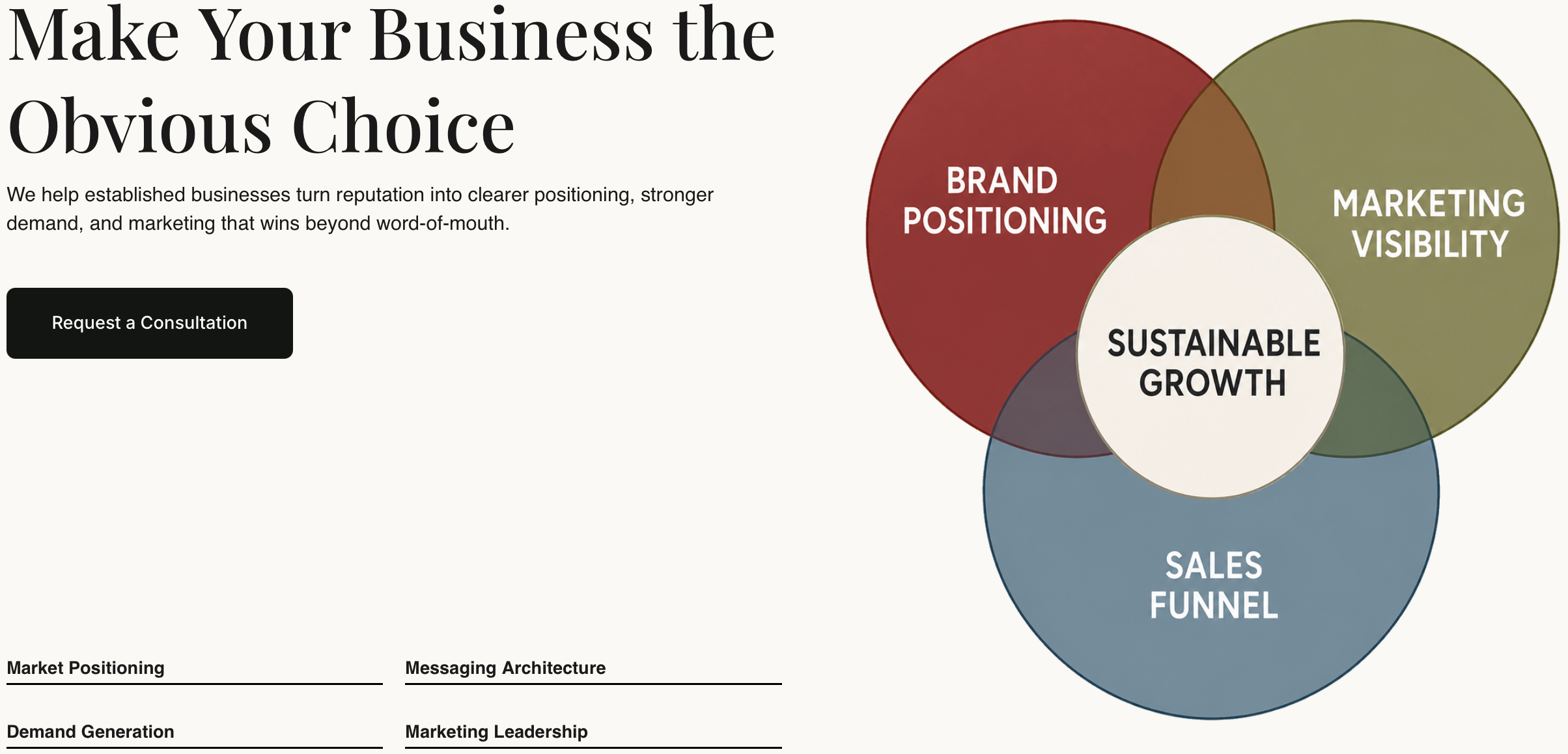
From social media management that keeps your brand visible and credible every week, to sales page optimization that converts more of the traffic you already have, Reasonatestudio handles the execution so you can focus on delivering your service. Explore the full range of marketing and growth services built specifically for service businesses, and find the right entry point for where you are right now.
The most effective growth strategies for service businesses combine customer retention, pricing standardization, and marketing automation into a repeatable system. Retaining existing clients costs up to five times less than acquiring new ones, making retention the highest-ROI starting point.
Systematize delivery through documented SOPs and automate repetitive tasks using tools like HubSpot, Zapier, and Calendly before adding headcount. Operational efficiency creates capacity for growth without the overhead of new hires.
Track monthly recurring revenue, customer lifetime value, lead-to-client conversion rate, and client churn rate at minimum. Setting a specific monthly target for new qualified leads, such as four per month, replaces vague goals with measurable traction.
Standardized tiered packages protect gross margin, make delivery consistent, and simplify the sales process. Businesses that custom-quote every engagement struggle to delegate work and control profitability as they scale.
Invest in marketing automation once your core service delivery is documented and your pricing is standardized. Automating a broken or undefined process only accelerates the chaos. Once the foundation is solid, automation multiplies your output without multiplying your hours.