September 22, 2026
Why Update Brand Messaging: Essential Guide for Growth


Discover the concept of social media marketing for small businesses. Learn strategies to boost brand visibility and engage your audience today!
TL;DR:
- Social media marketing involves using platforms like Instagram, Facebook, and TikTok to build brand visibility and drive business results. A clear strategy focuses on goals, audience research, and platform selection to foster authentic community engagement and conversions. Consistent, targeted efforts on select channels produce better growth and ROI than spreading resources across many platforms.
Social media marketing is the strategic use of platforms like Instagram, Facebook, LinkedIn, TikTok, YouTube, and X to build brand visibility, engage audiences, and drive measurable business outcomes. The concept of social media marketing goes well beyond posting content on a schedule. It is a deliberate system of organic content, paid advertising, community building, and data-driven refinement that works together to grow your business. The average person spends 143 minutes per day on social media. That is nearly two and a half hours of daily attention your brand can earn. For small business owners and entrepreneurs, understanding how this system works is the first step toward using it with real intention.
Social media marketing is defined as the practice of using social platforms to promote a brand, connect with customers, and achieve specific business goals. The industry term most professionals use is “social media marketing,” though you will also hear it called “social marketing” or “social media management” depending on the context. The core idea stays the same: you show up where your audience already spends time, and you give them a reason to pay attention to you.

The importance of social media in business today is not theoretical. 63% of Gen Z and 49% of millennials say their purchase decisions are influenced by social media ads or influencer recommendations. That data tells you something critical: social platforms are not just awareness tools. They are active parts of the customer buying journey.
For small business owners, the concept is especially powerful because it levels the playing field. A well-run Instagram account or a consistent LinkedIn presence can generate the same trust and visibility as a much larger brand, without a large advertising budget. The key is understanding what social media marketing actually includes and how its components work together.
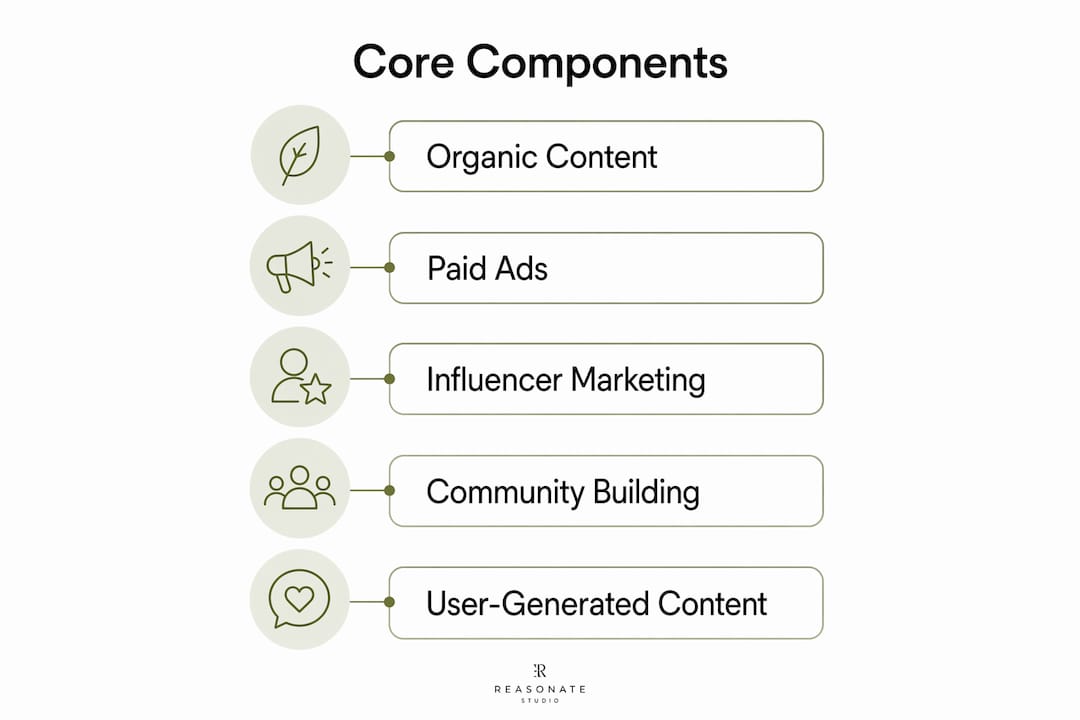
Social media marketing combines organic content, paid ads, influencer marketing, and community building depending on business goals and budget. Most successful brands use three to four of these types together. Each type serves a different purpose, and knowing which to prioritize saves you time and money.
| Type | Purpose | Best for |
|---|---|---|
| Organic content | Build trust and brand voice over time | All businesses, especially early-stage |
| Paid advertising | Reach new audiences quickly and precisely | Businesses with a defined offer and budget |
| Influencer partnerships | Borrow credibility from trusted voices | Product-based and lifestyle brands |
| Social selling | Convert followers into buyers through direct conversation | Service providers and consultants |
| Community building | Create loyal brand advocates | Coaches, educators, and membership businesses |
| Social commerce | Sell directly through platform storefronts | E-commerce and product brands |
| Employee advocacy | Extend reach through team members’ networks | B2B brands and professional services |
Organic content is the foundation. It builds your brand voice, earns trust, and gives paid campaigns something credible to amplify. Paid social media advertising techniques, like Meta Ads or LinkedIn Sponsored Content, accelerate reach but work best when your organic presence already communicates value clearly.
Pro Tip: If you are a small business with a limited budget, start with organic content on one or two platforms for 60–90 days before investing in paid ads. You will learn what resonates with your audience before spending money to amplify it.
Influencer partnerships and user-generated content (UGC) sit in a powerful middle ground. They deliver authenticity that polished brand content rarely achieves on its own. For entrepreneurs, even micro-influencer collaborations with 5,000–20,000 followers in a niche can drive meaningful results at a fraction of the cost of traditional advertising.
A social media strategy is not a content calendar. A true strategy is a concise document that articulates your business goals and explains exactly how social media supports them. The calendar is a tactical tool that lives inside the strategy, not the other way around. Confusing the two is one of the most common mistakes entrepreneurs make.
Building a solid social media plan follows a clear sequence. Here is the process broken into six phases:
Developing a foundational strategy typically takes 2–4 weeks. After that, it functions as a living document with monthly and quarterly revisions. Markets shift, algorithms change, and your audience evolves. Your strategy needs to keep pace.
The biggest mistake at this stage is skipping the goal-setting step and jumping straight to content creation. Without clear goals, you cannot measure whether your effort is working. You end up posting consistently but growing slowly, with no clear explanation for why.
Platform choice is one of the most consequential decisions in your social media approach. The wrong platform wastes time. The right one puts your brand in front of people who are already looking for what you offer.
Here is a breakdown of the major platforms and their best uses for small businesses:
Focusing on 2–3 platforms where your audience is most active leads to higher-quality engagement and sustainable growth. Spreading across every platform dilutes your effort and produces mediocre results everywhere instead of strong results somewhere.
Platform authenticity matters as much as platform selection. A LinkedIn post repurposed word-for-word as a TikTok caption will not perform. Each platform has its own culture, format expectations, and algorithm behavior. Platform-authentic content tailored to each channel’s native format is crucial for reach. Repurposing identical content across platforms reduces both engagement and visibility.
The most important shift in social media marketing right now is the move away from follower count as a success metric. Algorithms now prioritize engagement signals over follower counts. A post that generates 200 genuine comments from 1,000 followers will outperform a post that gets 50 likes from 50,000 followers. That means the goal is not to grow a large audience. The goal is to grow the right audience and give them reasons to respond.
Community building is the mindset that produces this kind of engagement. Broadcasting is the mindset that kills it. Broadcasting means posting content and waiting for reactions. Community building means asking questions, responding to every comment, starting conversations in DMs, and treating your followers like people rather than metrics.
| Engagement signal | What it tells the algorithm | What it means for your brand |
|---|---|---|
| Comments | High relevance and conversation value | Your content sparks real reactions |
| Saves | Content is useful enough to return to | You are solving real problems |
| Shares | Content is worth passing on | You are building word-of-mouth |
| Link clicks | Audience is ready to take action | Your call to action is working |
| Watch time (video) | Content holds attention | Your storytelling is strong |
Social listening is one of the most underused tools available to small business owners. It means monitoring conversations about your brand, your industry, and your competitors to understand what your audience actually cares about. Social listening provides the most valuable social media data, surpassing vanity metrics like follower counts. It informs product decisions, content direction, and customer experience improvements.
User-generated content delivers creator-level authenticity and social proof, outperforming polished brand content across many key performance indicators. Encourage your customers to share their experiences and tag your brand. Repost that content with credit. It costs nothing and builds trust faster than any ad campaign.
Pro Tip: Post less and engage more. Three high-quality posts per week with active community engagement will outperform seven mediocre posts with no follow-up. Quality signals to the algorithm. Consistency signals to your audience.
Learning how to market on social media effectively also means understanding the role of data. Review your analytics monthly. Identify which content types, topics, and posting times drive the most meaningful engagement. Then do more of what works and less of what does not.
Most small business owners come to social media marketing with the wrong frame. They think the goal is to post more. More content, more platforms, more frequency. What I have seen consistently across more than 100 businesses is that the ones who grow fastest are the ones who post with clarity, not volume.
The most common mistake I see is treating social media like a megaphone. Founders broadcast their offers, their wins, their updates, and then wonder why engagement is low. Social media is not a megaphone. It is a conversation. The brands that win are the ones that build genuine community by showing up with curiosity, consistency, and a clear point of view.
I also see a lot of founders paralyzed by platform choice. They feel pressure to be everywhere at once. The reality is that being excellent on two platforms beats being mediocre on six. Pick the platforms where your ideal clients actually spend time, and commit to showing up there with intention.
The other thing I want entrepreneurs to understand is that top brands treat social media teams as strategic translators of real-time consumer data, not just content creators. Your social media presence is a listening tool as much as a publishing tool. Pay attention to what your audience responds to, what questions they ask, and what problems they keep mentioning. That data is more valuable than any trend report.
Social platforms will keep changing. Algorithms will shift. New formats will emerge. The businesses that stay ahead are the ones with a clear brand foundation and a flexible strategy, not the ones chasing every new feature. Build the foundation first. The tactics become much easier after that.
— Kaitlyn Cole
Social media marketing builds attention. But attention only becomes revenue when it lands on a page that converts. Many small business owners invest months into growing their social presence, then lose potential clients the moment those visitors reach a sales page that does not clearly communicate the value of the offer.
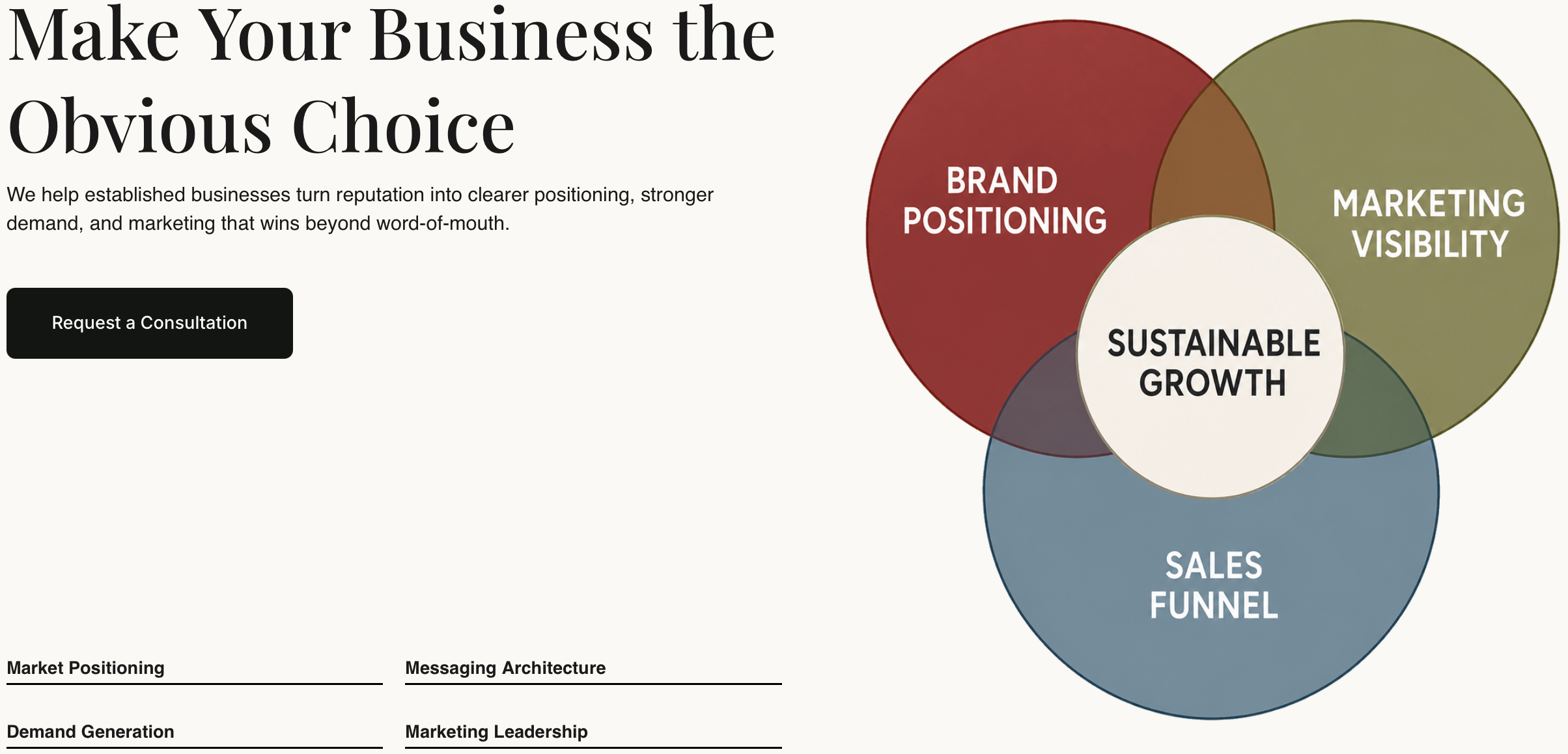
Reasonate Studio’s sales page optimization service is built specifically for founders, coaches, and consultants who want their social media traffic to actually convert. The service covers offer positioning, messaging clarity, page structure, and copy that speaks directly to the buyer’s decision-making process. If your social media is generating interest but your sales page is not closing it, that is the gap Reasonate Studio closes. The work is personal, strategy-first, and led directly by Kaitlyn Cole.
Social media marketing is the practice of using platforms like Instagram, Facebook, LinkedIn, and TikTok to promote a business, connect with customers, and drive sales. It includes both organic content and paid advertising techniques.
Focusing on 2–3 platforms where your audience is most active produces better results than maintaining a presence on every network. Spreading resources too thin leads to inconsistent content and weaker engagement across the board.
A social media strategy is a goal-focused document that explains why and how social media supports your business objectives. A content calendar is a scheduling tool that organizes what gets posted and when. The strategy comes first; the calendar executes it.
Meaningful results typically appear within 60–90 days of consistent, strategy-driven effort. Building a foundational strategy takes 2–4 weeks, and ongoing measurement and iteration are required to sustain and improve performance over time.
Comments, saves, and shares signal stronger audience connection than likes or follower count. Algorithms prioritize these engagement signals, and they indicate that your content is genuinely useful or resonant rather than simply visible.