September 22, 2026
Why Update Brand Messaging: Essential Guide for Growth


Discover how a small business marketing service can boost your brand. Learn essential tactics for growth tailored to founders in 2026.
TL;DR:
- Small business marketing services combine digital, content, and local tactics to help brands grow. They focus on core channels like SEO, social media, and email, with prices ranging from $500 to over $15,000 monthly. Consistent effort over 60 to 90 days generates measurable results, especially with targeted channels like email and local SEO.
A small business marketing service is a specialized set of digital, content, and local marketing tactics designed to help small enterprises grow their brand and engage customers consistently. Unlike generic agency retainers built for corporate budgets, these services are scoped for founders, coaches, and consultants who need real results without a full in-house team. The right provider combines brand strategy, content creation, social media management, and local SEO into one coordinated system. Reasonate Studio’s Aligned Impact Model™ is one example of this approach, built specifically for small business owners who want clarity and revenue growth from their marketing.
A small business marketing service typically bundles four core components: brand strategy, content creation, social media management, and performance reporting. These four areas form the foundation of any credible marketing engagement. Without all four working together, even well-funded campaigns tend to produce inconsistent results.
Beyond the core, most providers offer add-on services based on business type and growth stage. Common additions include:
The channels covered vary by provider. A boutique agency like Reasonate Studio focuses on social media, SEO, and email as the primary growth channels for founders and coaches. Larger generalist agencies may spread across more channels but with less depth per channel.
Scope matters more than the service label. A provider offering “social media management” might deliver 8 posts per month or 20. One offering “SEO” might mean keyword research only, or it might include full on-page optimization and monthly content. Always ask for a deliverables list, not just a service name.
Pro Tip: Before signing with any provider, ask for a sample content calendar and a sample monthly report. These two documents reveal more about actual service quality than any sales call.

Pricing for a small business marketing service in 2026 ranges widely based on scope, channels, and output volume. Monthly retainers range from $1,500 to $25,000 for most small and mid-market businesses. That range reflects the difference between a single-channel starter package and a full-service engagement covering strategy, content, social, SEO, and email.
| Service tier | Monthly cost range | Typical scope |
|---|---|---|
| Starter | $500 to $1,500 | 1 channel, basic content, minimal reporting |
| Growth | $1,500 to $5,000 | 2–3 channels, content creation, monthly reporting |
| Full-service | $5,000 to $15,000 | Strategy, content, social, SEO, email, analytics |
| Enterprise | $15,000+ | Multi-channel, dedicated team, advanced funnel work |
Reasonate Studio’s social media management starts at $900 per month, which places it in the accessible growth tier. That entry point includes a full social strategy, 16 or more posts per month, monthly analytics reports, and direct access to Kaitlyn Cole.
Three pricing models dominate the market. Retainer models charge a fixed monthly fee for an agreed scope. Flat-fee models price individual deliverables like a brand audit or a content package. Performance-based models tie fees to specific outcomes like leads or sales, though these are less common for small businesses because they require strong tracking infrastructure.
About 68% of marketing agencies prefer monthly retainers, with the median for mid-market small businesses sitting around $7,500 per month. That figure reflects full-service engagements. Founders just starting out can access meaningful support for far less.
Pro Tip: Evaluate pricing by scope elements: number of channels, output cadence, who is doing the work, and what the exit terms are. A low monthly fee with a 12-month lock-in can cost more than a higher fee with a 30-day out clause.
The three highest-ROI channels for most small businesses are email marketing, local SEO, and social media. Each serves a different stage of the customer relationship, and together they create a system that attracts, nurtures, and converts.

Email marketing leads on pure return. Email delivers $36 to $42 for every $1 spent in 2026, with some businesses reaching $79 per $1 through automation and segmentation. That number is not from bulk newsletters. Automated flows like welcome sequences and abandoned cart reminders drive a disproportionate share of email revenue despite representing a small fraction of total sends. Build the automation before scaling volume.
Local SEO is the highest-leverage channel for businesses that serve a geographic area. An actively managed Google Business Profile increases location visits by 70% and direction requests by 50%. That kind of lift comes from consistent weekly activity: new photos, posts, Q&A responses, and review replies. Dormant profiles lose effectiveness even when the underlying website is strong.
Timeline expectations matter here. Local SEO results appear in 15–60 days for established businesses with existing citations and reviews. New businesses should plan for 4–6 months before seeing consistent traction. Competitive markets can take 9–12 months. Knowing this upfront prevents the common mistake of abandoning a working strategy too early.
Here is a quick channel comparison for small business owners:
Focusing on one or two primary channels first produces better results than spreading thin across five. For most founders and coaches, social media paired with email marketing is the most practical starting point. For local service businesses, Google Business Profile management paired with local SEO is the stronger combination. You can read more about marketing ROI strategies that apply specifically to small business contexts.
Choosing the right provider is the decision that determines whether your marketing investment pays off or disappears. Most small business owners evaluate providers on price and portfolio alone. That approach misses the factors that actually predict results.
Follow this checklist when evaluating any marketing agency or consultant:
Ask for case studies with real numbers. A provider who has delivered results will show them. Look for specific metrics: percentage increases in traffic, follower growth, lead volume, or revenue. Vague testimonials without data are a warning sign.
Confirm who does the actual work. Many agencies sell at the senior level and deliver at the junior level. Ask directly: who will manage your account day to day? Reasonate Studio’s model keeps every client working directly with Kaitlyn Cole, which is a meaningful structural difference from larger agencies.
Request a 30/60/90 day plan. Businesses should expect clear deliverables for the first 30, 60, and 90 days before signing anything. A provider who cannot articulate what they will do in the first month has not thought through your engagement carefully.
Evaluate how they listen. A strong agency listens more than it talks, asking questions that reveal genuine understanding of your business. If a sales call feels like a pitch with no real questions about your customers or offer, that pattern will continue after you sign.
Understand the scope behind the label. “SEO” can mean keyword research only, or it can mean full on-page optimization, technical audits, and monthly content. “Social media management” can mean 8 posts or 20. Get a deliverables list in writing before committing.
Check exit terms. Long-term contracts are not inherently bad, but you should know what you are agreeing to. Reasonate Studio offers a Love It or Leave It guarantee: a 30-day sprint, and if you are not satisfied, you choose between a free additional service or a full refund.
Running a marketing audit before you hire a provider also helps. It gives you a baseline so you can measure what actually changes after the engagement begins. You can also review how to develop a marketing strategy before your first agency call so you arrive with clear goals.
Working with founders and small business owners since 2017 has taught me one thing above all else: the biggest threat to a marketing campaign is not the strategy. It is the timeline.
Most small business owners judge their marketing results at the 30-day mark. That is almost always too early. A 60–90 day window is the minimum realistic timeframe to trace early actions through to actual leads and sales. Changing strategy every four weeks creates noise, not learning. You end up with a pile of disconnected experiments instead of a compounding system.
The other pattern I see constantly is founders chasing the channel that feels exciting rather than the one that fits their business model. A local service provider does not need a viral Instagram presence. They need a fully active Google Business Profile and a steady flow of five-star reviews. A coach selling a $2,000 program does not need paid ads on day one. They need a clear message and an email sequence that converts warm leads.
The businesses I have seen grow the fastest are the ones who commit to two or three channels, stay consistent for at least 90 days, and measure the right things. Not follower counts. Not impressions. Leads, conversations, and revenue. That is the only scoreboard that matters.
If you are evaluating agencies right now, read about the real role of a small agency before you sign anything. Understanding what a good agency relationship actually looks like will save you from expensive mistakes.
— Kaitlyn Cole
Reasonate Studio works with founders, coaches, and consultants who are ready to stop guessing and start building a marketing system that actually generates revenue.
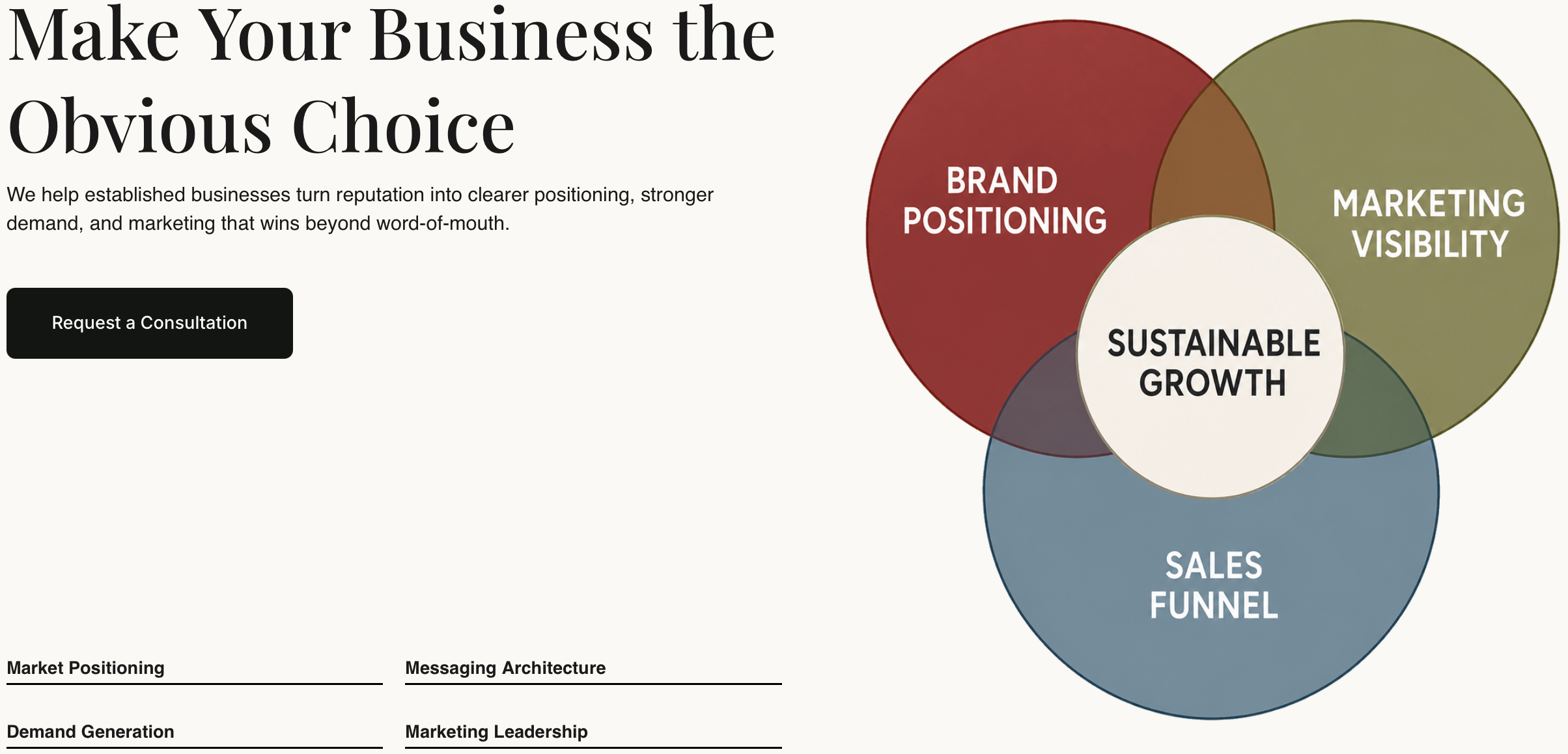
The studio’s social media management service starts at $900 per month and includes a full strategy, 16 or more posts per month, and direct access to Kaitlyn. For businesses focused on local visibility, Reasonate Studio’s local SEO service covers Google Business Profile optimization, citation building, and local keyword targeting. Both services are built inside the Aligned Impact Model™, so every tactic connects back to a clear brand foundation and audience strategy. The studio also offers a free Brand Audit Report, currently valued at $297, as a no-risk starting point for founders who want clarity before committing to a full engagement.
A small business marketing service is a set of digital and local marketing tactics, including social media, SEO, email, and content creation, designed to help small enterprises grow their brand and attract customers. It differs from enterprise marketing in scope, budget, and the level of personalization involved.
Monthly retainers for small business marketing services typically range from $1,500 to $5,000 for growth-tier support. Entry-level packages start around $500 to $900 per month for single-channel services like social media management.
Email marketing delivers the highest measurable ROI, returning $36 to $42 for every $1 spent in 2026. Automated flows like welcome sequences and abandoned cart reminders drive the largest share of that return.
Most small businesses see meaningful results within 60–90 days of consistent marketing activity. Local SEO for established businesses can show movement in 15–60 days, while new businesses should plan for 4–6 months before seeing consistent traction.
Ask for case studies with specific metrics, a written deliverables list, a 30/60/90 day plan, and clarity on who will manage your account day to day. Avoid any provider who relies on vague promises or refuses to show past client results.