September 22, 2026
Why Update Brand Messaging: Essential Guide for Growth


Learn what do you mean by content marketing and how it can help small business owners grow their brand through valuable content.
TL;DR:
- Content marketing involves creating and sharing helpful content to attract a specific audience and build trust. It relies on an inbound system that focuses on long-term engagement rather than immediate promotion.
Content marketing is defined as a strategy where businesses create and share valuable, relevant content to attract and build trust with a specific audience rather than pushing products directly. If you have ever wondered what do you mean by content marketing, the short answer is this: you earn attention by being genuinely useful, not by interrupting people with ads. For small business owners, coaches, and consultants, this distinction is not just philosophical. It is the difference between a brand that grows on its own momentum and one that constantly fights for visibility.
Content marketing is an inbound approach that earns attention organically by giving helpful answers and information rather than sending interruptive promotional messages. The core principle is “value first, promotion second.” You solve a problem, answer a question, or educate your audience before you ever ask them to buy anything. That sequence builds credibility in a way that a paid ad simply cannot replicate.
The industry term you will hear most often is “content marketing,” and it is recognized by organizations like the Content Marketing Institute, Salesforce, and Asana as a foundational discipline within digital marketing. It sits inside the broader category of inbound marketing, which focuses on attracting prospects rather than chasing them. For coaches and consultants especially, content marketing is the primary way to demonstrate expertise before a prospect ever books a call.
The goal of content marketing is long-term engagement. It guides prospects along the buyer journey from first discovering you, to considering whether you are the right fit, to deciding to work with you. Content exists to guide people through each of those stages, not just to fill a feed or hit a posting quota.
Content marketing is made up of four connected stages: planning, creation, distribution, and measurement. Each stage depends on the one before it. Skipping planning and jumping straight to creation is the most common mistake small business owners make.
Planning starts with audience research. You need to know who you are talking to, what questions they are asking, and what problems keep them up at night. Keyword and topic analysis fits here too. It tells you which subjects your audience is actively searching for, so your content has a real chance of being found.
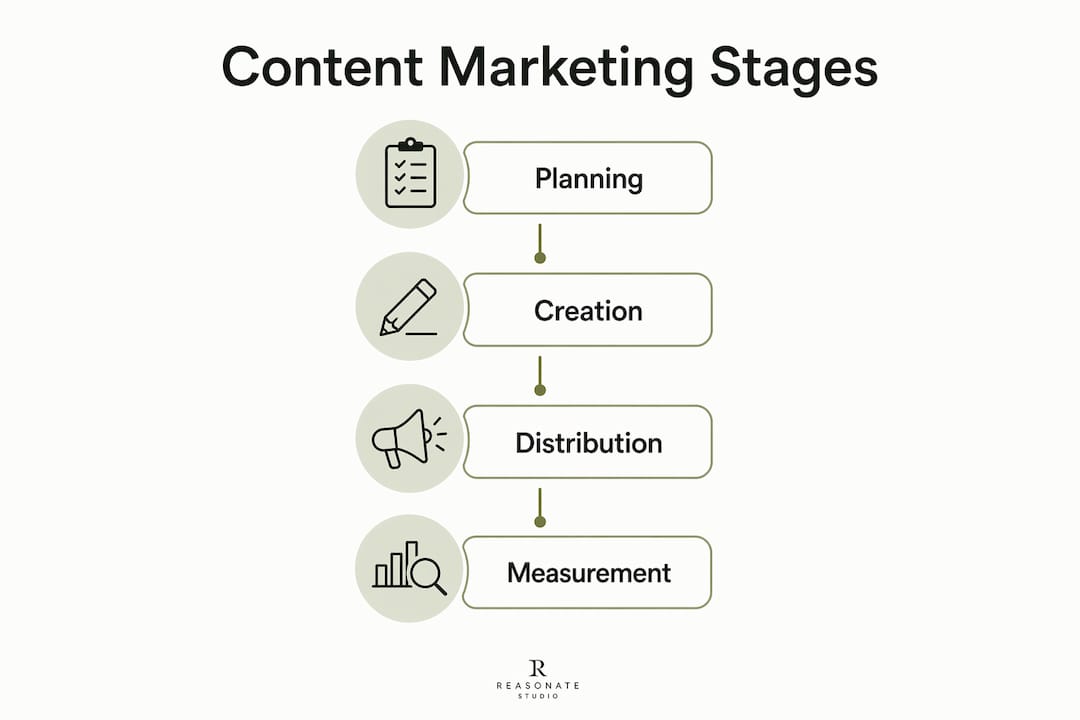
Content creation is where most people focus their energy, and common formats include blog posts, videos, podcasts, infographics, emails, newsletters, social media posts, webinars, templates, and quizzes. Each format serves a different purpose and reaches a different type of person. A podcast builds intimacy. A blog post captures search traffic. An email newsletter keeps warm leads engaged between purchases.
The table below maps content formats to the three buyer journey stages most relevant to small businesses, coaches, and consultants.
| Buyer journey stage | Goal | Content formats that work best |
|---|---|---|
| Awareness | Get discovered | Blog posts, short videos, social media posts, podcasts |
| Consideration | Build trust | Webinars, case studies, email newsletters, long-form guides |
| Decision | Convert | Testimonials, sales emails, templates, free consultations |
Distribution means choosing the right channels to put your content in front of the right people. Publishing a blog post and hoping someone finds it is not a distribution plan. You need to share it via email, social media, and any community where your audience already spends time.
Measurement closes the loop. Tracking performance metrics and refining your approach based on what you learn is what separates content marketing from content creation. Engagement rates, email open rates, and conversion rates tell you what is working. Vanity metrics like follower counts tell you almost nothing useful.
Pro Tip: Build a simple content tracker in a spreadsheet. Log every piece of content, the channel it was published on, and its performance after 30 days. Patterns will emerge fast, and you will stop wasting time on formats that do not convert.
Content marketing and traditional advertising operate on opposite logics. Traditional advertising is outbound and interruptive. It places a message in front of someone who did not ask for it, whether that is a TV commercial, a banner ad, or a cold email. Content marketing is inbound and permission-based. The audience comes to you because you offered something worth their time.
Content marketing builds trust and brand loyalty over time, while traditional advertising generates attention in the moment and stops working the second you stop paying for it. A well-written blog post can drive traffic for years. A paid ad disappears the moment your budget runs out.
| Factor | Content marketing | Traditional advertising |
|---|---|---|
| Approach | Inbound, permission-based | Outbound, interruptive |
| Primary goal | Build trust and relationships | Generate immediate attention |
| Longevity | Long-term asset | Active only while funded |
| Cost over time | Decreases as assets compound | Increases with scale |
| Audience relationship | Earned through value | Rented through spend |
For small businesses, coaches, and consultants, this distinction matters enormously. You likely do not have the budget to outspend larger competitors in paid advertising. Content marketing levels that playing field. A health coach who publishes genuinely useful content about nutrition can build an audience that trusts her before she ever runs a single ad.
Pro Tip: Think of content marketing as building equity in your brand. Every useful article, video, or email you publish is an asset that compounds. Traditional ads are expenses. Content is an investment.
A content marketing strategy is a documented plan that connects your content to specific business goals. Without a repeatable workflow, businesses produce content that fails to reach or engage effectively. Strategy is what turns random posting into a system that actually grows your brand.
A practical strategy for small business owners, coaches, and consultants covers five areas.
Define your audience clearly. Go beyond demographics. Build a buyer persona that captures what your ideal client is struggling with, what they have already tried, and what outcome they want. This shapes every content decision you make after it.
Map content to funnel stages. Tailoring content assets by sales funnel stage is one of the most impactful things you can do. Awareness content attracts cold audiences. Consideration content nurtures warm leads. Decision content converts. Most small businesses only create awareness content and wonder why nothing converts.
Build a repeatable workflow. Decide how often you will publish, who creates the content, how it gets reviewed, and where it gets distributed. A simple monthly content calendar prevents the “I don’t know what to post” paralysis that kills most content efforts. Tools like Asana or a shared Google Sheet work fine for small teams.
Separate content marketing from content promotion. Paid boosts complement but do not replace a strong content marketing foundation. Promoting weak content just gets more people to ignore it faster. Build quality first, then amplify.
Tie every content goal to a business outcome. If you publish a blog post, what should it do? Drive email signups? Book discovery calls? Rank for a specific search term? Content without a clear goal is just noise. Knowing the goal also tells you which metric to track.
Pro Tip: Start with one content format and one distribution channel. Master that before adding more. A coach who publishes one strong email newsletter per week will outperform someone posting mediocre content across five platforms.
Learning how to build a content marketing strategy from the ground up gives you a clear sequence to follow rather than guessing at what comes next.

Small businesses, coaches, and consultants use content marketing to position themselves as the go-to source in their niche. This long-term approach builds brand authority and audience engagement in ways that paid advertising cannot replicate. The key is consistency over volume.
Here is how to apply content marketing effectively as a small brand.
Build trust before you pitch. Publish content that solves real problems your audience faces. A business coach who writes about the specific mistakes new entrepreneurs make in their first year earns far more trust than one who only posts about their own services.
Personalize content by audience segment. Not every prospect is at the same stage. Someone who just discovered you needs different content than someone who has been on your email list for six months. Mapping content to prospect readiness means you are always giving people what they need next, not what is easiest for you to create.
Choose platforms based on where your audience already is. A B2B consultant’s audience is on LinkedIn. A wellness coach’s audience is on Instagram. Publishing everywhere dilutes your effort. Pick two platforms maximum and show up consistently on both.
Measure what matters. Track email click rates, website time on page, and conversion rates from content to inquiry. These numbers tell you whether your content is actually moving people toward a decision. Follower counts and likes are not business metrics.
Avoid the most common pitfall. Most small business owners create content in bursts and then disappear for weeks. Consistency beats frequency. Publishing one strong piece of content per week for a year builds more authority than publishing daily for a month and burning out.
Understanding what content marketing includes for small businesses gives you a clearer picture of where to focus your energy first.
Pro Tip: Repurpose every piece of content across formats. A blog post becomes an email newsletter. That newsletter becomes three social media posts. That social post becomes a short video script. One idea, five assets. This is how small teams stay consistent without burning out.
Working with small business owners and consultants over the years, I have noticed one pattern that holds almost without exception: the brands that grow steadily are the ones that treat content marketing as a foundation, not an afterthought. They do not start posting consistently after they have clients. They build the content engine first, and the clients follow.
The biggest mistake I see is treating content marketing like a sprint. Founders will post every day for three weeks, see no immediate results, and conclude that it does not work. Content marketing compounds. The blog post you write today may not generate a lead for four months. That is not failure. That is how trust-building works.
I also see coaches and consultants underestimate how much their personal voice matters. Generic content gets ignored. Content that reflects a specific point of view, a real opinion, or a hard-won lesson gets shared and remembered. Your expertise is the differentiator. The content is just the vehicle for it.
Realistic expectations matter here. Content marketing is not a shortcut to fast revenue. It is a system that, built correctly, creates more predictable and sustainable growth over time. The brands I have seen succeed with it are the ones who commit to a content marketing strategy and treat it as a long-term investment rather than a monthly checkbox.
— Kaitlyn Cole
Content marketing only converts when the content leads somewhere worth going. For small business owners, coaches, and consultants, that destination is usually a sales page, and a weak sales page wastes every piece of content that drove someone there.
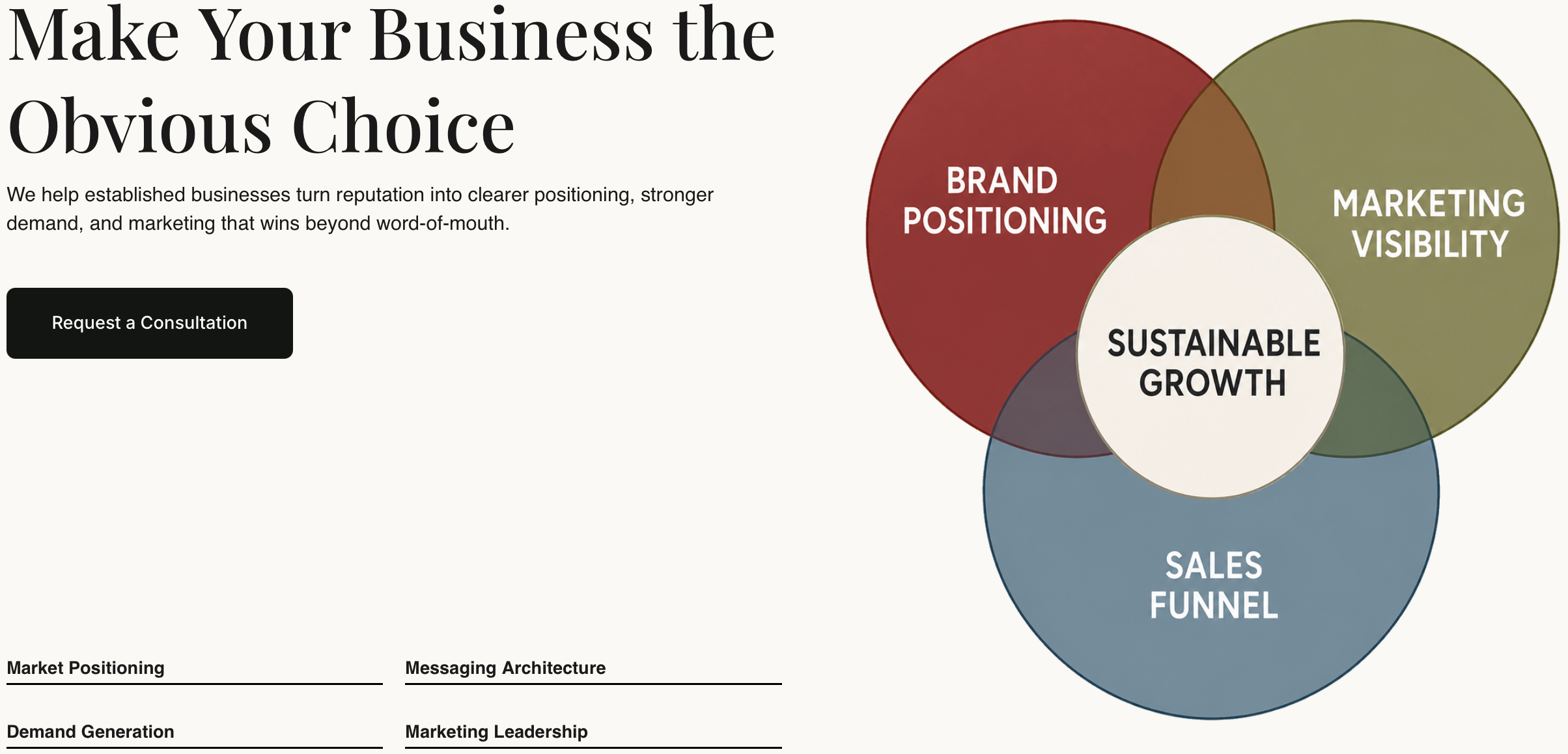
Reasonate Studio works with founders to make sure the full system connects. That means content that builds trust, messaging that speaks directly to the right audience, and a sales page that converts the traffic your content earns. With an 85% client retention rate and results like a 454% sales increase for a health coach, the approach is built on what actually works for small brands. If your content is strong but your conversions are not, that is the gap Reasonate Studio is built to close.
Content marketing means creating and sharing useful content to attract and build trust with a specific audience rather than advertising directly to them. The goal is to guide prospects toward a purchase by being genuinely helpful first.
Content marketing includes audience research, content creation in formats like blog posts, videos, emails, podcasts, and social media posts, distribution across relevant channels, and performance measurement. Each element works together as part of a larger system.
The main types of content marketing are written content such as blogs and newsletters, visual content such as videos and infographics, audio content such as podcasts, and interactive content such as quizzes and webinars. Each type serves different audience preferences and buyer journey stages.
A content marketing strategy is a documented plan that connects specific content types and distribution channels to defined business goals. It includes audience research, a content calendar, a workflow for creation and distribution, and metrics tied to outcomes.
Content marketing earns attention by providing value, while traditional advertising interrupts an audience with a promotional message. Content marketing builds long-term brand assets that compound over time, whereas advertising stops working the moment funding stops.