September 22, 2026
Why Update Brand Messaging: Essential Guide for Growth


Discover why simplify your marketing is crucial for small business success. Learn to focus your efforts for maximum growth and efficiency.
TL;DR:
- Simplifying marketing involves focusing only on channels, messages, and tools that directly drive revenue and customer connection. It improves message clarity, operational efficiency, and return on investment by reducing cognitive load and decision paralysis. Maintaining brand clarity and a lean tool stack enables small businesses to grow intentionally without unnecessary complexity.
Marketing simplification is the practice of reducing your channels, messages, and tools to only what directly drives revenue and customer connection. For small business owners, this is not a nice-to-have. It is the difference between a brand that grows and one that burns through budget without traction. The industry term for this discipline is “lean marketing,” and it applies consumer psychology, focused channel strategy, and brand clarity to help you do less while earning more. If you have ever felt scattered across Instagram, email, SEO, paid ads, and a podcast all at once, this guide explains why simplify your marketing is the most strategic question you can ask right now.
The core argument for simplification comes from cognitive science, not just business strategy. Reducing irrelevant information frees working memory, which directly improves a customer’s ability to process your message and make a buying decision. This is called reducing extraneous cognitive load, and it is one of the most well-supported findings in consumer psychology. When your marketing is cluttered, customers do not just feel confused. They leave.
Dave Chaffey at Smart Insights recommends that small businesses summarize their marketing plans into two to three pages to force prioritization and eliminate low-impact activity. That constraint is not arbitrary. It reflects the reality that most small business owners have limited time, limited budget, and limited attention to give to marketing execution. Spreading those resources across ten tactics produces weaker results than concentrating them on three.
The benefits of simplified marketing show up in three places: message clarity, operational efficiency, and return on investment. Customers understand you faster. Your team executes more consistently. And your budget stops leaking into channels that do not convert. These are not theoretical gains. They are the direct result of removing complexity from a system that was never designed to carry it.
Every piece of marketing you publish asks your customer’s brain to do work. When that work becomes too demanding, the brain defaults to the easiest option, which is usually doing nothing. Consumer psychology research confirms that mental resource limits degrade persuasion when a message is overloaded with information, choices, or competing calls to action. This is why a landing page with one clear offer almost always outperforms one with five options.

Choice paralysis compounds this problem. Salesforce describes customer analysis paralysis as a buyer freeze caused by too many options, and it is a direct revenue leak for small businesses. The fix is not better copywriting on a cluttered page. The fix is curation. Limiting your offer presentation to three to four choices, and making the recommended path obvious, reduces friction and increases the likelihood of a purchase.
Simplified messaging also improves recall. A customer who hears a clear, repeated message across two channels will remember your brand far better than one who encounters seven inconsistent messages across six platforms. Consistency is a function of simplicity. You cannot maintain a coherent brand voice when you are producing content for too many surfaces at once.
Here are the most effective message simplification tactics for small business owners:
Pro Tip: Before publishing any piece of marketing, ask yourself: “Could a 12-year-old read this and immediately understand what I’m offering and why they should care?” If the answer is no, simplify before you publish.
A bloated marketing tool stack is one of the most common and least discussed budget problems for small businesses. Founders often accumulate tools gradually, adding a social scheduler here, an email platform there, a landing page builder, a CRM, a design tool, and an analytics dashboard, until the monthly software bill rivals a part-time salary. Lean marketing stack research from 2026 shows that a foundation-first approach to tool selection reduces both cost and the rework caused by disconnected systems.
The operational case for a lean stack goes beyond cost. When your tools do not integrate well, your data does not connect. You cannot accurately attribute which channel drove a sale, which means you cannot make confident decisions about where to invest next. A layered marketing stack built in sequence, starting with foundational tools and expanding only when a clear need exists, produces cleaner attribution and better decision-making at every stage of growth.
Here is the sequence that lean marketing stack research recommends for small businesses building from scratch:
This sequence matters because adding tools out of order creates gaps you will spend months trying to fix. A founder who launches paid ads before their website converts is paying to send traffic to a leaky bucket. Sequence is strategy.
Brand clarity is the ability to describe what you do, who you serve, and why it matters in a single sentence that every person in your business would say the same way. Charlsie Niemiec’s brand clarity test makes this concrete: if you cannot pass it in one sentence, you do not yet have a brand. You have a collection of ideas that have not been resolved into a position.
The internal cost of unclear branding is significant. When founders cannot articulate their brand in one sentence, their content reflects that confusion. Social posts go in different directions. Website copy tries to appeal to everyone. Email newsletters shift tone from week to week. Customers sense this inconsistency even when they cannot name it, and it erodes trust faster than any competitor could.
“If you can’t say it in one sentence, you don’t have a brand.” — Charlsie Niemiec
The external cost is even more direct. A customer who lands on your website and cannot immediately understand what you offer and whether it is for them will leave within seconds. Consistent messaging reduces buyer confusion and lowers the cognitive effort required to make a purchase decision. That reduction in effort is a conversion driver.
Here is how brand clarity connects to practical marketing simplification:
The jargon trap is a specific version of this problem. Founders who describe their work in industry language rather than customer language create an invisible barrier between their brand and the people they want to reach. “We provide holistic wellness solutions” tells a customer nothing. “We help busy moms sleep better in 30 days” tells them everything. The second version is a brand. The first is a placeholder.
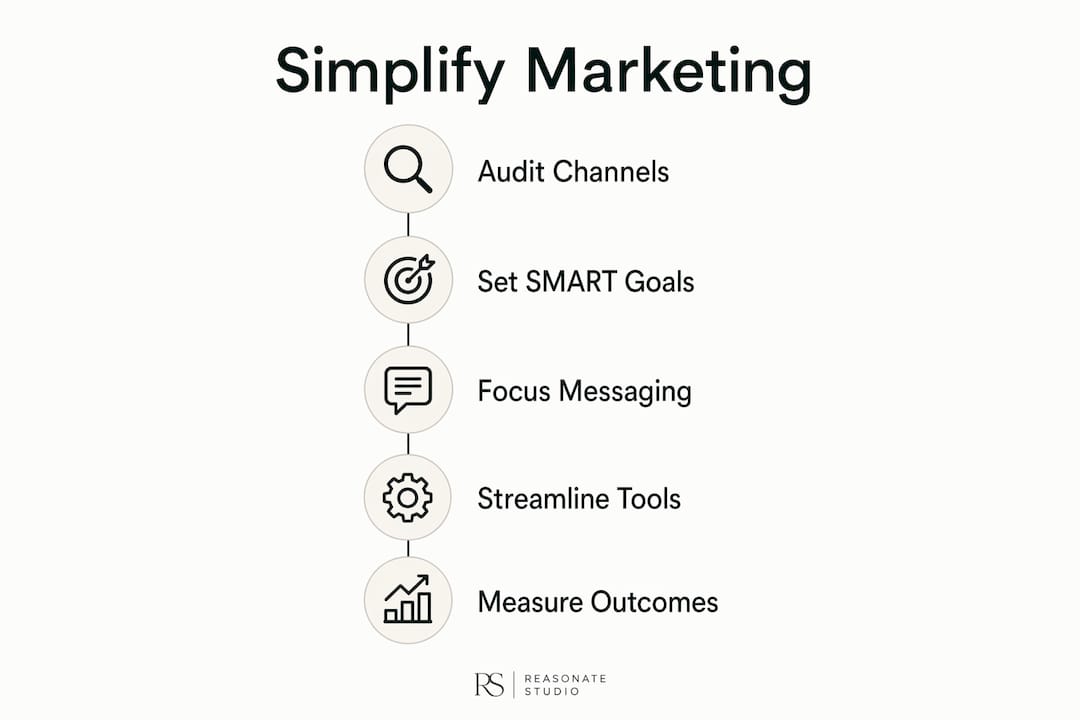
The most practical starting point for effective marketing simplification is a channel audit. List every platform and tactic you are currently using, then assign each one a revenue contribution score based on actual data, not gut feel. Most small business owners discover that two or three channels drive the majority of their results, and the rest are consuming time without producing returns. Cutting the bottom half of that list is not a retreat. It is a reallocation.
Setting SMART objectives, which stands for Specific, Measurable, Achievable, Relevant, and Time-bound, gives your simplified marketing a direction that is easy to evaluate. “Grow my audience” is not a marketing objective. “Generate 50 qualified leads from Instagram in 90 days” is. The specificity forces you to choose the right channel, the right content type, and the right measurement approach. Smart Insights consistently recommends this kind of focused objective-setting as the foundation of any effective digital marketing plan.
The table below compares a scattered marketing approach against a simplified one across the dimensions that matter most to small business owners:
| Dimension | Scattered approach | Simplified approach |
|---|---|---|
| Channels active | 6 or more | 2 to 3 |
| Message consistency | Varies by platform | Unified brand voice |
| Content volume | High, inconsistent | Lower, consistent |
| Budget allocation | Spread thin | Concentrated on proven channels |
| Attribution clarity | Difficult | Clear and trackable |
| Team bandwidth | Stretched | Focused |
| ROI visibility | Low | High |
AI tools are now a practical part of how small businesses can maintain simplicity at scale. Tools like ChatGPT, Claude, and Jasper can draft content, repurpose existing posts, and generate keyword research in a fraction of the time manual processes require. The key is using AI to execute a clear strategy, not to generate more volume without direction. More content from an unclear brand is still unclear. AI amplifies what you already have, so clarity must come first.
The most common pitfall in marketing simplification is confusing “fewer tactics” with “less effort.” Simplification does not mean doing less work. It means doing the right work with greater depth and consistency. A founder who posts twice a week on one platform with strong creative and clear messaging will outperform one who posts daily across five platforms with generic content. You can explore how this plays out in practice through marketing ROI strategies built specifically for small business growth.
Pro Tip: Run a 30-day channel freeze. Pick your top two performing channels and go all-in on them for one month. Pause everything else. At the end of the month, compare your results to the previous month. The data will tell you exactly where your energy belongs.
I have worked with over 100 small business owners since founding Reasonate Studio in 2017, and the pattern I see most often is not a lack of effort. It is effort pointed in too many directions at once. Founders who come to me are usually doing a lot. They are posting, emailing, running ads, attending networking events, and updating their websites. But none of it is connected, and none of it is working as well as it should.
The turning point for almost every client I have worked with is not a new tactic. It is a decision to stop. Stop adding channels. Stop chasing trends. Stop producing content that does not connect to a clear offer. That decision feels counterintuitive because the cultural message around marketing is always “do more.” But the businesses I have seen grow the fastest are the ones that got ruthlessly focused on one message, one audience, and two channels.
The uncomfortable truth I have learned is that complexity in marketing is often a form of avoidance. When you are not sure your offer is right, or your message is clear, adding more tactics feels productive. It is not. It is noise. The founders who simplify first, who do the hard work of getting clear on who they are and what they stand for, are the ones who see results that compound over time.
My advice is this: treat simplicity as a discipline you return to every quarter. As your business grows, complexity creeps back in. New tools, new platforms, new ideas. Your job is to keep cutting. The brands that stay clear stay competitive. The ones that accumulate tactics without strategy eventually collapse under their own weight. Simplicity is not a starting point you graduate from. It is a practice you maintain.
— Kaitlyn
If you recognize your own marketing in this article, the scattered channels, the unclear message, the tools that do not talk to each other, Reasonate Studio was built specifically for that moment.
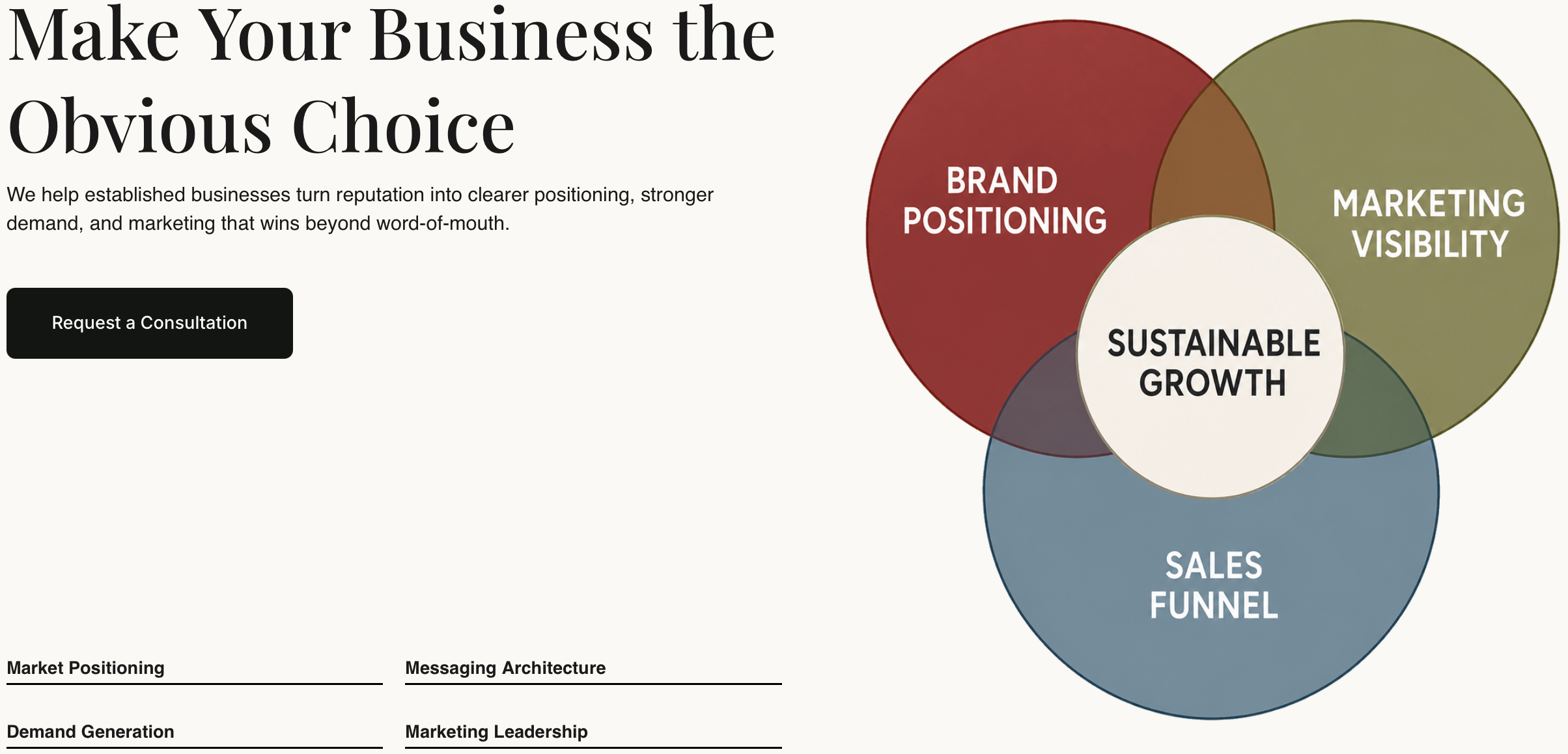
At Reasonate Studio, we help founders, coaches, and consultants cut through the noise and build marketing that actually works. Our social media management service gives you a focused, consistent presence on the platforms that matter most to your audience, without you having to manage it yourself. For businesses that need a documented system behind their marketing, our marketing strategy SOP documentation creates the clear, repeatable process that keeps your brand consistent as you grow. We also offer sales page optimization for founders who want their offers to convert more effectively. Every service is built around the Aligned Impact Model™ and led directly by Kaitlyn. No handoffs. No guesswork. Just focused, strategic marketing that moves the needle.
Marketing simplification means reducing your channels, messages, and tools to only what directly drives customer engagement and revenue. The goal is a lean, focused system where every element serves a clear purpose.
Simplified marketing reduces cognitive load for customers, making it easier for them to understand your offer and take action. Research shows that limiting choices to three or four options reduces analysis paralysis and increases purchase rates.
Most small businesses see stronger results by concentrating on two to three channels rather than spreading effort across six or more. The right channels depend on where your specific customers spend time and which platforms have already shown measurable returns for your business.
Start with a channel audit. List every platform and tactic you currently use, assign each a revenue contribution score based on real data, and cut the bottom half. Then build a one-sentence brand clarity statement before creating any new content.
Brand clarity is the foundation that makes simplification possible. Without a clear, one-sentence brand position, every content decision becomes a judgment call, which leads to inconsistency. A clear brand statement acts as a filter that makes channel selection, content creation, and campaign planning faster and more consistent.