September 22, 2026
Why Update Brand Messaging: Essential Guide for Growth


Discover the essentials of a messaging framework how to guide for entrepreneurs. Boost your brand's communication and drive conversions!
TL;DR:
- A messaging framework is a structured blueprint that guides consistent brand communication across all channels. It includes core elements like positioning, value proposition, target audience, voice, pillars, and proof points to ensure clear and effective messaging. Entrepreneurs should conduct research, analyze competitors, and refine their framework regularly to maintain relevance and impact.
A messaging framework is a structured blueprint that defines how your brand communicates its value, voice, and purpose to the right audience, consistently across every channel. For entrepreneurs and small business owners, this is the difference between marketing that feels scattered and marketing that converts. The messaging framework how-to process covers six core components: brand positioning, value proposition, target audience definition, voice and tone, messaging pillars, and proof points. Brands like Asana and frameworks like the GTM Playbook Messaging Map have formalized this process, and the same structure works just as well for a solo founder as it does for a growth-stage company. Get this right, and every piece of content you create has a clear job to do.
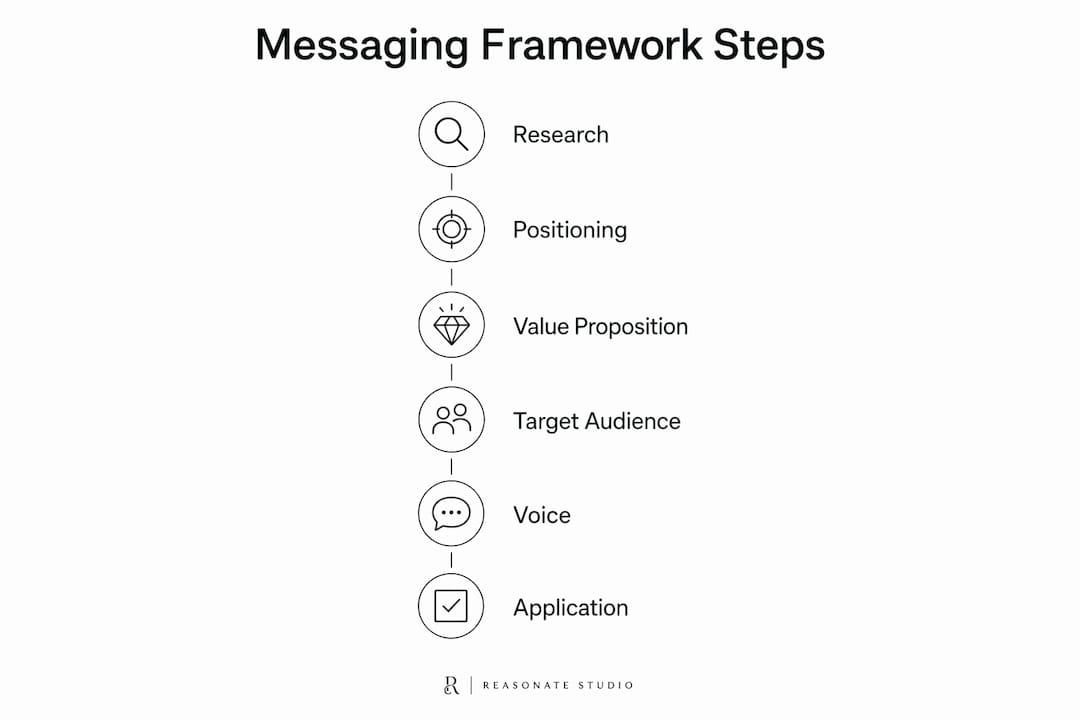
A well-built messaging framework contains five to six foundational elements, and each one carries a specific job. According to Asana’s brand messaging guide, a standard framework includes brand positioning, value proposition, target audience definition, voice and tone guidelines, messaging pillars, and proof points. Skipping any one of these creates gaps that show up as inconsistent content, weak copy, and confused customers.

Here is what each component does and why it matters:
| Component | Purpose | Example Output |
|---|---|---|
| Brand Positioning Statement | Internal compass that defines who you serve and how you differ | “For health coaches who want more clients, [Brand] is the only platform that…” |
| Value Proposition | External-facing claim of the specific benefit you deliver | “We help you get 10 new clients in 90 days without paid ads.” |
| Target Audience (ICP) | Defines exactly who your message is for | Female founders, ages 30–45, service-based businesses |
| Voice and Tone Guidelines | Sets the personality and emotional register of all communication | Warm, direct, confident, never corporate |
| Messaging Pillars | The 3–4 core themes that support your positioning | Clarity, Connection, Consistency, Results |
| Proof Points | Evidence that validates each pillar | Testimonials, case studies, statistics |
The positioning statement is the internal guiding star for your messaging. As Asana defines it, it is a concise summary describing who you serve, what problem you solve, and how you differ from competitors. Every other element in the framework flows from this statement.
Your value proposition is the external version of that same idea. It speaks directly to your customer’s desired outcome. Your messaging pillars are the three to four themes that support your positioning across all content. Think of them as the recurring proof that your brand delivers on its promise.
Effective messaging frameworks also serve as a foundation for employee alignment, not just marketing collateral. If you ever bring on a team member, contractor, or social media manager, this document tells them exactly how to represent your brand without a lengthy onboarding process.
Preparation is the step most entrepreneurs skip, and it is the reason so many messaging frameworks end up vague. Before you write a single word of your framework, you need three things: customer research, competitor analysis, and honest self-reflection on your business’s core purpose.
Customer research means talking to your best clients or surveying your audience to understand the exact language they use to describe their problem. The words your customers use to describe their pain are the words that should appear in your messaging. This is not a creative exercise. It is a listening exercise.
Competitor analysis means reviewing how similar businesses position themselves. You are not looking to copy them. You are looking for the white space they are not occupying. Tools like Google Search, social media profiles, and review platforms give you a clear picture of how the market is already talking about your category.
Self-reflection means journaling your business’s “why,” your core differentiators, and the emotional transformation you create for clients. Sam Tanner Marketing’s guide recommends starting with templates and best practices rather than expensive professional services, which makes this phase accessible for any budget.
Here is a quick overview of tools that support each preparation phase:
| Preparation Phase | Recommended Tool or Resource | What It Helps You Do |
|---|---|---|
| Customer Research | Surveys, client interviews, review mining | Capture real customer language and pain points |
| Competitor Analysis | Google Search, social media, review platforms | Identify positioning gaps in your market |
| Brand Reflection | Journaling prompts, brand questionnaires | Clarify your “why,” values, and differentiators |
| Framework Templates | Sam Tanner Marketing, Asana, GTM Playbook | Structure your findings into a usable document |
| Emotional Motivation Mapping | Customer journey maps, persona worksheets | Understand what drives your audience’s decisions |
Pro Tip: Plan 2–3 weeks for this preparation phase. Rushing the process produces vague, ineffective messaging that sounds like every other brand in your category. Give yourself the time to do it right.
Building your framework is a six-step process. Each step builds on the last, so do not skip ahead. The goal is a single document that anyone on your team can use to write copy, create content, or represent your brand.
Write your brand positioning statement. Start with this formula: “For [target audience], [Brand Name] is the [category] that [key benefit] because [reason to believe].” Keep it to two to three sentences. This is an internal document, not a tagline. It should be specific enough to make decisions from.
Develop your value proposition. Your value proposition translates the positioning statement into a customer-facing promise. It answers one question: “What do I get, and why does it matter to me?” Write it in plain language. Avoid industry jargon. Test it by reading it aloud to someone outside your industry.
Establish your brand voice and tone. Your brand voice and tone is the personality behind every word you publish. Choose three to five adjectives that describe how your brand sounds. Then write a short “we are / we are not” list. For example: “We are direct. We are not cold. We are warm. We are not casual to the point of unprofessional.” This list becomes the filter for every piece of content you create.
Define your messaging pillars. Choose three to four core themes that support your positioning. Each pillar should represent a key benefit or belief your brand stands for. For a business coach, pillars might be Clarity, Accountability, and Results. For a product brand, they might be Quality, Simplicity, and Community. Every piece of content you create should connect back to at least one pillar.
Gather proof points for each pillar. Proof points are the evidence that makes your pillars believable. They include client testimonials, case study results, statistics, certifications, and media mentions. Assign two to three proof points to each pillar. This is what separates a messaging framework from a wish list.
Compile and test your messaging across channels. Pull everything into one document. Then test it. Write a sample Instagram caption, a homepage headline, and an email subject line using only your framework. If the output feels consistent and on-brand, your framework is working. If it feels forced or generic, revisit your positioning statement.
Pro Tip: The biggest mistake entrepreneurs make is failing to assign a clear purpose to their framework. Decide upfront whether your framework is built for strategic narrative, customer insight, or market positioning. Trying to do all three at once produces unfocused messaging.
A common pitfall at this stage is mixing multiple frameworks. Frameworks like StoryBrand, Jobs-to-be-Done (JTBD), and traditional positioning models each serve a different purpose. Mixing them dilutes your message and creates confusion. Pick one core structure and build from there. StoryBrand works best for clarity-focused brands. Positioning frameworks work best when you are defining a new market category. JTBD works best when customer insight is your primary goal.
For more on how a framework connects to your broader marketing strategy, it helps to see how messaging feeds into campaign planning and content creation at every level.
A messaging framework is only useful if it gets used. The most common failure point is building a strong document and then leaving it in a folder. Your framework needs to show up in your Instagram captions, your website copy, your email sequences, and your sales conversations.
The concept of a messaging map makes this practical. According to the GTM Playbook Messaging Map, a messaging map captures your core value proposition, benefit pillars with proof points, internal positioning, and persona-specific adaptations. It is a living document that keeps communication coherent at every touchpoint. The key word is “living.” Your framework should evolve as your audience grows and your offers change.
Here is how the messaging map components translate into real-world use:
| Messaging Map Component | Where It Shows Up |
|---|---|
| Core Value Proposition | Homepage headline, elevator pitch, bio |
| Messaging Pillars | Blog categories, social content themes, email series |
| Proof Points | Sales pages, testimonials, case study pages |
| Persona-Specific Adaptations | Ad copy, landing pages, segmented email campaigns |
| Brand Voice and Tone | All written content, customer service responses |
Maintaining your framework over time requires a few consistent habits:
Maintaining your messaging also means training your team on brand voice and adapting messages to new audiences and channels. This is where many small business owners fall short. They build the framework but never share it. The document only creates value when the people producing content actually use it.
Brand messaging examples from 2026 show that the brands gaining the most traction are the ones that stay consistent across channels while adapting their tone to fit the platform. The core message stays the same. The delivery changes.
Most entrepreneurs come to me with the same problem. They have a great offer, a real skill set, and genuine results for their clients. But when you ask them to explain what they do and who it is for, the answer changes every time. That inconsistency is not a confidence problem. It is a messaging problem, and a framework fixes it.
The thing I tell every founder I work with is this: your messaging framework is not a marketing document. It is a decision-making tool. When you are not sure whether to say yes to a collaboration, whether a piece of content fits your brand, or how to position a new offer, your framework gives you the answer. That is its real job.
The mistake I see most often is entrepreneurs trying to build their framework from scratch without doing the customer research first. They write what they think sounds good instead of what their best clients actually say. The result is messaging that feels polished but does not connect. The emotional motivations of your audience are the foundation of your framework, not an afterthought.
I also push back hard on the idea that you need a complex, multi-page document to get started. The best first version of your framework fits on one page. It has a positioning statement, a value proposition, three pillars, and a handful of proof points. That is enough to create consistent content, write a strong homepage, and train a contractor. You can add depth over time.
One trend I am watching closely in 2026 is the shift toward more human, values-driven messaging. Audiences are getting better at recognizing generic brand language, and they are tuning it out faster than ever. The frameworks that are working right now are the ones built on a specific point of view, not just a list of features and benefits. If your messaging sounds like it could belong to any brand in your category, it is time to go back to your positioning statement and get more specific.
Start simple. Test it. Iterate. The entrepreneurs who build the clearest brands are not the ones who spent the most time on their framework. They are the ones who actually used it.
— Kaitlyn
A strong messaging framework is the foundation every piece of content, every sales page, and every social post should be built on. If you are ready to stop guessing and start communicating with real clarity, Reasonatestudio can help you get there faster.
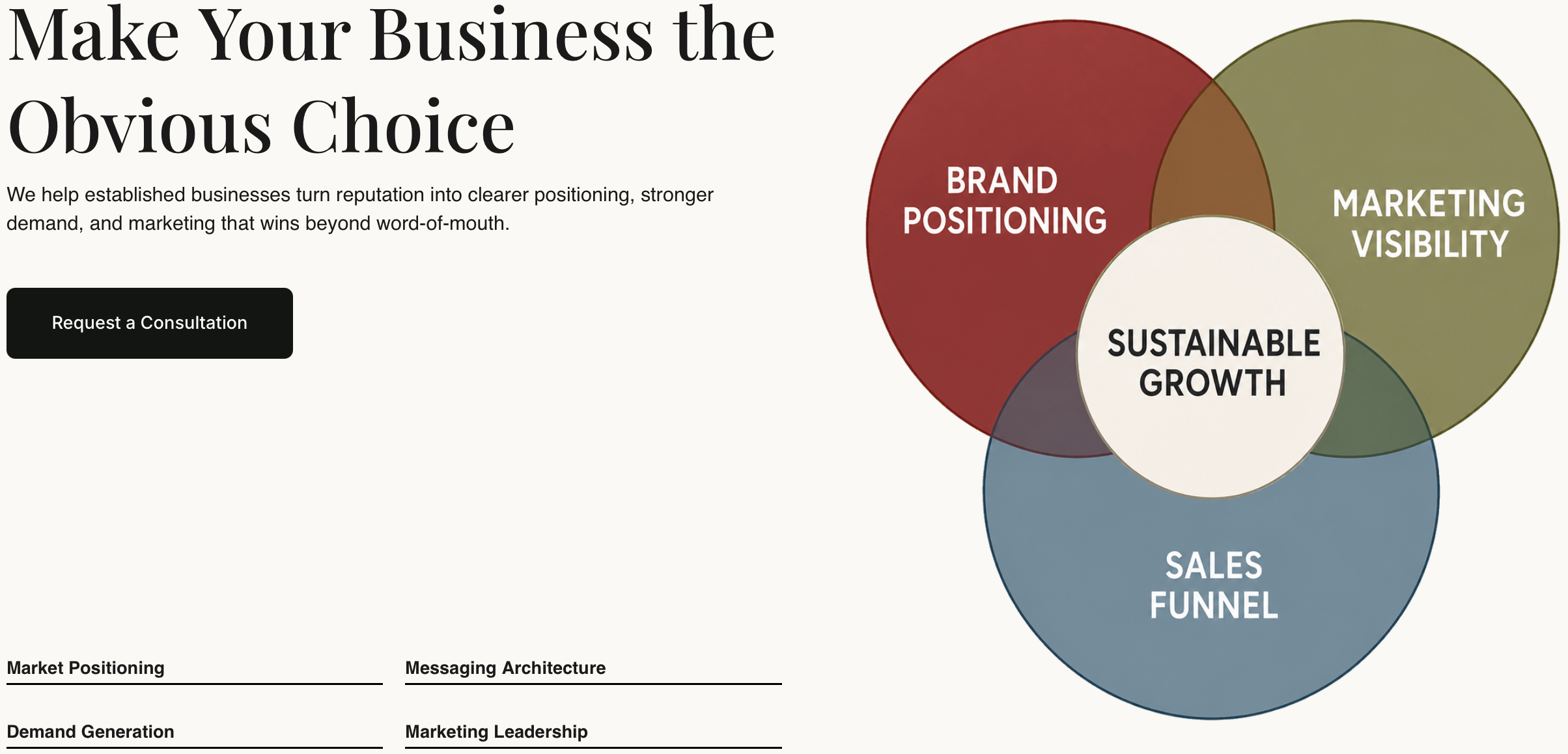
Reasonatestudio’s social media management service takes your messaging framework and puts it to work across every post, caption, and campaign. Every piece of content is written to your brand voice, aligned to your pillars, and built to convert. If your sales pages need the same treatment, Reasonatestudio’s sales page optimization service applies your framework directly to your highest-converting pages. Both services are built on the Aligned Impact Model™, the same strategy-first approach that has delivered a 454% sales increase for a health coach and a 283% order increase in 30 days for a consumer brand.
A messaging framework is a structured document that defines your brand’s positioning, value proposition, voice, messaging pillars, and proof points. It gives every piece of content a clear direction and keeps your communication consistent across all channels.
Building a thorough messaging framework typically takes 2–3 weeks for solo founders when you include customer research, competitor analysis, and iteration. Rushing the process produces vague messaging that fails to connect with your audience.
A standard messaging framework includes five to six elements: brand positioning statement, value proposition, target audience definition, voice and tone guidelines, messaging pillars, and proof points. Each element serves a distinct purpose in guiding consistent communication.
No. Mixing multiple frameworks dilutes your message and creates confusion. Choose one core structure, such as StoryBrand for clarity, traditional positioning for market category logic, or Jobs-to-be-Done for customer insight, and build from there.
Review your framework every six months or after a major change to your offer, audience, or market position. Your framework is a living document, and updating it regularly keeps your messaging aligned with how your business and audience are evolving.