September 1, 2026
Understanding B2C Business to Consumer Dynamics


Discover high-impact promotional techniques in marketing to boost ROI. Master strategies like SEO, paid search, and email for immediate results.
For marketing professionals and business owners who need results now, the highest-impact promotional techniques are content/SEO, paid search, email nurture, account-based marketing (ABM), referral and loyalty programs, PR and earned media, social (paid and organic), and influencer or strategic partnerships. Run them as a connected system, not a checklist. McKinsey research shows that linking brand-building and performance tactics with shared KPIs lifts marketing ROI by an estimated 15–20%.
Start here if you are deciding where to focus first:
Read the full catalog and the sequencing section before allocating budget. The order you activate these techniques matters as much as which ones you choose.

A promotion strategy is the plan governing how you communicate your product or service’s value to the market. It covers the tactics, channels, messages, timing, and budget you use to create awareness, generate demand, and move buyers toward a decision. It does not determine what you sell, how you price it, or where you distribute it. Those belong to the broader marketing strategy.

The confusion between the two is common and costly. Here is the practical distinction:
| Dimension | Marketing strategy | Promotion strategy |
|---|---|---|
| Scope | Product, price, place, promotion (the 4 Ps) | Communication and campaign execution only |
| Objective | Define market position and competitive advantage | Drive awareness, demand, and conversion |
| Timeline | 1–3 year horizon | Campaign-level: weeks to quarters |
| Primary KPIs | Market share, brand equity, revenue growth | Impressions, leads, conversion rate, CAC |
| Ownership | CEO, CMO, senior leadership | Marketing manager, demand-gen team |
Inside the classic 4 Ps framework, promotion is one quadrant. In the expanded 7 Ps model used for service businesses, it sits alongside people, process, and physical evidence. Digital channels blur the lines further: content marketing, for example, overlaps promotion (it drives awareness) and product (it delivers value directly to the buyer). That overlap is not a problem to solve; it is a feature to exploit.
The practical rule: if a decision changes what you sell or how you price it, it belongs in the marketing strategy. If it changes how you tell the story or where you show up, it belongs in the promotion plan.
Before you pick a single tactic, audit your promotion plan against this checklist. Missing any one of these is usually the reason a campaign underperforms.
Pro Tip: Before writing a single headline, rewrite your three strongest service claims as buyer outcomes. “We provide strategic marketing support” becomes “Clients reduce founder time in marketing by building a system that runs without them.” That shift alone changes how every downstream tactic performs.
Every tactic belongs somewhere in the funnel. Misplacing them is one of the most common and expensive mistakes: running brand video ads to a warm retargeting list, or pushing discount codes to cold audiences who have never heard of you.
| Funnel stage | Recommended tactics | Ideal objective | Sample KPIs |
|---|---|---|---|
| Top (TOFU) — Awareness | Content/SEO, paid social, PR, influencer, brand video, podcast sponsorships | Reach new audiences; build category authority | Impressions, reach, branded search volume, new website visitors |
| Middle (MOFU) — Consideration | Webinars, case studies, email nurture, retargeting, ABM outreach, comparison content | Educate and build preference | Email open/click rates, time on site, demo requests, MQL volume |
| Bottom (BOFU) — Conversion | Paid search, promo codes, free trials, direct outreach, sales enablement content | Drive purchase or commitment | Conversion rate, CAC, SQL-to-close rate, revenue |
| Post-purchase — Retention | Loyalty programs, referral programs, customer newsletters, upsell campaigns | Expand and retain | Repeat purchase rate, NPS, referral rate, LTV |
A few tactics span stages and require deliberate sequencing. Paid social, for example, works at TOFU (broad prospecting) and MOFU (retargeting with case studies), but the creative, audience targeting, and KPIs must be completely different for each. Running the same ad to both audiences wastes budget and confuses buyers.
Balanced funnels that combine brand-building with performance tactics consistently outperform single-stage approaches. The practical implication: do not cut brand spend the moment conversion campaigns start working. The brand investment is what keeps conversion costs from rising quarter over quarter.
This is the operational core. Twelve proven techniques, each with the constraints and metrics you need to make a real decision.
Captures buyers who are already searching for what you sell. Google Ads and Microsoft Advertising are the primary U.S. platforms. Best for BOFU demand capture.
Builds authority by publishing useful, specific content that ranks in search and earns citations. The modern promotional mix maps content/SEO as low-to-medium cost with a 6–12 month timeline to meaningful impact. It is also increasingly critical for AI-driven research channels: buyers using Perplexity, Claude, and ChatGPT to research vendors will only find you if you have authoritative, citable assets like case studies with metrics.
The highest-return channel per dollar for most established businesses. Works across every funnel stage: welcome sequences for new subscribers, nurture for prospects, and retention campaigns for existing customers. See the email marketing execution checklist for a practical setup guide.
Organic social builds community and brand voice over time. Paid social accelerates reach and enables precise audience targeting. They serve different purposes and should be budgeted separately.
Extends your reach into audiences you cannot efficiently buy. For B2B service firms, this often means co-authoring content with industry voices, co-hosting webinars, or building referral relationships with adjacent service providers rather than traditional influencer campaigns.
Bold, specific activations can generate earned media value worth 10–50× their production cost when executed well. A well-placed feature in a trade publication or a data-driven press release can drive more qualified traffic than months of paid ads. The key is having something genuinely newsworthy—such as a client outcome with real numbers, a contrarian point of view, or proprietary research.
In-person and virtual events remain among the highest-conversion tactics for B2B service firms. A well-run webinar with a specific, useful topic converts attendees to pipeline at rates most paid channels cannot match.
Converts your existing customer base into a growth channel. For established businesses with strong retention, this is often the most cost-efficient acquisition tactic available. Referral programs work best when the referral incentive is meaningful and the ask is made at the right moment in the customer relationship.
Time-limited offers, bundled pricing, and promotional pricing drive short-term conversion spikes. Use carefully: frequent discounting trains buyers to wait for sales and erodes perceived value. For service businesses, a discovery session or a limited-availability offer often works better than a price cut.
Partners promote your product or service in exchange for a commission on sales. Common in e-commerce and SaaS; less common but growing in professional services through referral-fee arrangements.
Concentrates resources on a defined list of high-value target accounts. For B2B service firms, ABM often outperforms broad demand generation because it aligns sales and marketing around the same accounts. See the B2B marketing strategy framework for a practical ABM setup guide.
Personalized outreach via direct mail, LinkedIn, or cold email to a defined prospect list. Effective when the list is tight, the message is specific, and the offer is relevant. Generic mass outreach is noise; targeted, researched outreach to 50 right accounts beats blasting 5,000 wrong ones.
The most common budget mistake is spreading spend across six channels at once and doing none of them well. Master three channels where your audience already pays attention before broadening. That principle applies at every business stage.
Use this five-factor decision framework to select your starting channels:
Promotional budget allocations vary significantly by company stage. These are ballpark ranges, not guarantees:
| Stage | Typical promotional spend as % of revenue | Channel priority |
|---|---|---|
| Startup (year 1–2) | Aggressive; often 20–50% of early revenue | Paid search + content + direct outreach |
| Growth (year 3–5) | 20–40% of revenue | Paid digital + content/SEO + email + events |
| Established (year 6+) | 5–15% of revenue | Content/SEO + email + ABM + referral + PR |
Within those totals, paid digital advertising typically represents 30–40% of a promotional budget. Content and SEO, email, and events split most of the remainder, with PR and partnerships taking a smaller share.
Pro Tip: Before adding a new channel, audit where your current funnel is leaking. High traffic but low conversions? Fix the landing page and offer before buying more traffic. High demo requests but low close rates? The problem is in sales enablement, not promotion. Scaling a broken funnel just burns budget faster.
Measurement starts before launch. Define your primary KPI for each objective before the campaign runs, or you will spend the post-campaign review arguing about which metric matters.
Last-click attribution is still the default in most analytics platforms, and it consistently overcredits paid search while undercrediting content, email, and social. Three better approaches:
Run creative A/B tests continuously, review performance weekly, reallocate budget monthly, and run incrementality tests quarterly for your highest-spend channels.
Most B2B funnel failures trace back to content misaligned with buyer intent. If you see high pricing-page traffic but low demo requests, the problem is not traffic volume. It is a conversion leak at that specific step. Fix the step before increasing spend at the top.
| Tactic | Startup cost (ballpark) | Ongoing monthly cost | Timeline to impact |
|---|---|---|---|
| Paid search (PPC) | $500–$2,000 setup | $3,000–$15,000+ | Days to weeks |
| Content/SEO | $1,000–$3,000 setup | $1,500–$8,000 | 6–12 months |
| Email marketing | $500–$1,500 setup | $300–$2,000 | Immediate (promo); 3–6 months (nurture) |
| Paid social | $500–$1,500 setup | $2,000–$20,000+ | Days to weeks |
| Organic social | Staff time | Staff time | 6–12 months |
| Influencer/partnerships | $500–$5,000 per campaign | Varies | 1–3 months |
| PR/earned media | $1,000–$3,000 setup | $2,000–$10,000 | 1–6 months |
| Events (virtual) | $500–$2,000 | $500–$5,000 per event | Immediate pipeline |
| Referral/loyalty | $1,000–$5,000 setup | Incentive cost | 1–6 months |
| ABM | $2,000–$5,000 setup | $3,000–$20,000+ | 3–9 months |
| Affiliate | $500–$1,000 setup | $200–$500 + commissions | 3–6 months |
| Direct outreach | $500–$1,000 setup | $500–$5,000 | 1–3 months |
Cost drivers that shift these ranges: audience size (larger audiences cost more to reach), creative production quality, media CPMs in your category, and whether you are running in-house or through an agency.
One legal note: influencer content requires FTC disclosure (clear “#ad” or “#sponsored” labeling), and all commercial email must comply with CAN-SPAM, including a working unsubscribe mechanism and accurate sender identification.
The sequence matters as much as the tactics. Here is the order that produces compounding results for established B2B service firms and independent businesses.
Phase 1: Establish category authority Publish expert content on the specific problems your best clients face. Build SEO around those topics. Audit your AI citation presence and create citable assets (case studies with real metrics, original frameworks, named methodologies). This is the foundation everything else builds on.
Phase 2: Capture existing demand Run paid search against high-intent keywords once your landing pages and offers are tested. Add retargeting to re-engage visitors who did not convert. At this stage, your content from Phase 1 becomes the retargeting creative.
Phase 3: Convert with precision Email nurture sequences for leads who are not yet ready to buy. ABM outreach to your highest-value target accounts. Sales enablement content that answers the questions buyers ask in the final stages of a decision.
Phase 4: Expand and retain Referral programs for satisfied clients. Customer newsletters and thought-leadership to maintain relationships. Upsell and cross-sell campaigns for existing accounts. This phase often generates the lowest-CAC growth available to an established business.
Reasonate Studio’s Aligned Impact Model™ maps directly to this sequence: Diagnose, Define, Build, Activate. The model ensures that every promotional tactic is rooted in a clear position and a buyer-led message rather than channel activity for its own sake.
Step-by-step sequencing checklist:
Pro Tip: Translate every service-led claim into a buyer outcome before writing a single ad or email. “We provide fractional CMO services” tells the buyer what you do. “Clients reduce founder time in marketing while building a system that generates demand beyond referrals” tells them what changes for them. The second version is what gets a response.
For B2B campaign examples that show this sequence in practice, Reasonate Studio has documented client outcomes including a 454% increase in sales, a $46.3 million partnership secured after a brand repositioning, and 1,000% website traffic growth through ongoing Fractional CMO leadership. These are not typical results, but they illustrate what a coherent sequence produces when positioning, messaging, and execution are aligned.
Most promotional failures are not channel failures. They are positioning failures that show up in channel performance.
When a business runs paid search and gets clicks but no conversions, the instinct is to blame the channel. Usually, the real problem is that the landing page message does not match what the buyer expected when they clicked. The ad promised one thing; the page delivered something different. That is a positioning and messaging problem, not a media-buying problem.
The same pattern appears in content marketing. A firm publishes consistently but generates no leads because the content is written about what the firm finds interesting rather than what buyers are actively trying to solve. High traffic, zero pipeline.
Disconnected tactics amplify this problem. When a freelance copywriter, a social media contractor, and a PPC agency are each working from different briefs with no shared messaging foundation, every channel tells a slightly different story. Buyers who encounter the brand across multiple touchpoints get a fragmented impression and move on to someone who is easier to understand.
The businesses that get disproportionate results from promotional investment are not running more tactics. They are running fewer tactics with sharper positioning, clearer buyer-led messages, and a sequence that builds on itself. That is the gap most established businesses need to close before adding another channel.
These are the primary sources referenced throughout this article. Each is worth reading in full if you want to go deeper on a specific topic.
Most established businesses have already earned something valuable: a strong reputation, proven expertise, and clients who trust them. The gap is not capability. It is that the quality of the business is not visible in its positioning, messaging, or marketing system.
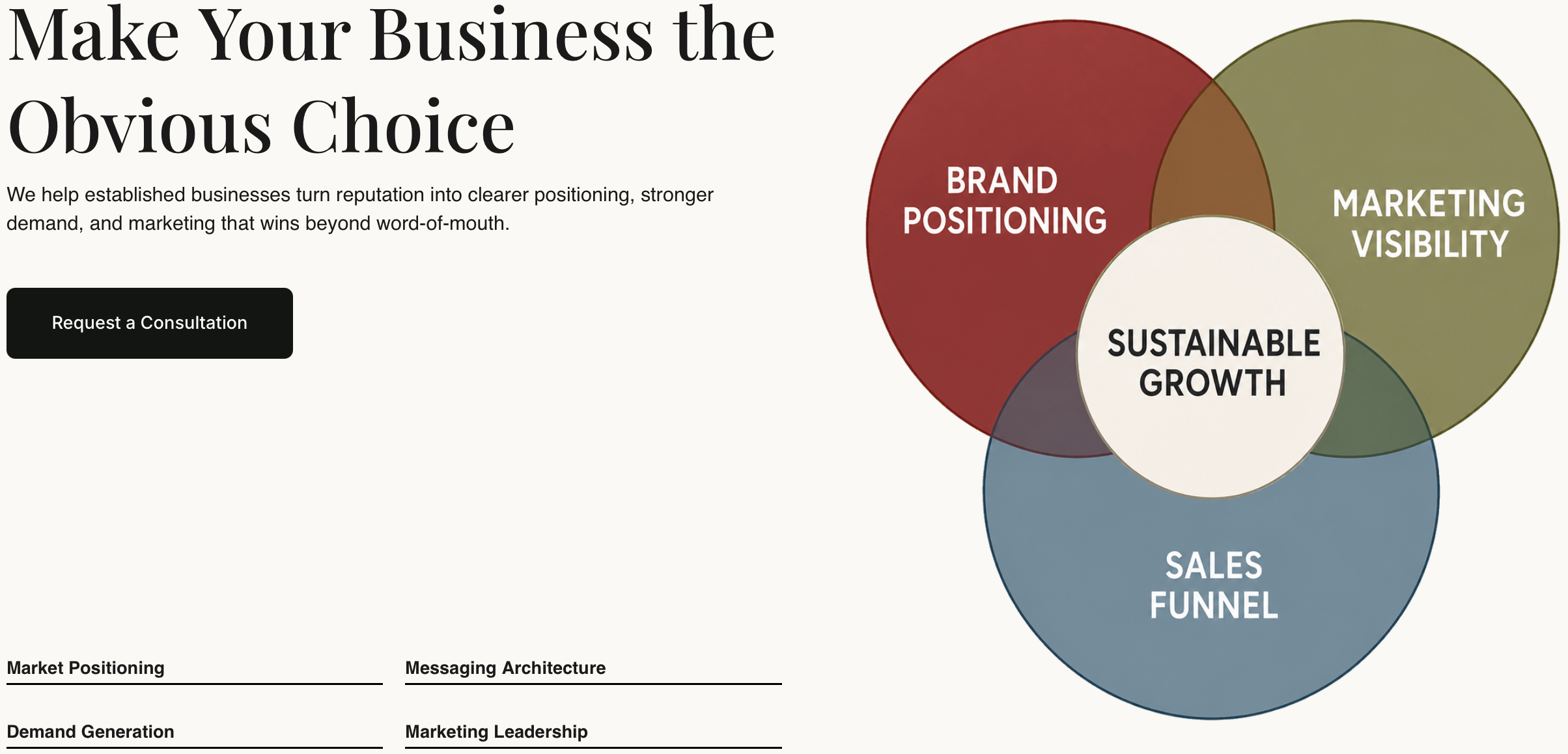
Reasonate Studio works with independently owned businesses generating $2M–$10M in revenue that have outgrown referral-only growth. Through Brand Strategy and Fractional CMO leadership, we connect positioning, buyer-led messaging, and promotional execution into one system so every channel tells the same story and builds on the last.
The result is not more marketing activity. It is marketing that reflects what the business has already built and creates demand beyond the founder’s personal network.
If you are ready to move from disconnected tactics to a promotion strategy with a clear sequence and measurable results, explore Reasonate Studio’s services or learn more about visibility and lead-generation planning to see which engagement fits where you are now.