September 22, 2026
Why Update Brand Messaging: Essential Guide for Growth


Learn how to update brand identity to build trust and attract customers. This guide covers everything small business owners need for success.
TL;DR:
- Updating brand identity involves more than just changing visuals; it requires strategic repositioning and consistent messaging. A thorough audit, audience research, and clear objectives are essential steps to ensure the update advances your business and builds trust. Long-term success depends on applying and maintaining the new identity regularly, guided by comprehensive brand guidelines.
Brand identity is the complete system of visuals, messaging, tone, and customer experience that tells the world who your business is and why it matters. Knowing how to update brand identity is one of the highest-leverage moves a small business owner can make, because a misaligned brand quietly costs you customers every single day. 81% of consumers require trust before making a purchase, and trust is built through consistent, clear brand signals. This guide walks you through every stage of a successful brand identity update, from the audit that reveals what is broken to the documentation that keeps your new identity intact for years.
Updating your brand identity, also called brand identity redesign or strategic repositioning, is not something you start with a new color palette. The work that happens before any design decision determines whether the update actually moves your business forward or just looks different.

A brand audit is a structured review of every element your audience encounters: your logo, website copy, social media profiles, email tone, packaging, and customer service language. You are looking for gaps between how you want to be perceived and how you actually come across. Pull your most recent customer feedback, read your own website as a stranger would, and compare your visual assets side by side. Inconsistencies will surface quickly.
The audit should cover three layers. The first is visual: colors, fonts, logo usage, and photography style. The second is verbal: your tagline, website headlines, social captions, and email subject lines. The third is experiential: what it feels like to buy from you, onboard with you, or receive support from you. Most small business owners find the verbal and experiential layers are far more outdated than the visual ones.
Audience research is the foundation of effective brand identity, not an optional add-on. You need to understand your ideal customer’s values, what they distrust, and what visual and verbal language feels credible to them. Surveys, one-on-one conversations, and social listening on platforms like Instagram or Reddit all produce useful data. If you skip this step, you risk designing a brand that you love but your audience ignores.
Set clear objectives before moving forward. Ask yourself what the update needs to accomplish. Common goals include building trust with a new audience segment, differentiating from competitors, or reflecting a service expansion. Vague goals produce vague results.
The table below outlines the core phases of a brand identity update, the tools commonly used, and realistic time estimates based on professional rebranding timelines.
| Phase | Common Tools | Estimated Time |
|---|---|---|
| Brand audit | Google Analytics, Hotjar, customer surveys | 1–2 weeks |
| Audience research | Typeform, social listening tools, interviews | 1–2 weeks |
| Strategy and positioning | Brand brief templates, competitive analysis | 3–6 weeks |
| Visual identity development | Adobe Illustrator, Canva Pro, Figma | 6–10 weeks |
| Brand guidelines creation | Notion, Google Docs, Frontify | 1–2 weeks |
| Rollout and implementation | Website CMS, social schedulers, email platforms | 2–4 weeks |
Pro Tip: Block time for the strategy phase before you hire a designer. Showing up to a design brief without a clear positioning statement wastes both time and money.
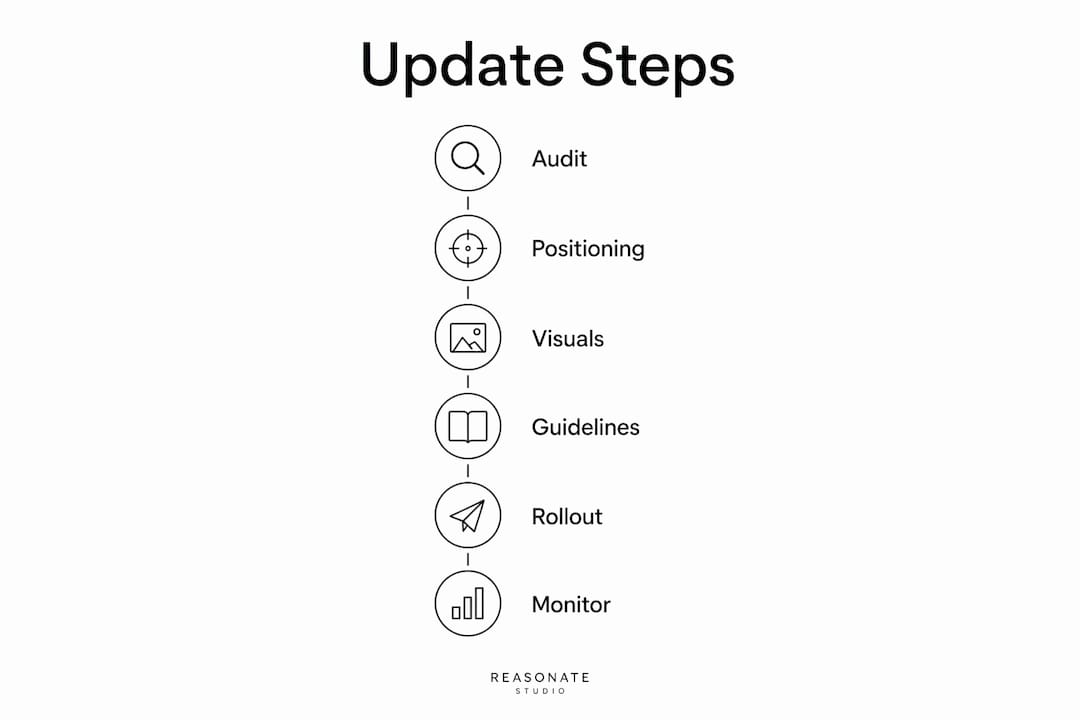
The step-by-step process below gives small business owners a clear roadmap. Each step builds on the one before it. Skipping steps is the most common reason brand updates fail to produce results.
Use your audit findings to list every element that no longer reflects your business. Be specific. “The logo feels dated” is less useful than “The logo uses a font style popular in 2015 and does not read well on mobile screens.” Specificity tells you exactly what to fix and why. Prioritize gaps by their impact on customer trust and conversion, not by how easy they are to fix.
Positioning is the strategic claim your brand makes in the market. It answers why a customer should choose you over every other option. Your messaging is how that claim gets expressed in words across every channel. Refine your positioning statement before writing a single new headline. A strong positioning statement names your audience, the problem you solve, your solution, and the proof that it works.
Rebranding is most effective when it reflects a real business change, such as a new audience, a new price point, or a new service category. If nothing material has changed in your business, a visual refresh may be all you need. Clarity is the goal, not volume.
Visual identity includes your logo, color palette, typography, photography style, and graphic elements. Every visual decision should connect back to your positioning. A health coach moving upmarket needs a different visual language than one serving budget-conscious beginners. Work with a designer who asks strategic questions, not just aesthetic ones. Provide them with your positioning statement, your audience research, and examples of brands your audience already trusts.
Strategy must lead design for the update to be effective. A new logo without a revised strategic narrative produces a polished but confusing brand. This is one of the most expensive mistakes small business owners make.
Brand guidelines are the operational manual for your identity. They document every visual and verbal rule: exact color codes, approved font pairings, logo usage rules, tone of voice descriptions, and example copy. Brand guideline documents reduce repeated production decisions by 70% and protect consistency as your team or contractor list grows. Store them somewhere accessible, such as Notion or a shared Google Drive folder, and treat them as a living document.
Your rollout plan should cover every place your brand appears: your website, social media profiles, email templates, business cards, invoices, packaging, and any paid advertising. Prioritize the highest-traffic touchpoints first. Your website homepage and Instagram profile will be seen by more people in the first week than your invoice template will be seen all year.
A phased rollout approach, including staged customer communication and dual branding during the transition, reduces confusion and builds acceptance. Tell your audience what is changing and why. A short email or social post explaining the update builds goodwill and prevents customers from wondering if you are a different company.
Set a 90-day review after launch. Track metrics tied to your original objectives. If the goal was to build trust, monitor email open rates, social engagement, and direct feedback. If the goal was differentiation, watch for changes in how prospects describe you during sales calls. Consistent brand presentation across all platforms increases revenue by 23–33%. That number only materializes if you maintain the updated identity without reverting to old habits.
Pro Tip: Allocate roughly 70% of your brand update budget to strategy and research, and 30% to creative execution. Most small business owners do the opposite, and then wonder why the new logo did not change anything.
The most common mistakes in a brand identity update are predictable, and every one of them is avoidable with the right preparation.
Treating logo redesign as a full rebrand. A new logo is a visual asset. A brand update is a strategic repositioning. Changing your logo without revising your messaging, positioning, and customer experience is decorating the same confused message with new paint. The result looks different but performs the same.
Rebranding too frequently. Changing your brand identity every 12–18 months destroys recognition. Consumers need 5–7 brand impressions before they recall a brand. Frequent changes reset that clock every time.
Designing for personal preference instead of audience insight. Your brand is not for you. It is for the customer you are trying to attract. Founders who choose colors and fonts based on personal taste, without audience research, often end up with a brand that feels good internally but lands flat externally.
Skipping documentation. Without brand guidelines, every new piece of content becomes a guessing game. Contractors use the wrong fonts. Social posts drift in tone. The brand slowly fragments across channels without anyone noticing until the damage is done.
Underinvesting in strategy. Most of the budget goes to design because design is tangible and exciting. Strategy feels abstract. But launching a new visual identity without first revising the strategic narrative results in a polished but confusing brand that fails to connect.
“The goal of a rebrand is to become clearer, not louder. If your new identity does not make it easier for the right customer to say yes, the update has not done its job.”
Communicate changes to your team before you go public. Internal confusion about the new brand leads to inconsistent customer interactions, which undermines the update before it has a chance to take hold.
Updating your brand identity is not a one-time project. It is an ongoing practice. The businesses that build lasting recognition treat their brand as something that needs regular attention, not a task to complete and forget.
The moment your new brand guidelines are finalized, apply them everywhere. Do not let old assets linger on secondary pages or in email footers. Inconsistency signals to customers that the business is disorganized, even when the new identity itself is strong. Prioritize the highest-visibility touchpoints first, then work systematically through lower-traffic assets over the following weeks.
A well-maintained brand guideline document is the single most practical tool for long-term brand consistency. It removes guesswork for every team member, freelancer, or agency you work with. Brand guidelines reduce 70% of day-to-day decisions on fonts, tone, and assets, which means your team spends less time second-guessing and more time executing. Update the document whenever you make an intentional change to the brand, and review it with new contractors before they produce their first piece of work.
A brand audit should not only happen before a major update. Schedule a lighter version every six months. Review your most recent customer feedback, check your social profiles for visual drift, and read your website copy with fresh eyes. Ask whether the brand still reflects where the business is today. Markets shift, audiences evolve, and your positioning may need a small adjustment before it needs a full overhaul.
A visual refresh updates aesthetics while keeping the core positioning intact. A full rebrand revises the strategic foundation, including positioning, audience definition, and messaging architecture. The signs that you need a full rebrand include entering a new market, targeting a significantly different audience, recovering from a reputation issue, or merging with another business. If only your visual style feels dated, a refresh is enough. If your positioning no longer reflects what you do or who you serve, you need the full process. You can explore the difference in more depth through this overview of what rebranding actually means for small businesses.
Pro Tip: Put a recurring calendar reminder every six months to review your brand guidelines and compare your live assets against them. Catching drift early costs far less than fixing a fragmented brand later.
Most founders come to me thinking their brand problem is a design problem. They want a new logo, a new color palette, maybe a new website. What they actually have is a clarity problem. The visual identity is just the symptom.
The pattern I see repeatedly is this: a founder builds a business, gets some traction, and then realizes their brand no longer reflects what they do or who they serve. So they hire a designer, get a beautiful new logo, and feel excited for about three weeks. Then nothing changes. Inquiries stay flat. The brand still feels off. That is because the design was updated but the strategy was not.
The work that actually transforms a brand is the work that happens before any design file is opened. It is the audience research that reveals what your ideal customer actually values. It is the positioning work that clarifies why you and not someone else. It is the messaging framework that gives every piece of content a consistent voice. When that foundation is solid, the design almost designs itself.
I also want to say something about consistency that most brand guides skip. Consistency is not about being boring or rigid. It is about being recognizable. When your audience sees your content on Instagram, reads your email, and lands on your website, they should feel the same brand in all three places. That feeling is what builds trust over time. And trust is what drives purchase decisions for 81% of consumers.
The founders who get the best results from a brand update are the ones who treat it as an investment in clarity, not a cosmetic fix. They do the strategy work first. They document everything. They apply the new identity consistently and then review it regularly. That is not glamorous work. But it is the work that compounds.
If you are a small business owner reading this and feeling overwhelmed by where to start, begin with the audit. Write down every place your brand appears and ask honestly whether it reflects the business you have built. That single exercise will tell you more than any design trend report ever could. For a deeper look at practical approaches, the rebranding tips for founders resource covers the nuances specific to service-based businesses.
— Kaitlyn
Knowing the steps is one thing. Executing them with clarity and confidence is another, especially when you are running a business at the same time.
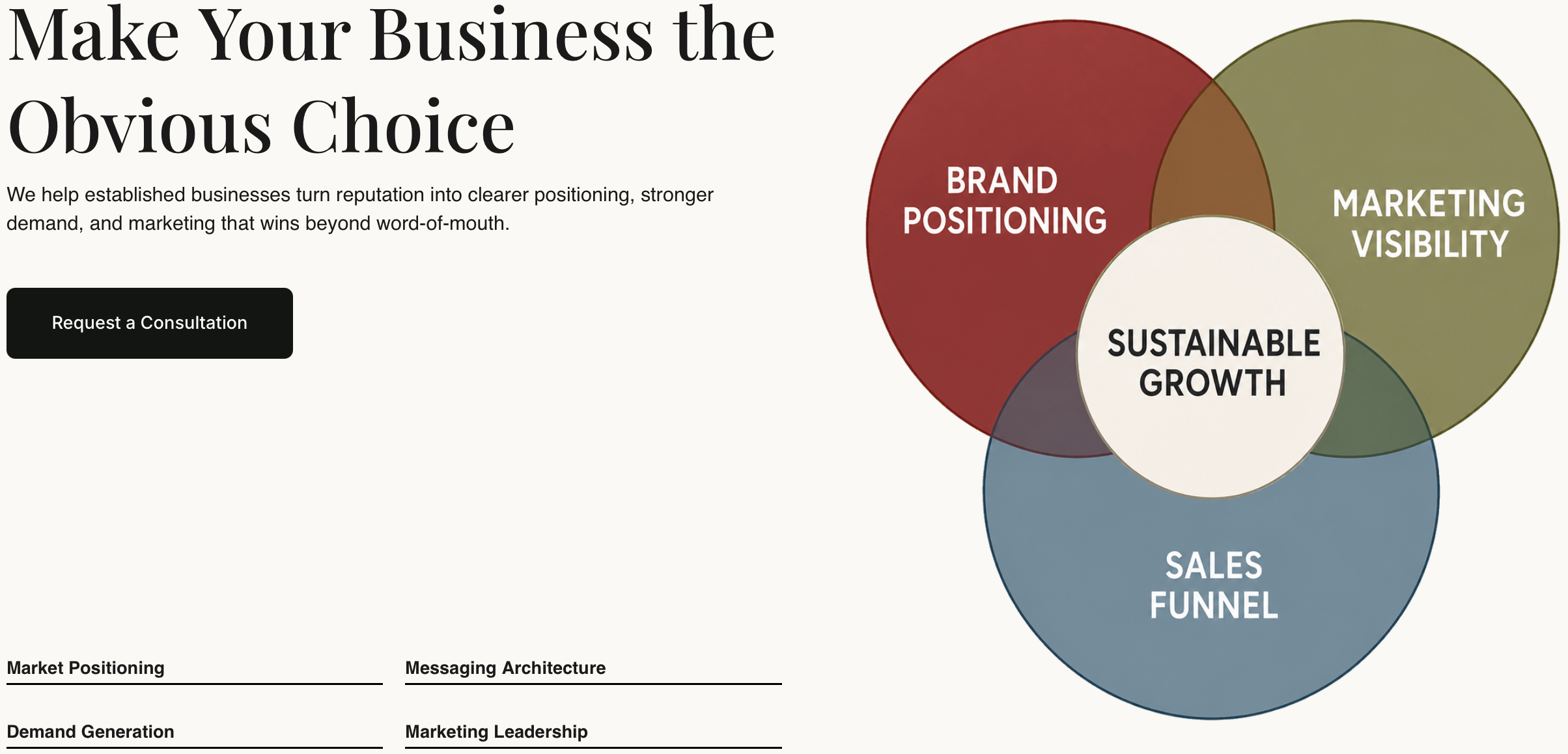
Reasonatestudio works directly with founders, coaches, and consultants to clarify their brand, sharpen their messaging, and build a marketing system that actually converts. From brand audits to full identity alignment, every engagement is led personally by Kaitlyn and grounded in the Aligned Impact Model™. If your brand no longer reflects the business you have built, or if you are ready to attract a better-fit audience, the sales page optimization service at Reasonatestudio is a strong starting point for turning your updated brand into measurable revenue.
Updating brand identity means revising the full system of visuals, messaging, tone, and customer experience that represents your business. It goes well beyond a logo change and includes positioning, voice, and consistent application across every channel.
A professional brand identity update typically spans 3–6 weeks for strategy, 6–10 weeks for visual identity development, and 2–4 weeks for rollout and implementation. Smaller refreshes focused only on visuals can move faster.
A visual refresh is right when your positioning is still accurate but your aesthetics feel dated. A full rebrand is needed when your audience, offer, or market position has materially changed. If your messaging no longer reflects what you do, start from the strategy level.
Consistent brand presentation increases revenue by 23–33%, and consumers need 5–7 impressions before they recall a brand. For small businesses with limited marketing budgets, consistency multiplies the impact of every dollar spent.
The biggest mistake is treating a logo redesign as a complete brand update. Strategy must lead design for any brand update to produce real results. A new visual identity without revised positioning and messaging produces a polished but ineffective brand.