September 22, 2026
Why Update Brand Messaging: Essential Guide for Growth


Create a winning marketing strategy outline for your small business. Discover how a clear plan drives growth and delivers measurable results.

TL;DR:
- A marketing strategy outline defines a business’s goals, target audience, and priorities to drive measurable growth. Small business owners must separate strategy from tactics, set a single primary goal, and regularly review their plan to stay aligned with results. A concise, adaptable document that accounts for emotional customer insights leads to focused actions and sustained success.
A marketing strategy outline is a structured document that defines your business goals, target audience, value proposition, and marketing priorities to drive focused, measurable growth. Without one, small business owners default to patchwork marketing, spending time and money on disconnected tactics that rarely compound into real results. The Aligned Impact Model™, used by Reasonate Studio, is built on exactly this principle: clarity before execution. A solid marketing strategy outline is the difference between a business that grows intentionally and one that stays busy without moving forward.
A strong marketing strategy outline starts with one primary goal. Focusing on a single measurable outcome over a 6–12 month window prevents the scattered effort that kills small business marketing. Secondary goals can exist, but they must support the primary goal rather than compete with it. Think of it as a hierarchy: one north star, everything else in orbit.

The second component is a clearly defined target audience. This goes beyond age and location. You need a full customer persona that captures what your ideal customer fears, wants, and believes before they ever find you. Reasonate Studio’s brand intelligence work, for example, goes beyond surface demographics to map out what motivates buying decisions at an emotional level.
The third component is your unique value proposition (UVP). Your UVP answers one question: why should your ideal customer choose you over every other option? A weak UVP sounds like “we provide quality service.” A strong UVP names the specific transformation you deliver and who it is for.
The fourth component is your strategic bets. Documenting where you will compete and how you plan to win moves your outline from generic to focused. This means committing to specific customer segments, specific channels, and specific offers rather than trying to reach everyone everywhere.
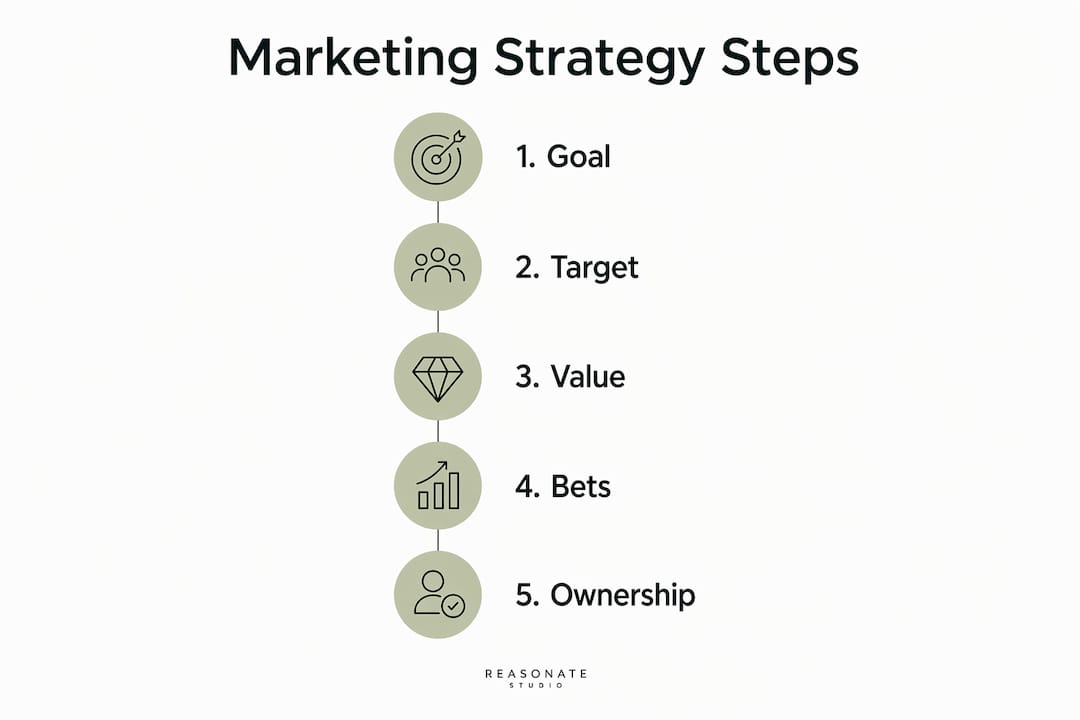
The fifth component is your operational constraints. Sales capacity, product release schedules, and compliance requirements must be documented in the strategy. Ignoring these turns your outline into a theoretical document that no one can actually execute.
Here is a quick checklist of the core components every marketing strategy outline needs:
Pro Tip: Write your primary goal as a single sentence with a number in it. “Grow monthly revenue from $8,000 to $15,000 by december 2026” is a goal. “Grow the business” is a wish.
The most common structural mistake is mixing strategy with tactics inside the same document. A marketing strategy defines the “why” and “what,” while a marketing plan is the tactical roadmap covering the “how” and “when.” Keeping these separate gives you a stable compass and a flexible execution plan. Your strategy can hold for 12 months. Your tactical plan should be reviewed and refreshed roughly every 90 days.
A well-structured marketing strategy document has four layers:
The campaign layer is where most small business owners get stuck. They write a strategy but never assign a name to each campaign or a deadline to each deliverable. Without that, the document sits in a folder and collects digital dust.
One of the most practical structural moves you can make is building a shared library of reusable template blocks for your ideal customer profile, messaging framework, and channel assumptions. This means you are not rebuilding your brand foundation every time you update your strategy. You pull the block, update what changed, and move on.
Clear ownership is equally non-negotiable. Assigning who fills out and who reviews the marketing strategy document prevents it from becoming a “ghost” document that everyone references but no one maintains. One owner. One reviewer. One review date per quarter.
| Document layer | Time horizon | Owner | Review cadence |
|---|---|---|---|
| Strategic foundation | 12 months | Founder or CMO | Annually or at major pivots |
| Strategic priorities | 6–12 months | Marketing lead | Every quarter |
| Campaign layer | 90 days | Campaign manager | Monthly |
| Measurement layer | Ongoing | Analytics owner | Monthly |
This table gives you a working governance model. Adapt the titles to your team size, even if “team” means just you right now.
Building a marketing strategy template from scratch feels overwhelming until you break it into a repeatable sequence. The steps below reflect best practices for small business owners who need a practical, executable process.
Define your mission, vision, and business context. Start with why the business exists and where it is headed. This grounds every marketing decision that follows. Without this, your strategy has no anchor.
Conduct audience and competitive research. Talk to current customers. Review what your competitors are saying and where they are saying it. Identify the gaps they are not filling. This research shapes your positioning and your UVP.
Set SMART marketing objectives. SMART stands for Specific, Measurable, Achievable, Relevant, and Time-bound. “Increase email subscribers by 500 in 90 days” is a SMART goal. “Get more leads” is not. Every objective in your outline should pass this test.
Document your strategic bets. Choose the two or three customer segments, channels, and offers where you will concentrate your resources. Committing to these choices is what separates a real strategy from a wish list.
Develop your messaging and positioning. Write the core message that speaks directly to your ideal customer’s problem and your specific solution. This message should run consistently across your website, social media, email, and ads.
Plan campaigns, assign owners, and set timelines. Map out the specific campaigns that will execute your strategy. Each campaign needs a name, a goal, a budget range, a start date, and a person responsible for delivery.
Define your KPIs and measurement framework. Choose three to five metrics that directly reflect progress toward your primary goal. For a coach growing a client base, that might be discovery call bookings, email open rates, and Instagram profile visits.
Treat the document as a living record. Marketing strategies must evolve based on real performance data rather than function as static yearly plans. Schedule a quarterly review to assess what is working, what is not, and what needs to shift.
Pro Tip: Before you write a single tactic, write your primary goal at the top of the page and leave it there. Every decision you make in the document should pass one test: does this support that goal?
A free marketing strategy guide can help you work through each of these steps with prompts and examples if you are building your first outline.
The most damaging mistake is patchwork marketing, where efforts are spread across too many goals, channels, and audiences at once. This reduces efficiency and return on investment. Small businesses with limited budgets and lean teams cannot afford to dilute their focus. One primary goal, pursued consistently, outperforms five goals pursued half-heartedly every time.
The second mistake is confusing strategy with tactics. A strategy answers “what are we trying to achieve and why?” A tactic answers “what specific action will we take?” Mixing these in the same document creates confusion and makes it hard to evaluate whether the strategy is actually working. Keep them in separate sections or separate documents.
The third mistake is building an overstuffed template with no clear ownership. A marketing strategy document that lists every possible initiative but assigns no names and no deadlines is not a strategy. It is a brainstorm. Templates that connect strategy to campaigns, budgets, and owners are the ones that actually get executed.
The fourth mistake is ignoring operational constraints. If your sales team can handle 20 new clients per month, your marketing strategy should not be designed to generate 200 leads per month. Misalignment between marketing output and operational capacity creates chaos, not growth.
“The biggest misconception is that a marketing strategy is static. Businesses that treat their strategy as a fixed annual document miss the signals that tell them when to pivot, double down, or stop. A strategy that does not evolve with your data is just a document. A strategy that evolves with your data is a growth engine.”
The fix for all of these mistakes is a consistent review rhythm. Set a calendar reminder for the first week of every quarter. Pull up your strategy document. Check your KPIs. Ask three questions: What worked? What did not? What do we change? That 60-minute review keeps your strategy alive and your team aligned.
Here is a quick list of red flags that signal your marketing strategy outline needs attention:
Working with founders, coaches, and consultants across dozens of industries, the pattern I see most often is not a lack of ambition. It is a lack of constraint. Founders want to be on every platform, serve every audience, and launch every idea at once. The marketing strategy outline is not just a planning tool. It is a permission structure for saying no.
The most effective outlines I have seen are also the shortest. One page of strategic foundation. One page of priorities. One page of campaigns. Three pages total. When a document is too long to read in five minutes, it does not get read. When it does not get read, it does not get followed. Simplicity is not laziness. It is respect for the reality of running a small business.
The second thing most guides skip is the emotional component of strategy. A marketing plan outline that does not account for what your ideal customer feels before they buy is missing the most important variable. Reasonate Studio’s Aligned Impact Model™ is built on this premise. Brand clarity is not just about what you say. It is about why your audience should believe it.
The third thing I would tell every small business owner is this: your strategy document is not finished when you write it. It is finished when you use it. The first version will be imperfect. That is fine. The goal is to get it out of your head and onto a page so you can see it, test it, and improve it. A marketing strategy that delivers results is one that gets reviewed and revised, not one that gets filed and forgotten.
— Kaitlyn Cole
Building a marketing strategy outline is the first step. Turning it into revenue is the next one.
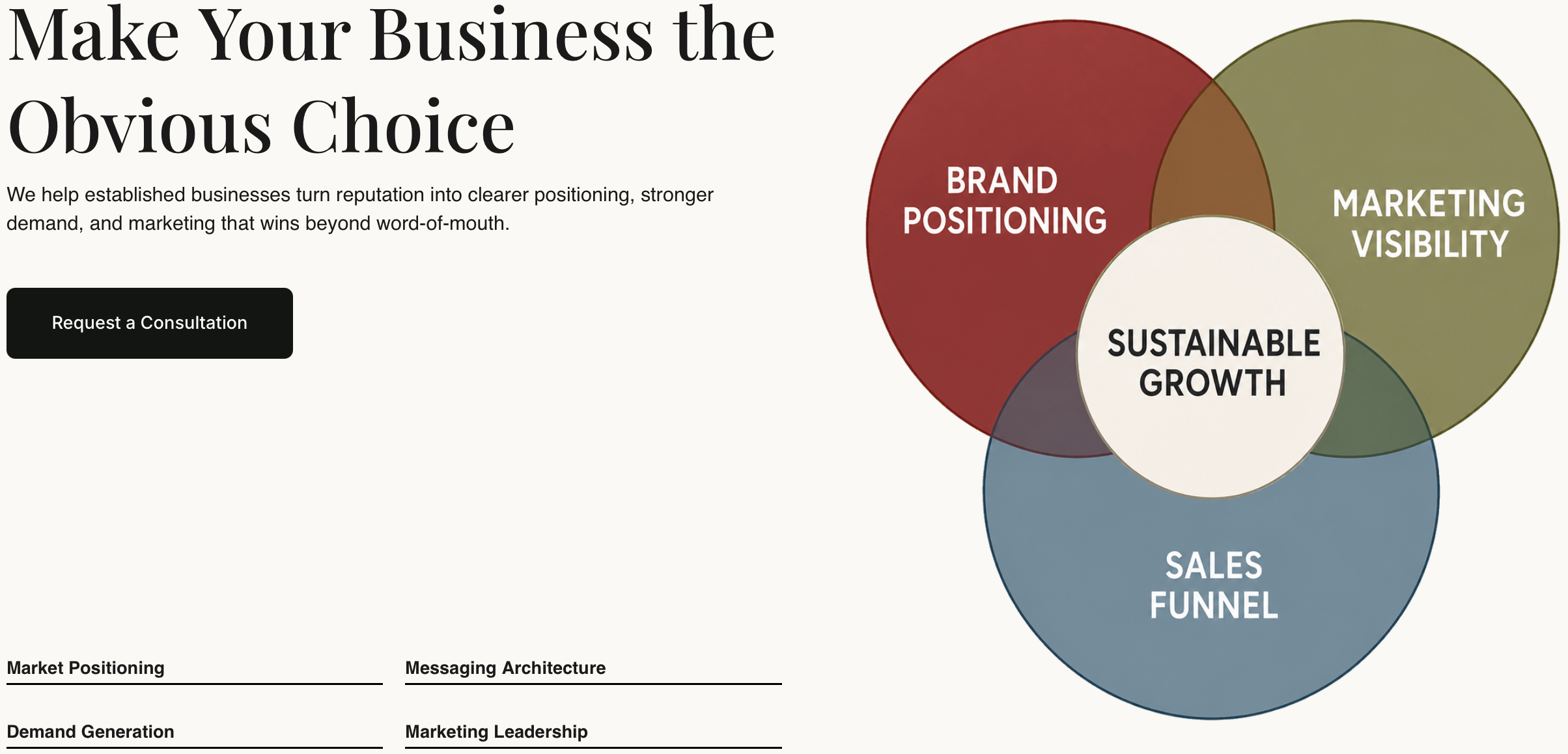
Reasonate Studio works directly with founders, coaches, and consultants to build strategy-first marketing systems that connect brand clarity to real business growth. From the Aligned Impact Model™ to done-for-you execution, every service is designed to replace scattered marketing with a focused, repeatable system. If your strategy is solid but your sales page optimization is not converting visitors into clients, that is exactly where Reasonate Studio can help. A well-built strategy deserves a sales page that closes.
A marketing strategy outline is a structured document that defines your primary marketing goal, target audience, value proposition, strategic priorities, and measurement framework. It serves as the guiding compass for all marketing decisions and activities.
A marketing strategy defines the “why” and “what” of your marketing direction, while a marketing plan is the tactical roadmap covering specific campaigns, timelines, and budgets. The strategy is long-term; the plan is typically refreshed every 90 days.
A marketing strategy outline should focus on one primary measurable goal over a 6–12 month period. Secondary goals are allowed but must support the primary goal rather than compete with it.
Strategic bets are the specific choices a business makes about which customer segments, channels, and offers to prioritize. Documenting these choices focuses resources and prevents the scattered effort that reduces marketing effectiveness.
A marketing strategy outline should be reviewed quarterly and updated whenever performance data signals a need to shift priorities. Treating it as a living document rather than a static annual plan keeps it relevant and executable.