September 22, 2026
Why Update Brand Messaging: Essential Guide for Growth


Discover the essential marketing channels list for small business owners. Choose wisely to engage your audience and boost your brand in 2026.
TL;DR:
- Most small businesses succeed using 5 to 8 marketing channels; focusing on a few builds stronger customer trust. Effective channels include email, organic social media, SEO, paid ads, and content marketing, chosen based on customer behavior. Mastering a few channels with authentic energy yields better results than spreading effort across many platforms.
A marketing channels list is a defined set of platforms and methods a business uses to reach, engage, and convert its target audience. Most high-performing small businesses use 5 to 8 channels for consistent customer connection rather than spreading thin across every available option. The industry recognizes two broad categories: digital marketing channels (email, SEO, paid ads, social media) and traditional channels (direct mail, events, referrals). Choosing the right mix from this list determines how efficiently your budget works and how quickly your brand builds recognition. This guide covers the full marketing channels list and shows you exactly how to pick the ones worth your time.
Choosing from a digital marketing channels list is not about picking what is popular. It is about matching each channel to where your customer actually is in their buying process.
The marketing industry organizes channels into three media types:
Channel selection based on customer journey stage and demographics yields higher engagement than choosing by platform popularity alone. A busy professional on LinkedIn responds differently than a Gen Z shopper on TikTok. Matching the channel to the audience mindset is what separates effective marketing from wasted spend.
One of the most common mistakes small business owners make is channel proliferation. That is the habit of signing up for every platform and posting inconsistently across all of them. The result is low-quality presence everywhere instead of strong presence somewhere. Depth beats breadth every time.

Time-to-impact also varies widely. Paid channels like PPC deliver visibility within 24 to 48 hours, while organic channels like SEO may need a 6 to 12 month runway before results compound. Knowing this upfront helps you plan your budget and set realistic expectations.
Pro Tip: Before adding any new channel, ask one question: “Is my ideal customer actively using this platform to find solutions like mine?” If the answer is not a clear yes, skip it.
Email marketing is the most cost-effective, high-ROI channel in the list of all marketing channels, and it is consistently underused by small businesses chasing social media metrics. Email delivers superior ROI for customer retention compared to most social platforms. The reason is simple: your email list is owned media. No algorithm change can cut your reach overnight.
Email works across every stage of the customer journey. Welcome sequences build trust with new subscribers. Promotional emails drive sales. Re-engagement campaigns win back cold contacts. For coaches and consultants especially, a well-written weekly newsletter builds the kind of relationship that converts readers into paying clients over time.
Organic social media is the practice of posting content on social platforms without paying for distribution. 70% of marketers report organic social media as a top channel, with Facebook leading platform engagement at 69.6%, followed by YouTube at 68.6%, TikTok at 56.5%, and X at 55.8%. Those numbers show that organic reach is still very much alive when content is built for the platform.
The key word is “organic.” Posting the same caption across five platforms does not work. Facebook rewards community-driven content. TikTok rewards entertainment and education in short video form. Instagram rewards visual consistency and Reels. Each platform has its own content language, and learning it is what separates brands that grow from brands that stagnate. For a deeper look at how these platforms drive audience growth, the guide on organic marketing strategies for small businesses breaks it down by platform.
SEO is the process of making your website rank higher in Google search results for terms your customers are already searching. It is one of the most powerful long-term channels in any digital marketing channels list because it generates traffic without ongoing ad spend.
The tradeoff is time. SEO is not a quick-win channel. It requires consistent content creation, technical site health, and link building over months. But once pages rank, they drive traffic around the clock. For local businesses, local SEO (optimizing your Google Business Profile and location-based keywords) can produce results faster than national SEO campaigns.
Pro Tip: Start SEO with a cluster of 5 to 10 tightly related blog posts targeting one core topic. Google rewards topical authority, and a cluster approach builds it faster than isolated posts.
Paid advertising covers pay-per-click search ads on Google, display ads across the web, and paid placements on social platforms like Meta, LinkedIn, and TikTok. It is the fastest channel on any marketing channels list for generating visibility. Results appear within 24 to 48 hours of launching a campaign.
The limitation is cost. Paid ads require ongoing budget to keep running. The moment you stop paying, the traffic stops. This makes paid advertising most effective when paired with owned channels like email or SEO, so you capture leads and build relationships that do not depend on continued ad spend.
For small businesses, Meta Ads (Facebook and Instagram) offer the most granular audience targeting at accessible price points. Google Search Ads work best when customers are already searching for what you sell, because you capture existing demand rather than creating it.
Content marketing is the practice of creating educational or entertaining content that attracts your ideal customer without a direct sales pitch. Formats include blog posts, long-form articles, YouTube videos, podcasts, and short-form video. It is one of the most versatile types of marketing channels because it feeds multiple other channels simultaneously.
A single well-researched blog post can rank on Google (SEO), be shared on social media (organic social), be repurposed into an email newsletter, and be clipped into short videos for TikTok or Instagram Reels. That multiplier effect makes content marketing one of the highest-leverage activities for small businesses with limited teams.
The most effective content marketing strategies focus on answering the specific questions your audience is already asking. Tools like Google’s “People Also Ask” feature and keyword research platforms reveal exactly what your customers want to know.
Influencer marketing places your brand in front of an existing audience through a trusted creator. Affiliate marketing pays a commission to partners who drive sales. Both belong on any complete list of all marketing channels because they extend your reach without requiring you to build that audience yourself.
For small businesses, micro-influencers (creators with 10,000 to 100,000 followers in a specific niche) consistently outperform celebrity influencers on engagement and conversion. Their audiences are tighter, more trusting, and more likely to act on recommendations. Understanding how influencer strategy fits into your broader channel mix is worth the time before you commit budget.
Affiliate programs work especially well for product-based businesses and online courses. You pay only when a sale happens, which makes it one of the lowest-risk paid channels available.
Direct mail is a physical marketing channel: postcards, catalogs, letters, and packages sent to a curated mailing list. It sounds old-fashioned, but it performs well precisely because digital inboxes are crowded and physical mailboxes are not.
Direct mail works best for local businesses targeting a specific geographic area, high-ticket service providers reaching a defined professional audience, and re-engagement campaigns for lapsed customers. Response rates for direct mail consistently outperform display advertising because the physical format demands attention in a way a banner ad never will.
Event marketing includes in-person events like workshops, pop-ups, and trade shows, as well as virtual events like webinars and live streams. Events compress the trust-building timeline dramatically. A 60-minute workshop can do more for your relationship with a prospect than six months of social media posts.
For coaches and consultants, hosting a free monthly webinar is one of the most effective ways to demonstrate expertise and convert warm leads. For product-based businesses, pop-up events create direct customer contact and immediate sales feedback that no analytics dashboard can replicate.
PR is the practice of earning media coverage in publications, podcasts, and broadcast outlets without paying for placement. A single feature in a respected industry publication can build more credibility than months of paid advertising.
Small businesses often overlook PR because it feels inaccessible. The reality is that journalists and podcast hosts are constantly looking for credible sources and interesting stories. A clear brand story, a specific point of view, and a targeted media list are all you need to start pitching. HARO (Help a Reporter Out) is a free tool that connects journalists with expert sources and is a practical starting point for any small business.
Referral marketing turns your existing customers into a channel. A structured referral program gives satisfied customers an incentive to recommend your business to their network. Word-of-mouth has always been the most trusted form of marketing, and a referral program makes it systematic.
The simplest referral programs offer a discount or bonus for both the referrer and the new customer. More sophisticated programs track referrals through unique links and automate reward delivery. For service businesses especially, referrals often produce the highest-quality leads because they arrive with built-in trust.
SMS marketing sends text messages directly to subscribers who have opted in. Push notifications deliver alerts through a mobile app or browser. Both channels have exceptionally high open rates compared to email, making them effective for time-sensitive promotions, appointment reminders, and flash sales.
The tradeoff is permission. Customers guard their phone numbers more carefully than their email addresses. SMS works best when the value exchange is clear: exclusive deals, early access, or genuinely useful updates. Overuse destroys trust fast. Treat SMS as a high-value, low-frequency channel.
Co-marketing is a formal arrangement between two non-competing businesses that share an audience. Each partner promotes the other’s offer to their own list or following. The result is mutual audience growth at zero media cost.
A fitness coach and a nutritionist serve the same customer but do not compete. A wedding photographer and a florist share the same client base. Identifying two or three strong co-marketing partners can produce consistent referral traffic and new leads without any ad spend.
The goal is not to use every channel on this list. Focusing on 2 to 3 channels where your audience is most active produces higher ROI than spreading effort across a dozen platforms. The right channel marketing mix for most small businesses uses 5 to 8 channels total, with 2 to 3 as primary drivers and the rest in a supporting role.
Here is a practical framework for building your mix:
Balancing owned and rented media is the single most important structural decision in your channel mix. Relying entirely on social media means an algorithm change can cut your reach overnight. A strong email list protects you from that risk.
Pro Tip: Audit your current channels every 90 days. Drop any channel where you have been consistently active for six months without measurable results. Redirect that time and budget to what is working.
The question of how to develop a marketing strategy that ties all these channels together is where most small business owners get stuck. Channel selection is only one piece. The strategy underneath it determines whether those channels actually produce growth.
Working with founders and coaches for years, I have seen one pattern repeat itself constantly. The businesses that struggle most are not the ones with the smallest budgets. They are the ones trying to be everywhere at once.
A health coach comes in posting on Instagram, Facebook, LinkedIn, TikTok, and Pinterest, sending a weekly email, running Google Ads, and writing a blog. None of it is done well because there is not enough time or energy to do any of it well. The result is a brand that looks scattered and a founder who is exhausted.
The businesses that grow fastest are the ones that pick two or three channels and go deep. One client of mine, a business consultant, dropped everything except a weekly LinkedIn post and a monthly email newsletter. Within four months, her inbound inquiries doubled. She was not doing more. She was doing less, better.
The counterintuitive truth about channel selection is that channel depth beats channel breadth every time. Mastery of one platform builds more momentum than mediocre presence on five. Your audience needs to see you consistently in one place before they trust you enough to buy.
My honest advice: pick the channel where you can show up with genuine energy and consistency. Marketing you actually enjoy doing gets done. Marketing that feels like a chore gets abandoned. And an abandoned channel is worse than no channel at all, because it signals to potential clients that you do not follow through.
— Kaitlyn Cole
Choosing the right channels is only half the equation. The other half is making sure your message converts once people arrive.
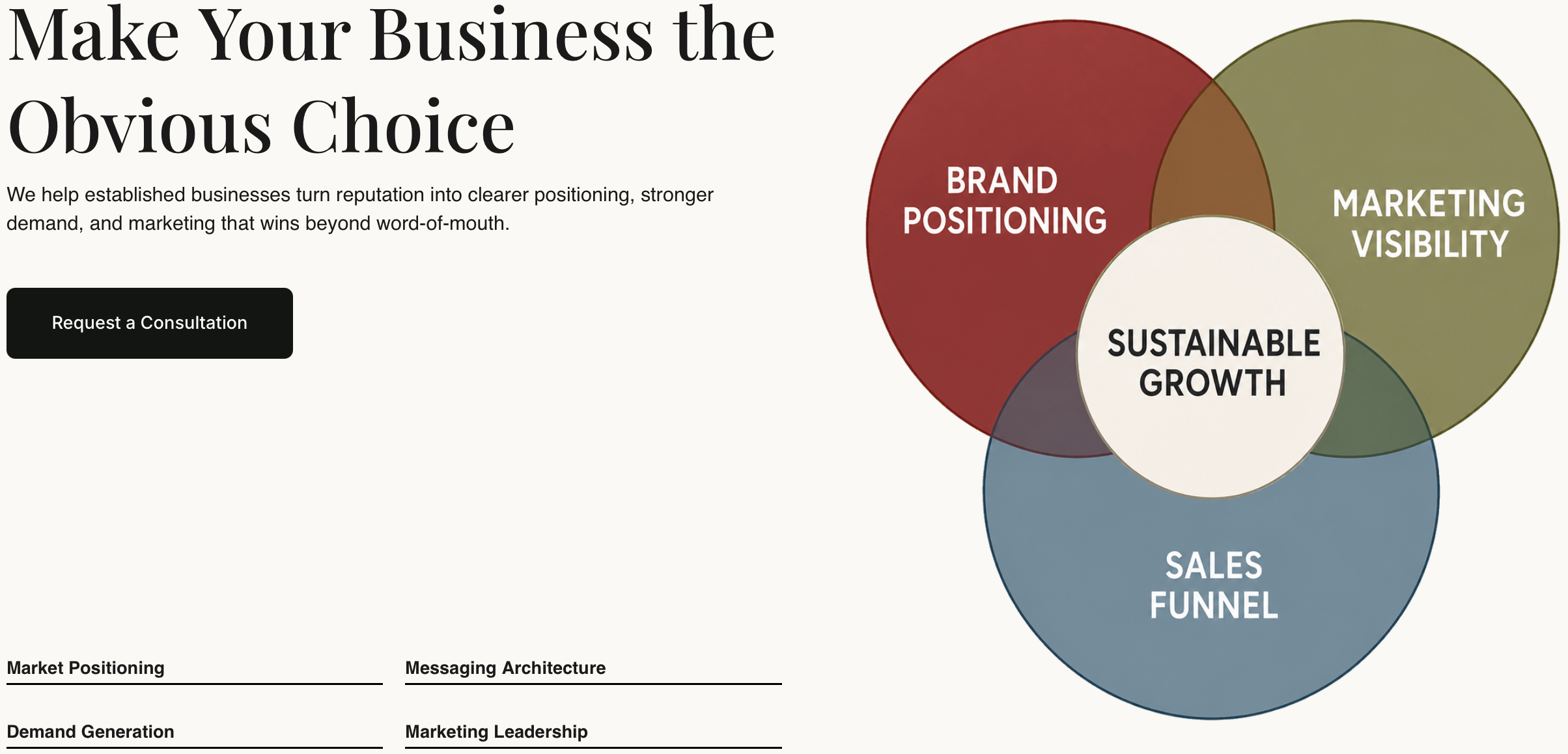
Reasonate Studio works with founders, coaches, and consultants to build marketing systems that connect the right channels to the right message. The sales page optimization service at Reasonate Studio is designed specifically to turn channel traffic into paying clients. Whether you are driving visitors through SEO, social media, or email, a weak sales page bleeds conversions. Reasonate Studio audits your current page, sharpens your offer positioning, and rewrites copy that actually closes. If your channels are working but your revenue is not reflecting it, the sales page is usually where the gap lives.
A marketing channels list is a defined set of platforms and methods a business uses to reach and engage its audience. It typically includes both digital channels (email, SEO, social media, paid ads) and traditional channels (direct mail, events, referrals).
Most high-performing small businesses use 5 to 8 channels for effective reach. Focusing on 2 to 3 primary channels where your audience is most active produces stronger results than spreading effort across many platforms.
Owned media includes channels you fully control, like your email list and website. Rented media includes social platforms where reach depends on algorithms. Relying solely on rented channels risks sudden drops in visibility when platform rules change.
Email marketing consistently delivers the highest ROI for customer retention among all channel types. Paid channels like PPC deliver faster visibility but require ongoing spend, while SEO builds compounding organic traffic over a 6 to 12 month period.
Start by identifying where your ideal customers are already spending time, then select channels that match your content strengths and budget. Align channel choice with your customer journey stage, and prioritize owned media as your foundation before adding paid or social channels.