September 22, 2026
Why Update Brand Messaging: Essential Guide for Growth


Discover the essential elements of a strong brand in our 2026 guide. Learn how to build customer loyalty and market relevance effectively.
TL;DR:
- A strong brand is a system of interconnected elements rooted in clear strategy that fosters loyalty. Consistent governance, documentation, and deliberate application across touchpoints are essential for brand longevity. Entrepreneurs can build a lasting brand by focusing first on strategy, then aligning visual and verbal identities over time.
A strong brand is defined as a system of interconnected elements that create clarity, relevance, and customer loyalty in a specific market. The elements of a strong brand go far beyond a logo or color palette. They include strategic positioning, a distinct verbal identity, a coordinated visual system, and the governance processes that hold everything together over time. Frameworks like the MAGNET framework and Reasonate Studio’s Aligned Impact Model™ both confirm that brands built on strategic foundations outperform those built on aesthetics alone. This guide breaks down each core component so entrepreneurs and small business owners can build something that actually lasts.
Brand strategy is the foundation every other element rests on. Without it, your visuals are decoration and your messaging is noise. The strategic layer defines who you serve, what you stand for, and why someone should choose you over every other option in your category.

Brand positioning requires four core components: target audience, competitive category, primary point of differentiation, and supporting proof. Missing any one of these creates a gap a competitor can walk right through. The MAGNET framework formalizes this structure and treats each component as non-negotiable.
Your positioning statement is not a tagline. Positioning statements serve as internal strategic anchors that guide every marketing decision and keep messaging consistent across your team. Without one, your content drifts toward generic feature claims that could describe any business in your space.
Focused targeting is what gives new brands traction. Addressing niche segments that larger competitors ignore outperforms broad targeting for startups and small businesses. A narrowly defined audience lets you speak directly to real problems, which builds trust faster than trying to appeal to everyone.
Here is what a complete strategic foundation covers:
Pro Tip: Write your positioning statement before you brief any designer. If you cannot explain your differentiation in one sentence, your visual identity will not be able to communicate it either.
Visual and verbal identity are the outward expression of your strategy. They translate your positioning into something people can see, hear, and remember. The key is that every element in this system must connect back to your strategic foundation.
Successful brand identity distinguishes between strategic intent and visual output. Starting with visuals before strategy leads to disjointed marketing. Your logo, colors, and fonts should feel like the natural result of your positioning, not a separate creative decision.
The core visual elements every brand needs are:
Visual brand elements include logo variants, color palette with exact hex codes, typography choices with scale, and a clear imagery style. A well-designed system makes the brand recognizable, coherent, and aligned with personality and positioning.
Your verbal identity is equally important. It includes your brand voice, tone of voice attributes, and a core messaging framework. Voice describes your brand’s personality in writing. Tone describes how that personality shifts depending on context, such as warmer in social captions and more direct in sales copy.
| Verbal element | What it defines | Example output |
|---|---|---|
| Brand voice | Consistent personality traits | “Direct, warm, no-nonsense” |
| Tone of voice | Context-specific adjustments | Formal in proposals, casual on Instagram |
| Messaging framework | Core claims and proof points | Headline, subheadline, three key benefits |
| Tagline | External-facing brand promise | “We help you turn your story into income” |
Pro Tip: Choose three personality adjectives for your brand voice before writing a single word of copy. Every piece of content you create should pass the test: does this sound like those three words?
Documentation turns your brand identity from a concept into a durable system. Without it, every new hire, freelancer, or vendor interprets your brand differently. Over time, those small inconsistencies compound into something that no longer looks or sounds like you.
An actionable brand style guide includes clear examples of correct and incorrect brand use, terminology control, and is accessible to all stakeholders. Without documentation, brands degrade as freelancers and employees apply inconsistent interpretations. A style guide is not a luxury for large companies. It is a practical tool that saves you time and money every time someone creates content on your behalf.
A complete brand style guide covers:
Brand governance processes involving documentation, approvals, checkpoints, and audits prevent brand drift resulting from inconsistent use over time. Governance means assigning someone the authority to approve brand assets, scheduling quarterly audits, and building review checkpoints into your content workflow.
Here is a simple governance comparison for small businesses at different stages:
| Stage | Documentation level | Governance approach |
|---|---|---|
| Early stage | One-page brand reference sheet | Founder reviews all external assets |
| Growing team | Full style guide with examples | Designated brand lead approves new templates |
| Established brand | Versioned guidelines with change log | Quarterly audits with scheduled review dates |
Ongoing brand governance requires defining approval levels, built-in review checkpoints, and systematic quarterly audits to sustain brand integrity. Neglecting governance does not just create visual inconsistency. It erodes customer trust because your brand starts to feel unreliable.
Pro Tip: Even a one-page brand reference document is better than nothing. List your hex codes, approved fonts, three voice adjectives, and your positioning statement. Share it with every person who touches your brand.
Consistency is what converts a brand from a collection of assets into a recognizable presence. Every place a customer encounters your business is a touchpoint, and each one either reinforces or undermines the brand you are building.
Applying brand elements consistently across all touchpoints including website, social media, product UI, and packaging builds recognition and trust. Auditing and scoring inconsistencies help prioritize updates with designated ownership and deadlines. The goal is not perfection on day one. The goal is a clear system for identifying gaps and closing them.
Common touchpoints to audit and align:
Assign ownership to each touchpoint. One person should be responsible for keeping each channel on-brand. Without ownership, updates stall and inconsistencies persist. Set a deadline for your first full touchpoint audit and treat it like a product launch.
Score each touchpoint on a simple three-point scale: fully aligned, partially aligned, or off-brand. Start your updates with the highest-traffic touchpoints first, typically your website and primary social profile. This approach gives you the fastest return on your effort.
Small business owners do not need a big budget to build a strong brand. They need a clear order of operations and the discipline to follow it. Most brand mistakes come from skipping steps, not from lacking money.
Entrepreneurs should prioritize brand strategy and focused positioning before designing logos or choosing colors to build durable brands. Starting with strategy aligns visuals and messaging, while informal early documentation avoids future brand drift. This is the single most common mistake: spending money on design before the strategy is clear.
Practical steps for building a strong brand on a limited budget:
Pro Tip: Free tools like Google Fonts and Coolors can help you build a consistent visual system without a designer. The discipline of using them consistently matters more than the sophistication of the tools themselves.
You can also learn more about building brand identity through a step-by-step process that takes you from audience definition all the way through governance.
Working directly with founders, coaches, and consultants for years has shown me one pattern more clearly than any other: the businesses that struggle with marketing almost always skipped the strategy step. They hired a designer, got a beautiful logo, and then had no idea what to say or who to say it to.
The uncomfortable truth is that most entrepreneurs treat branding as a visual project when it is actually a strategic one. Your logo does not attract clients. Your positioning does. Your colors do not build trust. Your consistency does. When you get the strategy right first, the visuals become easy because you know exactly what they need to communicate.
I have also seen what happens when governance gets ignored. A brand that looked sharp at launch starts to feel scattered after 18 months because different team members, freelancers, and platforms have all made small, well-intentioned decisions that pulled the brand in different directions. Brand drift is not dramatic. It is quiet, and by the time you notice it, the damage is already done.
The brands I have seen grow the fastest are the ones that treat their brand as a living system, not a one-time project. They revisit their positioning when the market shifts. They update their style guide when they add new channels. They assign someone to own brand decisions even when the team is small. That discipline is what separates brands that build real recognition from brands that stay invisible.
If you are just starting out, do not wait until you have the perfect logo to start building. Start with your positioning statement and your audience definition. Everything else follows from there. The brand positioning tips that actually move the needle are simpler than most people expect.
— Kaitlyn Cole
Building a brand with all the right elements is one thing. Making sure it actually drives revenue is another.
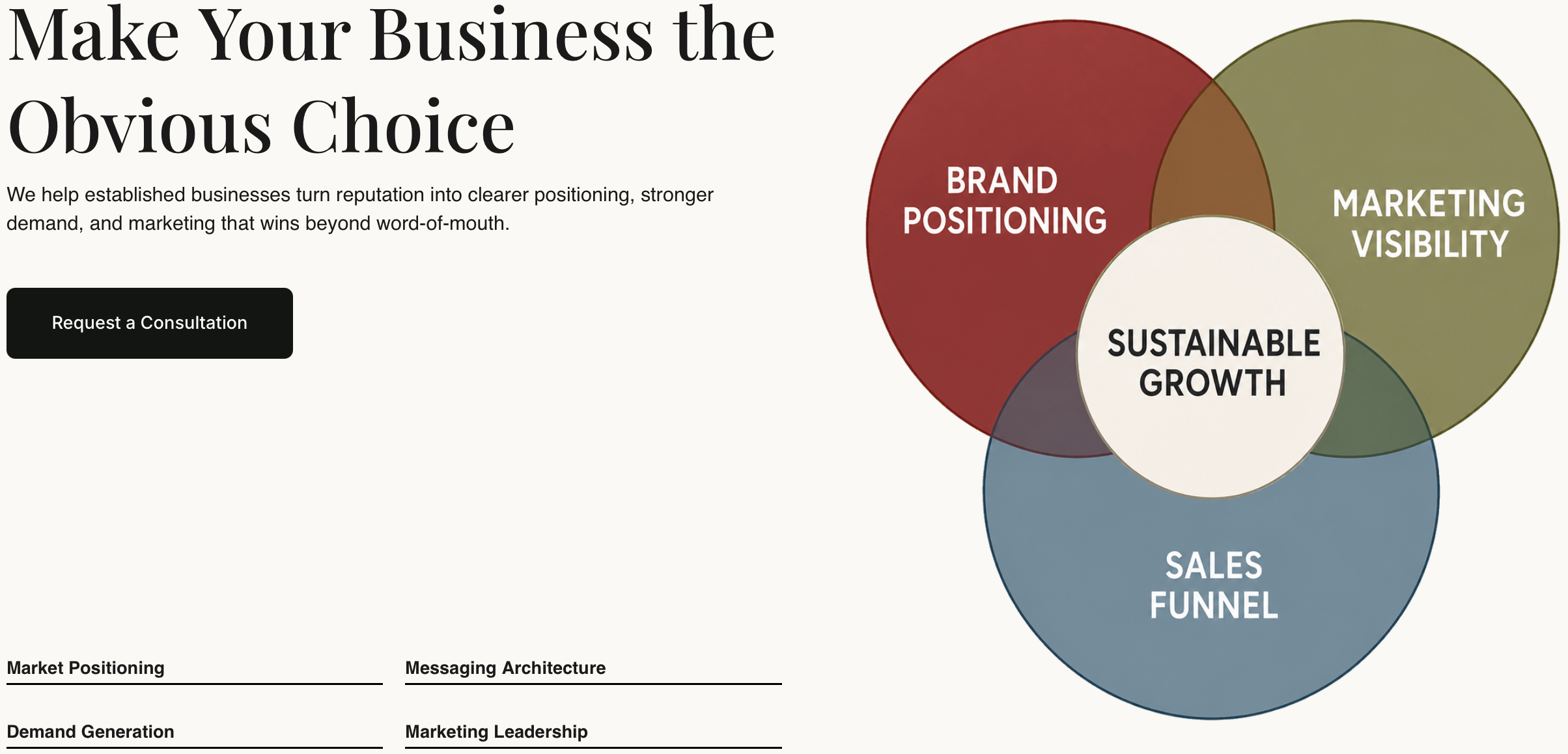
Reasonate Studio works with founders, coaches, and consultants who are ready to move from scattered marketing to a brand that shows up clearly and consistently. The Aligned Impact Model™ covers every element covered in this guide, from positioning and messaging to content, social media, and funnel performance. Services like sales page optimization and SEO keyword research are built to work inside a strong brand foundation, so your visibility and your conversions grow together. If you are ready to build a brand that feels aligned and performs, Reasonate Studio is the place to start.
The core elements of a strong brand are positioning, visual identity, verbal identity, and governance. Each element must connect to a clear strategy that defines the target audience, competitive category, and point of differentiation.
A brand positioning statement is an internal strategic document that defines your target audience, competitive category, differentiation, and proof in a single structured sentence. It guides messaging decisions and is not the same as a public tagline.
Starting with visuals before strategy leads to disjointed marketing because the design has no strategic anchor. Positioning and messaging must come first so that visual choices communicate something specific and intentional.
Brand drift is the gradual inconsistency that develops when different people apply brand elements without clear guidelines or oversight. Preventing it requires a documented style guide, assigned brand ownership, and scheduled quarterly audits.
Small businesses maintain consistency by documenting brand decisions early, assigning one person as the brand decision-maker, and auditing their highest-traffic touchpoints on a quarterly schedule. A simple one-page brand reference sheet is enough to start.