September 22, 2026
Why Update Brand Messaging: Essential Guide for Growth


Grow your coaching business with a sharper niche, stronger offers, credible authority, and systems that turn marketing into steady demand.

TL;DR:
- Coaching businesses often fail due to scattered marketing and vague positioning.
- Clear niche, targeted offers, and authority-building are essential for sustainable growth.
- Automation and human connection blending are key for scalable, trusted coaching enterprises.
Half of all new coaching businesses fail within five years, and the ones that collapse rarely do so because the coach lacked skill. They fail because of scattered marketing, vague positioning, and no real system underneath the work. The good news is that the coaches who do break through share a common thread: they got strategic early, built offers with intention, and created marketing that actually matched their expertise. This guide walks you through the exact steps to grow your coaching business with clarity and confidence, from nailing your niche to scaling without burning out.
| Point | Details |
|---|---|
| Niche clarity is vital | Defining a precise client and transformational outcome is the strongest predictor of long-term coaching success. |
| Package, don’t price hourly | Structured programs and group offers deliver more value and revenue than charging by the session. |
| Branding builds authority | Consistent content and testimonials on major platforms attract premium coaching clients. |
| Leverage smart systems | Delegate, automate, and move to group or digital models to scale beyond time-for-money. |
| Balance scale with connection | High-impact growth is sustainable only when you preserve genuine relationships alongside new systems. |
Before setting up systems, you must get clear on where and how you deliver the most value. This is the step most coaches skip, and it costs them everything. Vague niches are consistently cited as a top reason coaching businesses fail, because when you try to help everyone, you connect with no one.
A strong niche is specific enough to attract the right client and broad enough to sustain a business. Think “career transition coaching for mid-level tech professionals” rather than “life coaching for people who want more.” The more precisely you can name your ideal client’s situation and desired outcome, the easier every marketing decision becomes. You can explore brand building examples from coaches who have done this well to see how specificity translates into real positioning.
Here are the key questions to pressure-test your niche clarity:
Once you can answer those questions without hesitation, you are ready to craft a value proposition. A value proposition is a single, clear statement that tells your ideal client what you do, who you do it for, and what changes for them when they work with you. Keep it to one or two sentences. Test it out loud. If it sounds like a corporate tagline, simplify it.
| Niche | Core value proposition | Target price point |
|---|---|---|
| Executive leadership coaching | Help senior leaders reduce team turnover and improve performance | $3,000 to $8,000 per package |
| Health coaching for founders | Help burned-out founders rebuild energy without quitting their business | $2,500 to $6,000 per package |
| Career transition coaching | Help mid-career professionals land roles that pay 30% more | $1,500 to $4,500 per package |
| Business coaching for coaches | Help new coaches sign their first five clients in 90 days | $2,000 to $5,000 per package |
North American coaches average $234 per session, but coaches with a sharp niche and strong value proposition consistently earn well above that benchmark. The market rewards clarity. You can also study branding for coaches to understand how your niche feeds directly into your brand identity.
Pro Tip: Book five short discovery calls with people who fit your ideal client profile before you finalize your niche. Real conversations will tell you more about resonance than any amount of internal brainstorming.
With a defined niche and sharpened value proposition, focus next on shaping offers clients cannot ignore. The structure of your offer matters as much as the quality of your coaching. Most coaches start by charging hourly, which feels safe, but it quietly caps your income and makes your revenue unpredictable.

Hourly pricing caps income; packaged programs tied to a measurable return on investment are what enable real scaling. When a client pays for a package, they are buying a transformation, not your time. That shift in framing changes everything, from how you sell to how clients engage.
High-ticket packages ranging from $5,000 to $25,000 tied to clear transformation outcomes consistently outperform hourly pricing in both revenue and client satisfaction. Here is a simple formula to build your flagship offer:
| Offer type | Typical price range | Primary transformation outcome |
|---|---|---|
| 1:1 flagship package (90 days) | $3,000 to $12,000 | Specific measurable result in a defined timeframe |
| Group coaching cohort (8 to 12 clients) | $1,500 to $5,000 per person | Shared outcome with peer accountability |
| Digital course or self-paced program | $297 to $1,997 | Foundational skill or framework delivered async |
| VIP intensive (1 to 2 days) | $2,000 to $8,000 | Deep-dive strategy or transformation in a short window |
Group programs and digital products are where leverage really starts. You can also look at marketing strategy examples to see how other founders have structured their offer ecosystems for sustainable revenue. Pairing promotional strategies with a strong flagship offer creates a launch-ready system that works even when you are not actively selling.
Pro Tip: Tie your program outcomes to specific, measurable client KPIs (key performance indicators). “You will feel more confident” is weak. “You will have a 90-day revenue plan and three signed clients” is compelling and worth paying for.
Now that your offer is ready, it is time to amplify your reach and credibility in the coaching marketplace. Authority is not built overnight, but it compounds fast when you focus on the right platforms and the right content.
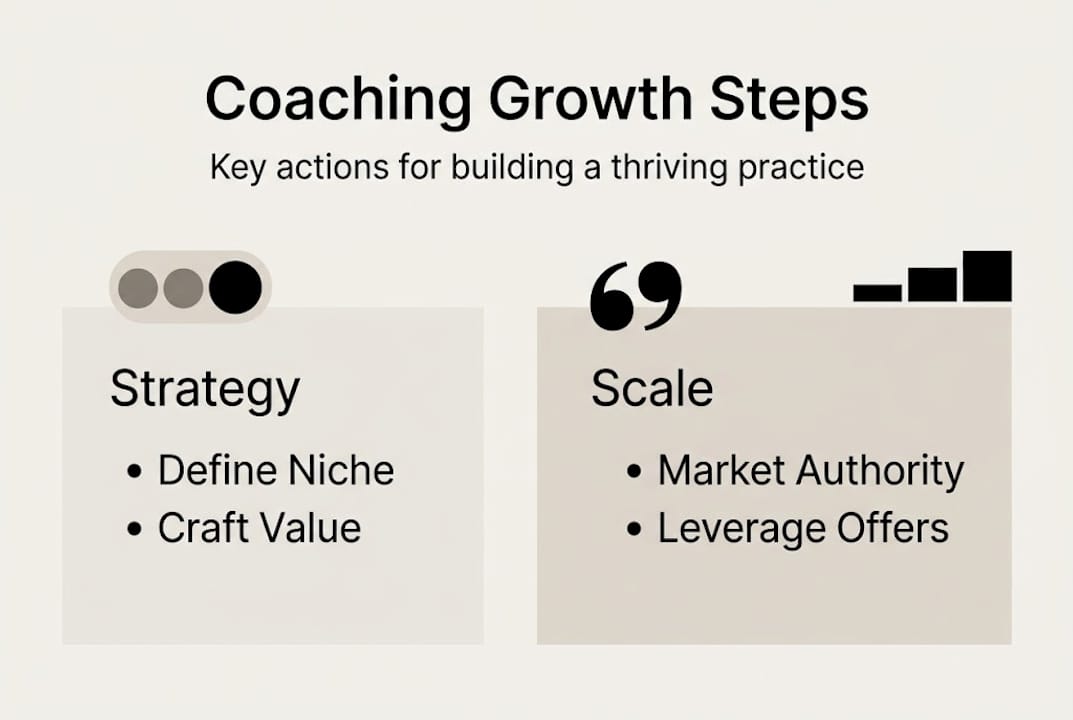
LinkedIn and YouTube are the two highest-leverage platforms for coaches targeting founders and consultants. LinkedIn drives high-intent professional traffic, while YouTube builds long-term search authority and trust through video. You do not need to be everywhere. Pick one primary platform and go deep before expanding.
Here are the content pillars that attract high-intent coaching leads:
Social proof is one of the most underused assets in coaching marketing. Testimonials, video reviews, and documented case results do more selling than any sales page copy. Collect them intentionally and display them prominently. You can build a brand visibility action plan that integrates social proof at every stage of your funnel.
“59% of coaches expect to grow revenue primarily by attracting more clients and sessions, which means the coaches who build authority now will capture the largest share of a growing market.”
Content marketing is not just about visibility. It is about building the kind of trust that makes a prospect feel like they already know you before they ever book a call. Read more about content marketing for founders to understand how to build a system that generates leads consistently. You can also study B2B marketing campaign examples for inspiration on how to structure campaigns that convert.
With authority and leads flowing, you are ready to operationalize and set up leveraged growth that will not burn you out. This is where most coaches stall. They get busy, skip building systems, and end up trapped in a cycle of feast and famine.
Here are the operational steps to automate and delegate effectively:
Tools that make automation realistic for coaches:
VAs can free up to 25 hours a week with a reported 279% return on investment, and group coaching cohorts can generate 2.5 to 3.5 times the revenue of the same number of 1:1 clients. Group cohorts of 8 to 12 clients can generate between $16,000 and $60,000 per cohort depending on your price point and niche. Understanding the right marketing funnel types for your model helps you build a pipeline that feeds these leveraged offers consistently.
Pro Tip: Do not scale past 80% capacity, roughly 12 to 15 active clients, until your systems are stable and documented. Premature scaling is the fastest way to deliver a poor client experience and damage the reputation you have worked hard to build.
Most growth guides for coaches fixate on numbers: more clients, more revenue, more automation. What they miss is the human dimension that actually keeps clients coming back and referring others. Automation is a tool, not a strategy. When it replaces genuine connection entirely, your retention suffers and your reputation quietly erodes.
The coaches we see build the most durable businesses use what we call a “deep and wide” hybrid model. They use automation and group leverage to serve more people efficiently, but they protect the touchpoints that make clients feel seen. A personal voice message after a big client win. A handwritten note at the end of a program. A live Q&A inside a group cohort that no AI can replicate.
Hybrid humanized funnels preserve the connection that makes coaching valuable while still leveraging automation and group models for efficiency. The coaches who ignore this end up with high churn and a business that feels hollow even when the revenue looks good.
Scale with systems, but never lose your signature presence. Your clients chose you, and the best systems in the world will not replace that. Branding for trust is what makes your presence feel consistent and compelling even when you are not in the room.
You now have a clear path: sharpen your niche, build offers tied to real outcomes, grow your authority, and systematize for scale. The challenge is that executing all of this alone, while running a coaching practice, is genuinely hard.
That is where Reasonate Studio comes in. We are a strategy-first marketing agency built specifically for founders, coaches, and consultants who want to grow without becoming their own marketing department. From social media management that keeps your brand visible and consistent, to sales page optimization that turns traffic into paying clients, we handle the execution so you can focus on your clients. If you are ready to stop guessing and start growing, explore our coaching growth solutions and see what a strategy-first partner can do for your business.
The first step is clarifying your coaching niche and crafting a value proposition that speaks directly to your ideal client’s most urgent problem. Vague niches are one of the leading causes of coaching business failure, so specificity is your competitive advantage.
Switching from hourly rates to packaged programs and group coaching models is the most direct path to higher revenue with fewer hours. High-ticket packages and group models can two to three times your monthly coaching revenue without adding more 1:1 client time.
Calendly for scheduling, ConvertKit or ActiveCampaign for email automation, and Dubsado for client management are the most practical starting points. Automation and VAs can save 15 to 25 hours per week in admin work, freeing you to focus on coaching and business development.
Build visible authority on LinkedIn and YouTube by sharing client results, process breakdowns, and contrarian insights in your niche. North American coaches who target premium markets and lead with outcome-focused messaging consistently earn above the $234 per session average.
Scaling before systems and capacity are ready is the most common and costly mistake. 78% of coaching businesses that attempt premature scaling fail, so build your operational foundation first and grow from a position of stability.