
August 8, 2026
Understanding B2C Business to Consumer Dynamics

Learn how to build a coach marketing strategy with proven steps: clarify your brand, choose the right channels, create signature assets, and track real results.

TL;DR:
- Clear, focused branding and choosing a few strategic channels are crucial for coaching growth.
- Building owned assets like websites and email lists provides long-term, stable marketing leverage.
- Simplifying marketing efforts and prioritizing quality over quantity leads to more sustainable success.
You are brilliant at what you do. But if your marketing is vague, scattered, or feels like a second job you never signed up for, your ideal clients simply cannot find you. The coaching industry is growing fast, and average active coach income sits around $49,000 globally, with North American coaches earning closer to $68,000 annually. That gap between potential and reality often comes down to one thing: a clear, repeatable marketing strategy. This article walks you through a four-step framework built specifically for coaches, consultants, and small business founders who want to grow sustainably without hiring a full marketing team or burning out trying to do everything at once.
| Point | Details |
|---|---|
| Focus on brand clarity | A clearly defined brand foundation sets the stage for all successful coach marketing efforts. |
| Choose a few key channels | Selecting 2–3 primary marketing channels prevents overwhelm and drives more consistent results. |
| Invest in signature assets | High-performing assets like landing pages and nurture emails are vital for attracting and converting clients. |
| Measure and refine | Regularly tracking key metrics and optimizing your approach keeps your marketing efficient and effective. |
| Simplicity wins | Focusing on less—but better—lets coaches grow sustainably without burning out. |
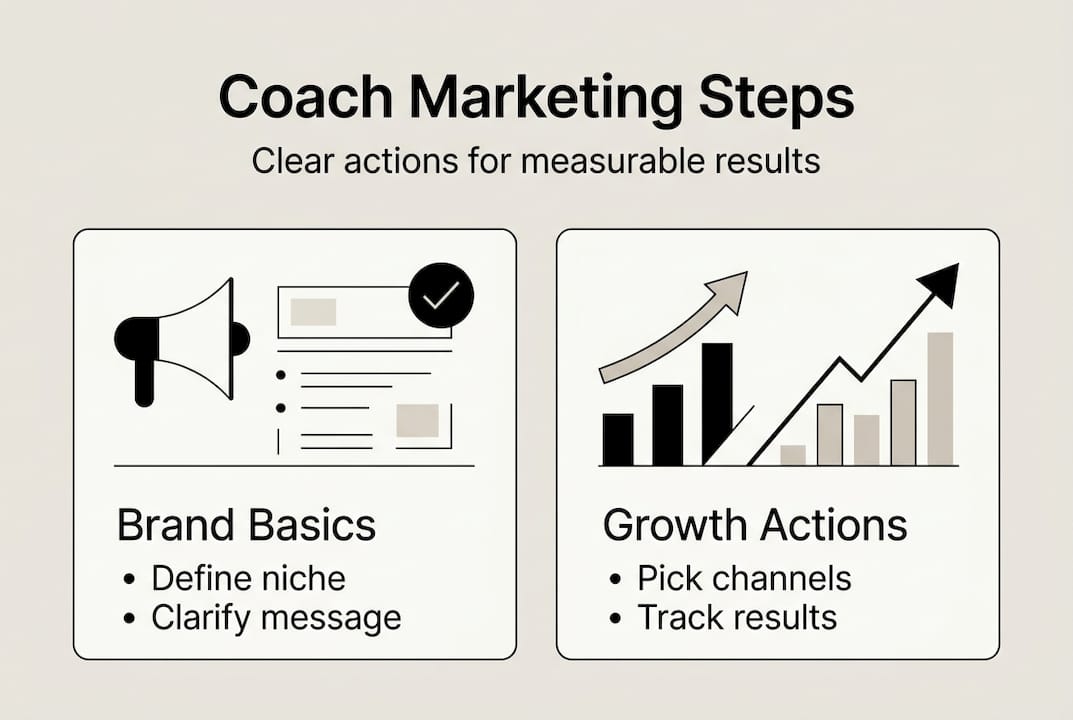
Before you write a single caption, run an ad, or redesign your website, you need to know exactly what your brand stands for and who it is built for. This is not a soft, philosophical exercise. It is the most practical thing you can do for your business. Without a clear brand foundation, every marketing effort you make will feel harder than it should, and produce less than it could.
The coaching industry is highly competitive, with thousands of coaches entering the market each year. North American coaches who earn more tend to have one thing in common: they are specific. They know their niche, they speak directly to a defined audience, and their offer is easy to understand at a glance. Broad targeting and unclear offers are the two most common mistakes that keep coaches stuck.
Here are the core elements every coach needs to define before investing in marketing tactics:
Strong brands outperform in saturated markets because they make it easy for the right person to say yes. When someone lands on your website or sees your content, they should immediately feel seen. That recognition is what turns a stranger into a lead.
“Great marketing starts with deep brand clarity. Understanding not just who you are, but why your audience should choose you and only you.”
Pro Tip: Write your core message as if you are explaining your work to a friend at a coffee shop. If it sounds too formal or vague out loud, it will feel the same way online.
If you are working through branding for coaches for the first time, start with your niche and USP. Everything else flows from those two decisions. And if you want to see how other coaches have built recognizable, client-attracting brands, exploring brand building strategies with real examples can help you move faster with more confidence.
Once your brand foundation is solid, the next question is where to show up. This is where a lot of coaches make a costly mistake: they try to be everywhere at once. Instagram, TikTok, LinkedIn, YouTube, a podcast, a blog, a newsletter, and paid ads, all at the same time. The result is exhaustion and mediocre content on every platform instead of great content on a few.
The smarter move is to prioritize owned assets over rented media. Your website and email list are assets you control. Social media platforms can change their algorithms, restrict your reach, or disappear entirely. Prioritizing owned assets like email and your website creates a more stable foundation for long-term growth.
Here is a quick comparison of the most common marketing channels for coaches:
| Channel | Effort level | Best for | Ownership |
|---|---|---|---|
| Email list | Medium | Nurturing and converting leads | Owned |
| Website with SEO | High upfront | Long-term organic traffic | Owned |
| Instagram or LinkedIn | Medium | Visibility and connection | Rented |
| YouTube or podcast | High | Authority building | Semi-owned |
| Paid ads | High cost | Fast lead generation | Rented |
| Webinars | Medium | High-conversion events | Owned |
Client acquisition costs for coaches range between $150 and $450 per new client, depending on the channel and offer price point. High-ticket coaching programs above $3,000 can justify higher acquisition costs, while lower-priced offers need leaner, more organic strategies.
The goal is to choose two or three primary channels and commit to them with consistency. Here is how to narrow it down:
Pro Tip: Before adding a new channel, ask yourself whether you can realistically maintain quality content there for six months. If the answer is no, skip it for now.
For coaches ready to build a more intentional presence, a clear social media strategy for coaches makes a real difference in results. Pair that with a strong email marketing guide and you have the two most reliable channels working together. If you are thinking bigger picture, resources on growing your coaching business can help you see how all the pieces connect.
With your channels selected, it is time to build the actual tools that turn attention into leads and leads into paying clients. These are your signature marketing assets, and they do the heavy lifting of your marketing system even when you are not actively promoting.

The most effective starting point for most coaches is a lead magnet paired with a simple landing page and a short email nurture sequence. This combination works because it gives potential clients something valuable for free, captures their contact information, and then builds trust over a series of emails before asking for anything.
Here is the order of operations that works best:
Business coaching average revenue and program pricing vary widely, but coaches with a clear funnel and strong assets consistently outperform those relying on word of mouth alone. A well-built asset works around the clock.
| Asset | Key metric to track | Healthy benchmark |
|---|---|---|
| Lead magnet landing page | Conversion rate | 25% to 40% |
| Email nurture sequence | Open rate | 35% to 50% |
| Discovery call booking page | Booking rate | 15% to 25% |
| Sales page | Conversion rate | 2% to 5% |
“Your lead magnet is not just a freebie. It is the first impression of your methodology, your voice, and your value.”
For coaches building their first email funnel, clear email marketing steps make the process far less overwhelming. And if you want to go beyond the basics, innovative marketing ideas can help you stand out in a crowded market with fresh approaches that feel authentic to your brand.
Your marketing assets are live. Now the real work begins. Too many coaches either ignore their numbers entirely or obsess over the wrong ones. Follower counts and likes feel good, but they do not pay the bills. The metrics that actually matter tell you whether your marketing is moving people toward a purchase.
Here are the numbers worth tracking every single week:
A useful benchmark: clients see a 7x ROI from professional coaching on average. That means your marketing investment needs to be proportional to the value you deliver, not just the price you charge.
Key stat: Successful founders reinvest 5 to 10% of revenue into marketing consistently. If you are spending nothing or spending randomly, sustainable growth becomes much harder to achieve.
When growth slows, the most common culprits are a weak lead magnet, unclear messaging on the landing page, or a nurture sequence that pitches too fast without building enough trust first. Fix one variable at a time so you know what actually moved the needle.
Pro Tip: Set a recurring 30-minute weekly review to check your top five metrics. Patterns emerge faster than you think, and small adjustments compound into big results over time.
If your numbers are flat and you are not sure where the breakdown is happening, working through how to clarify your brand at the strategy level often reveals the root cause faster than tweaking tactics.
Here is something most marketing advice will not tell you: doing more is usually the problem, not the solution. Coaches who struggle most with marketing are almost always the ones trying to run five channels, post daily on three platforms, launch a podcast, and write a newsletter, all at the same time. The result is a brand that feels scattered, exhausted, and inconsistent.
The coaches who grow steadily and sustainably tend to do fewer things with far more intention. They pick one or two primary channels and show up there with quality and consistency for months before adding anything else. They refine their message based on real feedback instead of chasing every new platform trend. They build depth before they build reach.
This is not a limitation. It is a strategy. A focused, high-quality presence on one or two platforms builds more trust and generates more leads than a thin presence spread across six. Simplicity scales. Complexity stalls.
We have seen this pattern repeat across dozens of clients. The ones who commit to clarity and consistency early on are the ones who build brands with real staying power. If you are feeling overwhelmed by your marketing, the answer is almost never to add more. It is to subtract until what remains is working well, and then build from there.
For coaches who want expert marketing help to cut through the noise and focus on what actually moves the needle, the right support can shortcut years of trial and error.
Building a marketing strategy that actually works takes time, clarity, and the right tools in the right order. If you have been spinning your wheels with content that does not convert, channels that drain your energy, or a message that feels off, you do not have to figure it all out alone.

At Reasonate Studio, we help coaches, consultants, and founders build focused, strategy-first marketing systems that generate real results without the overwhelm. Whether you need sales page optimization to convert more of your existing traffic, SEO keyword research to attract the right audience organically, or on-page SEO services to make your content work harder, we have the expertise to move your brand forward. Start with a free Brand Audit Report and get a clear picture of where you stand and exactly what to do next.
Most experts recommend spending 5 to 10% of revenue on marketing when starting out, scaling the investment as revenue grows and channels are proven.
Average client acquisition costs range between $150 and $450 per new client, depending on the channel, offer price, and how well the marketing funnel is optimized.
Email marketing and a professional website are the top choices for long-term growth, with owned assets outperforming rented social media platforms for sustainable client acquisition.
The average annual income for active coaches is $49,000 USD globally and $68,000 USD in North America, with higher earnings tied to niche clarity and strong marketing systems.
Clients typically see a 7x ROI from coaching on average, which means a well-positioned coaching offer with clear marketing can justify a strong client acquisition investment.