September 22, 2026
Why Update Brand Messaging: Essential Guide for Growth


Learn how Chicago founders and consultants can use a focused marketing strategy to reduce noise, reach better-fit clients, and grow sustainably.

TL;DR:
- Chicago markets favor personalized, community-focused marketing over high-volume activity.
- Focused strategies like local SEO and content marketing build long-term brand equity.
- Simplifying and streamlining marketing efforts reduces overwhelm and enhances sustainable growth.
If you’re a founder, coach, or consultant in Chicago, you’ve probably felt the pressure to post every day, run ads, show up on every platform, and still somehow find time to actually serve your clients. The assumption is that more activity equals more growth. But that belief is quietly draining founders across the city. The truth is, Chicago’s market rewards clarity and consistency far more than volume. Personalized marketing strategies built around your specific audience, your local context, and your brand story can drive compound growth without burning you out. This guide breaks down exactly how to build that kind of focused, sustainable marketing approach.
| Point | Details |
|---|---|
| Personalization matters | Customizing your marketing strategy for Chicago’s unique market drives better results than generic tactics. |
| Less is more | Focusing on a few effective channels prevents overwhelm and compounds growth. |
| Content builds trust | Consistent content and SEO deliver long-term brand equity and more quality leads. |
| Sustainable approach wins | Batching, automation, and smart delegation reduce stress while maintaining momentum. |
Chicago is not a generic market, and it shouldn’t be treated like one. The city has a thriving ecosystem of consultants, service businesses, coaches, and tech startups, all competing for the attention of a consumer base that is unusually savvy, community-oriented, and values-driven. What works in a broad national campaign often falls flat here because Chicago buyers tend to respond to brands that feel local, human, and genuinely connected to the communities they serve.
The city’s diversity is one of its greatest strengths, and also one of its biggest marketing challenges. Neighborhoods like Pilsen, Wicker Park, Lincoln Park, and Hyde Park each carry their own cultural identity and buying behavior. A message that resonates in one part of the city may feel completely off in another. This is why content marketing drives growth in ways that generic paid advertising simply cannot match here. Content lets you speak to a specific person in a specific context, which is exactly what Chicago consumers respond to.
Sustainability and community investment also matter more in Chicago than in many other U.S. markets. Consumers here are increasingly paying attention to whether a brand’s values align with their own. Kellogg research on marketing confirms that traditional SEO and content build long-term brand equity in ways that compound over time, while sustainability-forward positioning carries minimal liability for local brands when it’s authentic.
“In markets where consumers are values-driven and community-focused, brands that invest in content and authentic storytelling build equity that paid channels simply cannot replicate.” — Kellogg School of Management
Here’s a look at how common marketing channels perform in Chicago compared to U.S. averages:
| Marketing channel | Chicago ROI trend | U.S. average ROI trend |
|---|---|---|
| Local SEO | High, especially for service businesses | Moderate |
| Social media ads | Moderate, audience-dependent | Moderate to high |
| Content marketing | High, compounds over 6 to 12 months | Moderate |
| Email marketing | High for relationship-based businesses | High |
| Broad paid search | Low for small local brands | Moderate |
Chicago founders also face a distinct set of marketing challenges that generic playbooks don’t address:
A strong content strategy for small business built around these realities will always outperform a copy-paste approach borrowed from a national brand’s playbook.
With the local context in mind, it’s time to move from theory to practical frameworks tailored for Chicago businesses. Personalized marketing is not about doing more. It’s about doing the right things for the right people in the right places. And in Chicago, that distinction matters enormously.
Here’s a step-by-step framework for building a marketing strategy that actually fits your business:
Pro Tip: Chicago has a rich ecosystem of local business events, from 1871’s startup programming to neighborhood chamber mixers. Showing up in person, even once a month, builds the kind of trust that no digital campaign can manufacture. Pair that presence with a follow-up content piece and you’ve created a lead-nurturing loop that costs almost nothing.

Here’s how personalized strategies compare to generic ones in practice:
| Approach | Generic marketing | Personalized marketing |
|---|---|---|
| Audience targeting | Broad demographics | Specific personas and local context |
| Content | Templated, interchangeable | Story-driven, brand-specific |
| Channel selection | All platforms | Two to three high-fit channels |
| Results timeline | Unpredictable | More consistent over 60 to 90 days |
| Founder time investment | High, scattered | Lower, focused |
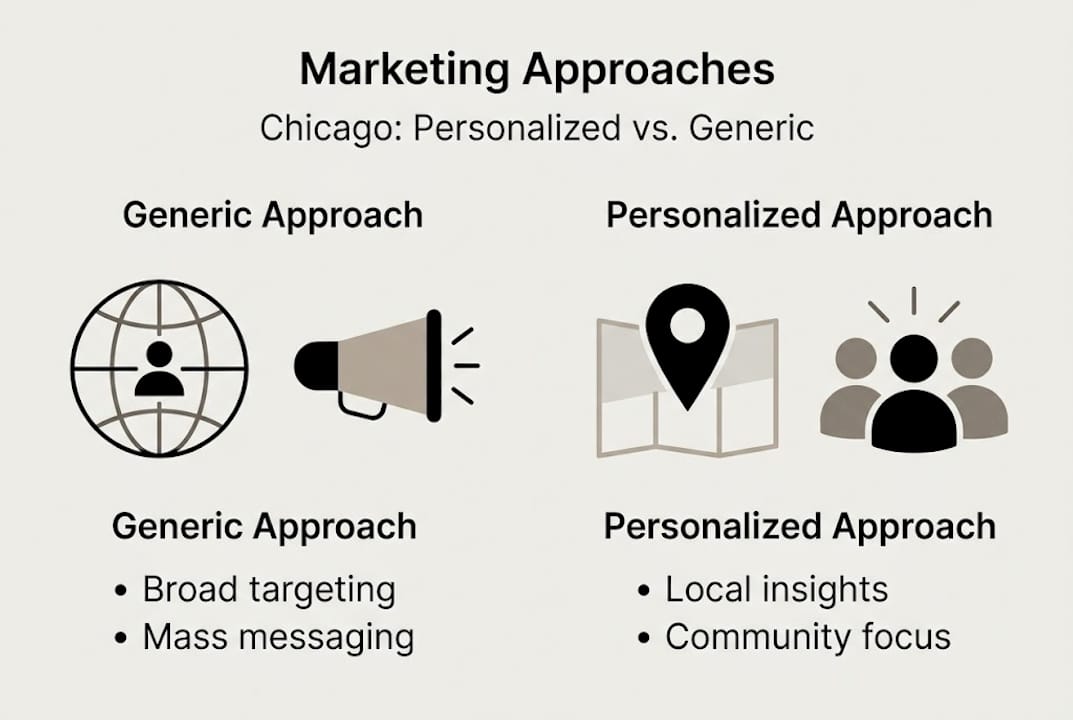
Personalized strategies are consistently more sustainable and effective for small business growth because they reduce wasted effort and increase message relevance. When you know exactly who you’re talking to and why they should care, every piece of content works harder.
Integrating sustainability and community values into your messaging is also a real competitive advantage in Chicago. This doesn’t mean greenwashing your brand. It means showing up as a business that cares about the city, its people, and its future. That kind of positioning helps you build brand equity that compounds over time and makes you harder to replace. Pair that with essential content marketing tips designed for local service businesses and you have a foundation that’s genuinely hard to compete with.
A strong content strategy for growth is the connective tissue that holds all of this together. Without it, even the best tactics feel disconnected.
Having outlined how to personalize your marketing blueprint, let’s zero in on tactics that repeatedly deliver real results for Chicago founders. Not every tactic deserves your time. These ones do.
Top-performing tactics for Chicago service businesses:
Content and SEO work best when they’re treated as long-term investments, not short-term campaigns. Content and SEO build compounding brand equity over time, which means the work you do today keeps generating inquiries months from now. A Chicago-based health coach who publishes one strong SEO-optimized article per week for six months will often outperform a competitor running paid ads with three times the budget.
A useful example: consider a Chicago bakery that shifted from social media ads to a consistent blog and local SEO strategy. Within six months, they tripled their online orders without increasing their marketing spend. The content kept working after it was published, which ads simply don’t do.
Pro Tip: Repurpose every piece of long-form content you create. Turn a blog post into three social captions, one email, and a short video script. This approach multiplies your output without multiplying your effort, which is exactly what overwhelmed founders need. A well-planned marketing content calendar makes this systematic rather than stressful.
Sustainability-focused messaging is also worth noting here. In Chicago’s market, positioning your brand as values-aligned is not a liability. It’s a differentiator. Consumers here are not turned off by brands that stand for something. They’re drawn to them. Understanding what content marketing includes for small businesses helps you see how all of these tactics fit together into one cohesive system. And if you’re ready to go deeper, learning how to build a content marketing strategy from the ground up is the most valuable thing you can do for your brand this year.
Now that you know which tactics work, let’s address the root struggle: marketing overwhelm and how to conquer it in the Chicago context. Most founders don’t fail at marketing because they lack ideas. They fail because they have too many ideas and no system for executing them sustainably.
Here’s a practical framework for cutting through the noise:
Sustainable, focused marketing eliminates the distractions and burnout that come from trying to do everything at once. The goal is not to be everywhere. It’s to be exactly where your best clients are, consistently.
“Simplicity is the most underrated competitive advantage in marketing. The brands that win long-term are not the ones doing the most. They’re the ones doing the right things with the most consistency.”
A content strategy outline gives you a repeatable structure so you’re not reinventing your approach every week. Think of it as a recipe. Once you have it, execution becomes mechanical rather than creative from scratch every time. This is especially valuable for Chicago founders who are managing client work, business development, and operations simultaneously.
For clarity for small brands, the single most important shift is moving from reactive marketing to proactive marketing. Reactive marketing means posting when you remember or running a campaign when business slows down. Proactive marketing means having a plan, working it consistently, and adjusting based on data rather than panic. That shift alone changes everything.
Here’s something we’ve seen consistently across the founders and consultants we work with: the ones who try to master every channel at once almost always plateau. The ones who pick two or three things and commit to them deeply are the ones who build real momentum.
Most Chicago founders feel enormous pressure to be on Instagram, LinkedIn, TikTok, YouTube, and every podcast that will have them, all while writing a newsletter and running Google ads. That pressure is real, but it’s also a trap. Spreading your attention across eight channels means none of them get the depth of focus required to actually work.
What we’ve seen work instead is a focused playbook. Choose one primary content channel where your ideal clients spend time. Get genuinely consistent there for 90 days before adding anything else. Then layer on a second channel only after the first one is running smoothly. This approach feels slower at first, but it compounds. Building brand equity through focused, consistent content creates a market position that’s genuinely hard for competitors to replicate.
Long-term brand equity and focused content lead to a sustainable market advantage that scattered, high-volume marketing simply cannot build. The brands we’ve watched succeed in Chicago are not the loudest ones. They’re the clearest ones. They know who they serve, they show up consistently for that audience, and they resist the urge to chase every new platform or trend.
Sustainable marketing means you have permission to do less. It means saying no to the tactics that don’t fit your audience, your brand, or your capacity. That kind of discipline is not a limitation. It’s a strategy.
If this article has clarified one thing, it’s that sustainable Chicago marketing is not about doing more. It’s about doing the right things with real intention and consistency. But knowing what to do and having the bandwidth to execute it are two very different problems.
At Reasonate Studio, we work directly with founders, coaches, and consultants who are ready to stop guessing and start growing. Our local SEO services and SEO keyword research are built specifically to help Chicago-area service businesses show up where their best clients are searching. We also offer sales page optimization to make sure your traffic actually converts. Whether you need a full strategy or targeted support in one area, we’re here to help you build marketing that works without taking over your life.
Chicago’s diverse local consumer base, strong community values, and competitive service landscape demand more personalized, relationship-driven marketing approaches. Traditional approaches perform differently here due to the city’s market diversity and deeply held local values.
Focus on two to three high-impact strategies, streamline your tasks, and avoid trying to master every channel at once. Sustainable, focused marketing eliminates the distractions and burnout that come from scattered, high-volume efforts.
Yes, local SEO and content remain extremely effective for building trust and driving inquiries for Chicago brands. Content and SEO build long-term equity and sustainable growth that paid channels alone cannot replicate.
No, focused and personalized marketing often outperforms large, generic campaigns, especially for local service providers. Personalized strategies are more sustainable and effective for small business growth than high-spend, low-specificity approaches.