September 22, 2026
Why Update Brand Messaging: Essential Guide for Growth


Wondering how can brands succeed? Discover essential strategies for small businesses to create emotional connections and stand out in 2026.
TL;DR:
- Building authentic brand DNA helps small businesses create emotional connections that competitors cannot copy. Consistent messaging, community building, and strategic use of AI strengthen brand loyalty and trust over time. Proper launch planning and emotional integrity form a lasting competitive advantage for brands.
Brand success is defined by the ability to create emotional connection and market differentiation that competitors cannot copy. For small business owners and entrepreneurs, that definition matters more now than ever. Can brands achieve lasting growth without massive budgets? Yes, but only when they build on authentic brand DNA, protect their human voice, and use marketing systems that compound over time. This guide breaks down exactly how that works, using 2026 research on brand failures, AI’s role in marketing, and the emotional mechanics behind the brands that win.

Brand DNA is the core story, values, and emotional truth that make your business recognizable and irreplaceable. It is not your logo or your color palette. It is the answer to the question: “Why would someone choose you over every other option?” When that answer is clear, every marketing decision gets easier and more consistent.

The business case for brand DNA is concrete. Product innovations built on clear brand DNA achieve 24% higher sales than innovations that ignore it. That gap exists because DNA-driven brands create products and messages that feel coherent to buyers, which builds trust faster and reduces the friction that kills conversions.
Without a defined brand DNA, you get commoditized. Your pricing becomes the only differentiator, and price wars are races to the bottom. A founder who knows their brand’s emotional truth can charge more, attract better clients, and hold their position even when a competitor undercuts them. Learning how to build brand strategy is the first practical step toward making that clarity real.
Start with three questions:
Write your answers in plain language, not marketing copy. The raw version is almost always more honest and more compelling than the polished version. Once you have it, test every new product, offer, or campaign against it. If something does not connect back to your brand DNA, it creates noise instead of momentum.
Pro Tip: Before launching any new offer or content series, run it through a single filter: “Does this reinforce what we stand for?” If the answer is unclear, the offer needs more work before it goes public.
Building loyalty requires more than a good product. It requires consistent visibility, emotional resonance, and a community that feels connected to your brand beyond the transaction. For small business owners, the most effective marketing approach in 2026 combines repetitive advertising, creator-led amplification, and careful AI integration.
Continuous, high-spend advertising helps brands dislodge competitors from consumers’ memories. Research from the auto insurance category confirms that brands which stop advertising lose mental prominence quickly, even when they were previously well-known. For small businesses, this does not mean spending like a Fortune 500 company. It means showing up consistently across the channels where your audience already spends time, with a message that does not change every month.
The most effective marketing systems for small businesses work in layers:
AI speeds up the mechanics of marketing but cannot build brand meaning like trust and cultural relevance. Marketers increasingly trust AI for media buying and scheduling, but they pull back when it comes to brand voice and creative direction. That distinction matters for small business owners. Use AI to draft, schedule, and analyze. Keep your brand voice, humor, and emotional tone in human hands.
“AI can optimize a bid. It cannot earn trust.” — Sunny Bonnell, brand strategist
Pro Tip: Use AI tools like ChatGPT or Claude to generate first drafts of social captions or email subject lines, then rewrite them in your own voice before publishing. The AI saves time. Your voice saves the relationship.
85% of new product launches fail primarily due to lack of preparation, not product defects. That statistic is worth sitting with. Most founders assume a failed launch means the product was wrong. The real cause is almost always that the launch infrastructure was not built before the product went live.
Modern launch preparation looks very different from what worked five years ago. Founders who succeed in 2026 build their launch plan around four pillars before anything goes public.
| Launch element | Old standard (pre-2024) | New standard (2026) |
|---|---|---|
| Media strategy | Press release to journalists | Earned media plus paid amplification |
| Creator partnerships | Optional add-on | Required before launch day |
| AI search presence | Not considered | Optimized before go-live |
| Community strategy | Post-launch activity | Built 60–90 days before launch |
| SEO content | Created after launch | Published before launch |
| Brand DNA validation | Rarely formalized | Required checkpoint for every offer |
Innovation pods are dedicated cross-functional teams focused on brand-aligned product development. Big brands struggle when they lack focused mechanisms for turning insights into products. Small businesses face the same problem at a smaller scale. Assigning one person or a small group to own the validation process, checking every new offer against brand DNA and real customer needs, prevents the innovation clutter that kills momentum.
Brands are increasingly valued as intangible assets that create emotional preference, a competitive moat that competitors cannot replicate. A product can be copied. A price can be matched. The emotional relationship a brand builds with its audience cannot be manufactured overnight by a competitor, no matter their budget.
The Grey Goose case makes this concrete. Superior brand perception yields an 80% profit margin for Grey Goose despite the vodka scoring in the middle of the pack in blind taste tests. Buyers are not choosing the best-tasting vodka. They are choosing the brand that signals something about who they are. That is the power of emotional trust, and it applies directly to small businesses.
Understanding why brand strategy matters as a long-term asset changes how founders allocate their time and money. Brand is not a marketing expense. It is a balance sheet asset that influences how much your business is worth when you eventually sell, raise capital, or scale. Treating it as a cost center is one of the most expensive mistakes a founder can make.
“Trust, cultural relevance, and emotional resonance cannot be automated. They are built through consistent human choices made over time.” — Kaitlyn Cole, Reasonate Studio
The conventional wisdom says: build the product first, then figure out the brand. After working with over 100 small businesses at Reasonate Studio, I can tell you that approach creates more rework, more confusion, and more wasted marketing spend than almost anything else a founder can do.
The founders who grow fastest are the ones who know their brand DNA before they write a single piece of content. They know who they are talking to, what emotional shift they create, and why someone would choose them specifically. That clarity makes every marketing decision faster and more effective.
I have also watched the AI conversation play out in real time with clients. The temptation is to hand AI the keys to your brand voice because it saves time. The problem is that AI produces the average of everything it has been trained on. Your brand should not sound average. It should sound like you. Human oversight is critical to maintain brand voice, humor, and ethos in creative content. I use AI every day for research, drafting, and scheduling. But I write every brand-level message myself, and I recommend every founder do the same.
The brands that will win over the next five years are not the ones with the biggest AI stack. They are the ones with the clearest sense of who they are and the discipline to protect that identity across every channel, every campaign, and every piece of content they publish.
— Kaitlyn Cole
Small business owners who want their brand to generate real revenue need more than good content. They need a clear message, a strong offer, and a sales page that turns visitors into buyers.
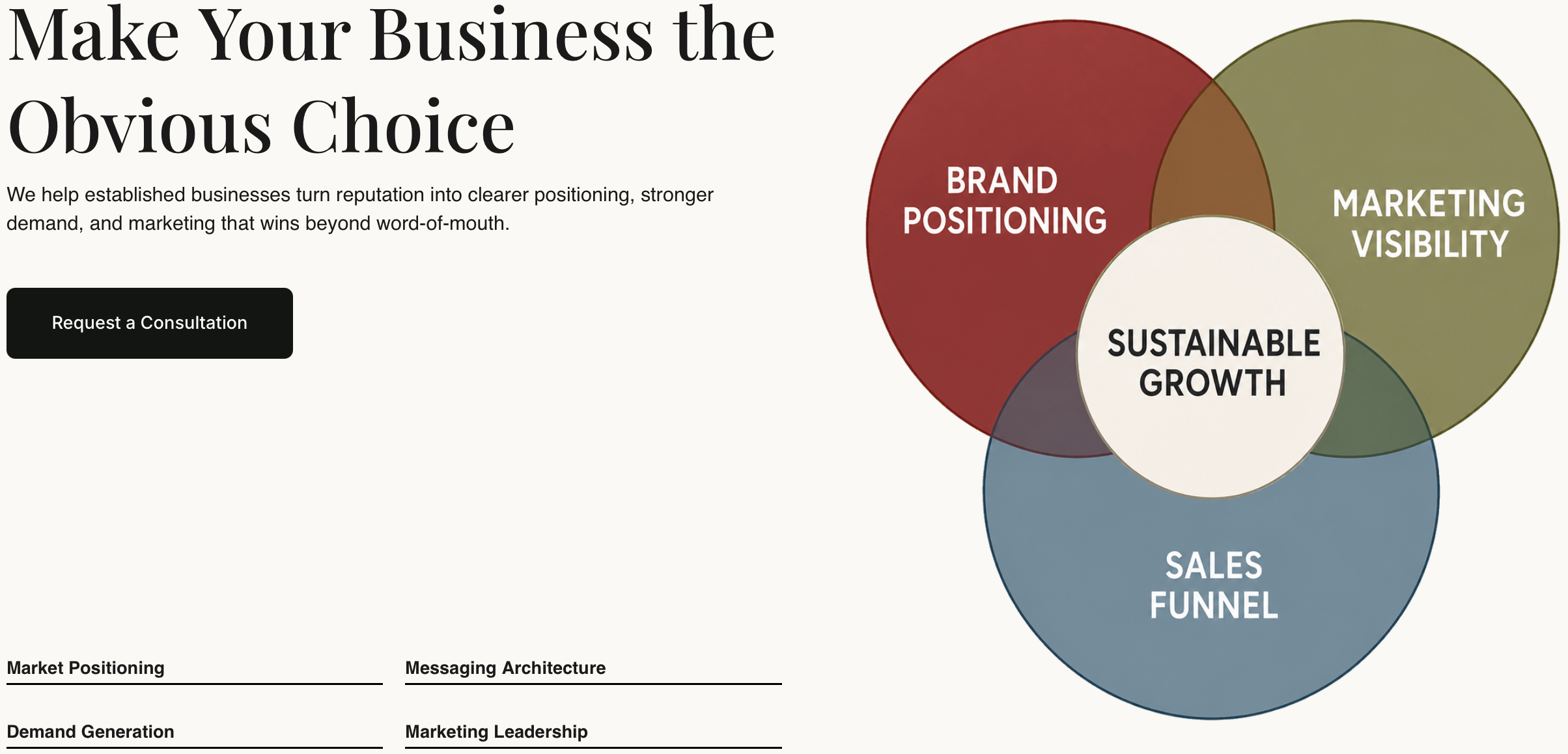
Reasonate Studio works directly with founders, coaches, and consultants to align brand strategy with marketing execution. From brand voice development to sales page optimization, every service is built to move your brand from scattered to focused. The Aligned Impact Model™ gives your marketing a clear foundation so your content, offers, and campaigns all pull in the same direction. If you are ready to stop guessing and start building a brand that compounds, Reasonate Studio is the partner built for that work.
Brand DNA is the core story, values, and emotional truth that make your business distinct. It guides every product, message, and marketing decision so your brand stays consistent and recognizable.
Yes. Consistent messaging, community building, and creator partnerships deliver strong results without large ad spend. The key is showing up regularly with a clear, specific message rather than spending heavily on a vague one.
85% of new product launches fail due to insufficient preparation, not product quality. Missing elements typically include creator partnerships, SEO infrastructure, and earned media strategy built before launch day.
Use AI for mechanical tasks like drafting, scheduling, and data analysis. Keep brand voice, tone, and emotional messaging in human hands. AI produces average output. Your brand should not sound average.
Consistency is the fastest path to trust. Show up with the same voice, values, and visual identity across every channel. Pair that with specific, proof-backed messaging and your audience will trust you before they ever buy.