September 22, 2026
Why Update Brand Messaging: Essential Guide for Growth


Learn how coaches can clarify their niche, sharpen their message, and build a credible personal brand that earns trust and attracts clients.

TL;DR:
- Reputation and messaging are more important than visuals for attracting coaching clients.
- Strong branding requires niche clarity, a unique value proposition, and consistent messaging.
- Visuals matter less than authentic communication and a clear story that builds trust.
Most coaches assume branding means a polished logo, a pretty color palette, and a well-designed website. That assumption is costing them clients. Research shows that reputation and messaging account for 80% of what actually attracts clients, not visuals. The coaches who consistently fill their rosters are not the ones with the flashiest brand kits. They are the ones who have gotten crystal clear on who they serve, what makes them different, and how to communicate that in a way that builds instant trust. This article walks you through exactly how to do that.
| Point | Details |
|---|---|
| Brand identity comes first | Defining your niche, value, and story is the foundation for all successful branding. |
| Modern trends matter | Staying current with tools like AI and video can give coaches a strategic edge in 2026. |
| True branding drives growth | Coaches who refine their brands see higher trust, more leads, and faster business growth. |
| Reputation over visuals | Messaging, clarity, and values do more for your brand than colors or logos alone. |
Branding and marketing are not the same thing, and confusing them is one of the most common mistakes coaches make. Marketing is how you promote your services. Branding is the foundation that makes that promotion work. Your brand is the impression people carry with them after they encounter you online, the feeling your content creates, and the reputation that travels ahead of you before a potential client even books a call.
For coaches specifically, branding is deeply personal. You are the product. Your story, your perspective, your values, and your track record are what clients are buying into. That is why brand clarity rooted in identity and niche accelerates trust and positions coaches as go-to experts far faster than any ad campaign or social media hack ever could.
Here is what strong branding actually delivers for coaches:
“Your brand is not what you say about yourself. It is what your clients say about you when you are not in the room.”
The coaches who struggle to grow are often the ones with scattered messaging, a generic value proposition, and no clear niche. They are trying to speak to everyone, which means they connect with no one. If you want to explore what strong branding looks like in practice, brand building examples for coaches can show you what the shift looks like in real businesses. And if you are just getting started building your foundation, branding strategies for small business offers a solid starting point for thinking strategically.

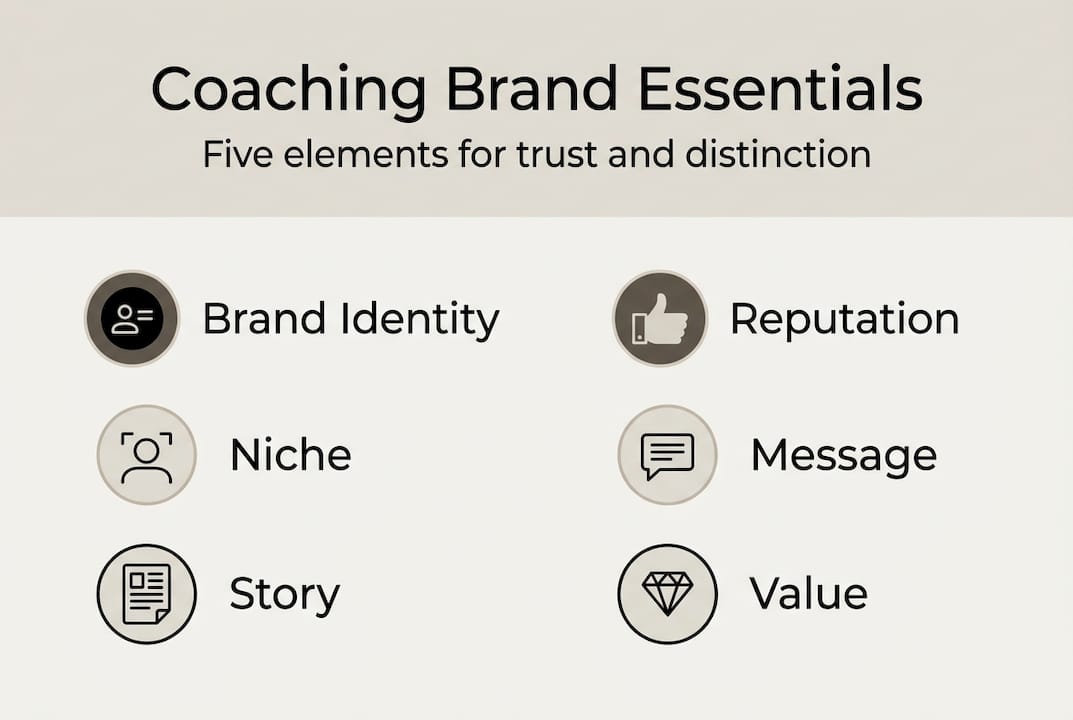
Before you touch a font, a color, or a website template, you need five foundational elements in place. These are the building blocks that every strong coaching brand is built on, regardless of niche or business model.
The 5 core elements of a coaching brand:
Experts across frameworks agree on this. Whether you look at Simon Sinek’s Golden Circle, Brand Archetypes, the 5Cs framework, or the Harvard 7-step branding model, niche precision and value articulation are non-negotiable starting points.
Here is a quick comparison of the most commonly referenced branding frameworks for coaches:
| Framework | Core focus | Best for |
|---|---|---|
| Golden Circle (Sinek) | Why, How, What | Clarifying purpose and messaging |
| Brand Archetypes | Personality and tone | Defining brand voice and feel |
| 5Cs Framework | Customer, Company, Context, Collaborators, Competitors | Full market positioning |
| Harvard 7-Step | Brand audit to strategy | Structured rebrands |
| Heine’s Brand Canvas | Identity and perception | Visual and verbal alignment |
Once you understand which framework fits your stage, use this stepwise approach to define your baseline brand elements:
Pro Tip: Do not spend money on a logo or website redesign until you have completed these five steps. Visuals built on a shaky foundation will not convert. Visuals built on a clear brand identity will.
For a deeper look at what to do and what to avoid, the branding do’s and don’ts for founders is worth reading before you make any major brand decisions. And if you want to see how these elements come together in real coaching businesses, brand building examples will give you concrete reference points.
The coaching industry is more competitive than it has ever been, which means the bar for standing out has risen. Here is what is working right now and what coaches need to pay attention to in 2026.
Top branding trends for coaches in 2026:
Stat to know: 87% of coaches are still not using video for brand building, making it one of the lowest-competition, highest-impact moves available right now.
Here is a quick look at the tools worth considering by category:
| Category | Tool examples | What it helps with |
|---|---|---|
| Newsletter platforms | Beehiiv, ConvertKit, Substack | Building owned audience and nurturing leads |
| Website essentials | Squarespace, Showit, WordPress | Credibility, SEO, and conversion |
| AI content tools | ChatGPT, Jasper, Claude | Drafting, repurposing, and ideation |
| Scheduling and automation | Later, Buffer, Zapier | Consistency without burnout |
| Video creation | Descript, CapCut, Loom | Short-form and long-form video content |
When deciding which trend to prioritize, ask yourself one question: where does my ideal client spend their attention? Start there. For a broader look at what is working across coaching and consulting businesses, marketing ideas for coaches in 2026 covers the full landscape. And if you want to understand why story is at the center of all of it, brand storytelling for growth explains the mechanics behind why it converts.
Strategy is only useful when it produces results. Here is what happens when coaches actually commit to brand clarity, and what holds most back from getting there.
Coaches who invested in clarifying their brand positioning have seen dramatic outcomes. Case studies show that coaches who sharpened their positioning achieved 87% higher win rates and consistently attracted 15 or more clients per month. Those are not outliers. They are the predictable result of a clear niche, a compelling story, and consistent messaging.
“Clarity is the most underrated growth strategy in coaching. When your ideal client reads your bio and thinks ‘this is exactly for me,’ the sale is already halfway done.”
But most coaches never get there because they make the same avoidable mistakes:
Pro Tip: If you want a fast brand refresh without overhauling everything, start with your bio. Rewrite it to name your specific client, their specific problem, and the specific outcome you deliver. That one change will improve your conversion rate across every platform where it appears.
For real-world examples of how story-driven positioning transforms coaching businesses, brand storytelling examples for entrepreneurs is a great resource. And if you want actionable techniques for making your story land, storytelling tips for coaches breaks down the craft behind it.
Here is something worth saying plainly: most coaches are investing in the wrong part of their brand. They spend weeks choosing fonts and color palettes while their messaging remains vague, their niche stays broad, and their ideal client has no idea the offer is meant for them.
Visuals and logos make up 20% or less of what actually attracts and converts clients. The other 80% is reputation, messaging, and the authentic connection a coach builds through consistent, values-aligned communication. That is not a small distinction. It is the entire game.
The coaches we see grow fastest are not the ones with the most polished aesthetic. They are the ones who can articulate exactly who they help, what changes for that person, and why they are uniquely positioned to make it happen. That clarity shows up in their content, their conversations, and their conversions.
If your brand is not generating the results you want, the answer is rarely a new logo. It is almost always a messaging problem. Start there. A solid branding strategies overview can help you see the full picture and identify where your foundation needs the most attention.
If this article has clarified anything, it is that strong branding starts with strategy, not aesthetics. The coaches who attract consistent clients have done the foundational work: niche clarity, compelling story, and a message that speaks directly to the right person.
At Reasonate Studio, we help coaches and consultants build brands that actually convert, using our Aligned Impact Model™ to move you from scattered to strategic. Whether you are starting fresh or refining what you already have, we bring the strategy, the execution, and the results. Explore branding services built for coaches or browse proven strategies and examples to see what is possible when your brand is built on the right foundation.
Start by defining your niche, value, and story before touching any visuals or marketing tactics. Your identity and message are the foundation everything else is built on.
Coaches who clarify their messaging and strategy often see measurable growth within 3 to 6 months. Case studies show coaches reaching 15 or more clients per month and a 44% increase in inbound leads after a focused rebrand.
A coaching brand centers on authenticity and human connection rather than products or services. You are the brand, which means your story, values, and reputation carry more weight than any visual element.
A website is essential. 88% of consumers say transparency builds trust, and a website signals credibility that social media alone cannot replicate. Relying only on social platforms puts your brand on rented land you do not control.