September 22, 2026
Why Update Brand Messaging: Essential Guide for Growth


Discover the 4 marketing segmentation types to target your ideal customers. Shift from broad outreach to effective, tailored campaigns today!

TL;DR:
- Market segmentation divides customers into demographic, geographic, psychographic, and behavioral groups to target marketing campaigns. Combining these types helps businesses understand who their customers are, where they are, why they buy, and how they behave. Small businesses should focus on behavioral data first, then add psychographic insights for more personalized marketing strategies.
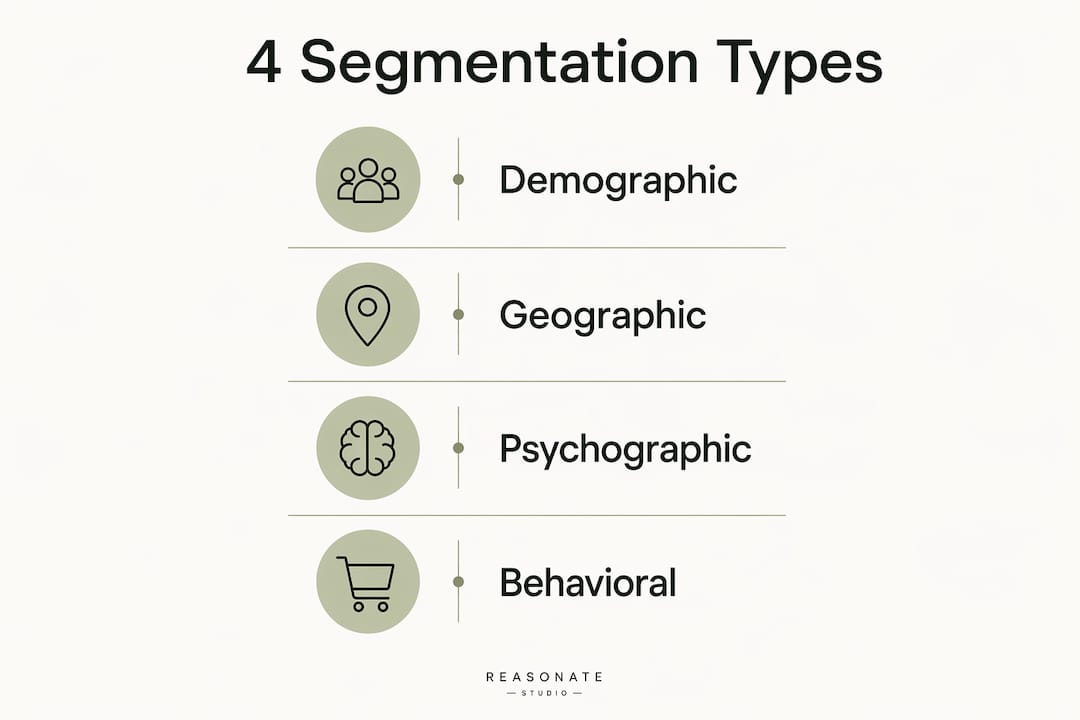
Market segmentation is defined as the process of dividing a broad customer base into four distinct groups: demographic, geographic, psychographic, and behavioral. These four types of marketing segmentation give marketing professionals and small business owners a structured way to stop broadcasting to everyone and start speaking directly to the people most likely to buy. The four foundational pillars shift your marketing from broad outreach to targeted campaigns that resonate. Used together, they answer four critical questions: who your customers are, where they live, why they buy, and how they behave.
The four types of market segmentation are demographic, geographic, psychographic, and behavioral. Each one captures a different dimension of your customer, and each one alone tells an incomplete story. Demographic data tells you a customer is a 35-year-old woman earning $80,000 a year. Behavioral data tells you she buys every three months and abandons her cart when shipping costs appear. You need both to write a message that converts.
The importance of market segmentation comes down to relevance. Generic messaging produces generic results. When you know exactly who you are talking to, what they value, and how they shop, every dollar you spend on marketing works harder. For small business owners with limited budgets, that precision is not a luxury. It is a requirement.
Segmentation also protects you from wasted spend. Without it, you run ads to people who will never buy, write copy that resonates with no one in particular, and build offers that miss the mark. The four segmentation types give you a repeatable framework to avoid all three mistakes. Learning how to build a marketing strategy that delivers results starts with understanding which segment lens to apply first.
Demographic segmentation groups customers by measurable personal characteristics. The most common variables include:
Demographic data is the easiest type to collect. Census data, platform analytics, and customer surveys all surface it quickly. That accessibility makes it the default starting point for most marketers.
The problem is that demographic data alone is the weakest predictor of actual buying behavior. Two 40-year-old women with identical incomes and education levels may have completely different values, shopping habits, and brand loyalties. Relying only on demographics produces segments that are too broad for precise messaging. Marketers frequently misuse demographic data by treating it as a complete picture when it is really just a starting frame.
For small business owners, demographics work best as a filter, not a strategy. Use them to define the outer boundaries of your audience, then layer in psychographic or behavioral data to sharpen the picture. A local fitness studio might know its customers are women aged 28–45, but that demographic slice still includes people who want weight loss, stress relief, community, or athletic performance. Those motivations require different messages entirely.
Pro Tip: Run a quick survey of your top 10 existing customers asking what problem they were trying to solve when they found you. Their answers will reveal psychographic and behavioral data that no demographic report can provide.
Geographic segmentation divides customers based on where they are located and the environmental context that shapes their needs. Location affects product relevance, seasonal timing, cultural expectations, and even the language and imagery that feels familiar.

| Geographic variable | What it captures | Marketing application |
|---|---|---|
| Country or region | Cultural norms, language, regulations | Localized messaging, legal compliance |
| City vs. rural | Density, access, lifestyle pace | Channel selection, delivery options |
| Climate | Weather patterns, seasonal needs | Seasonal promotions, product relevance |
| Neighborhood or zip code | Income concentration, community type | Hyper-local ads, event marketing |
| Time zone | Optimal send times for email and ads | Campaign scheduling |
A roofing company in Austin, Texas has no reason to advertise to customers in Minnesota. A cold-weather apparel brand should not run the same campaign in Miami and Chicago in november. These seem obvious, but geographic blind spots cost businesses real money when campaigns run nationally without regional filters.
Geographic segmentation also matters for tone and imagery. A brand selling outdoor gear to customers in the Pacific Northwest should use different visuals and references than the same brand targeting customers in the Southeast. Customers notice when marketing feels generic to their region, and they respond better when it feels local.
The limitation of geographic segmentation is similar to demographics: location tells you where someone is, not why they buy. A small business owner in Denver and one in Atlanta may face identical marketing challenges despite living 1,500 miles apart. Geography works best as a reach and distribution filter, not as a standalone conversion strategy.
Pro Tip: If you run paid ads, use geographic exclusions as aggressively as geographic inclusions. Cutting irrelevant locations from your targeting often improves conversion rates faster than adding new audiences.
Psychographic segmentation groups customers by internal characteristics: values, beliefs, personality traits, interests, attitudes, and lifestyle choices. It answers the question demographics never can: why does this person buy?
The key psychographic variables include:
Psychographic data is harder to collect than demographic or geographic data. You cannot pull it from a census. You gather it through customer interviews, social listening, survey tools, and behavioral pattern analysis. The effort is worth it. A customer who values sustainability will respond to a completely different message than one who prioritizes convenience, even if both fit the same demographic profile.
Psychographic segmentation is especially powerful for positioning and messaging. It tells you which emotional triggers to use, which objections to address first, and which brand voice will feel authentic to your audience. A health coach targeting high-achieving professionals who feel burned out needs to speak to identity and recovery, not just weight loss metrics.
The strongest results come from combining psychographic insights with behavioral data. Knowing a customer values sustainability is useful. Knowing they have purchased eco-friendly products three times in the past six months confirms that value is active, not just aspirational. That combination produces precise audience segments that drive both messaging quality and conversion rates.
Behavioral segmentation is the most actionable of the four types because it is built on observed actions, not assumed traits. Behavioral data points include purchase frequency, loyalty status, usage occasion, channel preference, and cart behavior. These are facts, not inferences.
Key behavioral variables include:
The predictive power of behavioral data is what separates it from the other three types. Past behavior is the strongest available signal for future behavior. A customer who has purchased twice in 90 days is far more likely to purchase again than someone who fits the same demographic profile but has never bought.
Heavy users often account for the majority of sales volume in many product categories. A small minority of your most active customers can generate a disproportionate share of your total revenue. Identifying and prioritizing that group with retention-focused campaigns, loyalty rewards, and personalized offers produces a much higher return than trying to acquire new customers at the same cost.
For small business owners, behavioral segmentation is often the fastest path to better results. Your existing customer data already contains purchase history, email engagement, and repeat visit patterns. You do not need a large budget or a data science team. You need to look at what your best customers actually do, then build campaigns that speak directly to that behavior. Explore audience engagement with personalization to see how behavioral data translates into campaign tactics that work.
Relying on a single segmentation lens is one of the most common mistakes in marketing. Combining at least two or three segmentation types reduces blind spots and produces audience segments precise enough to drive real messaging decisions.
The most effective combinations follow a clear logic. Demographics and geography define your reach. They tell you who is in your addressable market and where to find them. Behavioral and psychographic data drive your conversion strategy. They tell you what to say, which channel to use, and what emotional angle will land.
| Segmentation type | Primary role | Best paired with |
|---|---|---|
| Demographic | Define the addressable audience | Geographic for reach planning |
| Geographic | Localize reach and channel selection | Demographic for audience sizing |
| Psychographic | Shape messaging and brand positioning | Behavioral for confirmation |
| Behavioral | Drive targeting, retention, and conversion | Psychographic for motivation context |
A practical example: a small business selling premium coffee subscriptions might start with demographics (adults aged 25–50, household income above $60,000) and geography (urban zip codes). That defines the reach. Then behavioral data identifies customers who have subscribed for more than three months and purchase add-ons regularly. Psychographic data reveals they value craft, origin stories, and sustainability. The resulting segment is specific enough to write a single email that converts at a meaningfully higher rate than a generic campaign.
Demographics and geography serve best as overlays for reach, while behavioral and psychographic data drive conversion and messaging strategy. Focusing solely on demographics leads to broad, ineffective marketing. For B2B marketers, firmographic segmentation, which uses company size, industry, and revenue, replaces individual demographic data and follows the same layered logic. Firmographic segmentation is preferred by 81% of B2B marketers over standard consumer demographics. That preference reflects the same principle: the more specific your segment, the more relevant your message.
Effective market segmentation is also iterative. Customer behaviors and values shift over time, and segments that were accurate 18 months ago may no longer reflect your actual buyers. Build a regular review cycle into your marketing calendar, at minimum quarterly, to test whether your segments still hold. Engagement strategies for small business owners in 2026 increasingly depend on this kind of ongoing refinement rather than a one-time segmentation exercise.
Working directly with founders, coaches, and consultants for years has taught me one consistent lesson: most small business owners skip segmentation entirely, or they do a surface-level version of it once and never revisit it. Both approaches leave real money on the table.
The most common mistake I see is treating demographic data as a complete audience strategy. A founder will tell me their customer is “women aged 30–50 who want to lose weight.” That is a demographic slice, not a segment. It tells me almost nothing about what message will move them to buy. Are they motivated by confidence? By health after a diagnosis? By fitting into clothes for an event? Each of those motivations requires a completely different campaign.
The clients who see the fastest results are the ones willing to look at their behavioral data first. Who has already bought from you more than once? What did they buy? When did they buy it? That data exists in your email platform, your payment processor, and your website analytics right now. You do not need a research budget to start. You need 30 minutes and a willingness to look at what your best customers actually do.
My honest recommendation for small business owners with limited resources: start with behavioral segmentation to identify your highest-value existing customers, then run a short survey to gather psychographic data from that group. Use demographics and geography to scale what you learn. That sequence produces results faster than any other approach I have seen, and it builds a segmentation foundation you can refine over time rather than starting from scratch every year.
— Kaitlyn Cole
Knowing your segments is only half the work. The other half is translating that knowledge into copy, offers, and pages that convert. That is exactly where most marketing efforts stall.
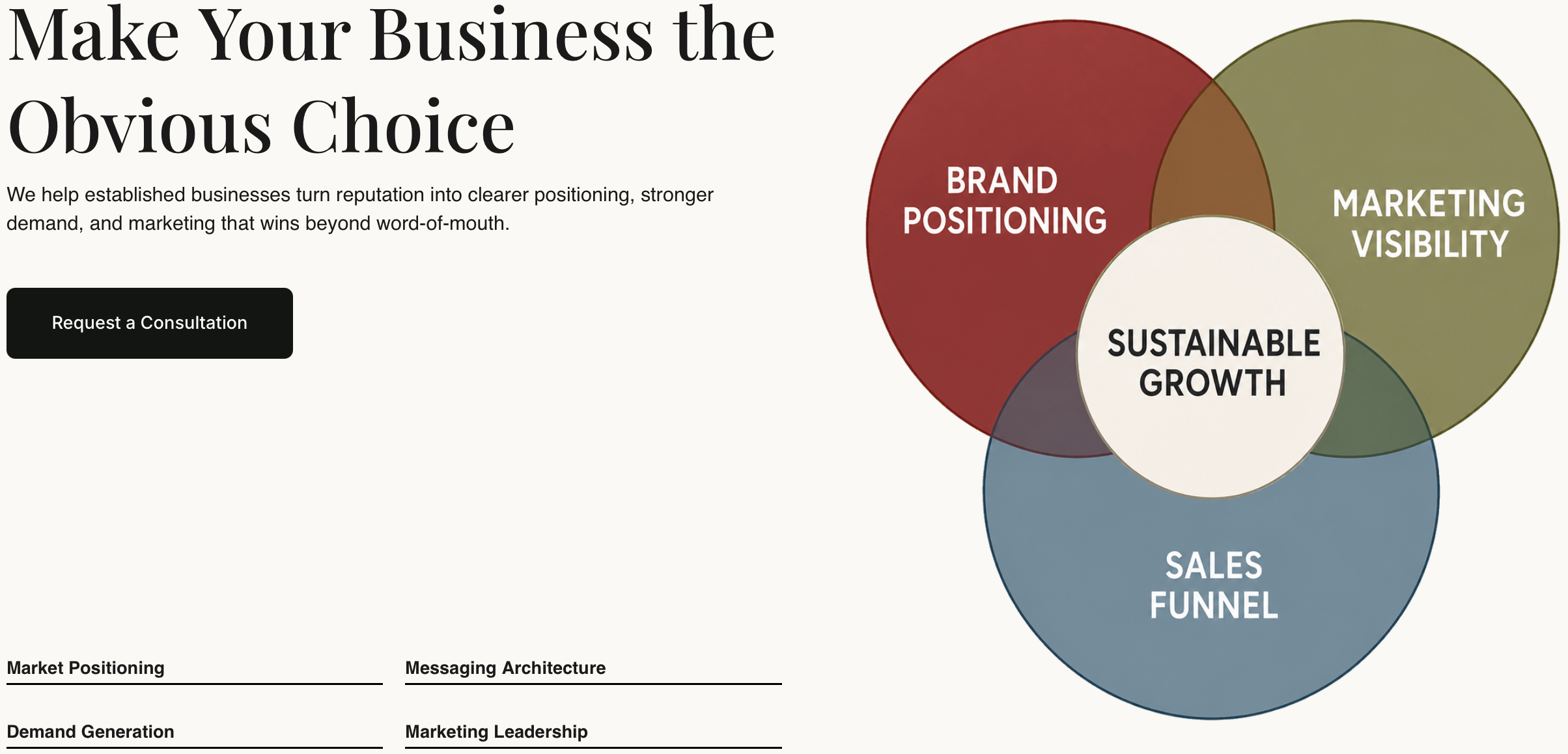
Reasonate Studio’s sales page optimization service is built to close that gap. Using the audience insights and segmentation data you already have, Reasonate Studio shapes your messaging, offer positioning, and page structure to speak directly to your highest-value segments. The result is a sales page that does not just describe what you offer. It speaks to why your specific audience should choose you. If you are ready to put your segmentation work to use, Reasonate Studio is the partner that turns audience clarity into consistent revenue.
The four types are demographic, geographic, psychographic, and behavioral segmentation. Each one captures a different dimension of your customer, from measurable traits and location to values and purchase behavior.
Behavioral segmentation is the most effective starting point because it is based on observed customer actions, making it the strongest predictor of future buying behavior. Small businesses can access behavioral data immediately through their existing sales and email records.
Start with the behavioral data you already have, such as purchase history and email engagement, then survey your best customers to gather psychographic insights. Use demographics and geography to scale what you learn rather than starting from scratch.
Demographic data is the easiest to collect but the weakest predictor of actual buying behavior on its own. It produces segments that are too broad for precise messaging, which leads to generic campaigns that underperform.
Market segmentation is an ongoing process, not a one-time exercise. Customer behaviors and values shift over time, so reviewing and refining your segments at least quarterly keeps your targeting accurate and your campaigns relevant.