September 22, 2026
Why Update Brand Messaging: Essential Guide for Growth


Unlock your brand's potential with the brand story crafting process. This guide helps founders and coaches create compelling narratives that resonate.
TL;DR:
- Most founders struggle to explain why their brand story matters, which hampers revenue and marketing efforts. Crafting a compelling brand narrative requires thorough research, clear elements, and consistent storytelling aligned with customer journeys. Founders must own their story to build trust, differentiate in crowded markets, and turn storytelling into a scalable revenue system.
Most founders can describe what they do. Very few can explain why anyone should care. That gap between a service description and a real brand story is exactly where revenue stalls, content falls flat, and marketing feels like shouting into a void. The brand story crafting process is not about writing something pretty for your About page. It is about building a narrative foundation that drives every piece of content, every sales conversation, and every customer decision. This guide walks you through that process step by step, with specific frameworks built for founders, coaches, and consultants who want a brand that earns.
| Point | Details |
|---|---|
| Brand storytelling matters | Authentic stories build emotional connections that double customer lifetime value and differentiate your business. |
| Research first | Audit content and interview customers deeply to discover the true story before crafting messages. |
| Craft with clarity | Create a concise brand story focused on your customer’s journey and tailor it to specific audiences. |
| Test and refine | Use data-driven methods including A/B tests and feedback loops to optimize your story’s impact. |
| Founder-owned | Founders must lead and embed storytelling across all business areas for sustained success. |
The market is noisier than it has ever been. Coaches offering leadership development, consultants promising business transformation, founders building the next great product — they all sound roughly the same when they lead with credentials and features. The only real way to stand out is through a story that makes your audience feel seen before they spend a dollar.

This is not soft marketing advice. Emotionally connected customers have over twice the lifetime value of satisfied customers. That is a revenue number, not a feelings number. When your story resonates emotionally, you are not just winning attention. You are compressing sales cycles, reducing churn, and generating word-of-mouth that paid ads cannot replicate.
There is also a trust dimension that founders often underestimate. When a potential client reads your story and thinks “that is exactly how I feel,” they stop comparing you to competitors. The decision is half-made before a single sales conversation. That is the real importance of brand stories — they do sales work around the clock, without a pitch.
Here is what strong brand storytelling does for founders, coaches, and consultants specifically:
We have seen firsthand how brand storytelling powers stronger growth for small businesses when the story is intentional rather than accidental. The difference is always in whether the founder owns the narrative or just reacts to what feels like it should be said.
You cannot write your way to a great brand story. You have to research your way there first. Most founders skip this phase entirely and wonder why their story never quite lands. Good brand identity crafting starts with two sources of truth: what already exists in your content and what your customers actually say.
The complete brand storytelling guide for 2026 recommends auditing your last 50 social posts and conducting real conversations with 10 customers before writing a single word of your brand narrative, with the initial draft typically taking one to two weeks. That is not an arbitrary number. Fifty posts reveal patterns in what you naturally talk about, and ten customer conversations surface language, emotions, and before-and-after experiences that you could never invent on your own.
Here is how to run the preparation phase properly:
These proven brand storytelling tips for entrepreneurs consistently point back to one truth: the best brand language already lives in your customers’ words. Your job is to surface it, not invent it.
Pro Tip: During customer interviews, ask “What would you tell a friend who was on the fence about hiring me?” The answer is almost always your best sales copy, word for word.
Here is a quick reference for the elements of a brand story you need to gather before drafting:
| Element | What to uncover | Where to find it |
|---|---|---|
| Founding tension | The problem that made you start | Your own memory and early notes |
| Customer language | How buyers describe the problem | Interviews and direct messages |
| Before state | What life looks like without you | Customer interviews |
| After state | What transformation you deliver | Testimonials and case studies |
| Point of view | What you believe that others deny | Your content and client feedback |
| Proof | Evidence the transformation is real | Data, metrics, reviews |
Taking time to develop brand identity properly at this stage means your story will feel grounded and real rather than aspirational and vague.
With your research in hand, you are ready to write. The mistake most founders make here is trying to say everything at once. A strong brand story is not comprehensive. It is focused, specific, and emotionally clear.
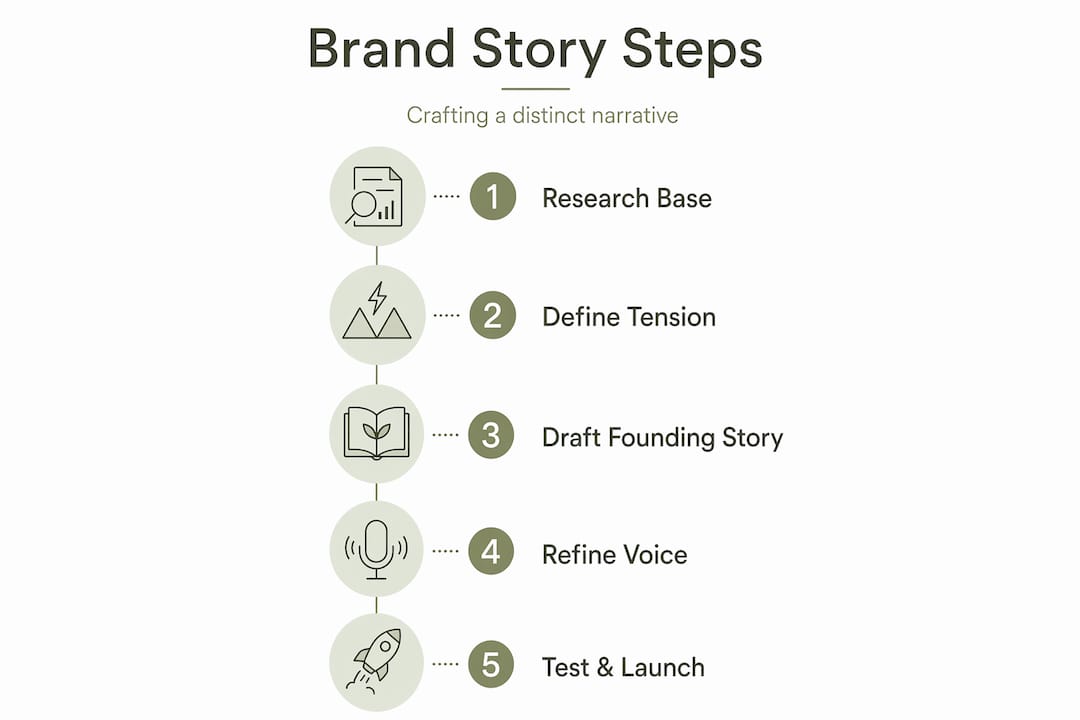
The core brand narrative framework from HubSpot’s 2026 guide maps four story elements to customer journey stages: status quo (the world as it was), conflict (the problem that arose), resolution (what your brand does), and proof (evidence it works). This structure works across industries because it mirrors how humans naturally process change. Every great film, speech, and sales conversation follows the same arc.
Here is how to execute the brand story crafting process in a repeatable way:
These brand story best practices apply regardless of your industry. The underlying mechanics of how humans connect with stories do not change.
Pro Tip: Write your 300-word founding story, then cut it to 100 words. Whatever survives is your core message. Use that version for your bio, your intro on calls, and your pinned post.
Here is a comparison of weak versus strong brand story elements to guide your writing:
| Story element | Weak version | Strong version |
|---|---|---|
| Problem statement | “I help people with their marketing” | “Most coaches have a great offer and zero clients because nobody knows they exist” |
| Founding story | “I started my business in 2017” | “I watched brilliant consultants go broke while mediocre ones with better marketing thrived” |
| Transformation | “I improve results” | “Clients go from invisible to booked out in 60 days” |
| Proof | “Many clients have succeeded” | “One health coach saw a 454% sales increase in 90 days” |
| Call to action | “Work with me” | “Let’s find the story that turns your expertise into income” |
Once you understand how to create a brand voice that reflects your perspective, the story becomes much easier to write and much harder to imitate.
A story that sounds good in a document but fails to move people in real channels is not a brand story. It is a writing exercise. The goal of brand message creation is not internal clarity alone. It is external behavior change: clicks, conversations, conversions.
Watch for these common failure modes that kill otherwise solid stories:
A/B testing brand stories increased average order value by 15%, and leads generated from narrative content close 30 to 40 percent faster. That is not a minor optimization. Those are business-changing numbers achievable through simple testing.
Pro Tip: Set up an exit-intent survey on your sales page with one question: “What almost stopped you from buying?” The answers will reveal exactly where your story is losing people.
Here is a measurement framework for tracking story effectiveness over time:
| Metric | What it tells you | Target signal |
|---|---|---|
| Average order value | Whether story increases perceived value | Rising over 60 to 90 days |
| Sales cycle speed | Whether story pre-sells before the call | Shorter time from lead to close |
| Unsolicited story mentions | Whether clients repeat your language | Customers using your exact phrases |
| Content engagement rate | Which story elements resonate most | Saves and shares over likes |
| Exit-intent survey responses | Where the narrative loses people | Patterns pointing to one weak spot |
Look at brand storytelling examples from real entrepreneurs to calibrate what measurable storytelling success actually looks like in practice.
Here is the uncomfortable truth most marketing agencies will not tell you: you can outsource execution, but you cannot outsource conviction.
We have worked with founders who handed their story to a copywriter and got technically good content that generated nothing. We have also worked with founders who could barely string a sentence together on camera but whose raw, authentic story generated more leads than polished video ads. The difference is never production quality. It is always ownership.
Founders who define their narrative clearly outperform those who rely solely on product features and numbers. This is not just a marketing observation. It shows up in fundraising, hiring, and partnership conversations. Investors bet on people before they bet on products. Employees join stories before they join companies. Partners align around shared belief before they align around shared revenue.
The shift that changes everything is when a founder stops treating storytelling as a marketing function and starts treating it as a leadership function. Your story is not your tagline. It is the organizing principle for every decision your business makes. When your team hires, they should be hiring for story fit. When you design an offer, it should extend the transformation your story promises. When you write an email, it should carry the same emotional thread as your founding narrative.
Most content fails not because of poor execution but because there is no unifying, founder-owned story underneath it. You can have the best designer, the fastest writer, and the most aggressive distribution strategy in your category. Without a clear story that you personally believe and consistently tell, the content is noise.
The founders who grow fastest are not always the best marketers. They are the ones most committed to their narrative. Consistency and conviction build trust faster than scale and distribution ever will. Tell your story in the same way in pitch decks, in Zoom calls, in Instagram captions, and in hiring conversations. Over time, that repetition becomes recognition. Recognition becomes trust. Trust becomes revenue.
That is why brand storytelling powers stronger growth for small businesses far more reliably than any individual tactic. The story is the strategy.
The difference between a great story and a great business is a system that carries the story from discovery to purchase. Your narrative needs to live in more than a bio. It needs to be built into your offers, your sales pages, your positioning, and your pricing.
At Reasonate Studio, we help founders, coaches, and consultants do exactly that. Our offer positioning and pricing strategy services take the story you have worked to build and align it directly with how your offers are framed and priced, so the emotional resonance you create actually converts. We also provide sales page optimization services that ensure your story does not stop at awareness. When someone lands on your page, the narrative carries them all the way through to the purchase decision. If you are ready to turn your brand story into a system that generates more consistent revenue, we are ready to build it with you.
Start by auditing your existing content and conducting real conversations with customers to uncover your authentic brand story. Brand story crafting involves reviewing your last 50 social posts and conversations with 10 customers before writing a single word of narrative.
The initial draft usually takes one to two weeks, including research, interviews, and writing. According to the brand storytelling process guide, this timeline assumes you complete the research phase before drafting begins.
Founders who own their story build stronger emotional connections and trust that drive long-term business success. Storytelling is now a core business strategy that founders must lead personally, not delegate entirely to marketing teams.
Use A/B testing, track metrics like average order value and sales cycle speed, and gather direct customer feedback to evaluate impact. A/B testing brand narratives has been shown to increase average order value by 15% and close leads 30 to 40 percent faster.