September 22, 2026
Why Update Brand Messaging: Essential Guide for Growth


Unlock growth with our brand storytelling process! This step-by-step guide empowers founders to create a clear, captivating narrative that resonates.
TL;DR:
- Unclear brand storytelling confuses prospects, hampers growth, and leads to lost clients and longer sales cycles. Building a strategic, customer-centered narrative using essential frameworks and positioning your story around client transformation strengthens market perception and attracts the right clients. Effective storytelling requires integrating both tactical content and overarching brand identity to drive measurable business success.
If your ideal clients are visiting your website or social media and still not sure what you do or why it matters, your brand story is the problem. Unclear messaging doesn’t just create confusion — it costs you clients, delays growth, and forces you to constantly over-explain yourself in sales conversations. This guide gives you a structured, practical brand storytelling process built specifically for founders, coaches, and consultants. You’ll learn how to move from scattered positioning to a clear, customer-centered narrative that drives real business outcomes.
| Point | Details |
|---|---|
| Customer-centered process | Great brand storytelling puts your customer’s outcomes at the heart of your narrative to clarify value and boost engagement. |
| Framework adapts to assets | Use frameworks like SB7 to systematically turn positioning into website copy, sales scripts, and more. |
| Positioning is the benchmark | The real test of your story is if it moves the needle on your market position—beyond likes or shares. |
| Strategic and tactical balance | Blend overarching brand identity with tactical stories for maximum credibility and growth impact. |
Brand storytelling is not the same thing as writing a catchy tagline or sharing a founder origin story on Instagram. It is a deliberate, strategic system for how you communicate who you are, who you serve, and what transformation you create. Without that system, your marketing becomes noise — content that fills a feed but never converts a client.
Empirical research distinguishes two important dimensions here. Strategic storytelling frames the brand itself as a story, shaping how the market understands your identity and value at a high level. Tactical storytelling, on the other hand, involves the individual stories you tell about your brand across channels. Both dimensions matter, and research finds strong links between brand storytelling and brand positioning, directly connecting brand identity to how customers perceive and choose you.
“Brand storytelling sits at the intersection of identity and perception. Strategic storytelling shapes the brand’s overall narrative identity, while tactical storytelling brings that identity to life through specific stories. The two must work together to create positioning that sticks.” — Research on brand storytelling dimensions
This matters enormously for founders and consultants because you are often selling something intangible: your expertise, your process, your judgment. When your story is unclear, prospects cannot evaluate your value. They hesitate. They shop around. They choose the competitor whose message makes more sense to them, even if you are objectively the better choice. Understanding the connection between brand storytelling and growth is the first step toward fixing that.
Here is what unclear brand messaging actually costs you:
These are not abstract consequences. They are the daily frustrations that keep talented founders stuck at the same revenue ceiling for years. The solution is not more content. It is a clearer, more intentional story built on a real strategic foundation.

Before you can build a compelling brand story, you need the right building blocks. Most founders skip this step and jump straight into writing content, which is exactly why their messaging ends up inconsistent or generic. Taking time to gather and organize your core story elements saves you enormous amounts of rework later.
The most widely used framework for structuring a brand story is the customer-centered narrative approach that converts your positioning into usable messaging assets. Frameworks like this work because they force you to organize your story around what your customer experiences, not around what you want to say about yourself. They give you a logical sequence that the human brain naturally follows.
Here is a quick overview of the essential tools and frameworks that support effective brand storytelling:
| Tool or framework | What it does | Best for |
|---|---|---|
| StoryBrand SB7 | Structures your story around seven narrative elements | Website copy, pitch decks, one-liners |
| Brand voice guide | Defines tone, language, and personality | All written and verbal communication |
| Audience persona document | Maps customer motivations and decision triggers | Messaging targeting and content strategy |
| Customer journey map | Shows how clients move from awareness to purchase | Funnel and content planning |
| Messaging hierarchy doc | Prioritizes your core claims and proof points | Sales pages, ads, and proposals |
| Competitive positioning matrix | Shows how you differ from alternatives | Pitch refinement and differentiator clarity |
Before you sit down to write your brand story, you need to have a few prerequisites in place. Skipping any of these will lead to a story that sounds polished on the surface but fails to resonate with the people you are trying to reach.
Pro Tip: Structure every story around the customer’s transformation, not your credentials. Your background and expertise are supporting evidence. They are not the headline. The headline is always about what life looks like for your client after working with you.
Once these building blocks are in place, you can move into the actual storytelling process with much more confidence and speed. Explore practical storytelling tips and brand story best practices to sharpen your foundation before you write a single word of copy.
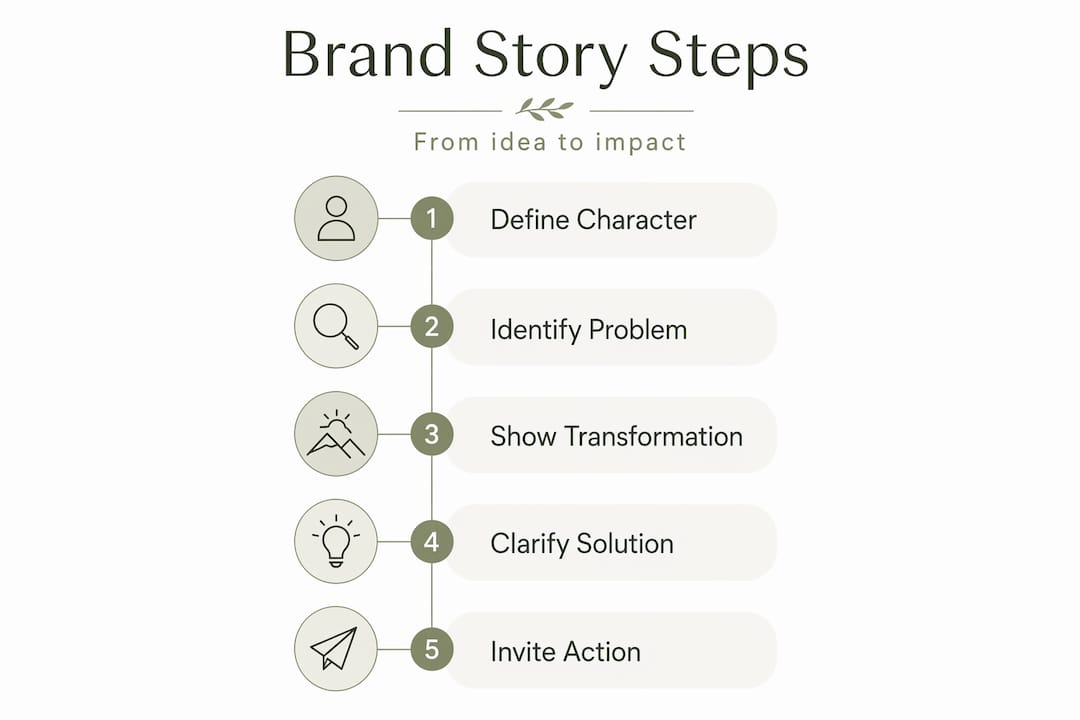
Now we get to the actual work. The SB7 framework organizes your story into seven elements — Character, Problem, Guide, Plan, Call to Action, Failure, and Success — which you then translate into a BrandScript and eventually into channel-ready copy. Here is how to apply each element in practical terms for your business.
Character: identify your customer’s primary desire. This is the person your story is about. Not you. Them. What is the one thing they want most in relation to the problem you solve? For a business coach, this might be reaching $250k in revenue without working 60-hour weeks. Be specific. Vague characters create vague stories.
Problem: articulate the problem at three levels. Every meaningful problem has an external layer (the visible, practical problem), an internal layer (the frustration or fear it creates), and a philosophical layer (why it is unjust or wrong). Most founders only address the external problem, which results in surface-level messaging that does not emotionally connect. If you are a brand strategist, the external problem is “unclear messaging.” The internal problem might be “feeling like an imposter when pitching.” The philosophical problem might be “talented experts deserve to be seen and paid for their real value.”
Guide: position yourself as the trusted guide, not the hero. This is where you introduce yourself, but only as the person who has been where the client is and now helps others get through it. Your empathy and authority go here. “We’ve helped over 100 small businesses transform their marketing” is a guide statement. “I started this agency because I believed founders deserved better” is a hero statement. Know the difference.
Plan: make the path forward clear and simple. Confused people do not buy. Give your client a simple, three-step path that shows what working with you looks like. At Reasonate Studio, for example, we use Discovery and Strategy, Build and Align, and Launch and Scale. Three steps feel manageable. Seven steps feel like homework.
Call to action: make the ask direct and specific. Your CTA should be one clear, confident invitation. “Book a free brand audit” is strong. “Let’s connect to see if we might be a fit to potentially explore something together” is not. Direct language signals confidence and makes it easy for the right client to say yes.
Failure: name what is at stake if they do nothing. This is the most under-used element in most founder messaging. People are motivated by avoiding loss as much as pursuing gain. Name the real cost of staying stuck. What does unclear messaging cost them over the next year in missed revenue, wasted time, and lost opportunities?
Success: paint the after-picture vividly. Describe what life looks like for your client after working with you. Be specific. “You’ll feel more confident” is weak. “You’ll have a brand that attracts three to five qualified leads per week without posting every day” is strong. Specificity builds believability.
Pro Tip: The most common brand storytelling error is centering the story on yourself. Read your homepage copy and count how many times the word “I” or your company name appears in the first three paragraphs. If it dominates, flip it. Make the first three paragraphs entirely about the client’s world before you introduce yourself at all.
Here is how the process looks different depending on where you are in your business:
| Brand stage | Primary focus | Key challenge |
|---|---|---|
| Startup founder | Defining the character and problem clearly | Avoiding the urge to say too much too soon |
| Consultant or coach | Separating your story from your offer | Making the guide role believable without over-credentialing |
| Established brand | Sharpening positioning and updating the after-picture | Shedding outdated messaging that no longer reflects the business |
Each element of your BrandScript becomes usable copy in different places. Your character and problem statements become your above-the-fold website headline. Your plan becomes your services page structure. Your failure and success elements power your email sequences. Your guide section feeds your LinkedIn about or podcast bio. Review messaging frameworks and real-world storytelling examples to see how others have put this into practice.
Even founders who work through a storytelling framework can end up with messaging that still does not convert. Usually, this comes down to a small set of predictable errors that are easy to fix once you know what to look for.
Common brand storytelling mistakes founders and consultants make:
“Frameworks like SB7 explicitly require the customer to play the role of hero in the story. If your messaging centers on the founder’s journey instead of the customer’s desired outcome and decision context, the framework will not perform. Clear articulation of problem, plan, and stakes is what reduces confusion and moves people toward action.”
So how do you actually verify that your brand story is working? The answer is not to look at likes or follower counts. Those numbers tell you about entertainment value, not positioning strength. Track storytelling effectiveness by whether it strengthens your positioning and shifts how potential clients perceive and describe you, not just by surface engagement metrics.
Practical steps to assess and improve your brand story:
Look at messaging examples built for growth to see what strong, verified brand stories look like in practice before you finalize your own.
Here is something the standard advice does not address clearly enough: most founders treat brand storytelling as a content activity when it is actually an identity activity. They use it to fill a blog or post a reel, but they never use it to actually define and own a market position. That gap is expensive.
Research makes this distinction explicit: coaches and consultants should not only craft stories about the brand at a tactical level, but also shape the overarching narrative identity of what the brand represents to the market at a strategic level. Most people only ever work at the tactical layer. They create content, run campaigns, refresh their bio. But the deeper question — what narrative does your brand represent in the minds of your ideal clients — often goes unanswered.
Think about what this looks like in practice. A business coach who only tells tactical stories might post client wins, share tips, and talk about their process. But if there is no strategic narrative underneath it, the audience cannot form a clear, lasting impression of what that coach stands for. They become one of many coaches in the feed. Whereas a coach who has also built a strategic story — say, “I help first-generation entrepreneurs build wealth without sacrificing their identity” — creates a narrative identity. That is not just a tagline. It is a positioning decision that shapes everything from the clients who seek them out to the price they can charge.
Another thing most advice misses: story validation should be measured in positioning movement, not engagement spikes. A post going viral means nothing if it does not attract the right kind of client or reinforce your market position. We have worked with founders who had audiences of tens of thousands and could not fill a $2,000 program. The story was entertaining, but it was not doing positioning work.
Shift your benchmark. Ask whether your brand storytelling is moving your market position rather than just generating attention. Ask whether your story is creating preference. Ask whether prospects arrive at sales conversations already knowing why they want to work with you specifically. Those are the signals that tell you your story is doing real strategic work.
Tactical storytelling is the vehicle. Strategic storytelling is the destination. You need both, but most founders are so focused on the vehicle that they never decide where they are actually going. Elevate your brand positioning by working at both levels simultaneously, and the results will compound over time in ways that random content never will.
Building a brand story that truly works, one that positions you clearly, attracts the right clients, and converts, takes more than a framework. It takes someone who can see your business from the outside, push back on the parts that do not land, and translate strategy into the actual copy, content, and channels that move revenue.
At Reasonate Studio, we specialize in doing exactly that for founders, coaches, and consultants. Whether you need help clarifying your core story, optimizing your sales page to reflect your positioning, building out your social media management with story-aligned content, or strengthening your discoverability through SEO keyword research, we bring strategy and execution together inside one cohesive system. Start with a free Brand Audit to see exactly where your story is working and where it is leaving opportunity on the table.
Strategic storytelling shapes how your brand is perceived at a high level, forming your overall narrative identity in the market, while tactical storytelling covers the specific stories you tell about your brand through content, campaigns, and channels.
Measure success by whether your story strengthens your market positioning and shifts how clients describe and perceive you. As research recommends, track positioning and customer perception links rather than relying on engagement metrics alone.
Shift your messaging so the customer is the hero. Frameworks like SB7 explicitly place the customer in the lead role and require you to clearly articulate their problem, your plan, and what success looks like for them.
Translate each part of your story into the format each channel requires. Once you have a BrandScript, teams use it to build website wireframes, one-liners, email sequences, social captions, and sales decks that all maintain consistent positioning and clarity.