September 22, 2026
Why Update Brand Messaging: Essential Guide for Growth


Build an intentional marketing strategy around customer needs, clear positioning, and focused execution that supports stronger conversion and loyalty.

TL;DR:
- Intentional marketing is customer-focused, data-informed, and built for long-term growth.
- Emotional branding and storytelling create deep connections and increase trust.
- Authenticity, deep audience understanding, and consistent messaging are essential for lasting impact.
Most founders and coaches believe that posting more content or running more ads will eventually produce results. It rarely does. The real problem is not effort or budget. It is the absence of intent. When your marketing lacks a clear strategic core, every campaign feels like a shot in the dark, and your audience can sense it. This guide walks you through why intentional, emotionally driven marketing produces measurably better outcomes, what frameworks actually work, and how you can shift from scattered tactics to a focused system that attracts the right clients and keeps them coming back.

| Point | Details |
|---|---|
| Intent trumps tactics | Marketing anchored to intent and real customer needs produces better results than following trends or random campaigns. |
| Emotional connection matters | Brands that lead with empathy and authentic storytelling stand out and build lasting client trust. |
| Frameworks enable clarity | Using proven frameworks for segmenting intent and gathering feedback transforms vague goals into measurable actions. |
| Balance automation wisely | Overdependence on AI or generic outreach can harm authenticity—find the right mix for personal connection. |
Let’s start by examining why many marketing campaigns underperform and what makes intentionality a game changer.
Most founders default to what we call “shiny object” marketing. A new social platform launches, and they rush to create a profile. A competitor runs a giveaway, and they copy it. A marketing guru posts a reel about trending audio, and they scramble to follow suit. The result is a brand that looks busy but feels scattered, and a marketing calendar that has no connective tissue holding it together.
Intentionality in marketing means every single tactic, post, email, and campaign is anchored to a clear understanding of who you are serving, what they need, and where they are in their decision-making journey. It is not about doing less. It is about doing things with purpose.
Here is a side-by-side look at how the two approaches compare:
| Approach | Random marketing | Intentional marketing |
|---|---|---|
| Starting point | Latest trend or competitor | Customer intent and need |
| Content decisions | Gut feel or volume | Data and audience insight |
| Measurement | Vanity metrics (likes, views) | Conversions and retention |
| Brand voice | Inconsistent | Consistent and strategic |
| Long-term result | Burnout and plateau | Compounding growth |
The numbers back this up. Intent-based marketing boosts conversions by 25%, improves sales productivity by 24%, and increases sales-qualified leads by 23% compared to random, untargeted approaches. Those are not small gains. They represent the difference between a business that grows and one that stalls.
The pitfalls of skipping intentionality go beyond poor ROI. Without a strategic foundation, your messaging becomes generic. Generic messaging fails to create emotional resonance, which means potential clients scroll past your content without feeling seen or understood. And when people do not feel understood, they do not buy.
A strong marketing campaign planning process is what separates brands that grow consistently from those that chase results without ever catching them. Before you build any campaign, you need to know the intent behind it and the emotion you want your audience to feel.
“Marketing without intent is just noise. Every piece of content should serve a purpose tied to your audience’s real needs and your business goals.”
The core lesson here: volume and frequency are not substitutes for strategy. Intentional marketing is not a luxury. It is the foundation.
Now that we’ve contrasted random and intentional approaches, let’s clarify what intentional marketing means and the practical frameworks you can use.
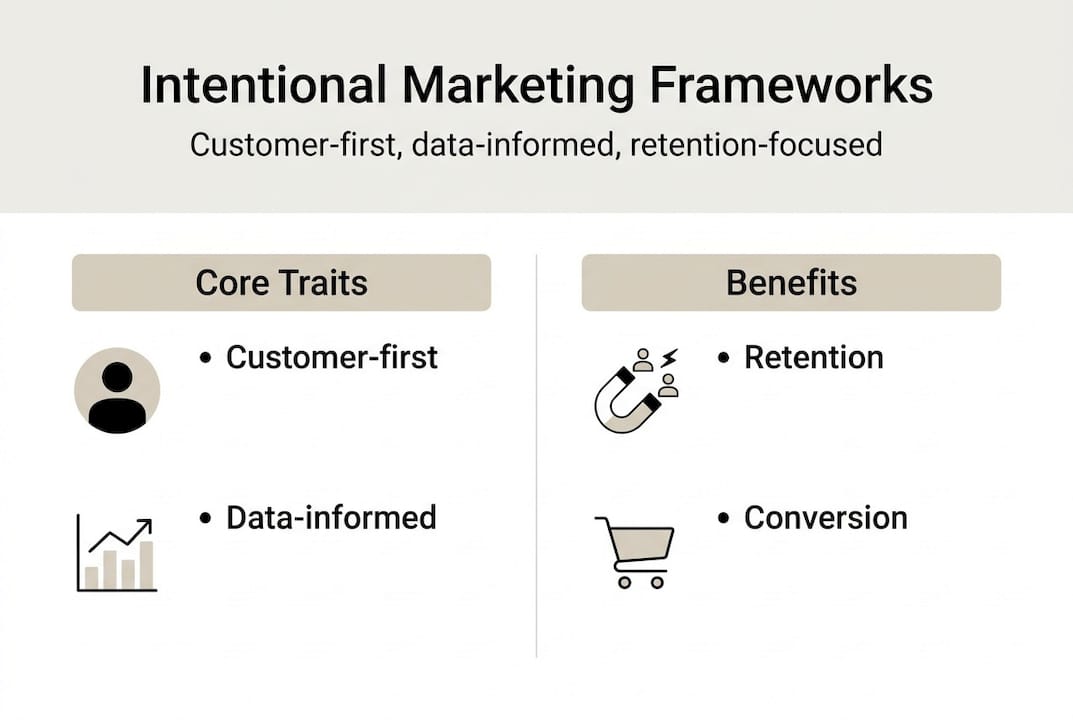
Intentional marketing is customer-first, data-informed, and built for long-term retention rather than short-term spikes. As modern marketing strategies show, the shift away from product-push models toward customer-first approaches that segment by intent and use continuous feedback loops is not optional anymore. It is the standard.
Three frameworks stand out as especially practical for founders, coaches, and consultants.
The Intent Ladder maps your audience’s awareness and readiness to buy, from completely unaware to ready to invest. Each rung of the ladder requires different messaging. Talking to a cold audience the same way you talk to a warm one is one of the most common and costly mistakes in marketing.
Behavioral Segmentation groups your audience not by demographics but by actions. Who clicked your email? Who watched your video past the 60-second mark? Who visited your pricing page twice? These behaviors tell you far more about intent than age or location ever will.
The Continuous Feedback Loop treats every campaign as a learning opportunity. You run, you measure, you adjust, and you run again. This is how customer-first approaches build compounding momentum over time.
Here is a simple sequence to move from scattered tactics to a working system:
| Framework | What it does | Best used for |
|---|---|---|
| Intent Ladder | Maps audience readiness | Messaging and content planning |
| Behavioral Segmentation | Groups by actions, not demographics | Email and ad targeting |
| Continuous Feedback Loop | Turns campaigns into learning cycles | Long-term strategy refinement |
Pro Tip: Before scaling any tactic, run a small-scale experiment with a segment of your audience. A single email to 100 people or a post tested on two different days can reveal intent signals that save you weeks of wasted effort.
With frameworks in place, let’s explore the crucial role of emotion, trust, and story in building a marketing strategy that resonates and lasts.
Here is a stat that should stop you in your tracks. 88% of consumers value authenticity when choosing which brands to support, but 50% of audiences can detect inauthenticity immediately. That means half your audience is already filtering out content that feels manufactured or performative before they even finish reading it.
Emotional branding works because human beings make decisions emotionally first and rationalize them logically second. When your marketing speaks to how someone wants to feel, not just what they want to have, you create a connection that goes far deeper than a transaction.
Storytelling is the most powerful delivery mechanism for emotional branding. Not polished, corporate storytelling. Real, human stories that show the struggle, the turning point, and the transformation. Stories that make your ideal client think, “That is exactly where I am right now.”
Here are the essentials for crafting brand messages that actually resonate:
Brands that excel at emotional storytelling do not just describe what they do. They make you feel what it is like to work with them. That feeling is what drives referrals, retention, and loyalty. For practical brand storytelling tips and real-world brand storytelling examples from entrepreneurs who have done this well, these resources are worth your time.
“Post-pandemic audiences are not just buying products or services. They are buying trust, alignment, and proof that you actually understand their world.”
Pro Tip: Storytelling lands hardest when it mirrors your client’s own journey. Before writing any story-based content, write out the specific moment your ideal client realized they needed help. Then write to that moment.
Finally, intentional marketing is not just about frameworks. It is about skillfully managing gray areas and new technologies. Let’s break down the most pressing challenges.
The biggest tension in modern marketing is between scale and soul. AI personalization tools can now send thousands of customized messages in minutes. That sounds like a win until those messages start feeling hollow. AI personalization risks manipulation when it prioritizes behavioral triggers over genuine connection, and audiences in 2026 are sophisticated enough to notice.
Here is how to keep your marketing authentic across channels without sacrificing efficiency:
Navigating omnichannel presence is less about being everywhere and more about being consistent. Your tone, values, and message should feel the same whether someone finds you on Instagram, reads your newsletter, or lands on your website. Reviewing influencer strategy best practices and influencer marketing frameworks can also help you understand how third-party voices either reinforce or dilute your brand’s authenticity.
“The brands that win long-term are not the ones with the most sophisticated automation. They are the ones whose audience never has to wonder if there is a real human behind the message.”
Pro Tip: Set up a simple social listening process, even just a weekly 15-minute review of comments, DMs, and mentions. This is often where you first notice that your tone has drifted or your audience feels less connected than they used to.
Having covered frameworks and pitfalls, let’s step back and apply our own hard-won lessons about what truly separates surface-level strategy from lasting impact.
We have seen a lot of founders read the right books, follow the right frameworks, and still produce marketing that falls flat. The reason is almost always the same. They treated intentionality as a checklist instead of a mindset.
You can map your Intent Ladder perfectly and still miss the mark if you are not genuinely listening to your audience. Real intent comes from deep listening, not trend-chasing. It comes from paying attention to the specific words your clients use when they describe their struggles, not the words you assume they use.
Emotional connection is not a tactic you add to your strategy. It is an ethos woven through every touchpoint, from your first Instagram caption to your onboarding email. Clients respond to founders and coaches who lead with curiosity and empathy, not those who lead with credentials and offers.
The power of relatable storytelling is not in the polish. It is in the honesty. When you lead with empathy and purpose instead of tools and tactics, your marketing stops feeling like marketing and starts feeling like a conversation worth having.
Ready to put intentionality into action? Here is how you can get expert support for your brand’s transformation.
Building an intentional marketing strategy takes more than reading a guide. It takes someone who can look at your specific brand, audience, and offer and help you find the emotional core that makes people choose you over everyone else.
At Reasonate Studio, we help founders, coaches, and consultants move from scattered marketing to a focused, strategy-first system that builds real connection and drives reliable revenue. Whether you want to start with a free Brand Audit Report, explore done-for-you social media management, or book a private coaching call, we are ready to help you turn your story into income. Your next step starts with a conversation.
Intentional marketing is a strategy focused on understanding customer intent, emotional connection, and data-driven actions instead of random tactics or trend-chasing. It prioritizes long-term retention and genuine audience alignment over short-term visibility.
Intent-based strategies increase conversions by 25% by targeting high-intent clients instead of using scattershot marketing. Focusing on where your audience is in their decision journey makes every message more relevant and more likely to convert.
Focus on sharing true stories, showing empathy, and using the channels your audience trusts while avoiding overuse of AI-driven personalization. Authenticity is valued by 88% of consumers, so even small shifts toward genuine human connection can significantly improve trust.
Emotional branding and storytelling help brands form deep, lasting connections and consistently outperform transactional, sales-based messages. Stories that mirror your client’s own journey create the kind of resonance that turns prospects into loyal, long-term clients.