September 22, 2026
Why Update Brand Messaging: Essential Guide for Growth


Learn proven steps to attract and retain coaching clients in 2026 with a clear system for lead generation, credibility building, and sustainable growth.

TL;DR:
- Clear niche and audience definition are essential for attracting coaching clients effectively.
- Building credibility with specific testimonials and strategic lead magnets boosts trust and authority.
- Focus on consistent relationship-building and targeted channels to generate sustainable client flow.
You built a real coaching practice around a real skill. But the clients are not showing up the way you expected. You post, you pitch, you tweak your bio for the fourth time, and still the inquiry inbox is quiet. This is one of the most common and most demoralizing experiences for coaches, and the problem is rarely the quality of your work. It is almost always the absence of a clear, repeatable system for attracting and converting the right people. There is no shortage of advice on the internet, but most of it is scattered, tactical, and disconnected from how real coaching businesses actually grow. This guide cuts through that noise and gives you a structured, proven path to building consistent client flow, starting with the foundational decisions most coaches skip entirely.
| Point | Details |
|---|---|
| Define your audience | Knowing exactly who you serve is the foundation for effective marketing and sustainable client acquisition. |
| Build trust assets | Testimonials, workshops, and branded free tools help establish credibility and attract leads. |
| Show up consistently | Commit to regular, strategic actions on your chosen channels to keep your pipeline healthy. |
| Nurture relationships | Personal follow-up and client care turn prospects into loyal clients and referral sources. |
Before you can market effectively, you need a clear sense of your coaching identity and a defined audience. This is not just a branding exercise. It is the single decision that determines whether every other marketing effort you make lands or disappears into the void.
Most coaches start too broad. They want to help people with confidence, leadership, mindset, relationships, and career transitions all at once. That instinct is generous, but it kills momentum. When you speak to everyone, you resonate with no one. The coaches who consistently attract clients are the ones who have made a specific promise to a specific person with a specific problem.
Start by getting ruthlessly honest about three things: who you are best suited to help, what specific outcome you deliver, and what makes your approach different from every other coach making a similar promise. These are not soft brand questions. They are the practical mechanics of getting found, understood, and chosen.
According to research on client acquisition mechanics, defining ideal client profiles, building sustainable value delivery systems, and mapping audience journeys are the core assets that prevent indifference in a crowded coaching market. In other words, clarity is not a nice-to-have. It is what separates coaches who grow from coaches who stall.
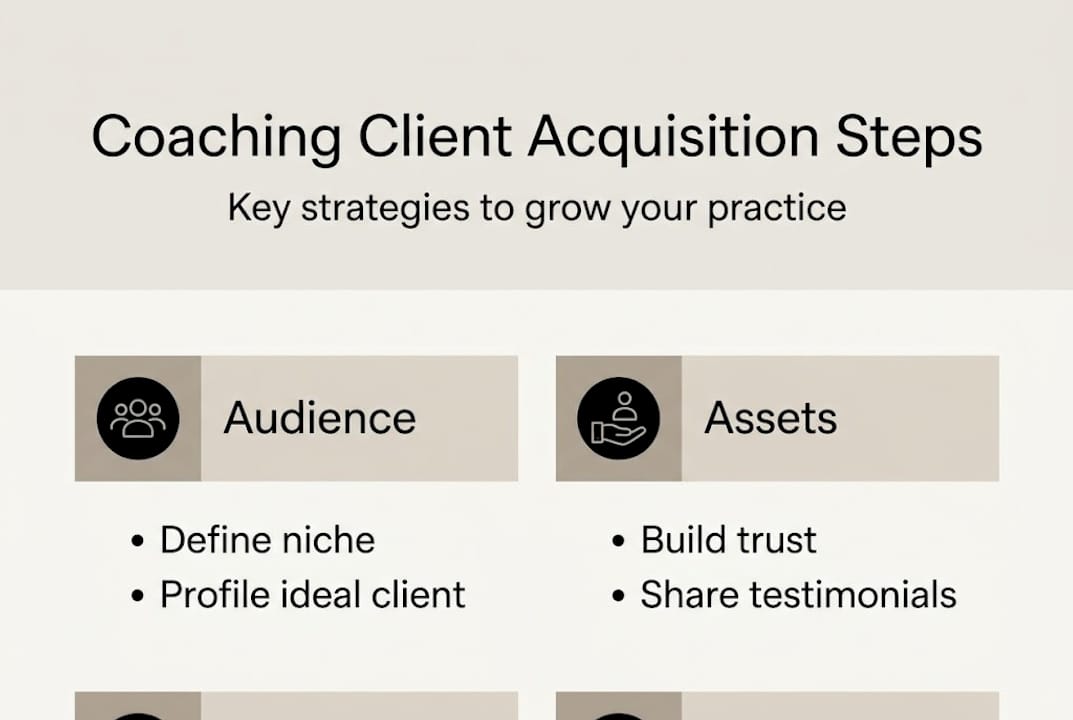
Use this simple client clarity table to guide every branding and marketing decision you make:
| Clarity element | Key question to answer |
|---|---|
| Niche | Who do I serve best and most naturally? |
| Outcome | What specific result do clients get? |
| Differentiator | Why would someone choose me over another coach? |
| Pain point | What does my ideal client struggle with most? |
| Transformation | What does their life look like after working with me? |
For deeper work on this, client profiling in marketing can help you build a more precise picture of who you are actually trying to reach.
Here are the foundational assets every coach needs before any outreach begins:
Pro Tip: Write your ideal client description as if you are writing a letter to one specific person. Include their age, their frustration, their goal, and the words they would use to describe their problem. Every piece of content you create should pass the test of whether that one person would feel it was written for them.
Common pitfalls to avoid: Trying to serve multiple audiences at once, writing a value proposition in coaching jargon rather than client language, and skipping the journey map because it feels theoretical. These shortcuts cost you clients at every stage of the funnel.
With your niche and audience identified, it is time to focus on building the credibility assets that invite real client interest. People do not hire coaches they do not trust. And trust is not built through a polished logo or a clever tagline. It is built through consistent proof that you understand their problem and have helped people like them solve it.
The most powerful credibility assets available to coaches right now are testimonials and success stories. Not the vague kind that say “working with Sarah changed my life.” The specific kind that describe where someone started, what shifted, and what became possible afterward. That specificity is what makes a potential client think, “that sounds exactly like me.”
Top strategies from Forbes experts include sharing client stories and testimonials, creating free tools, using video testimonials, writing thought-leadership content, and hosting events as the highest-leverage ways coaches attract and win clients in 2025 and beyond.
Here is a step-by-step system for gathering and showcasing testimonials that actually convert:
Beyond testimonials, lead magnets are one of the most underutilized tools in a coach’s marketing toolkit. But there is a significant difference between a generic freebie and a branded, strategic lead magnet.
| Element | Generic freebie | Branded lead magnet |
|---|---|---|
| Format | Basic PDF tips list | Custom guide tied to your framework |
| Voice | Neutral, template-like | Your tone, your language, your process |
| Lead quality | Mixed, low intent | Targeted, niche-specific |
| Follow-up potential | Low | High, leads into a natural next conversation |
| Brand impression | Forgettable | Positions you as the clear expert |
For brand-building strategies that help coaches position themselves with authority, the difference between a generic freebie and a branded lead magnet is often the difference between building a list and building a client pipeline.
Hosting a focused workshop or webinar is another fast path to credibility. Keep it tight: one specific problem, one clear framework, one next step. A 60-minute workshop that solves a real pain point will do more for your authority than six months of daily posting that lacks focus. And it gives you a natural, pressure-free environment to introduce your paid offer at the end. For deeper insight on building trust as a coach, this is the kind of consistent, value-first behavior that compounds over time.
After building credibility, the next challenge is reliably reaching and attracting the right prospects through targeted channels. The biggest mistake coaches make here is trying to be everywhere at once. They post on five platforms, write blogs, record podcasts, and send newsletters, all without enough consistency on any one channel to actually gain traction.
The smarter move is to choose one or two primary channels based on where your ideal client already spends time, and go deep before going wide. Your social media strategy should be built around your audience’s habits, not your personal preferences.
Here is how to prioritize your channels effectively:
Forbes experts recommend thought-leadership content, hosting live events, and LinkedIn posts as the top lead generation channels for coaches looking to build authority and attract ready-to-invest clients.
For coaches early in the growth phase, direct outreach is still one of the highest-converting activities available. Not cold pitching, but warm, personalized connection with people who already follow you, attend your events, or engage with your content. Commenting thoughtfully on someone’s post before sliding into their inbox is a fundamentally different experience than a generic cold DM.
Pro Tip: Block two dedicated time windows each week, one for content creation and one for direct outreach. Treat them like client appointments. When lead generation competes with everything else on your calendar, it always loses.
Here are tools that make lead generation more manageable for solo coaches:
A solid content marketing strategy ties all of these channels together into a system that builds momentum over time rather than requiring you to reinvent your approach every week. And for a bird’s-eye view of how the pieces connect, the proven coach marketing steps framework offers a practical sequence to follow.
With leads coming in, the focus shifts to building authentic relationships that turn interest into lifelong client value. This is where many coaches fall short. They do well at attracting attention but lose momentum in the follow-up, either waiting too long or overcorrecting into pushy, scripted pitches that kill the connection.

The foundation of good follow-up is genuine curiosity. When someone shows interest, your first response should not be to sell. It should be to understand. Ask a follow-up question. Share something relevant. Demonstrate that you were actually listening. That small behavior creates a disproportionate amount of trust.
Here is a sequence for turning a warm lead into a client without pressure:
As research on building a coaching client base confirms, focusing on assets over isolated steps creates a sustainable foundation that naturally generates referrals over time.
Here are the most effective nurturing tactics for post-contact relationships:
The coaches with the fullest rosters are not the most aggressive marketers. They are the most remembered ones. They show up consistently, they follow through, and they make every interaction feel like the beginning of a real relationship, not a sales transaction.
Building a referral system starts before you ask for referrals. It starts with delivering such a specific, clear, and memorable result that your clients know exactly who to send your way. When you finish a coaching engagement, ask your client: “Who in your network is dealing with the same challenge you came to me with?” That one question, asked at the right moment, is more powerful than any referral program. For more on growing your coaching business through relationship-based strategies, the principles here apply at every stage of growth.
After working through tactical steps, it is worth challenging some of the widespread myths coaches carry into their marketing. The most common mistake we see is the belief that more activity equals more clients. More posts, more DMs, more content, more platforms. It almost never works that way.
What actually compounds is trust. A coach who shows up consistently for one specific audience on one clear platform, with a message that speaks directly to one problem, will outperform a coach posting daily across five channels with no clear point of view. Every time.
The second myth is that cold outreach or viral content will replace the slower, stickier work of relationship building. It rarely does. The coaches who hit $10k months and beyond almost universally trace their early growth back to a small handful of real relationships, not a campaign that went viral.
The sustainable path is the one most people resist because it feels slower. Map your ideal audience. Build your core assets: a clear message, a branded lead magnet, and a trust-building content rhythm. Then layer in consistent outreach and follow-up over time. This is what creates compounding referrals, predictable revenue, and a practice that does not feel like it is starting from zero every month. For coaches ready to stress-test their current approach, the proven marketing strategy framework is worth reviewing before adding anything new to your plate.
Getting clear on your audience and building credibility assets are powerful first steps. But translating that clarity into consistent visibility and client flow often requires more than strategy alone. It requires precise execution across your website, search presence, and messaging.
At Reasonate Studio, we work directly with coaches and consultants to sharpen exactly these pieces. Our SEO keyword research helps your ideal clients find you before they even know you exist. Our sales page optimization services turn browsers into booked calls by making your offer immediately clear and compelling. And our on-page SEO for coaches ensures your website works as hard as you do. If you are ready to move from scattered marketing to a system that actually builds momentum, we would love to show you where your biggest opportunities are. Start with a free Brand Audit and get a clear picture of what is working and what is not.
The fastest approach is leveraging your existing network for direct referrals while using social proof to build initial trust quickly. Client stories and free tools are among the highest-converting tactics for winning clients fast.
Yes, defining a clear niche makes every marketing and outreach effort significantly more effective. Defining ideal client profiles is considered a core mechanic of successful client acquisition.
LinkedIn content, webinars, and guest podcast appearances are especially effective for early-stage coaches. LinkedIn posts and live events consistently rank among the top strategies used by high-performing coaches.
Personalized follow-up, offering relevant value at each touch point, and building trust through real stories make leads more likely to convert. Assets and trust-building lead to more referrals and stronger conversion rates over time.