September 22, 2026
Why Update Brand Messaging: Essential Guide for Growth


Discover the crucial role of education in marketing. Learn how it enhances competency and drives business success for owners and marketers alike.
TL;DR:
- Formal marketing education significantly enhances competency, strategic thinking, and organizational alignment, leading to better business outcomes. It results in higher career progression, retention, measurable impact, and resilience against AI. Ongoing, structured learning integrated with practical application is essential for marketing professionals and organizations aiming for sustained growth.
Education is the single most reliable predictor of marketing competency, career longevity, and measurable business impact for marketing professionals today. The role of education in marketing goes far beyond earning a degree. It shapes how marketers think, how they interpret data, how they align strategy with business goals, and how they hold their ground in budget conversations. Yet only 35% of marketers meet a foundational marketing knowledge benchmark in 2026. That means nearly two-thirds of the people running marketing campaigns, managing social channels, and advising business owners are operating below the knowledge threshold required to do the job well. For marketing professionals and business owners alike, that statistic is not a footnote. It is a call to act.
Formal marketing education, which includes degrees, certifications, and structured courses, gives practitioners a shared vocabulary, a set of proven frameworks, and the critical thinking skills that experience alone rarely produces. The difference between a marketer who learned on the job and one who has gone through structured training is not just knowledge depth. It shows up in confidence, in strategic clarity, and in the ability to connect marketing activity to revenue. This article breaks down what the research says, what the gap costs you, and how to close it.
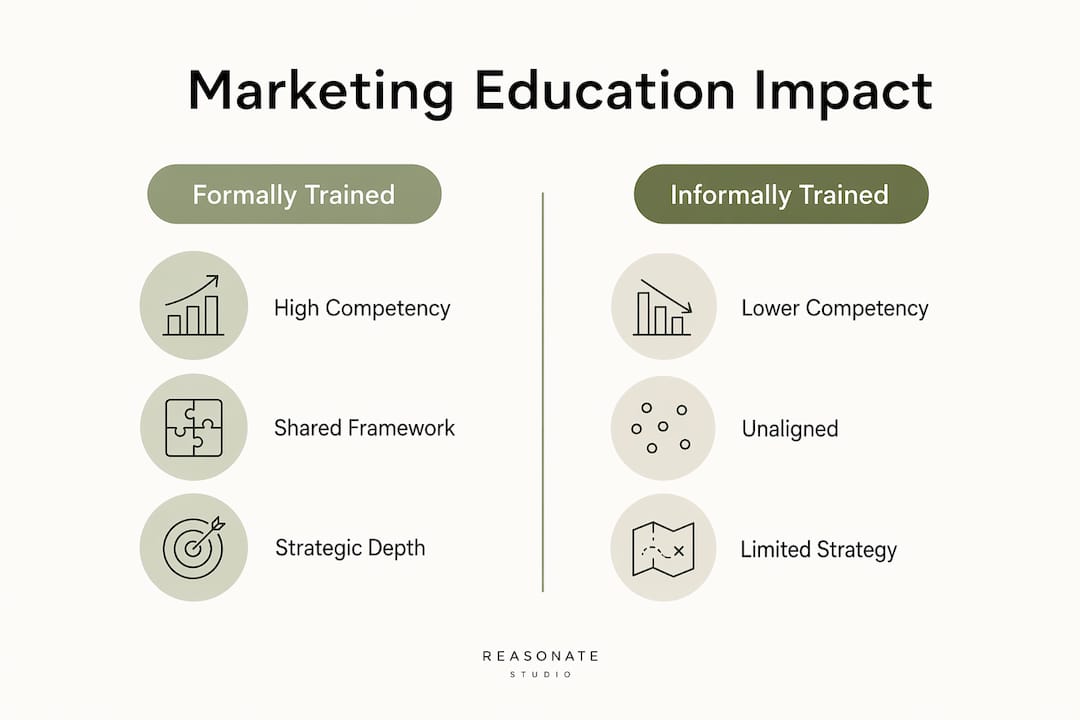
The gap between formally trained and informally trained marketers is not subtle. Formally trained marketers are four times more likely to meet competency benchmarks than those who rely on on-the-job learning alone. Forty percent of marketers with a degree, certification, or structured course reach the competency threshold, compared to just 9% of those who learned informally. That is not a marginal difference. It is the difference between a marketer who can build a strategy from first principles and one who is copying what worked for someone else last quarter.
Informal learning, which includes watching YouTube tutorials, reading industry blogs, or absorbing knowledge through trial and error, has real value. It keeps practitioners current and builds practical instincts. But it does not produce the structured thinking that formal education develops. Frameworks like the marketing mix, customer journey mapping, and segmentation theory are not just academic exercises. They are the scaffolding that holds a campaign together when instinct runs out. Without them, marketers tend to default to tactics over strategy, which is exactly why so many marketing efforts feel scattered.
One of the less-discussed benefits of formal training is what it does for organizational alignment. When a team shares the same marketing language and frameworks, they spend less time debating definitions and more time executing. A content strategist, a paid media manager, and a brand director who all understand positioning theory in the same way will produce more coherent campaigns than a team where everyone learned differently. This is especially true in global or cross-functional teams where misalignment is expensive.

| Learning Type | Competency Benchmark Met | Shared Framework Fluency | Strategic Thinking Depth |
|---|---|---|---|
| Formal (degree, certification, structured course) | 40% | High | Strong |
| Informal (on-the-job, blogs, tutorials) | 9% | Variable | Inconsistent |
| No structured learning | Below 9% | Low | Reactive |
Pro Tip: If you are a business owner hiring marketers, ask candidates to walk you through a framework they use to build strategy. The answer will tell you more about their education than their resume will.
Formal training also codifies institutional knowledge in a way that protects organizations during leadership transitions. When a senior marketer leaves and takes their mental model with them, teams built on informal learning lose their compass. Teams built on shared formal education have the frameworks to rebuild faster. That is a real competitive advantage that rarely shows up in job descriptions but shows up constantly in organizational performance.
Career outcomes for formally educated marketers are measurably better, and the data is specific enough to be useful. Seventy-seven percent of formally trained marketers report steady career progression, compared to 54% of their untrained peers. That 23-point gap represents promotions not earned, leadership roles not offered, and salary growth not realized. For marketing professionals who want to move up, formal education is not a credential. It is a career accelerator.
The impact on retention is equally striking. Seventy percent of formally educated marketers expect to stay in the profession for at least 10 years, compared to just 41% of untrained marketers. This matters for business owners too. High turnover in marketing roles is expensive, disruptive, and often a symptom of under-investment in training. When your marketing team feels competent and confident, they stay. When they feel like they are guessing, they leave.
Here is what the research shows about the specific career advantages education provides for marketing professionals:
The AI point deserves more attention. The marketers most at risk from AI displacement are those whose entire value is in execution: writing copy, scheduling posts, pulling reports. Formal education builds the critical thinking and human judgment that AI cannot replace. A marketer who understands positioning theory, audience psychology, and brand strategy will always have a role. A marketer who only knows how to use the tools is more vulnerable than they realize.
Education’s impact on marketing strategy is not theoretical. It shows up in how marketers interpret data, how they structure campaigns, and how they communicate results to leadership. Formally trained marketers are better equipped to connect marketing activity to revenue, which is the single most important skill for any marketer who wants to be taken seriously in a business context. Learning how to make a marketing strategy that drives growth requires exactly the kind of structured thinking that formal education develops.
The practical skills that formal marketing programs teach include:
The business case for investing in marketing education is also supported by what high-performing marketers do differently. They engage more with external perspectives, including agency training, industry conferences, and peer networks. This external engagement sharpens decision-making and prevents the insularity that leads to stale strategy. Business owners who encourage their marketing teams to attend events like Content Marketing World or HubSpot’s INBOUND conference are investing in exactly this kind of capability.
| Business Outcome | Formally Trained Marketers | Untrained Marketers |
|---|---|---|
| Measurable business impact | 86% | 68% |
| Effective budget advocacy | 79% | 62% |
| Career progression (steady) | 77% | 54% |
| Long-term profession retention | 70% | 41% |
The table above makes the case plainly. Every metric that matters to a business owner, from budget efficiency to team stability, improves when the marketing team has formal training. This is not about gatekeeping the profession. It is about recognizing that structured learning produces better outcomes than hoping experience fills the gap.
The most common mistake business owners make with marketing education is treating it as a one-time event rather than an ongoing investment. Sending a team member to a single workshop and calling it done is not a training strategy. It is a checkbox. Real capability development requires a deliberate, sustained approach that combines formal credentials with continuous learning and external engagement. Understanding why brand foundations matter is a good starting point, but it needs to be part of a broader education plan.
Here are the most effective ways to build marketing education into your organization or career:
Pro Tip: Use a shared education investment, such as a team-wide certification program, to create a common strategic language across your marketing function. Teams that think in the same frameworks execute faster and fight less about direction.
The goal is not to turn every marketer into an academic. It is to give your team the foundational knowledge that makes every decision more informed and every campaign more intentional. On-the-job experience is valuable, but formal courses provide measurable gains in strategic thinking that experience alone cannot replicate. The two work best together.
I have worked with founders, coaches, and consultants across dozens of industries, and the pattern I see most often is not a lack of effort. It is a lack of framework. People are working incredibly hard on their marketing, posting consistently, running ads, sending emails, but they are doing it without a strategic foundation underneath. The results are predictable: inconsistent performance, unclear messaging, and a growing frustration that nothing seems to stick.
What formal marketing education provides is not just knowledge. It is a way of thinking. When a marketer understands positioning theory, they stop asking “what should I post today?” and start asking “what does my audience need to believe before they buy?” That shift in question changes everything about how marketing gets done. It is the difference between reacting to the market and shaping how your audience perceives you.
I also think the AI conversation is being misread by most marketers. The fear is that AI will replace marketing jobs. The reality is that AI will replace the parts of marketing that were never the most valuable parts to begin with: the execution tasks, the formatting, the scheduling. What AI cannot replace is the judgment that comes from understanding your audience deeply, knowing how to position an offer, and making strategic calls under uncertainty. That judgment is built through education, not through using more tools.
The marketers and business owners who will thrive in the next decade are the ones who invest in building that judgment now. Not because a credential looks good on LinkedIn, but because the thinking it develops is genuinely irreplaceable. If you are a business owner reading this, the best investment you can make in your marketing is not a new platform or a bigger ad budget. It is building a team that knows why they are doing what they are doing.
— Kaitlyn
Understanding the importance of education in marketing is one thing. Applying it to a real business with real revenue goals is another challenge entirely. At Reasonate Studio, we work directly with founders, coaches, and consultants to translate strategic marketing knowledge into systems that generate consistent, measurable growth. Our Aligned Impact Model™ is built on the same foundational principles that formal marketing education teaches, applied specifically to your brand, your audience, and your offer.
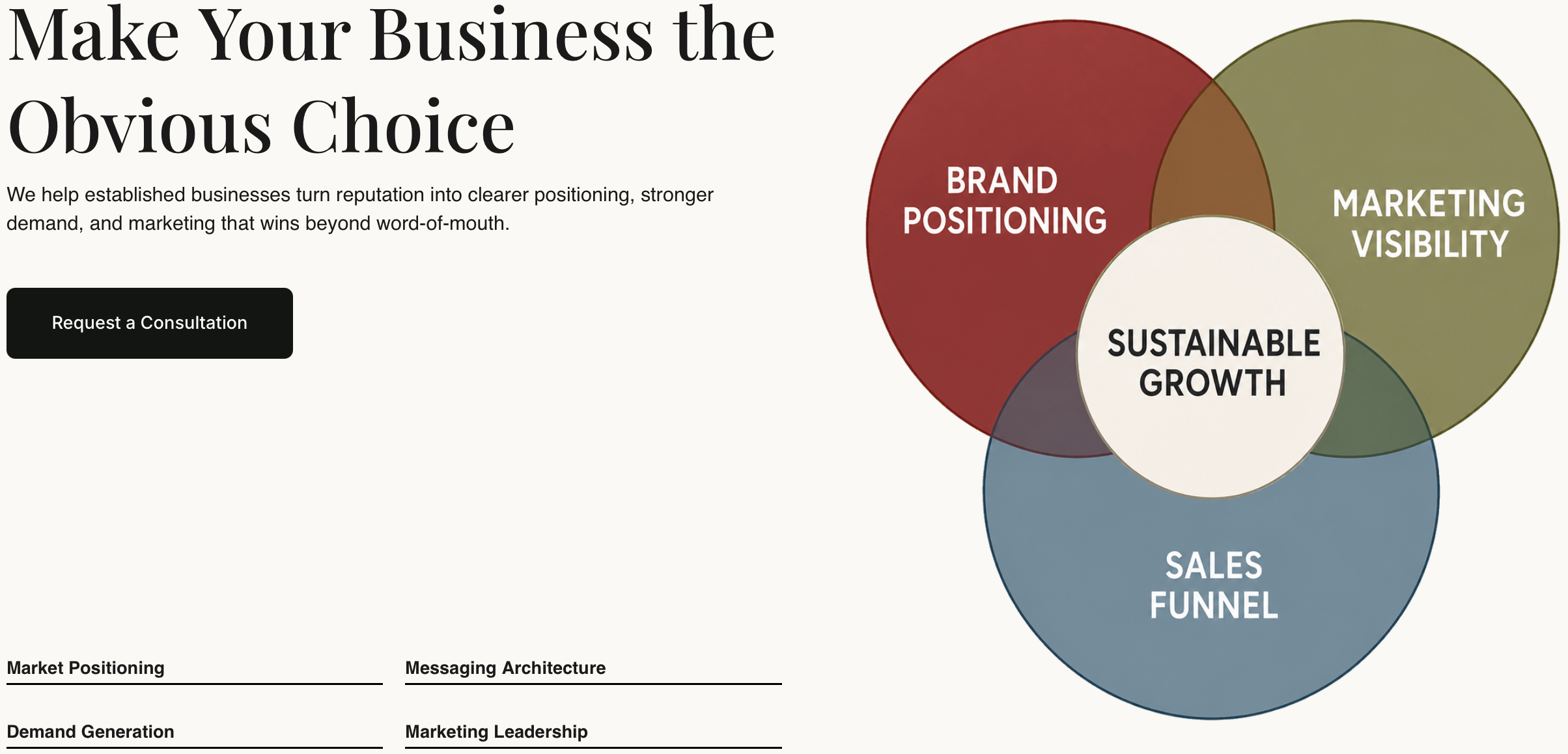
Whether you need a sharper sales page, a clearer brand message, or a marketing strategy that actually connects education to revenue, we build it with you, not for a generic client. Every engagement starts with strategy, not tactics. If you are ready to stop guessing and start marketing from a position of clarity and confidence, Reasonate Studio is the partner that makes that possible.
Education in marketing provides the strategic frameworks, critical thinking skills, and shared vocabulary that enable marketers to make informed decisions and connect marketing activity to business outcomes. Without it, most marketers default to tactics over strategy, which limits their effectiveness and career growth.
Yes. Formally trained marketers are four times more likely to meet competency benchmarks than those who rely on informal learning alone, with 40% reaching the threshold compared to just 9% of untrained peers. The improvement shows up in data literacy, budget advocacy, and measurable business impact.
Structured credentials like the American Marketing Association’s PCM designation, Google’s digital marketing certifications, and HubSpot Academy courses provide recognized frameworks and measurable competency gains. The most effective approach combines formal credentials with continuous external engagement through conferences and peer networks.
Seventy-seven percent of formally trained marketers report steady career progression, compared to 54% of untrained peers. Formal education also correlates with higher job satisfaction, stronger budget advocacy skills, and a 70% likelihood of staying in the profession for at least 10 years.
AI is replacing execution-level marketing tasks, which makes the strategic judgment that formal education builds more valuable, not less. Fifty-four percent of marketers worry about AI’s impact on their roles, but formally trained marketers adapt better because their value lies in critical thinking and strategic decision-making that AI cannot replicate.